From the Archives |
How America found its face: Portrait miniatures in the New Republic
April 1, 2009 | By Elle Shushan; from The Magazine ANTIQUES, April 2009.
The stunning events of July 1804 were almost unfathomable for the citizens of the new American republic. One Founding Father had fatally wounded another. Alexander Hamilton was dead and Aaron Burr would be indicted for murder. The duel and its aftermath marked a turning point in American culture.
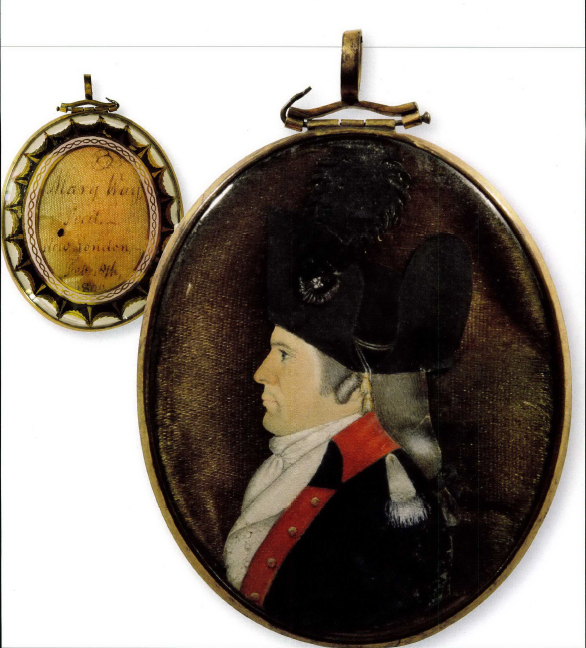
Five days before the Burr-Hamilton duel, Edward Greene Malbone arrived for a week's stay in NewYork. Considered the finest miniaturist in the United States, Malbone was attractive, popular, already exceedingly successful, and only twenty-six years old. As Hamilton's massive funeral snaked up Broadway on July 14, he was meeting twenty-five year-old Anson Dickinson for the first time. A fledgling artist, Dickinson had commissioned Malbone to paint his miniature, hoping to learn by watching the more experienced artist at work (Fig. 1).1 So absorbed was Malbone in the painting "that he neither paused himself to view the pagea…» More
From the Archives |
Reverie on a pair of Japanese screens
July 1, 2001 | By Michael R. Cunningham; from the Magazine ANTIQUES, July 2001
The idea of landscape in the West has historically been aligned with geography. The appearance of a given earthbound place in a painting or photograph normally initiates for the Western viewer an immediate response of physical orientation. We wish to understand the particular environmental conditions and perhaps the terrain of the place. Using personal experience, we gauge what it might hold in store for the actual-or the imaginary-viewer: its air, light, dampness or dryness, the presence of other beings, and so forth. Customarily, we associate ourselves with being there, feet on the ground, prepared for the elements and the delight or challenge of the site. Even if other, more evanescent qualities-such as light-constitute the central feature of a landscape image, as in some seventeenth-century Dutch paintings, we still inevitably parse the landscape setting in order to orient ourselves topographically so as to…» More
From the Archives |
Dated English delftware and slipware in the Longridge Collection
June 1, 1999 | By Leslie B. Grigsby. Originally published in June 1999.
The Longridge Collection of ceramics is English pottery Valhalla. Nestled in a New England house with rare English and Continental treen, medieval ivory and metalwork, and early furniture and carvings, this extraordinary collection of ceramics can be divided into two main groups: about 440 pieces of tinglazed earthenware (delftware) and 100 pieces of lead-glazed earthenware with slip decoration (slipware). Many of the pieces are quite rare, and all reflect the owner's fascination with bold shapes, decorative motifs, and inscriptions. Conspicuous is almost unheard of number of seventeenth- and eighteenth-century dated pots and dishes: 132 of delftware and 55 of slipware.
Many of the dated pieces in the collection can be organized by decorative subject: Chinese and Japanese (kakiemon) motifs and European themes, including neoclassical and commemorative designs, company arms, landscapes, and religious and everyday subje…» More
From the Archives |
Two hoof spoons
September 1, 1978 | By ALBERT SCHER; from The Magazine ANTIQUES, September 1978.
When Helen Burr Smith wrote about silver spoons with hoof-shape terminals in ANTIQUES in 1944 there were only four of these interesting survivals from seventeenth-century Dutch New York households known in America. Now two more hoof spoons have come to light.

Fig. 1-Silver hoof spoon, probably New York, seventeenth century. Length 6 9/16 inches. Inscribed F-A on the flat of the hoof. It is nearly identical to the spoon shown in Figs. 2, 2a. Private collection; photograph by Meyers Studio.
One bears the initials of the unidentified first owner F-A, in seventeenth-century lettering on the flat of the hoof, but is otherwise unmarked (Figs. 1, 1a). It appears to be identical to a spoon made by Ahasuerus Hendricks (Figs. 2, 2a) that was discussed and illustrated in Miss Smith's article, except that the bowl of the spoon in Figure 1 is slightly larger than that of the Hendricks example. In both cases, the …» More
From the Archives |
Skippets
July 1, 1978 | By J. S. BROWN; From The Magazine ANTIQUES, July 1978.
Skippets are small boxes made to hold and protect pendent wax seals attached to important documents. Silver, silver-gilt, and gold examples were used by the United States government between 1815 and 1871, primarily on treaties with other countries that had been ratified by Congress. The skippet was suspended from the treaty by woven strands of gold or silver, often entwined with strands of silk, which had been threaded through the box before the hot wax was poured in. The wax was impressed with the great seal of the United States, and the cover of the box was hand chased with a design based on the seal.
The first skippet made for the United States government was for the Treaty of Ghent, which settled the War of 1812 with England. Now in the Hall of Records in London, it is marked by the Georgetown silversmith Charles A. Burnett. His shop on Bridge Street was not far from the bookshop and bindery of Joseph Milligan, to who…» More
Pickle Dish, American China Manufactory (Bonnin and Morris), Philadelphia, 1771-72. Soft-paste porcelain with lead glaze; height 4 3/16, width 4 1/2
» View All