A return to Joan and Victor Johnson’s renowned Pennsylvania folk art collection, highlighting recent additions, lesser-known works, and enduring favorites within their Society Hill home.
Thirty-seven years ago, The Magazine ANTIQUES featured an anonymous collection of Pennsylvania folk art in “Living with Antiques,” penned by then Philadelphia Museum of Art curator Beatrice B. Garvan. In 2013 Laura Beach revisited the collection for ANTIQUES, revealing the collectors to be Joan and Victor Johnson, after their move to Philadelphia’s Society Hill and the announcement of their planned gift of 242 fraktur to the Philadelphia Museum of Art. Started in the 1950s, the Johnsons’ collection was largely mature by 1988, but even after Beach’s article, they added to the collection, and since Victor’s death in 2017, Joan has continued their collecting tradition. It is the goal of this article to feature some of the new additions, explore the distinguished but less-known parts of the collection, and visit some old favorites
The Johnsons had decided to move from their home in the enclave of Hidden Glen, outside of Philadelphia, to Society Hill for all its cultural advantages. While searching for an apartment, they encountered an empty shell in the Lippincott building, which was being converted from office space to a residential condominium. Realizing they could re-create most of the Hidden Glen home inside the blank space, they hired Joan Fleckenstein, an architect and the wife of their friend and conservator, Peter Deen, to accomplish the task. Using the original 1937 plans by George Edwin Brumbaugh, whose papers are preserved at Winterthur, Fleckenstein was able to reproduce nearly the entire house. No attention to detail was missed, including door frame moldings, baseboards, chair rails, flooring, crown moldings, the whole enhanced by historically accurate colors. Light switches were placed below the chair rails to become virtually invisible.
Joan curated the Philadelphia Antiques Show’s Loan Show from 1976 to 2023. As mentioned previously she and Victor promised their entire collection of fraktur to the Philadelphia Museum of Art in 2013. Now she has promised nearly all the fine and decorative arts assembled both before and after her husband’s death to that museum and to four additional organizations: the American Folk Art Museum, the Fenimore Art Museum, Historic Trappe, and the Robert and Penny Fox Historic Costume Collection at Drexel University.
At ninety-three but still active, Joan is in the process of downsizing into a smaller apartment. Her plan is to keep the kitchen, her bedroom, library, living room, and dining room as close to the current design as possible. She is also still actively collecting and refining the collection: at the 2025 Delaware Antiques Show, she acquired two wrought-iron snakes—a coiled snake to match the one on the kitchen counter and one, seven feet long, which will be displayed above the weathervanes in her new kitchen. Other acquisitions in the past year include the tiniest face jug in her collection (at just over three inches tall) and a pewter lid with a snake finial for one of her stoneware crocks in the kitchen. Bea Garvan, who wrote the first “Living with Antiques” article on the Johnson collection, lives in Joan’s new retirement community. So, perhaps this will not be the last we hear from this celebrated collector.
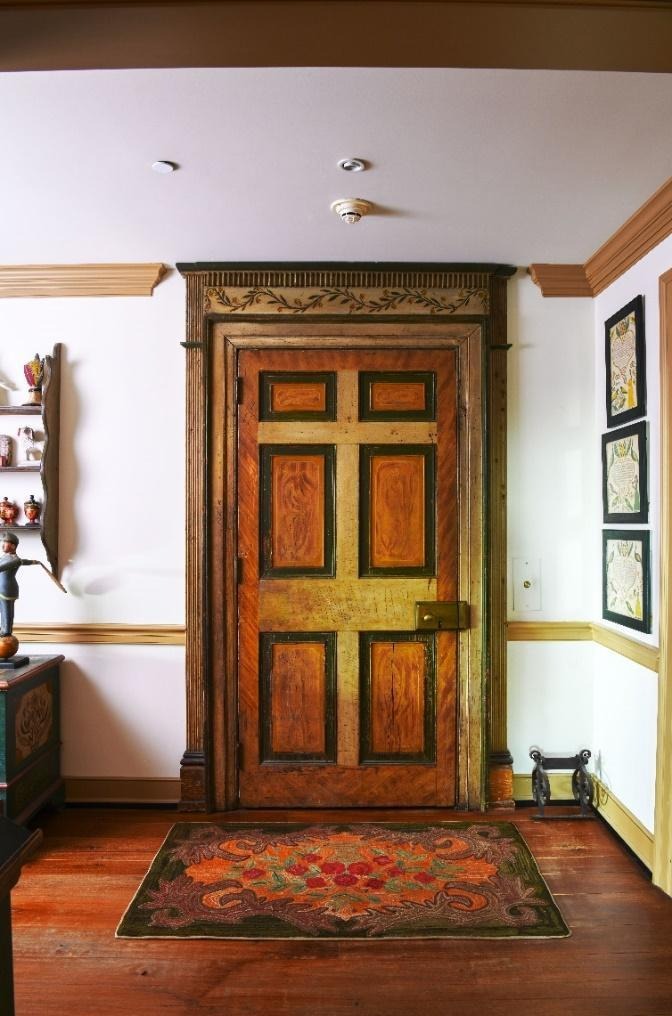
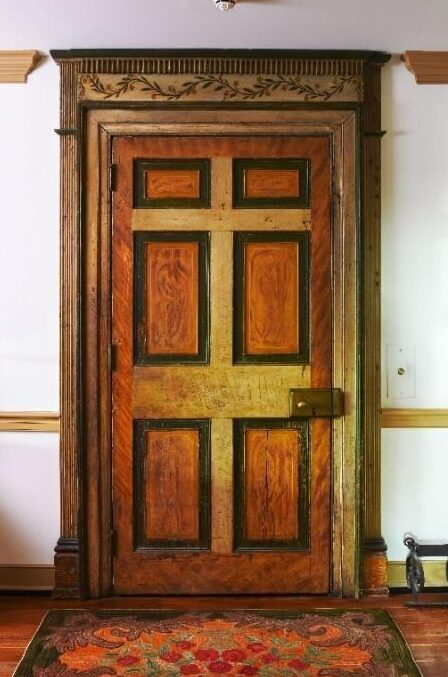
Guests enter the apartment from the elevator through a circa 1810 North Carolina paint-decorated door and door surround. Though the apartment had already been completed when Joan saw this door and its surround in the booth of noted antiquarian Joseph Kindig Jr., she bought it on the spot. The only caveat was that it had to fit without alteration—and fortunately, it did.
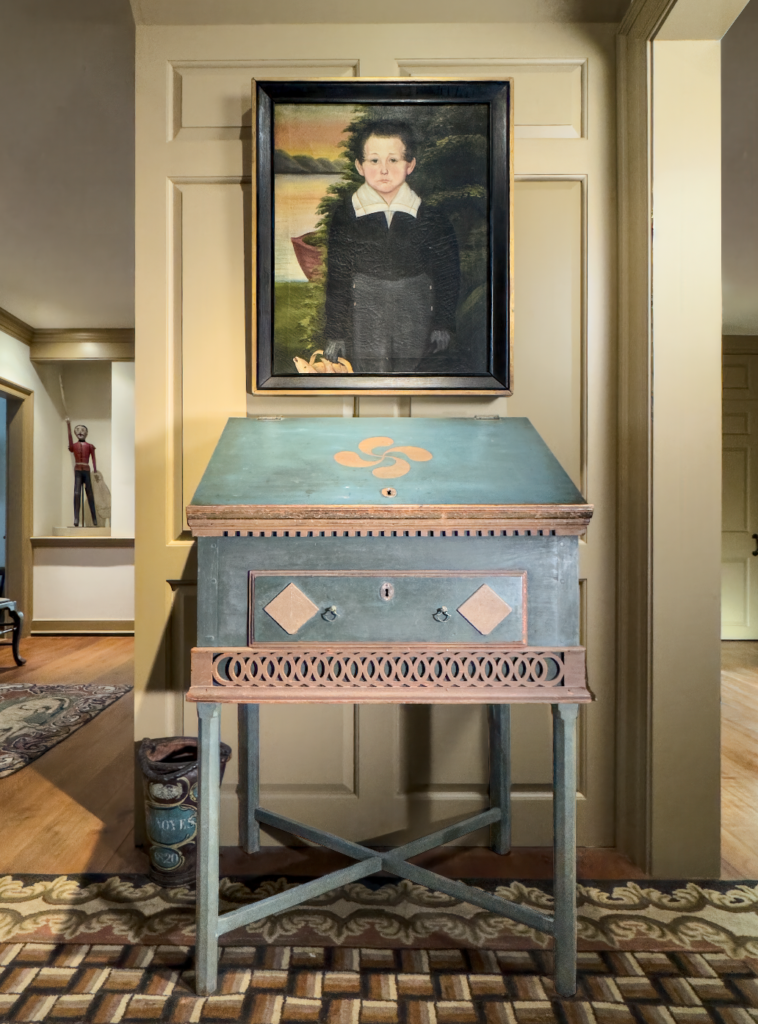
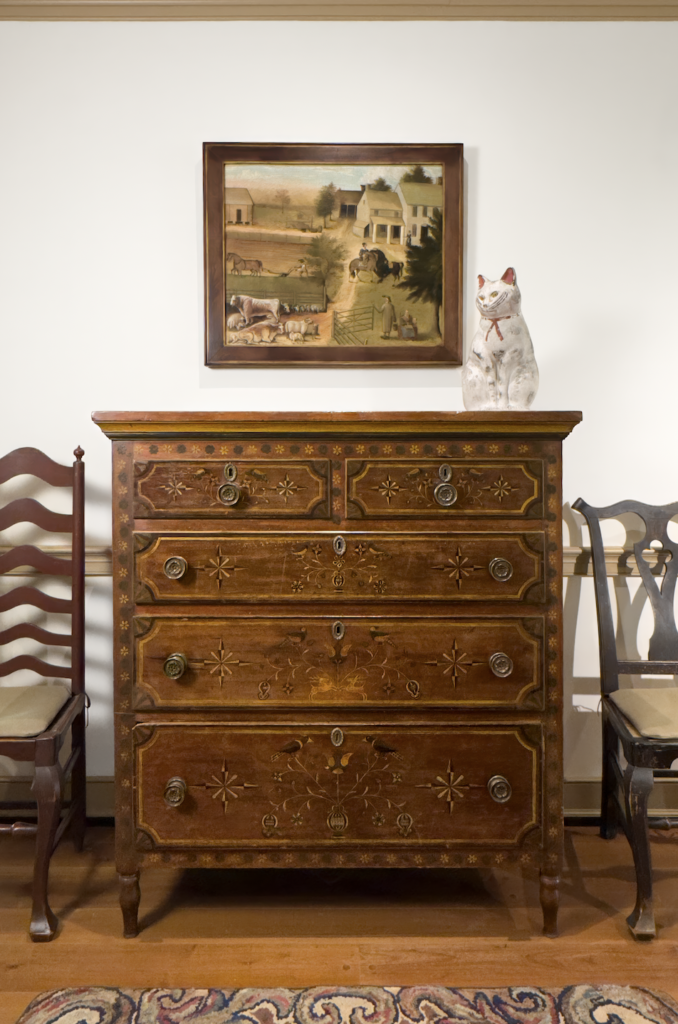
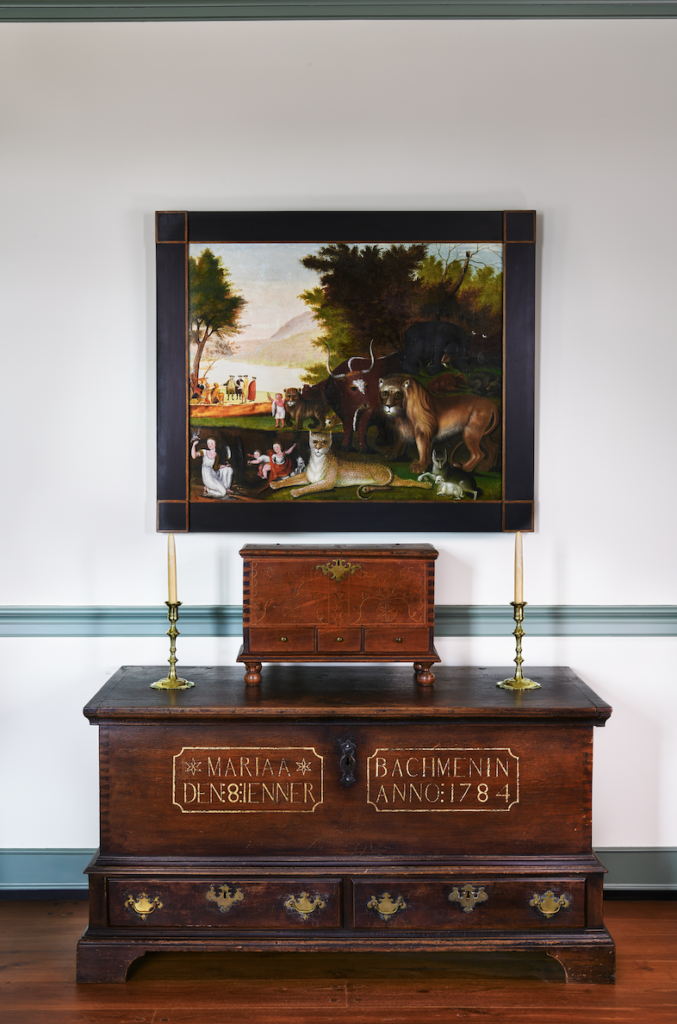
The entry hall displays important additions since Beach’s 2013 article, including a portrait of Theodore Myers, aged seven, signed “ J. B. Gregory,” probably of New York origin. Folk art expert Stacy Hollander identified it as likely posthumous based on its characteristic symbols of death: a sunset, basket of fish, and a boat. The portrait hangs above a Canadian standing desk with a fylfot decoration resembling a Pennsylvania German pinwheel motif. Theodore’s sister Henrietta’s portrait hangs on an adjacent wall. The famous painting of the farm of David Twining by Edward Hicks (1780–1849), 1845-1847, also hangs in the entry hall, above an 1830s chest from the Mahantongo Valley of Pennsylvania, which was noted for the elaborately painted furniture made by German immigrants there in the nineteenth century. .
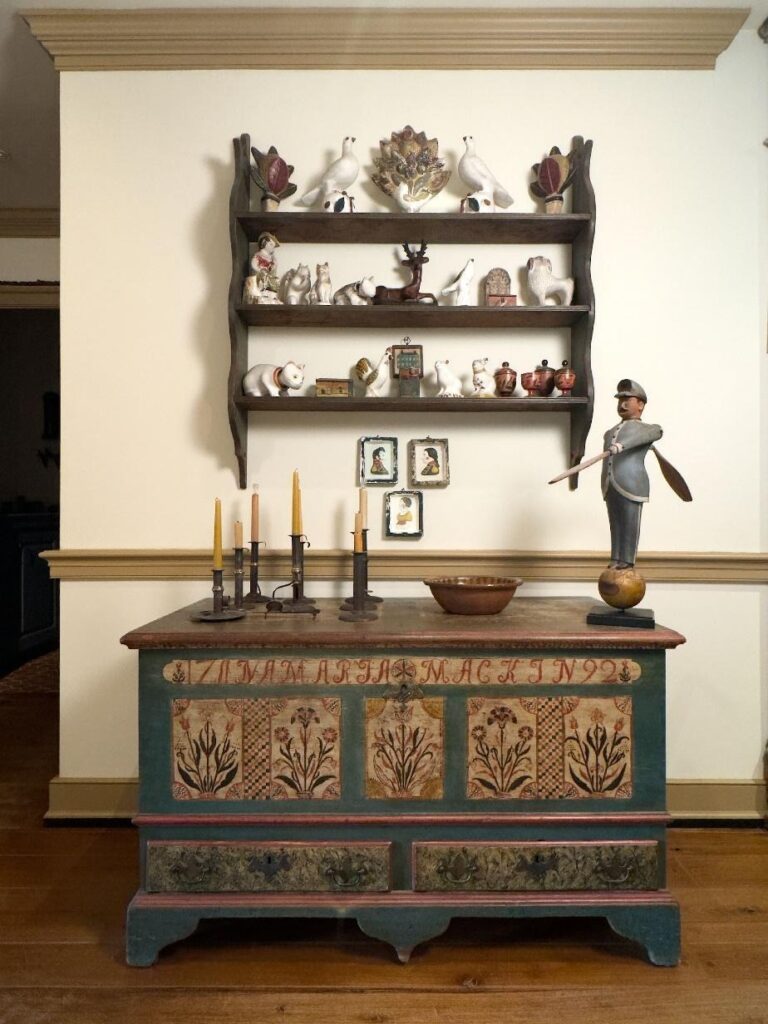
Numerous artfully curated small collections and assemblages are displayed throughout the apartment. This hanging shelf in the entry hall is filled with Pennsylvania chalkware and Lehnware, a type of woodenware made by Joseph Long Lehn (1798–1892), including an exceptionally rare lavender covered sugar jar. Below the shelf are chalkware portraits of George Washington and Andrew Jackson and his wife Rachel Donelson Jackson. In the election of 1824, Jackson was immensely popular in Pennsylvania, winning a majority in every county. Below is a dower chest made for Anamaria Mackin dated 1792. It is similar in construction and lettering to a dower chest pictured in Monroe Fabian’s seminal book The Pennsylvania-German Decorated Chest (1978) that is attributed to a craftsman working near the present-day Berks-Lehigh County line. The Johnson dower chest is remarkable for its elaborate decoration and original vinegar paint on the drawers as well as having its original feet.
A remarkable collection of nearly fifty stoneware crocks adorns the cupboards and counters in the kitchen. They are decorated with such classic designs as the deer popularized by the Norton manufactory in Bennington, Vermont; baskets of flowers; the fish motifs of W. Hart of Ogdensburg, New York; and the “man in the moon” motif of Cowden and Wilcox in Harrisburg, Pennsylvania. The crocks on the countertop continue to be used for storage, and three have unusual pewter tops with decorative finials that Joan has collected over the years. Face jugs by the Remmey family of Philadelphia and a rare Tennessee face bottle are also in the collection. Joan used to collect the containers in Germantown and recalls filling her station wagon with crocks while on the way to a school carpool; the children then sat between the pottery for the ride home.
Hand-forged iron weathervanes are featured in the kitchen, their unique designs appealing to Joan more than factory-made examples. The large cow was acquired at a farm sale in the 1960s for one dollar, while the Indian-figure vane—reflecting a common Pennsylvania German motif—was made by Berks County blacksmith Peter Derr (1793–1868) and has a well-documented provenance. The small rooster, found in Lancaster County, is dated 1766.
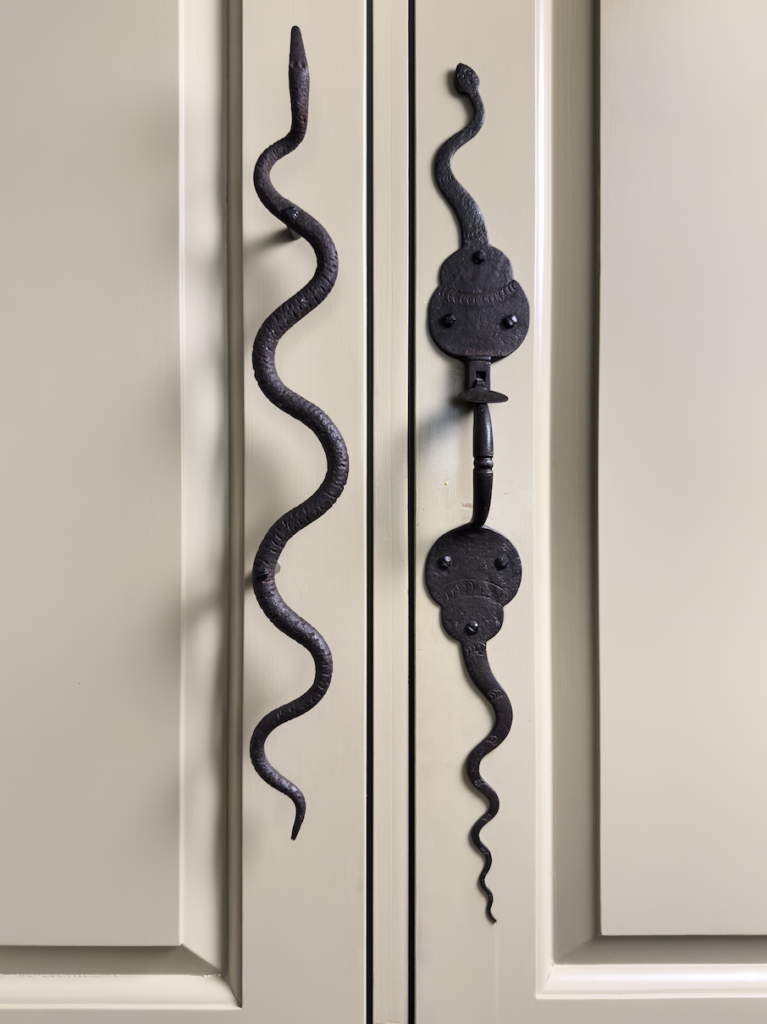
Joan’s iron collection is distributed throughout the apartment, and many fine examples are used for handles or hinges. This detail shows nineteenth-century wrought-iron examples on the wooden doors that conceal the modern refrigerator.
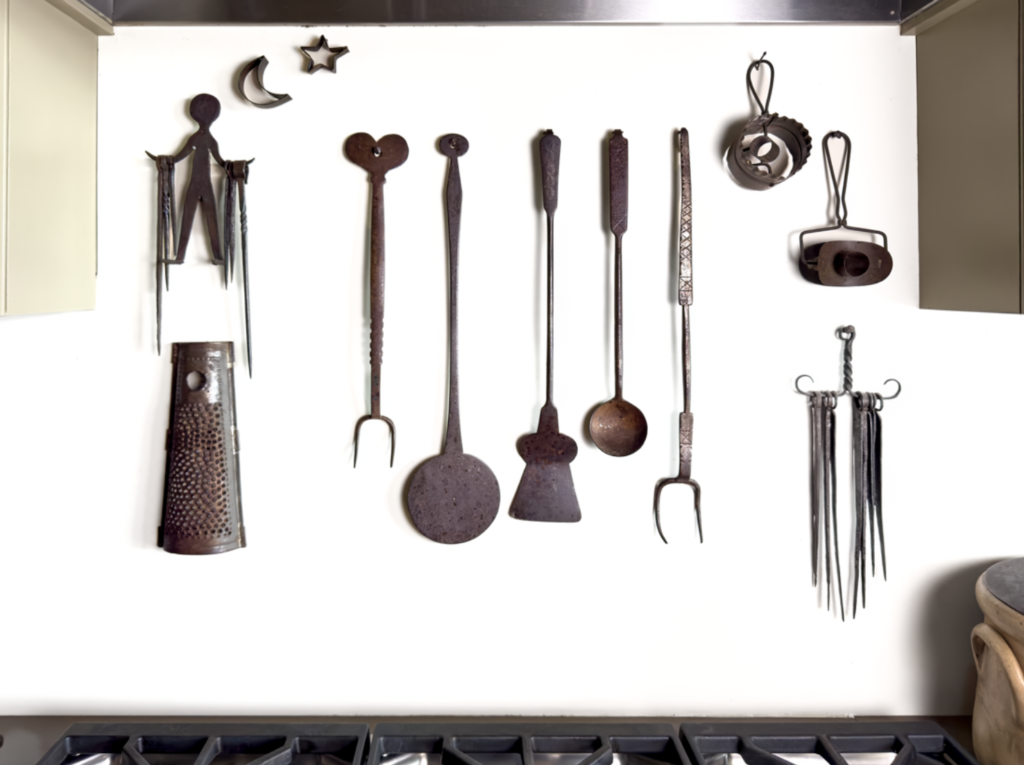
An artful display of iron utensils on the wall in front of the stove is another of Joan’s mini collections. The star and crescent moon are cookie cutters likely made in Pennsylvania, circa late nineteenth century.
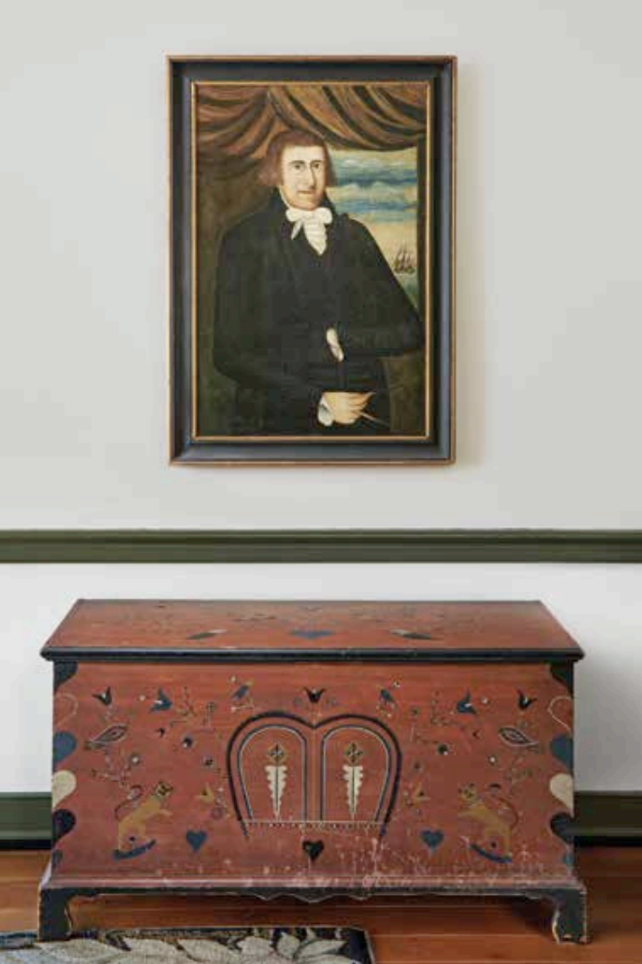
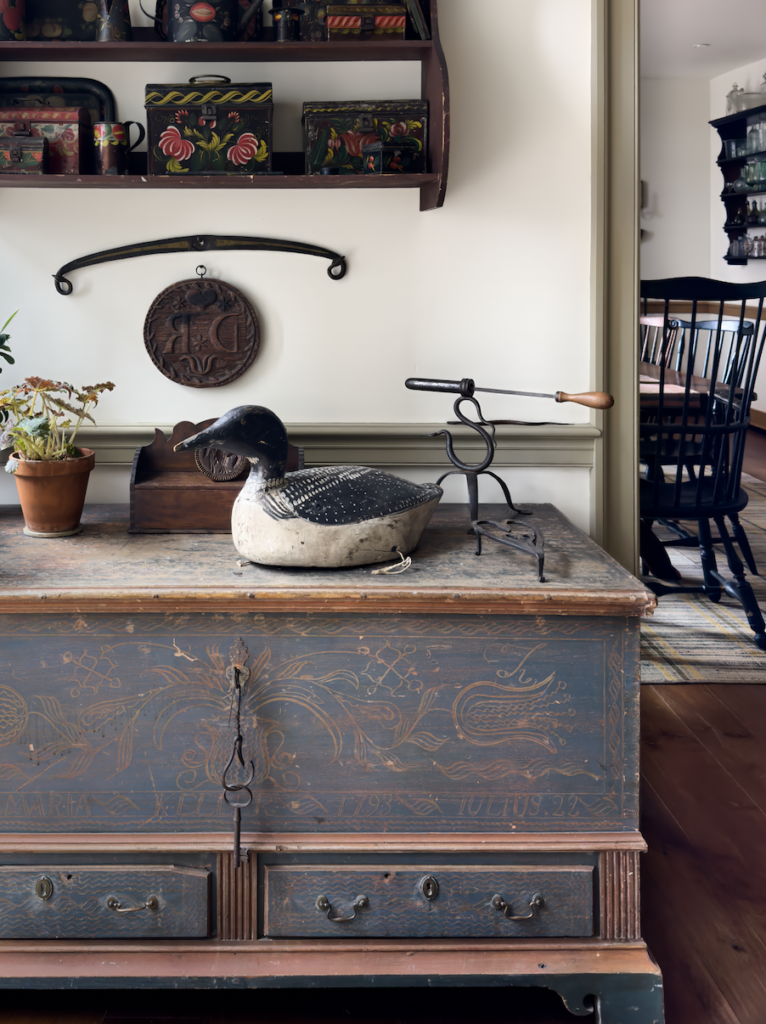
A collection of painted tin is displayed on a shelf above a rare sgraffito-decorated 1793 dower chest with blue paint on an orange ground. A similarly decorated chest from 1791 in Fabian’s Pennsylvania-German Decorated Chest was described as “found near Frederick, Maryland.” On the dower chest rests an extremely rare working loon decoy.
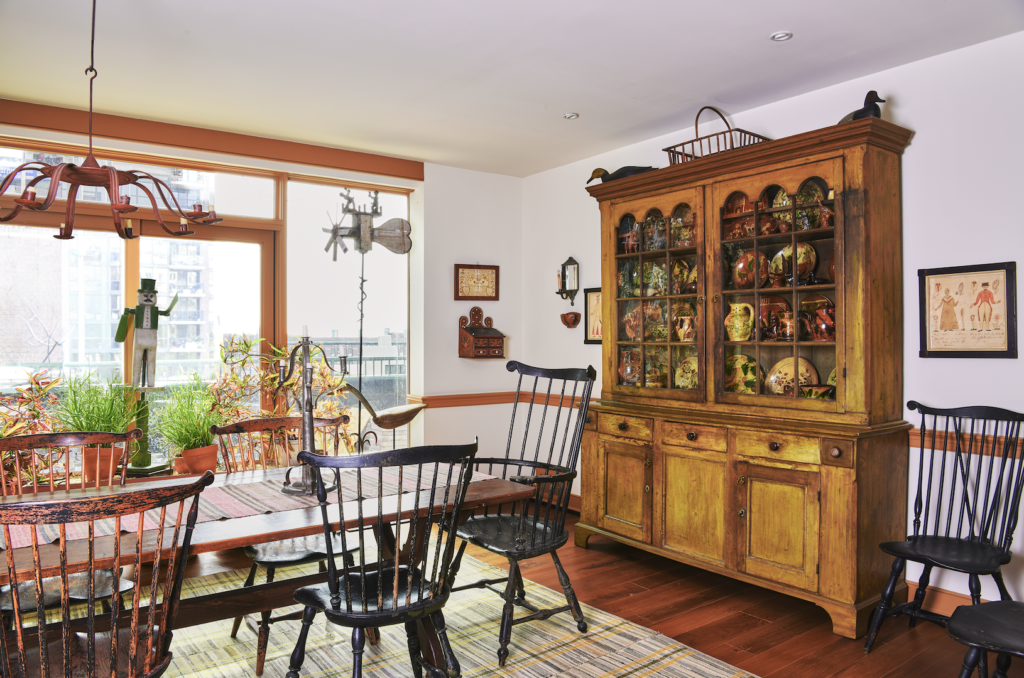
The softwood step-back cupboard in the dining room from the early nineteenth century holds an extraordinary group of sgraffito plates and jars and Pennsylvania redware animals. Important potters represented include Georg Huebner (1761–1835), John Neis (1785–1867), and Conrad Mumbauer (active c. 1800–1830). Although Joan does not consider herself a decoy collector, there are many fine and rare examples displayed in the apartment, including a great blue heron and an unusual swimming black duck (perched on top of the left side of the step-back cupboard). Joseph Henzey, working at Third and Market Streets in the 1770s and 1780s, just blocks from the apartment, made the set of six Windsor side chairs in the room, while the pair of comb-back Windsor armchairs was found in Bermuda—a reflection of eighteenth-century trade practices.
One of the largest of the approximately sixty Peaceable Kingdom paintings by Edward Hicks dominates a wall in the living room. Documented in a letter dated March 12, 1838, from Hicks to Samuel Hart of Doylestown, Pennsylvania, the painting was likely used to pay a debt owed to Hart. In the Peaceable Kingdom paintings of the mid-1830s, a new symbolic element appears: Liberty, depicted as an older child in the lower left, holds a dove representing Peace in her right hand, while an eagle stands by her left hand. This is the second Hicks Peaceable Kingdom Joan has owned. The first was a later example, circa 1840s, which Joan describes as having a “dark and foreboding palette.” When the chance came to acquire this one, she and Vic jumped at it. A hallmark of their collecting has always been to “trade up without sentimentality.”
The likeness of his half-sister Sophia by John Brewster Jr. (1766–1854) is a recent acquisition. Brewster painted both of his sisters (Sophia and Betsey Avery) around 1800; Betsey’s portrait is in another private collection. Both likenesses were once in the personal collection of noted antiques dealer Bill Samaha. To the right of a vine-and-berry secretary are a pair of portraits by Sheldon Peck of a brother and sister. Separated many years ago, they were reunited by Joan in the past decade. In the foreground stands a c. 1760–1770 walnut Philadelphia tea table, with a never restored surface. On it are a Philadelphia piecrust tray with a wine decanter and wine glasses. They, like the inkwell and eighteenth-century books and candlesticks on the secretary, are the sort of details that enrich Joan’s collection and are an important part of the charm of the apartment.
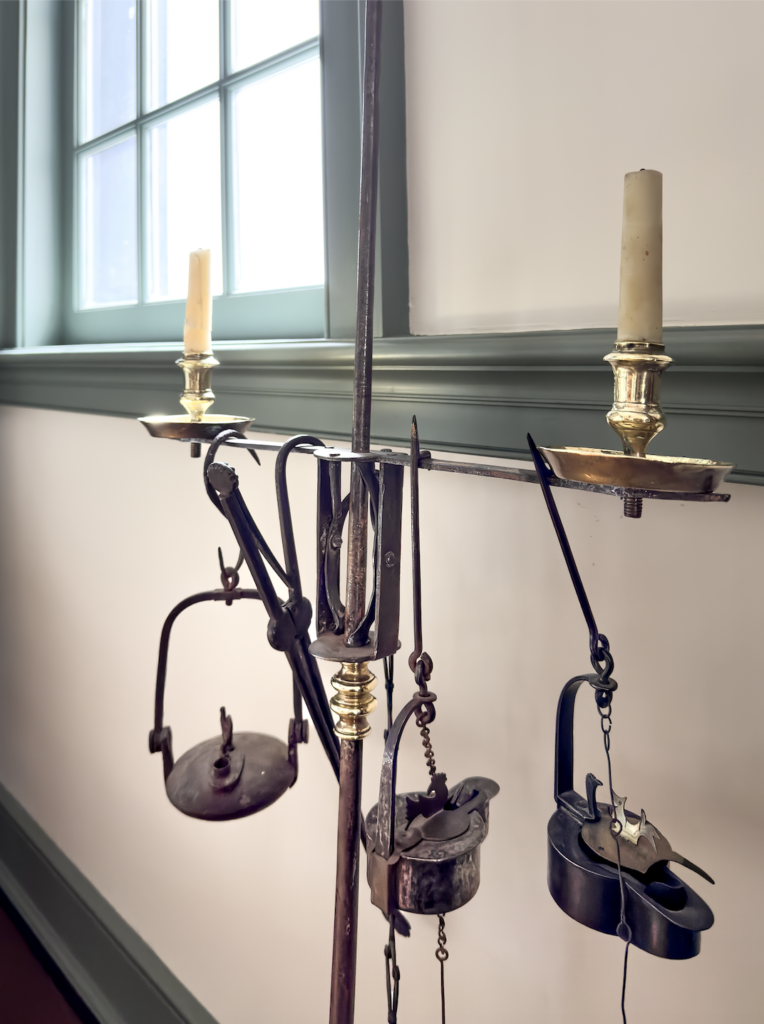
Also in the living room, an American wrought-iron and brass candlestand holds a collection of oil lamps known as Betty lamps, c. 1840s. Two of the three Betty lamps are decorated with small brass roosters on top, and two are signed by the Lancaster, Pennsylvania maker John Long (1787–1856).
While the focus of the collection is Pennsylvania German art, and nearly all the furniture is from Pennsylvania, Joan is also drawn to early New England folk portraits. Since moving to the Lippincott building, several such paintings have been added to the collection, including the likeness of a woman that hangs in the central hall downstairs. Attributed to the so-called Beardsley Limner, it came from the collection of Joan’s friend the scholar Helen Kellogg, who researched the Beardsley Limner.
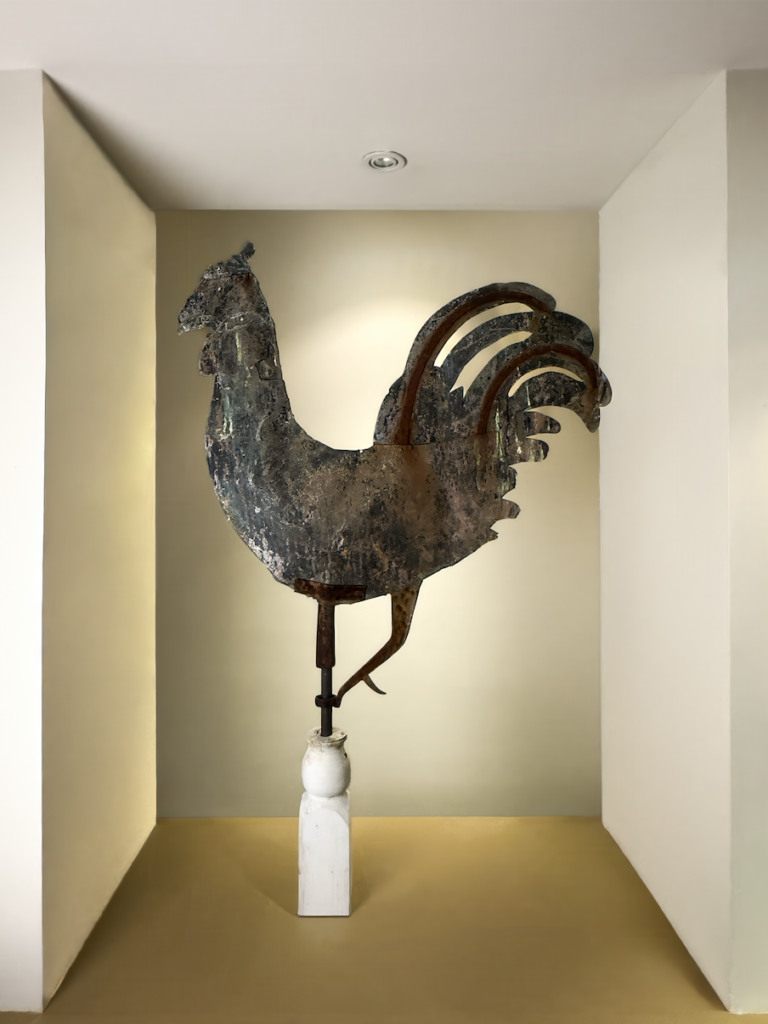
In the upstairs hallway is an exceptionally rare, large rooster weathervane purchased from Americana expert Roger Bacon. Bacon said it came from a Boston church and was made either by Shem Drowne (1683–1774), his son Thomas (1715–1796), or a contemporary coppersmith.
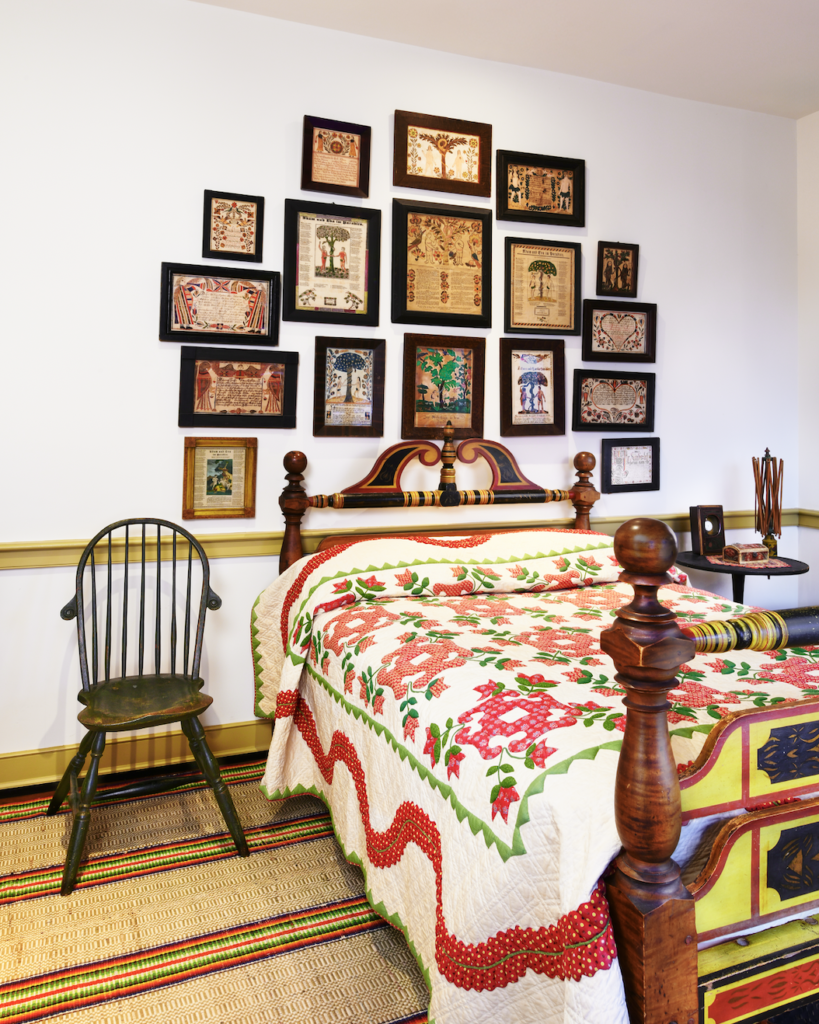
The Johnson collection is particularly well known for its fraktur, or hand-lettered and decorated documents, such as birth or baptismal certificates or house blessings, created by German immigrants in Pennsylvania from the late eighteenth century well into the nineteenth. All are illustrated in Painted with Spirit (2015) by Lisa Minardi. Joan’s favorites are the Adam and Eve fraktur that adorn her bedroom, including a unique example by the Sussel-Washington artist. Joan is particularly attracted to idiosyncratic furniture forms, such as the Windsor chair with misplaced “ears,” as she calls them, beside the bed.
This tabletop figure depicts Benjamin Butler, who served as a major general in the Civil War, led the prosecution of the impeachment of Andrew Johnson while serving in Congress, and ran on the Greenback and Anti-Monopolist Party ticket for president in 1884, which may explain his dress in Uncle Sam outfit. The figure, once in the folk art collection assembled by Edith and Bernard M. Barenholtz, originally stood on a countertop in the Huth Tobacco Company on East Chestnut Street in Lancaster, Pennsylvania.
JEFF PRESSMAN, a retired gastroenterologist, is chairman of the board of the Fenimore Art Museum and a member of the American Folk Art Society.


