
PART V: In which the author is awakened to the splendor of his vintage bathrooms.
Our plumber, his abundant enthusiasm notwithstanding, failed to fix our leaky sink. He returned, tried and failed again, and charged us for both visits. Needless to say, we parted company, but not before he made a valuable contribution to my appreciation for mid-century modern design. He couldn’t stop raving about the 1940s sink with its chrome appurtenances, as well as the matching bathtub and toilet. He claimed they constituted plumbing gold.
I frankly hadn’t given our bathrooms much thought. Well, actually, I had. But more in the context of celebrating the indulgence of a warm bath on a cold winter night. The reason for my blindness I suspect is that our bathrooms have been around, largely unchanged, for my entire life. “We’ve all lived in these bathrooms,” observes Ingrid Juliano, whose Vintage Tile Shop, devoted to unused boldly colored mid-century bathroom tiles and sinks, has almost 200,000 Instagram followers. “A lot of us haven’t noticed them or thought they were particularly special.”
My grandparents, Ben and Myra Gardner, bought our home, a nineteenth-century Hudson valley farmhouse, in the late forties. Before they introduced indoor plumbing, the comfort facilities consisted of an outhouse in the backyard. The structure stood, even if it saw little new traffic, until the 1960s.
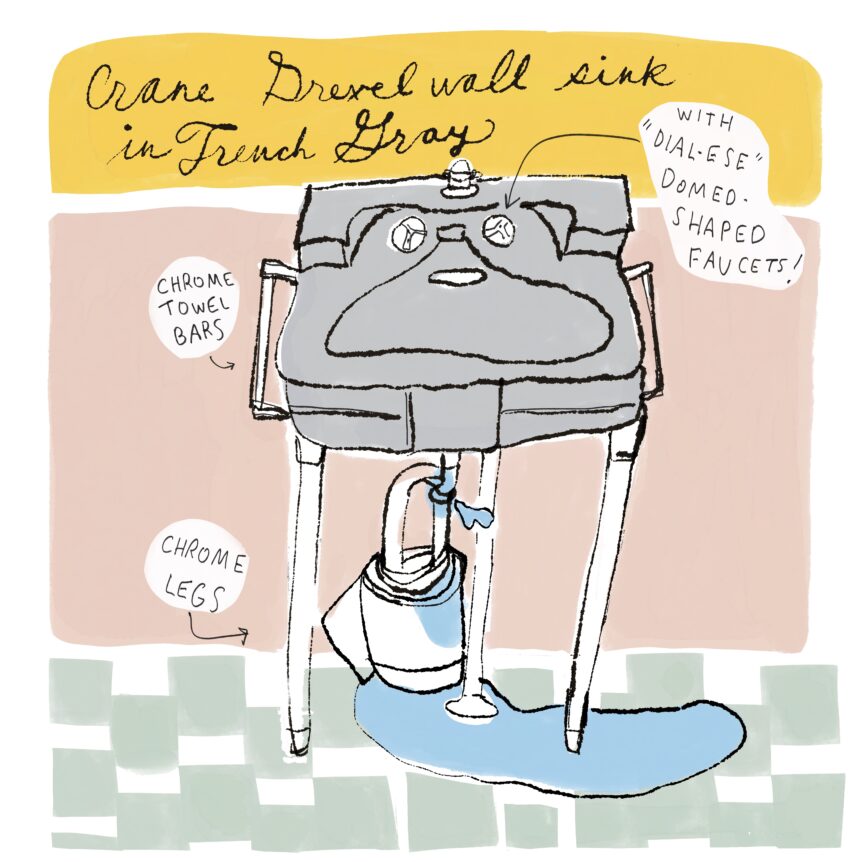
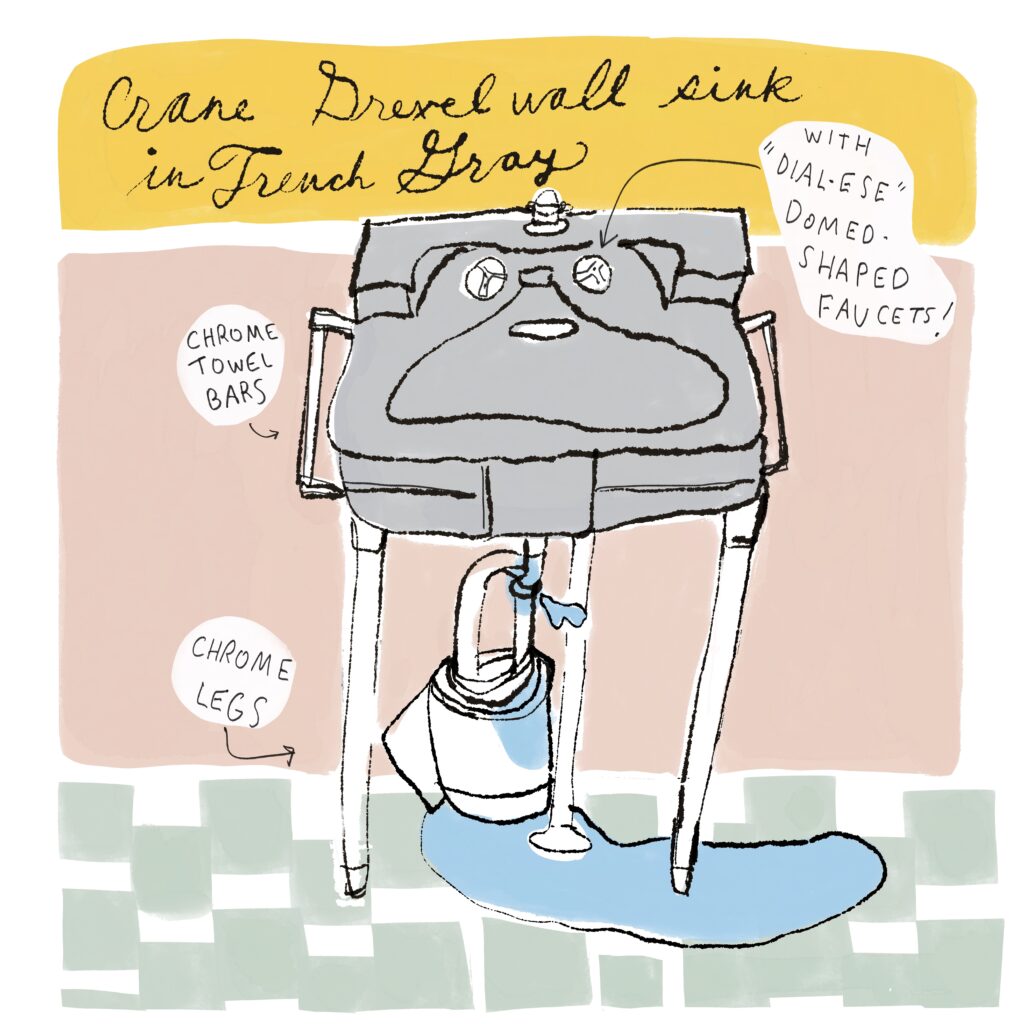
Ben and Myra weren’t wealthy, but they obviously understood quality bathroom fixtures. Hence our lovely, if leaking, Crane Drexel wall sink designed by famed industrial designer Henry Dreyfuss. Dreyfuss was also known for designing Bell telephones, ocean liners, John Deere tractors, and the Polaroid SX-70 Land camera. But as far as I’m concerned, our sink, standing on gleaming chrome legs with chrome towel bars and a built-in porcelain faucet, constitutes the pinnacle of his creation. Best of all are the atomic age “Dial-ese” dome-shaped faucets.
Even more attention grabbing is our second Crane bathroom and the powder room. They boast the same high-quality sinks and toilets. But they come in an arresting maroon color that a Crane catalogue from the early 1950s describes as Persian Red.
Our guests aren’t quite sure what to make of these Truman-era fantasias. Before closing the powder room door behind them they react with something between admiration and a snicker. Can we discuss powder rooms? Among a home’s most indispensable public-facing rooms, I fear they don’t receive the respect they deserve. In the same way that some button-down individuals, myself included, go wild with their choice of colorful socks, a powder room provides an excellent opportunity to indulge one’s eccentricities, perhaps even to create a folly, your visitors, a more or less captive audience.
Hence our art: a photograph acquired by my daughter during her tenure at the American Museum of Natural History, her first job out of college. It features a museum worker installing a giant centipede in its forest floor diorama. Even better is a framed card from my supposedly shy mother’s nightclub- and casino-going days. “You and your party,” it says, “will oblige the management by leaving quietly.”
But any art is just gilding the lily. We’ve put less effort into our powder room than most. The red sink and matching toilet set off by Farrow and Ball Charleston Gray walls need very little assistance.
For those rare guests who might find themselves skeptical of our inherited taste, it turns out that I’m having the last laugh—or would if I could find a new plumber to fix the upstairs sink. I may be sitting on a gold mine, quite literally, in the case of our whirlpool action Oxford water closet (the Crane catalogue’s euphemism for a toilet). Colorful models from the ‘40s and ‘50s are changing hands for hundreds of bucks on the salvage market. Yet they don’t fetch nearly as much as sinks. Those range in price from around $900 to $2,500 for one identical to mine that came from the home of Mercury astronaut Alan Shepard.
The plumbers at DEA Bathroom Machineries in Murphys, California, the company that acquired the celebrity sink, struggled to disassemble and rebuild it, apparently for good reason. They believe that Admiral Shepard, the first American to travel into space, made home repairs using a NASA sealant. I’d love to get my hands on some because whatever glue our plumber used isn’t working.
Ingrid Juliano told me that she deals with many high-end interior designers whose clients increasingly see their bathrooms as opportunities for self-expression. (Vintage Bathroom Love, another Instagram account focused on spectacular retro bathroom design, has over 260,000 followers.) “There’s such an obsessive, collaborative love for color,” she reports. “If I take a colored grout to a solid colored tile I’ll get six million views.”
People are mesmerized by the quality of the era’s tiles, toilets, and sinks. So am I. The colors of mine—our leaky one is French Gray—remain as vibrant, and the chrome fixtures sparkle as confidently, as they did when my grandparents installed them almost eighty years ago. “I bought fifty-eight sinks on Monday,” from the 1970s, Ingrid tells me. “You can just look at them and see the perfection, the glaze, the saturation of the color.”
Henry Dreyfuss apparently also held to a more generous standard when it came to water-saving devices. The chromium-plated economy shower heads in our bathrooms produce a stream so strong they could cause bruises.
Ingrid, recently returned from Palm Springs’s Modernism Week, says that Californians, in particular, seem to appreciate bathrooms of that era and are more likely to preserve them. Elaine Lipworth, a journalist and friend of mine—her Santa Monica master bedroom’s bathroom features a cast-iron double-slipper tub with lion’s-paw feet—suspects it’s a reaction to the Golden State’s next new thing, reputation. “People want to feel connected with history and heritage,” she says.
California’s larger-than-life scenery also might have something to do with it. “Many are remnants of the fifties’ penchant for color reflective of the landscape,” says Alix Becker, a designer and branding specialist who hails from one of Napa Valley’s founding wine families. “Think avocado green, mandarin orange, sun yellow adobe.”
I suppose what I most appreciate about our bathrooms is their link to the past and family history. My grandparents may be gone but their excellent taste in sinks, toilets, and bathtubs lives on. Swapping out our bathrooms at this point would constitute sacrilege. Thus, I’m rededicating myself to the search for a competent plumber.


