
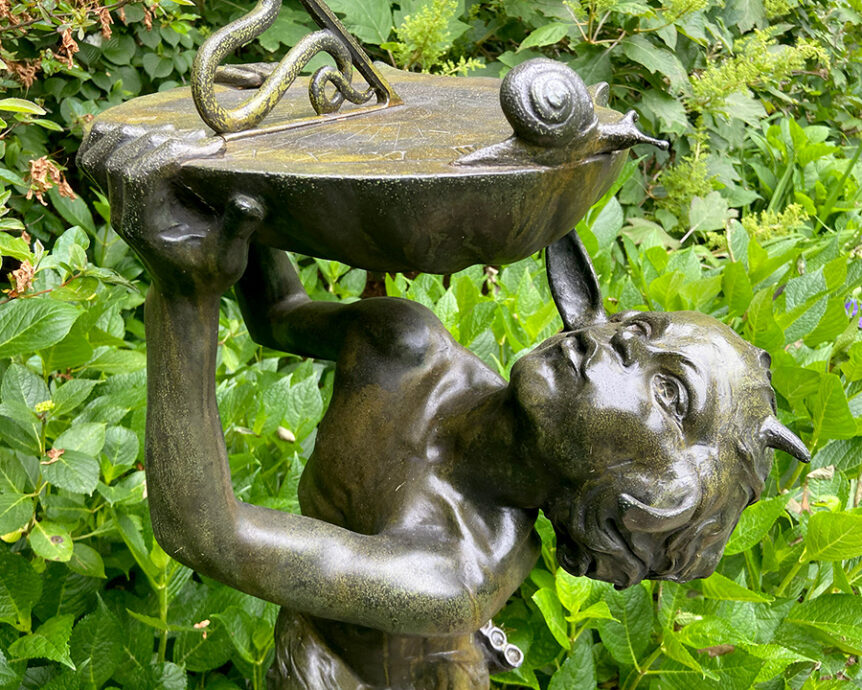
Obsolete yet beloved, the sundial traces a path from ancient necessity to decorative art, preserving centuries of ingenuity and romance.
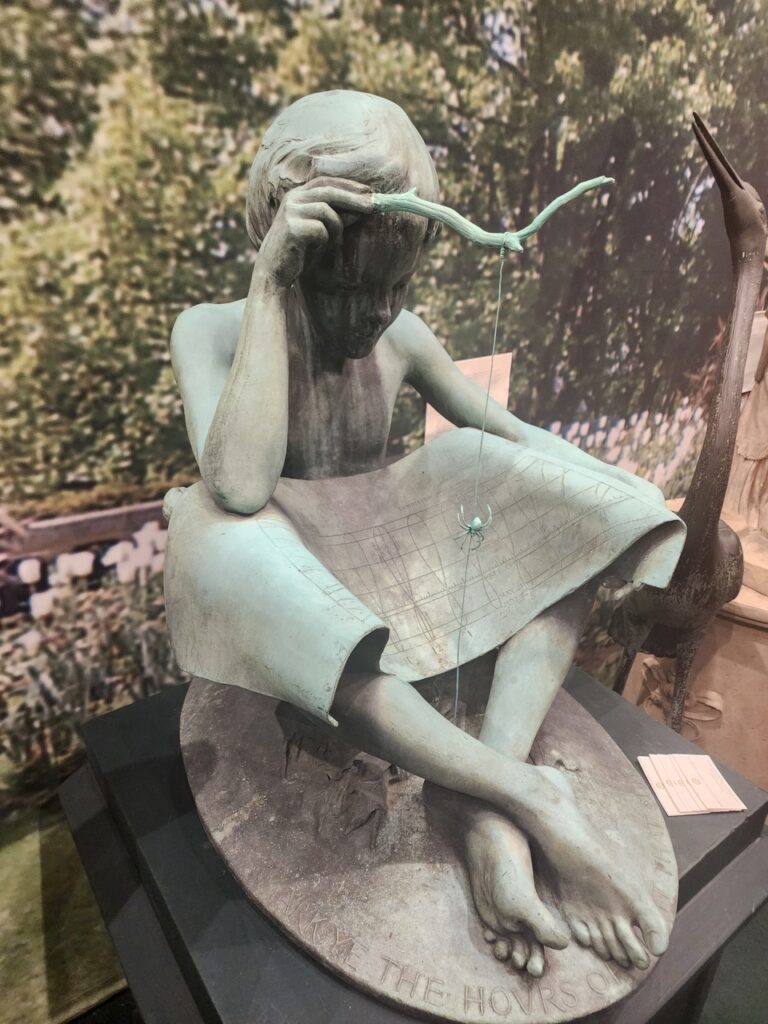
A boy sits with legs crossed, watching a spider hang from a twig. An unrolled scroll is draped across his knees, and everything you thought you knew about sundials is suddenly topsy-turvy.
Willard Dryden Paddock created this bronze sundial in 1916, following the analemmatic form. Unlike the sundials we are used to seeing, static discs with a fixed, raised fin that throws a shadow, analemmatic sundials rely on a vertical, movable gnomon, or shadow caster. On the scroll is an elliptical display of hours, with all seasons displayed at once, enabling the user to determine the time of day, regardless of the time of year.

Whether Boy with Spider was ever seriously used is unlikely given when Paddock designed it. In the early twentieth century, sundials had been outdated technology since at least the invention of the pocket watch in 1510. Certainly, well before telling time was made mobile, it was much simpler to listen to church bells than to try to discern the difference between 3 pm and 4 pm on a stationary disc. (Though, in fact, most often, even the church bells rang with the guidance of a sundial — the dial directing the bell ringer when to pull the rope.) The imprecision of a sundial became most apparent when the sun wasn’t shining, which we all know accounts for many of the twenty-four hours in a day. Even so, sundials continue to monopolize our imaginations, from Boy Scout projects to garden ornaments.
Perhaps their staying power is because sundials feel solemn and solid both in form and function. The sundial is ancient technology dating to at least 1500 BC, demarcating time for work and time for rest. As civilization plodded toward regularity, from the Sumerian’s base-60 mathematics (3500 BC) to Hipparchus’s equinoctial hours (2nd century BC) and even after the standardization of the mechanically measured twenty-four-hour day in the 14th century, the sundial retained a steady if diminishing level of usefulness.
Sundials were once so ubiquitous in mankind’s communities that they sometimes were the target of jabs from satirists and polemicists. “May the gods ruin the fellow who first invented hours, and moreover the one who first set up a sundial here; poor me, he tore Day to pieces for me, limb by limb!” is the first line in the sole remaining fragment of the Roman playwright Plautus’s lost play, The Boeotia. Plautus goes on to lament how, “the town is now so full of sundials, the majority of the population creep around dry from hunger.” The fragment, which survived as an example used by later grammarians to teach proper Latin prose, is one of the earliest recorded complaints about the introduction of sundials in Rome, as well as a prime example of Plautus bemoaning the rigidification of Roman mealtimes.
Before sundial technology was widely adopted, the Romans had divided the periods of daylight and darkness into two twelve-hour blocks with the length of each hour expanding or contracting such that every hour was equal to one-twelfth of the total. This meant both that a winter day’s hour was shorter than an hour in the summer and that the length of time also varied by one’s relative latitude. At Mediterranean latitude, an hour on the winter solstice was about forty-five minutes long, while during the summer solstice it lasted about seventy-five. All of this was understandably difficult to make uniform. Before the introduction of sundials to Roman society around 293 BC, many Romans appear to have recorded events in pre-sundial days as merely ante meridiem (before noon) or post meridiem (after noon).
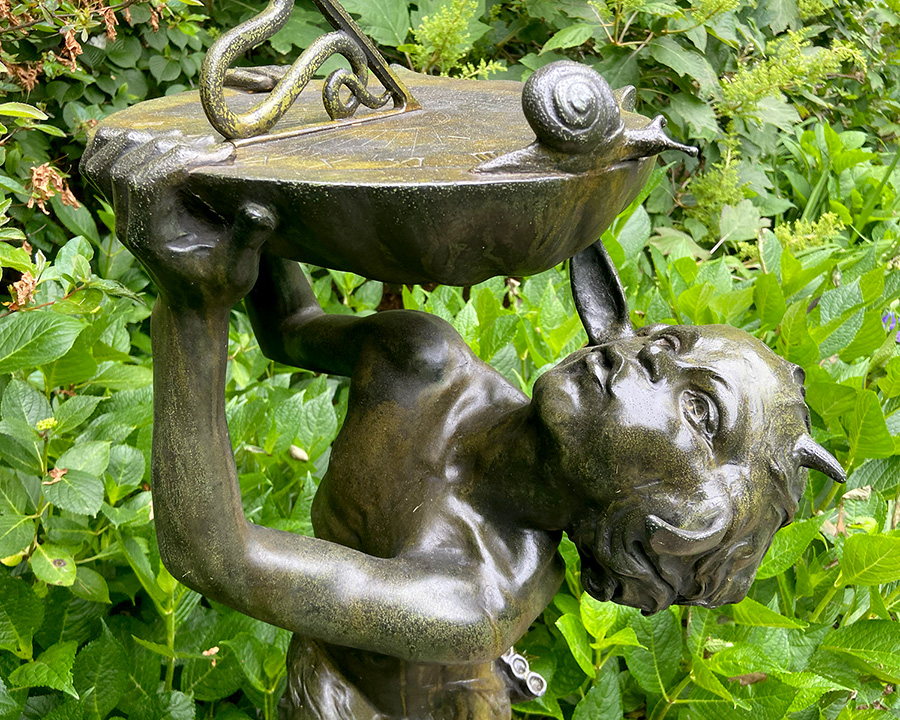
is embellished with a serpent and the dial plate is inscribed “AMICIS QUAELIBET HORA” (Friends at any hour). Height 47 1⁄2 inches.
The Romans spread the use of sundials far and wide. Throughout Europe, one can still find the simple scratched lines of innumerable “mass” or “scratch” dials in the southern facing walls of priests’ dwellings and country churches. With a simple wooden dowel set in a small hole acting as the gnomon, the user knew when a mass was to be held or a prayer said. For most of the Middle Ages, it was with this reckoning that the lives of millions of men and women were divided and arranged.
With the invention of the first all-mechanical clockwork mechanisms in the fourteenth century, the sundial slowly began to be displaced in cities and larger towns. It took another three hundred years for this drift toward mechanically measured time to diffuse into the rural countryside, as clocks remained expensive technology well into the twentieth century. This gradual shift allowed for nostalgic recollections to grow as memories of life measured “by the ‘dial’” took on halcyon hues.
As sundials became less relied upon, their connection to the romantic grew—an association facilitated by their frequent residence in the domestic home’s most natural, sun-filled habitat: the garden. Veteran garden antiques dealer and expert Barbara Israel has been helping people ornament the outdoors since 1985. Like us, her first love is the process of research and discovery, and her journey to antiques started in a garden. Growing up in Far Hills, New Jersey, she would sneak onto the property of Blairsden as a young girl. Then a convent, there was a constant electricity in the air, the risk of the Mother Superior finding her as she stood transfixed by the tall busts of Roman Emperors placed on columns that flank the memorably long reflecting pool. She established Barbara Israel Garden Antiques in 1985 and published Antique Garden Ornament: Two Centuries of American Taste in 1995, which remains the definitive work in the field. When she came across a version of Boy with a Spider, it was missing the wire and spider, but the family who purchased it wants the sundial to work. It’s been a fun research project for Israel as this requires precise placement and understanding of solar movement throughout the year.

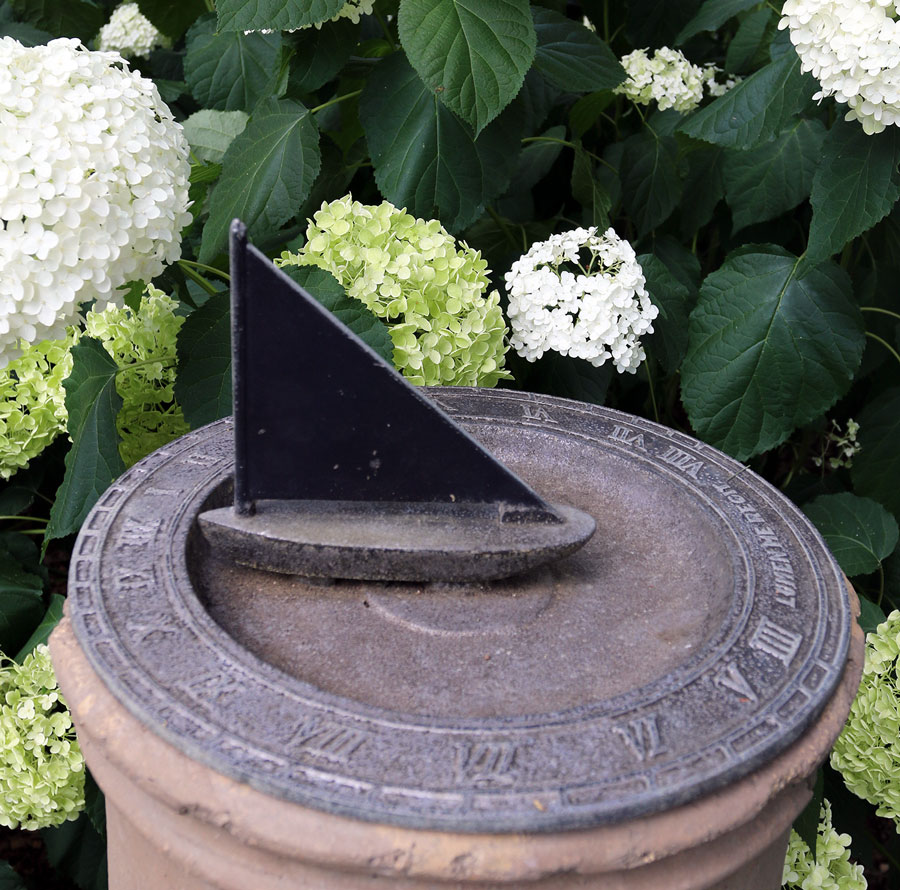
It doesn’t take a spider on a string to make a sundial more than a piece for telling time. A boat coasting over a quiet sea similarly merges sculpture with function. Although we agree with Israel that a sundial that doesn’t work is a bit of a folly—which is not a knock against follies, of course, as they can be both grand and grand fun. If you do want your sundial to perform its millennia-tested function, you need to remember that you aren’t only buying art. You are signing up for a science project.
Antique sundials run the gamut on price, as there is not much inherent to the material nor manufacture that demands a premium. When a sundial is offered on its original plinth, it is often the ornament of the plinth that pushes the price up. When the artist who designed it is known, that too pushes the price. While a large, twentieth century carved limestone sundial column sold at auction in Newbury, Berkshire, UK for £8,500 on March 26 of this year, and a nearly five-foot tall cast lead figural example sold through Freeman’s Auction in Chicago for $5,500 this past April, one can also find fine examples at more modest prices.
The sundial is a uniquely curious piece of ancient technology for us to keep around as often as we do, a singularity made all the more striking by its being one of the few items of obsolete tech that we (by and large) continue to use for its original purpose, at least in particular, decorative settings. Indeed, it would appear that, despite its frequently inscribed warning that “tempus fugit!” or “time flies,” the sundial itself isn’t going anywhere anytime soon.


