A forgotten French ceramist’s journey from the famed Sèvres manufactory to Missouri reshaped the course of modern ceramics.
By Laura Kugel
Every art lover knows the sensation: we leave home in search of one thing and return obsessed with another. Three years ago, I traveled to the Wadsworth Atheneum in Hartford, Connecticut, intending to spend the afternoon among mounted hardstones, Kunstkammer silver, and baroque ivories. Instead, I left thinking about a French ceramist whose name I had never heard before.
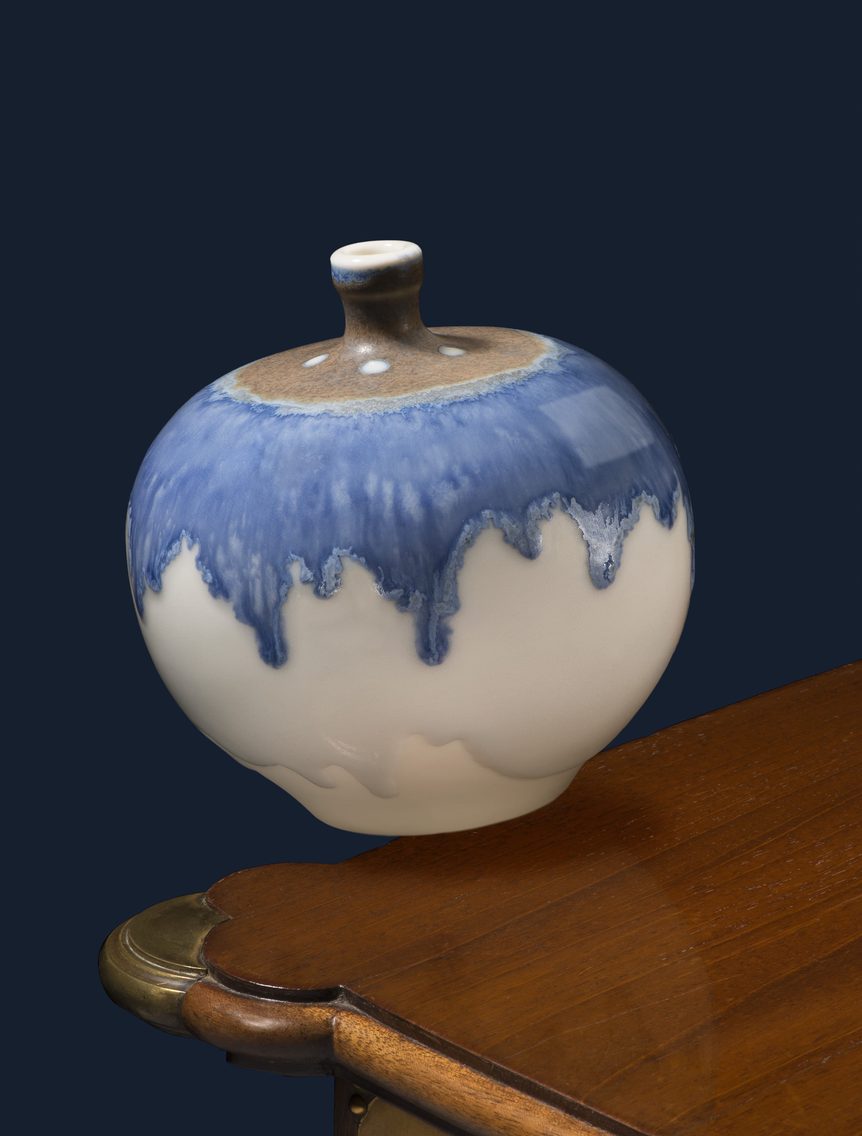
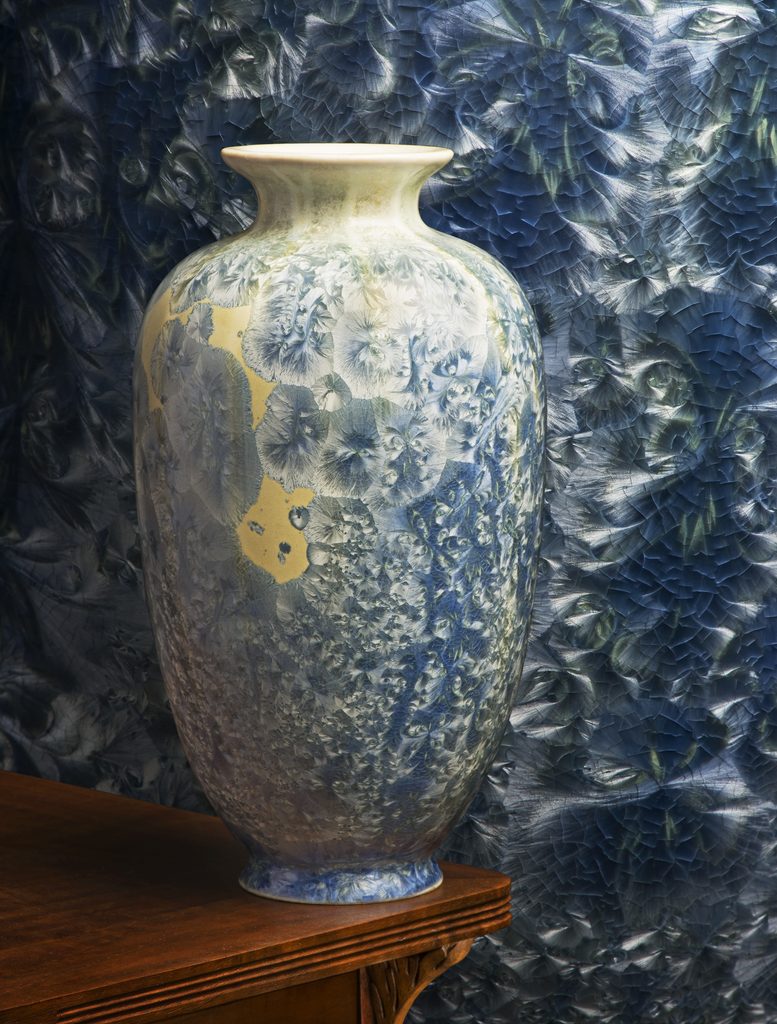
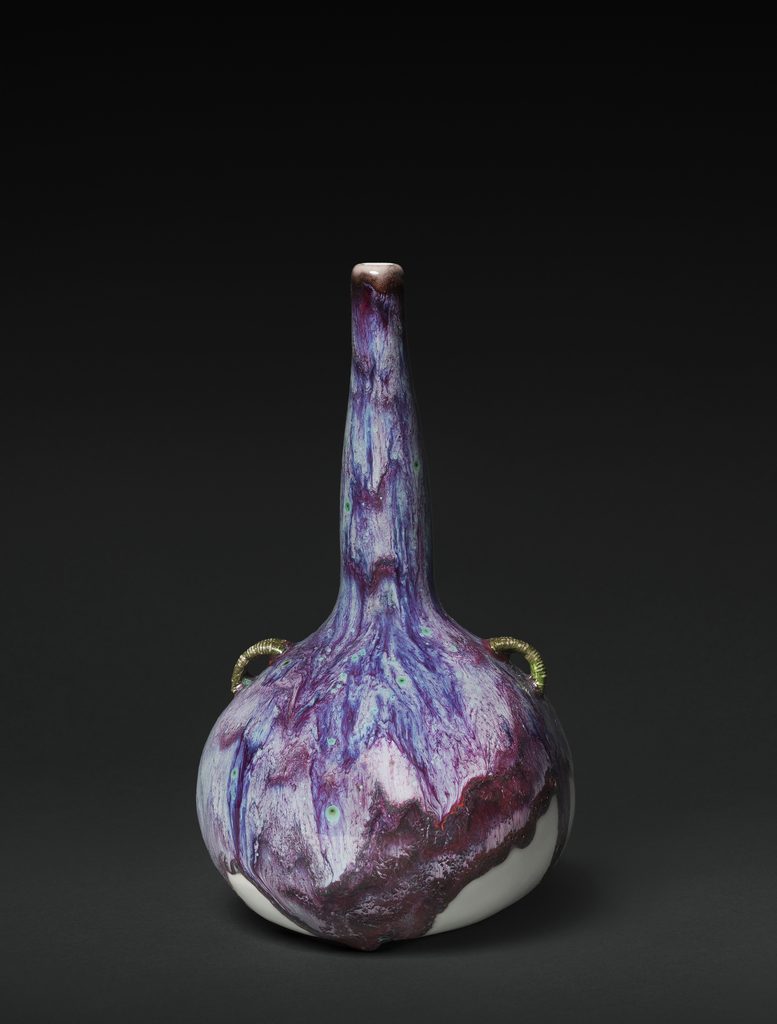
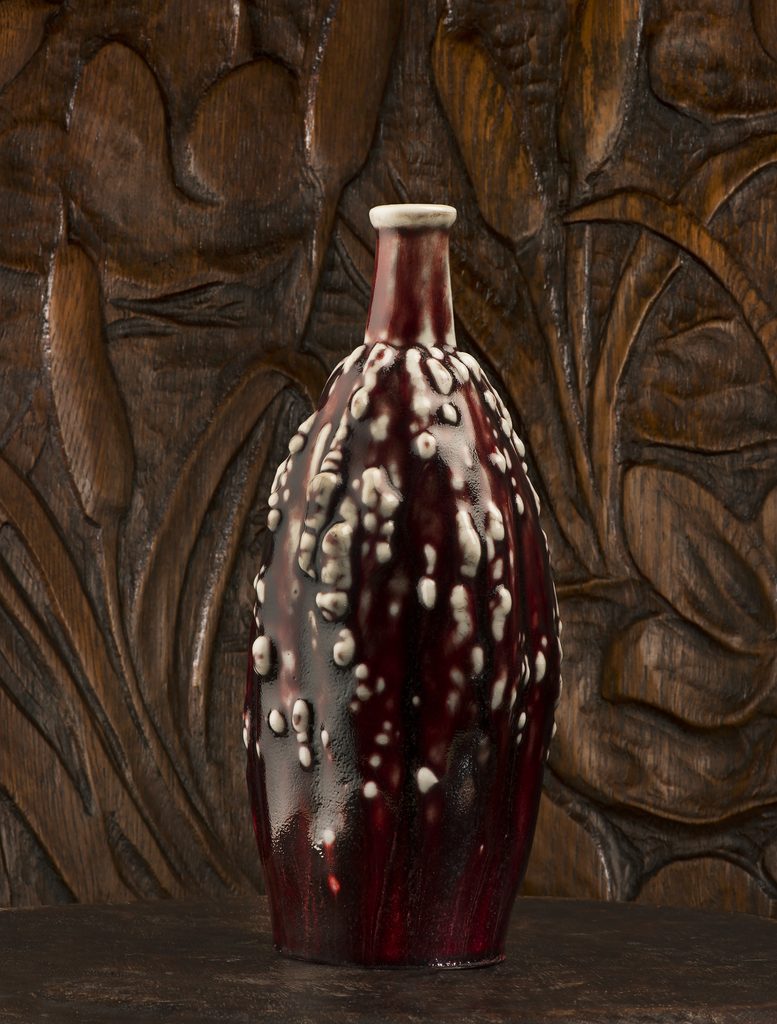
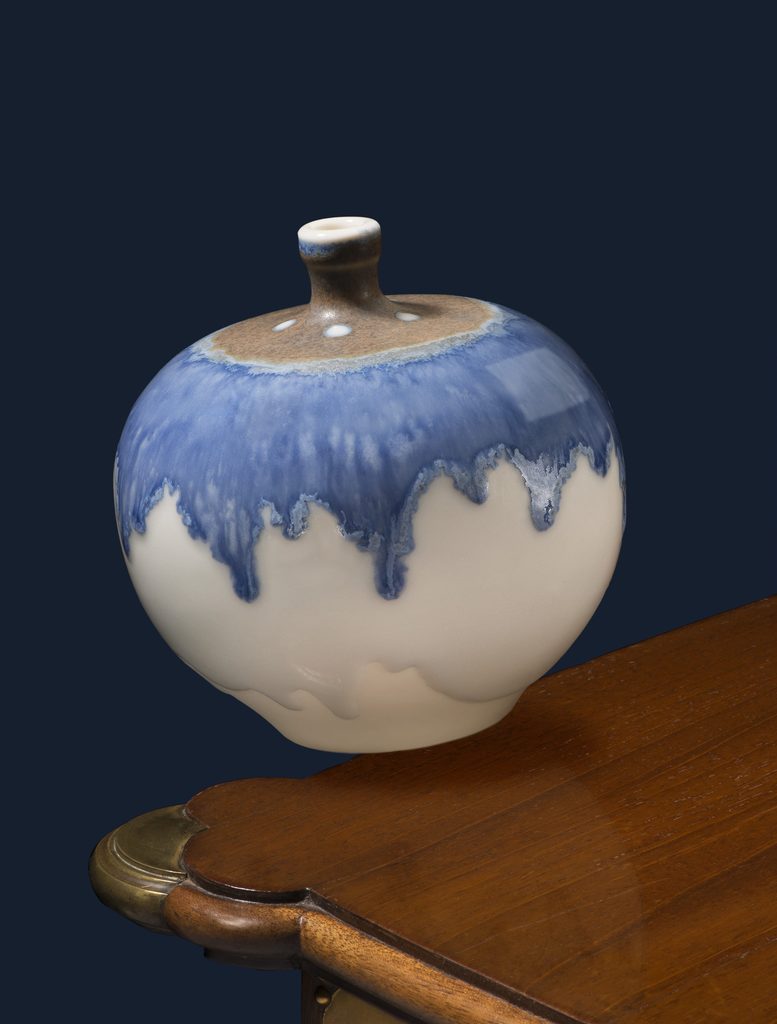
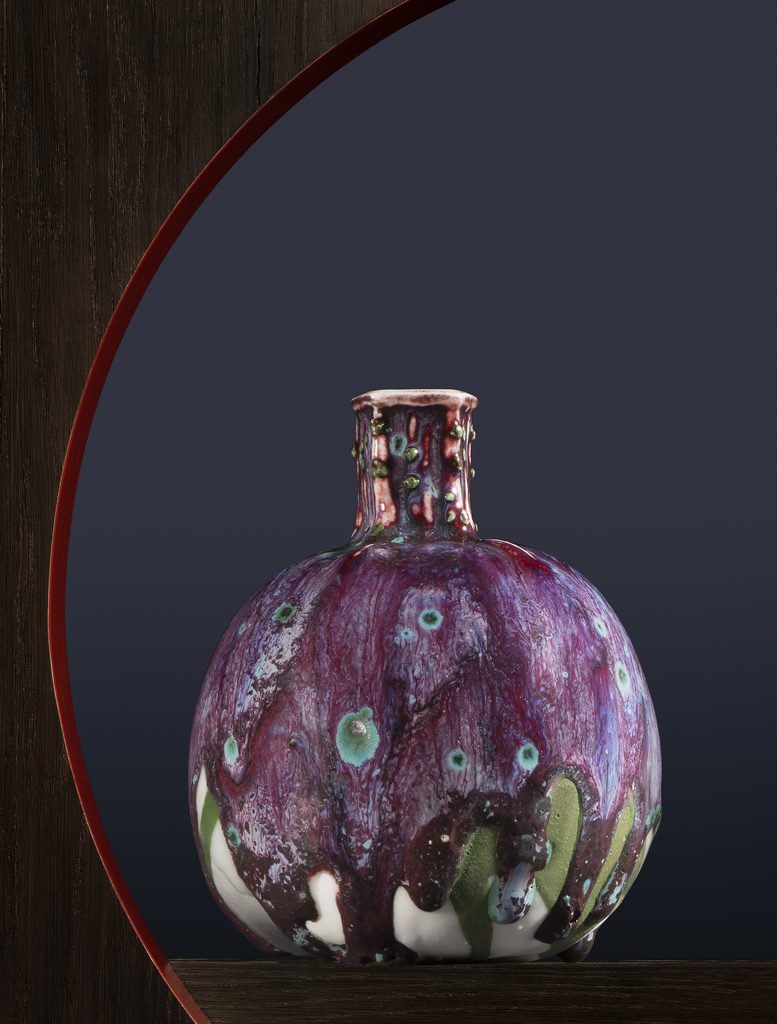
The artworks themselves were strange enough to grab my attention: two vases with irregular forms, their glazes resembling melted wax, vibrant with captivating colors. The name on the label was stranger still: Taxile Doat. Although a Frenchman long associated with the celebrated Sèvres manufactory, he was entirely unknown to me. The irony was irresistible: I had crossed the Atlantic in my endless pursuit, as an art dealer, of adding yet more European decorative arts to American museum galleries, only to discover, in an American museum, a French artist I had never heard of, who would soon become a fixation of mine.
The more I learned, the more fascinating the story became. After decades at Sèvres, Doat had accepted a position in the American Midwest in the early twentieth century. How had a ceramist so celebrated in his own day become such an elusive figure today? How had one of the most technically gifted craftsmen of his generation, still revered by a small circle of collectors and specialists, slipped so easily from public memory? And why does Taxile Doat continue to resist the categories into which art history so often insists on cornering its artists?
Thanks to Linda Roth, Charles C. and Eleanor Lamont Cunningham Senior Curator of European Decorative Arts at the Wadsworth Atheneum, I gathered enough information to begin my own investigation. As my research progressed, the visual plot thickened. Ever stranger forms passed before my eyes, adorned with delicate decoration executed in the arduous pâte-sur-pâte technique, which I later learned was Doat’s signature. Speaking of signatures, his own is deliciously part of the appeal. I often find myself turning over the few Doat vases now in my possession simply to look at it: so personal and revealing.
His shapes are endlessly varied. Some draw on classical Greek and Roman models while others swell into bulbous bottles and vessels of near-anthropomorphic form. The stranger, the better, in my view. Yet what unites them all are astonishing glazes and colors. They possess a vigor that seems to defy the very material from which they are made.
Doat was born in Albi in 1851 and joined the Manufacture nationale de Sèvres in 1877. He would remain there until 1905. Yet his official position tells only part of the story. Like many of the great artistic personalities who emerge from major workshops, Doat was never content to remain solely within the institution that trained him. Alongside his work for Sèvres, he established a private studio, first on the rue de Bagneux and later at 47 rue de Brancas in Sèvres itself, which he baptized Villa Kaolin. There, quite literally and audaciously under the nose of his employers, he pursued a parallel career as an independent creator. At the Exposition Universelle of 1900, his work appeared both on Sèvres’s stand and on his own private one.
Doat did not invent the techniques for which he became famous yet mastered them so completely that he transformed them. His greatest technical achievement lay in pâte-sur-pâte, the painstaking process of building translucent low-relief decoration through successive applications of liquid porcelain slip, which requires extraordinary patience, precision, and repeated firings. Contemporary critics marveled at the results. As Marie-Paule Vermeil noted in Art et Décoration in 1904: “Est-il besoin de rappeler avec quelle faveur le public l’accueillit! (Is it even necessary to recall the enthusiasm with which the public received him!”)
Yet technical mastery alone does not explain Doat’s fascination. What emerges again and again is a personality driven by experimentation. He was not content merely to decorate porcelain, he wanted to understand it.
By 1905 tensions with Sèvres had become impossible to ignore. His independent activities increasingly competed with the institution itself. Even his signatures could be interpreted as provocative. By inscribing works “Sèvres,” he referenced a place rather than an affiliation, subtly blurring the distinction between the artist and the manufactory. Eventually, he was forced to choose: the security of the institution or the freedom of independent practice. He chose freedom.
The same year, he published Grand Feu Ceramics: A Treatise on the Making of Fine Porcelain and Grès, and not long thereafter he accepted an invitation to join the ambitious artistic experiment unfolding in University City, outside St. Louis, Missouri. The circumstances that brought him there were almost as unusual as the man behind the endeavor.
The project was the brainchild of Edward Gardner Lewis, visionary entrepreneur, publisher, and founder of the American Woman’s League. Having transformed a modest publication into one of the most widely circulated magazines in the United States, Lewis dreamed of creating a vast educational and artistic community. During the construction of his headquarters, deposits of kaolin clay (the essential ingredient in porcelain) were discovered, which became the catalyst for an ambitious ceramics program centered on porcelain production.
Lewis recruited two of the most accomplished ceramic artists in the world at the time: Doat and Adelaide Alsop Robineau. Doat became director of the program, though his principal task was not administration but creation: “Their only aim will be to produce the finest artwork that they can produce regardless of the cost,” Lewis wrote.
The utopian venture was sadly short-lived, eventually undermined by financial difficulties, and the artists dispersed. Yet Doat’s impact on American ceramics proved lasting. Through his teaching, writings, demonstrations, and examples, he helped shape an entire generation of American potters.
When he arrived in Missouri, he brought a hundred artworks with him, both as teaching tools and as references for future creations. During his years there, he produced many more. On his return to France in 1914, these works entered the collection of the City Art Museum of St. Louis. When many were deaccessioned in 1945, they dispersed into museums and private collections across America. It is likely that a large proportion of Doat’s works found in the United States today can be traced back to that moment.
This was Doat’s life as I first came to understand it. The great and dangerous thing about art is that the mind is always tempted to fill the gaps. Those of us fortunate enough to work with historical material are, in the end, storytellers. Some of our stories inevitably contain inventions supplied by imaginations separated from artists by decades, sometimes centuries.
When looking at Doat’s work, I placed him somewhere between the boisterous and unrelenting genius of Bernard Palissy, while certain works feel surprisingly close to the world of Dagobert Peche, where decorative invention borders on the surreal. In my own simplified view, Doat became a figure larger than life. With his imposing beard and intense gaze, he looked almost Rodinesque. I imagined a rebel who had abandoned the security of Sèvres for artistic freedom, a creator so consumed by invention that he preferred exile to compromise.
I wanted to get to the bottom of it and thankfully, unlike many artists whose lives survive only through archives and secondhand accounts, Doat left us an extraordinary testimony. Grand Feu is not merely a technical manual. It is a remarkably revealing portrait of its author, and what surprised me most was how different the real Doat appeared from the figure I associated him with.
Far from dismissing Sèvres, he praised it repeatedly. “To Sèvres and to my comrades, I owe all my technical skill and the greater part of my art . . . . I have refused many brilliant offers from foreign factories, but as I was unable to resist the passion of the ceramist and as a ceramist does not exist without his kiln any more than a violinist without his violin, I have established at my residence an experimental laboratory where I win from the fires the wares which have brought me a gratifying success.” Later followed with: “The Manufactory of Sèvres has for more than a century shone with a matchless brilliance. No factory equals its renown, no productions have exceeded the sum of its artistic wares.”
This is not the voice of a bitter dissident. It is the voice of an artist profoundly grateful for his training and eager to share what he had learned. Again and again, I encountered generosity rather than self-promotion. “I simply relate how I have succeeded in the practice of my art and tell of the means and tools I use.” He describes constructing his own kilns, shares detailed plans, explains years of experimentation, and openly discusses failures alongside successes. Reading the book, one quickly realizes that Doat was not only an artist but also a teacher of exceptional gifts.
Perhaps the most revealing passage comes when he defines the ceramic artist himself: “Whether a painter, a sculptor or an architect, the ceramic artist must also be a chemist. . . . for the grand feu, each ceramist must mix his own colors or have them experimented on by a chemist who makes a specialty of such work. These chemists are rare and the additional expense of such collaboration is possible only in large manufactories . . . . the isolated artist, not having any help of this kind, must be his own chemist.”
Every great workshop produces remarkable artists. Yet each generation also gives rise to one or two individuals whose inner fire pushes them beyond established boundaries, not necessarily out of defiance, but in pursuit of possibilities others have not yet explored. Maybe Doat was not as rebellious as I first imagined. Maybe what drove him was something more interesting: an insatiable desire to understand every aspect of his medium.
Doat concludes his treatise with what seems to me as genuine and thoughtful generosity toward his readers: “It will be a pleasure for me and the best of rewards, if I succeed in making converts and in reducing their first expenses to a minimum.”
Three years after first discovering Taxile Doat, I still find myself looking for his work at auctions, questioning dealers who know him far better than I do, such as my friend Oscar Graf, whom I warmly thank for allowing the reproduction of images in this article, and eagerly awaiting a return to the place where the obsession began.
Next year, Linda Roth and the Wadsworth Atheneum will take a bold and admirable risk by organizing the first major retrospective devoted to Doat. Titled Art and Alchemy: The Ceramics of Taxile Doat, the exhibition (opening in March) promises to provide the context and visual spectacle I have long yearned for and I suspect it will create a new generation of Doat converts.
LAURA KUGEL is the sixth-generation director of the family’s Galerie Kugel in Paris.


