
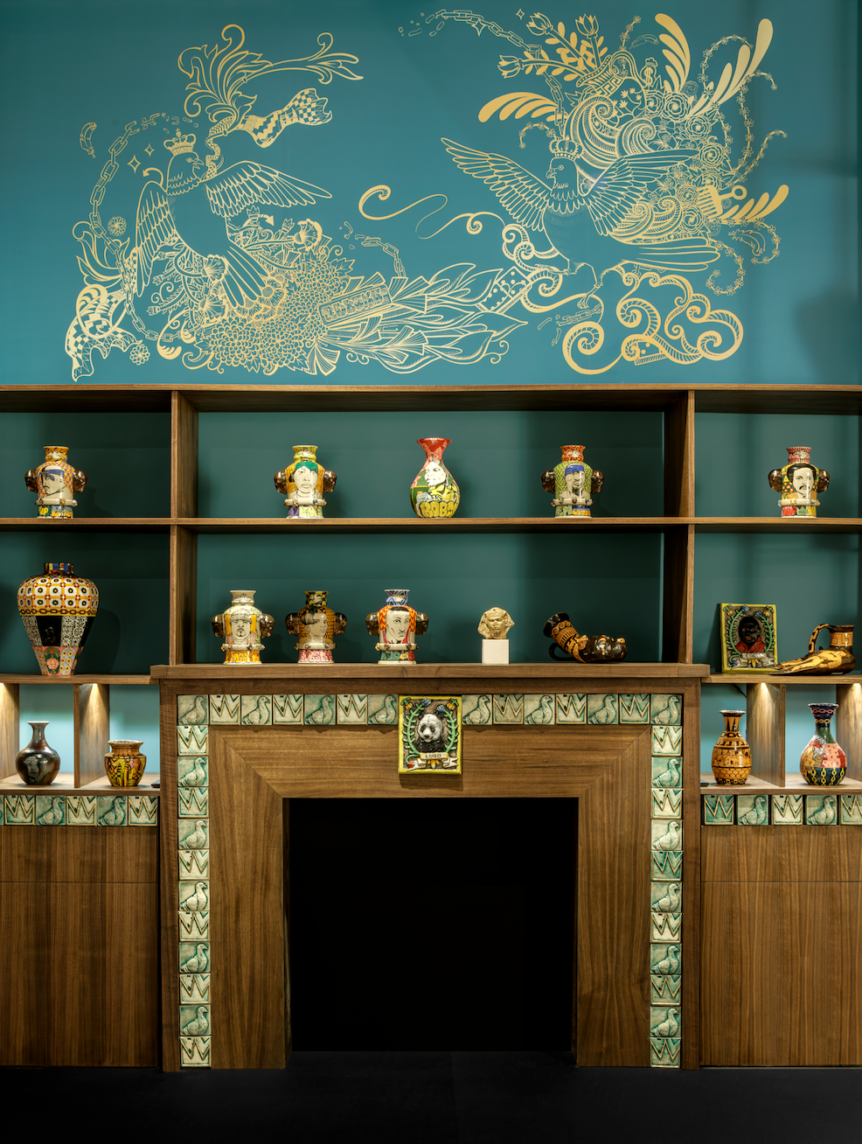
Beth Dunlop talks with Design Miami CEO Jen Roberts about collecting, evolving taste, and the ever-changing world of design.
Photograph by Kris Tamburello; all photographs courtesy of Design Miami.
Jennifer Roberts, now in her second decade as CEO of Design Miami, has spent much of her life exploring the world of design, from antiques to modern. She grew up in New York but spent weekends in Salisbury, Connecticut, where she would go along with her parents as they prowled antiques shops and sales. “To me,” she says, “it was an experience of finding hidden clues about history.” After graduating from Hobart and William Smith Colleges, she studied at the prestigious decorative arts program at Christie’s in London where inspiration struck. “I fell in love with the material,” she says, “especially with ceramics and eighteenth-century furniture, American, English, and French.”
She returned to New York and worked briefly at Sotheby’s and with a New York antiques dealer but also began selling antiques (some of which she had bought while she was in England at the night market in Bermondsey and others in New York), at the 26th Street Flea Market in Chelsea.
At the market, Roberts began to observe the way the world of collecting design was changing. She was selling little, while the sellers with mid-century and early modern furniture were arriving with vans full of material and leaving with their vans empty. “That was a moment of revelation to me, that the world of antiques had evolved, and there was a new appetite for modern design. I knew that I was onto something.”
In many ways what she saw was the vanguard, the first dealers who were selling art deco or mid-century modern. She put it to work, both in publishing and later in design shows. In both areas she has pioneered new ideas and introduced new work to the world.—Beth Dunlop

Beth Dunlop:
Let’s take it from the time you began working in publishing.
Jen Roberts:
After I joined the publishing team at The Magazine ANTIQUES, I worked in every region of the United States selling advertising. But as time went on, almost every dealer, every antiques dealer, would say the same thing—that the market was changing, the dealers are dying off, and nobody’s replacing us. I would hear this over and over. I also noticed that there was no clear path for recognition for modern design.
BD: And then came the pioneering opportunity to launch MODERN Magazine
JR: Yes. The auction houses were still calling design twentieth-century decorative arts, but there were a number of galleries opening that were selling what we now call “design.” They didn’t necessarily want to be associated with antiques, because “brown furniture” had become a pejorative term.
It became ever clearer that design was a burgeoning market, and I realized that there was an opportunity for a different kind of packaging and messaging. Design had a kind of sex appeal. It started with architecture. At that time, architects were being put on a pedestal—it was the period of “starchitects” and a burgeoning interest in the built environment.
BD:
Architecture came into the public conversation first, starting with modernism and postmodernism, and ultimately spinoffs of modernism. For a period—whether it was Philip Johnson, Robert Venturi, Michael Graves or others, there was a new freedom and a high level of ingenuity, not to mention celebrity, in architecture that somehow reflected the culture we were living in. And then, big (and corporate) money took over architecture, which made it in many ways less interesting.
But at the same time, design—the decorative arts–had always reflected culture, and it became so much more interesting in terms of that narrative. For both of us—and I didn’t know you then—we grew to see design as a kind of totem of culture. And it captured the public imagination.
JR: Right. And it was meeting a need and solving a problem. I love the idea of training your eye and training your eye to identify a time, right? You have to look at the material, you have to look at the form, you have to look at some of the function, you look at so many different things.
One of the most interesting questions I had when I was first getting interested in design was how do you find the material? One dealer told me that he would go and look at areas where there was a great amount of development over a short period of time. And when you look, you’ll see that innovation had to come out of that.
Look at Brasilia. It’s now over seventy years old, and when Oscar Niemeyer designed the city, it was so radically different that you couldn’t just put traditional furniture inside. You had to do the interiors as well. And when you start to look at that, and you start to think about the trends of development, you start to see the design that comes out of new architecture–Barragan houses or Frank Lloyd Wright houses, you know. And you can actually go way back in history and see this.
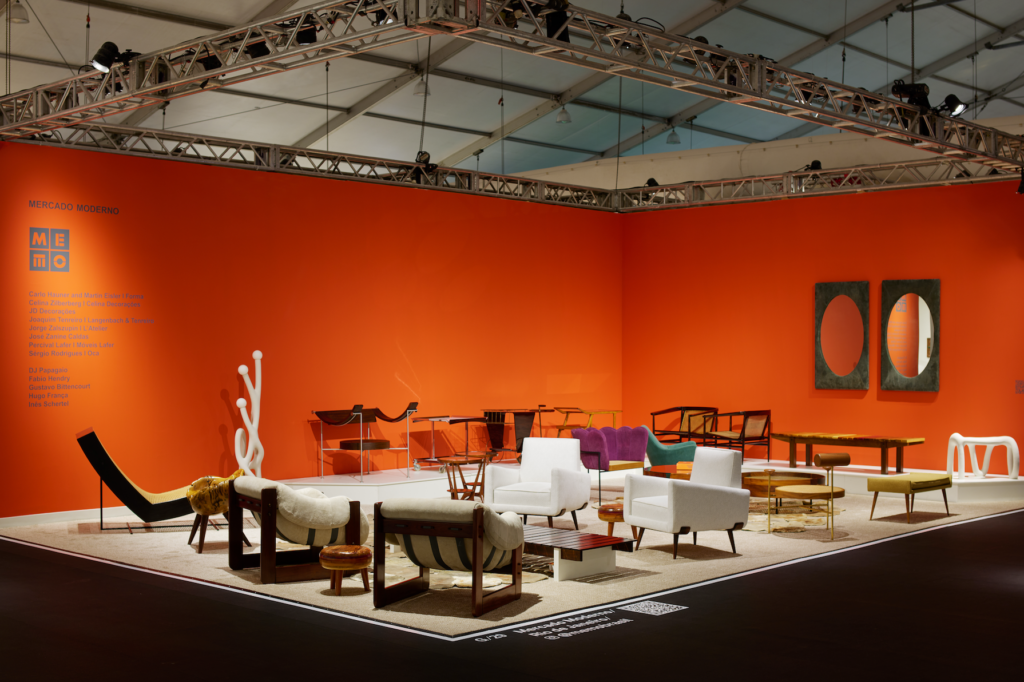
Design Miami 2023. Harris photograph.
BD:
I think one of the things you’ve done with Design Miami, which is so important, is to broaden the scope. You brought in some earlier furniture as well as contemporary designers who were working in different vocabularies, not necessarily experimental, but sometimes they were doing new work using old, old forms. There is much more of a mixing of periods and styles—is that true with some designers and galleries as well?
JR:
I do remember Carpenter’s Workshop at some point brought eighteenth-century boiserie panels to Art Basel and then had all their contemporary furniture in that contrasted environment, which was beautiful. Or Mark Newsom did a chest of drawers out of Lockheed sheet metal. But it was in contrast to an eighteenth-century marquetry cabinet of the same form.
Today a lot of people cross-collect—putting twentieth-century furniture and lighting and design in eighteenth- or nineteenth-century interiors. And the contrast is great. I think it’s going to be interesting to see what the antiques of tomorrow are.
BD:
We always talk about that—what lasts and what doesn’t, and how much does it matter? I also am fascinated by—and you see this a lot at Design Miami—what pieces from the past easily align into the current day and the future.
JR:
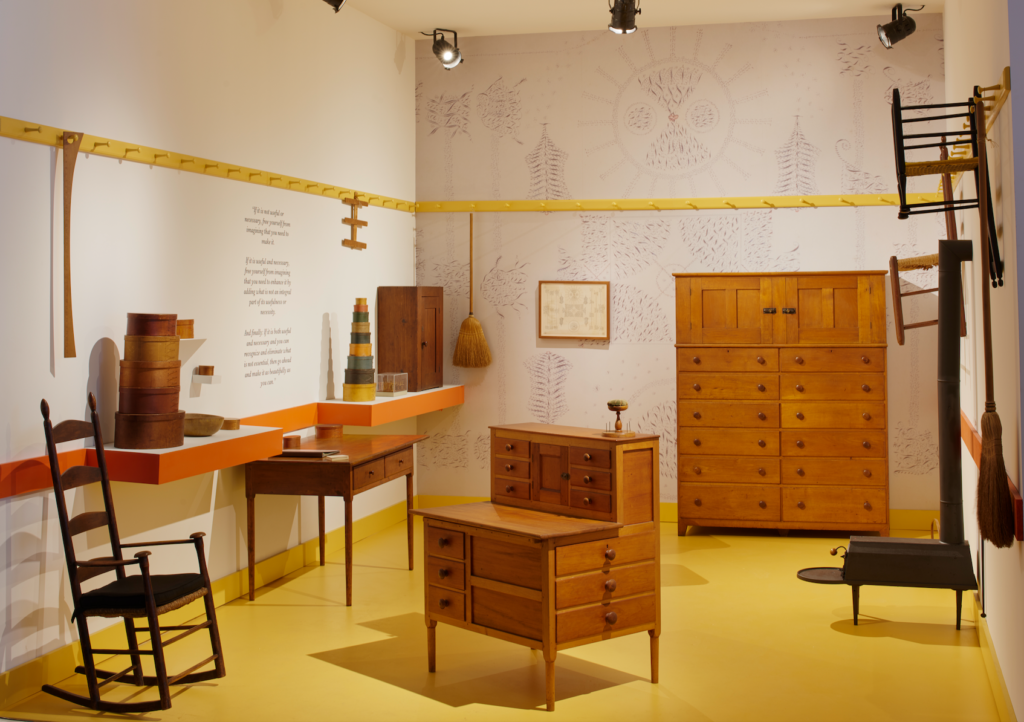
It’s hard to predict, right? A good example is Shaker furniture, which is somehow eternal, John Keith Russell found it to be very successful at Design Miami, which made me so happy, because he’s somebody that I’ve known from my early days at The Magazine ANTIQUES.
BD:
What you also see at Design Miami are designers who use history to create something entirely new and contemporary and even edgy. I’m thinking particularly of, say, Katie Stout, who is quite avant-garde but designs lamps and vases that draw on traditional forms, basically a lot of everyday objects, but they are “out there.” Or then there’s the amazing Roberto Lugo.
JR:
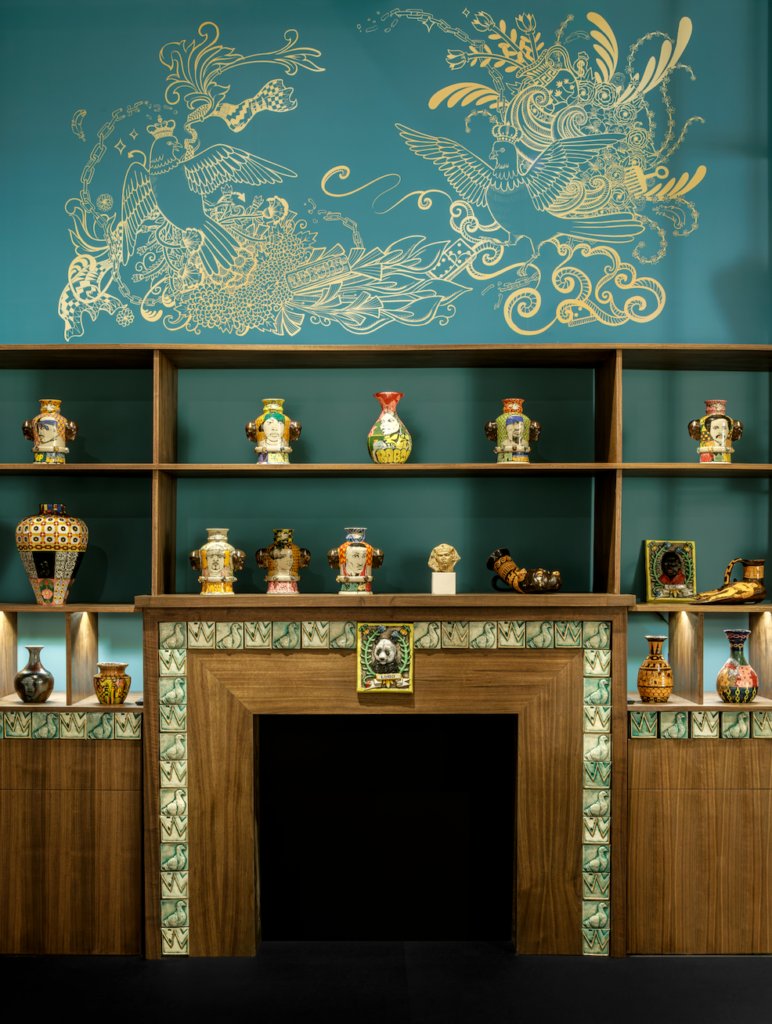
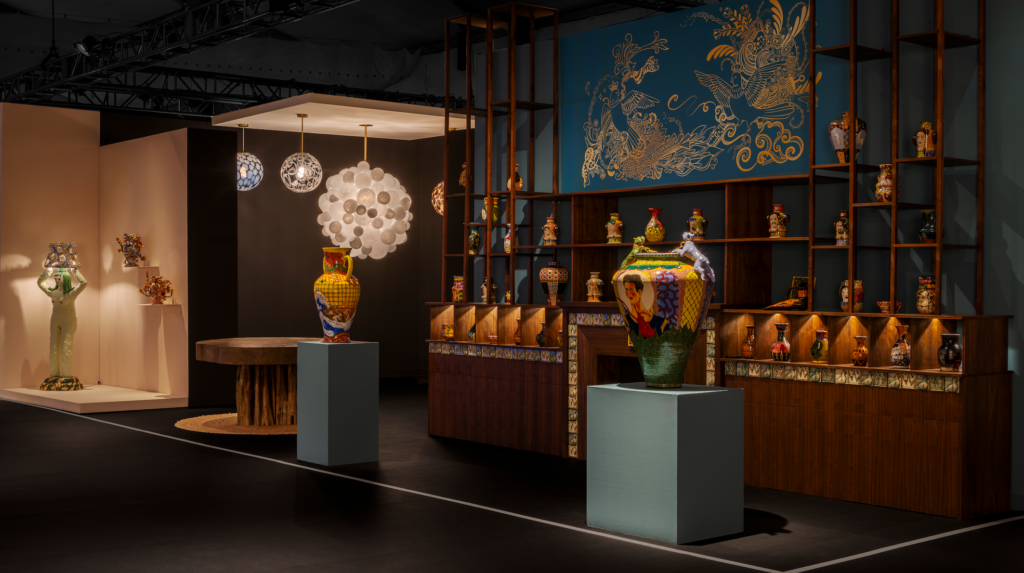
Roberto Lugo is really interesting because he’s somebody who’s looking at Delftware, Dutch Delftware, right? And English, too. He’s using the blue and white floral motifs and the traditional classical forms of ceramics and applying illustrious figures from contemporary culture.
BD:
And they’re beautiful. I thought Wexler Gallery was taking a big chance on him in a way because it wasn’t clear that people were going to get it. But they did, wholeheartedly. And he became enormously famous and successful and highly collected and museum-worthy, which his work certainly is.
JR:
He also did something I thought was really interesting, He was very democratic about his offerings. So he knew that not everybody who appreciated his work could necessarily afford him. So he would do these drops where he would launch, you know, a hundred or, I don’t know, twenty of his unique coffee mugs. And he would sell them at a really affordable price so that anybody could have one. So that was really nice. And yet he’s a great example of somebody who’s also looking to the past in both technique and motifs and so on.
BD:
There are so many ways that Design Miami affects people’s lives, including the opportunities it creates for early-career designers.
JR:
We’ve seen the trajectory of designers’ careers just completely change over the years. Design Miami is really a platform that magnifies this. It’s an opportunity to see so much in one place, and I think that makes us the amplifier. It’s the meeting place for so many in this market, but each show is super different too.
BD:
And what do you think are the most profound changes you’ve seen?
JR:
The market’s changed a lot. There’s actually one point that I realized the other day, I started thinking: Why has design become so popular with the younger generations? And, why is it a household word all of a sudden? I had to do a talk for 3daysofdesign in Denmark, and as I was planning it, I began to realize that it’s the iPhone. The first Design Miami was in 2005. The iPhone was launched in 2007. And the iPhone is the one item that got everybody thinking about design and function. And suddenly it was in everybody’s home.
And then of course, all the other things that the iPhone brought with it with Instagram, but I would argue the real impact of the iPhone came with Covid. It catapulted because everyone was stuck at home with social media. The iPhone is what made so many people think about design, people who would never have thought about design before.
BD:
Over the years, Design Miami has grown and morphed and changed so much.
JR:
Each of the fairs kind of reflects the locality of its home city. I think Miami itself is much more about the contemporary designers whose careers are really at the beginning of taking off. And I think there’s a lot more self-representation. Paris has much more historic European design, and Korea is mostly about Korean design. But, Miami is a little bit over the top. It’s a little loud. It’s a little in your face. It gets almost thirty-five thousand vistors.
BD:
What would you like to see in the future?
JR:
I would love to see more folk art at Design Miami. I think there’s a lot of room for folk art. I think that if it’s presented the right way and packaged the right way, it could really resonate. I do think that it would be interesting to include the folk realm and Americana. I’d also love to see Native American design. And I do think to some extent that there is American furniture that can make its way there, like William and Mary, you know, a little bit more simplified, not so ornate. I tried to do something with slipware one year. There is so much that is timeless, and at Design Miami we’re not constrained by a timeline. There are so many ways to stretch.


