
Design’s homage to the beauty and poetry of the humble tree.
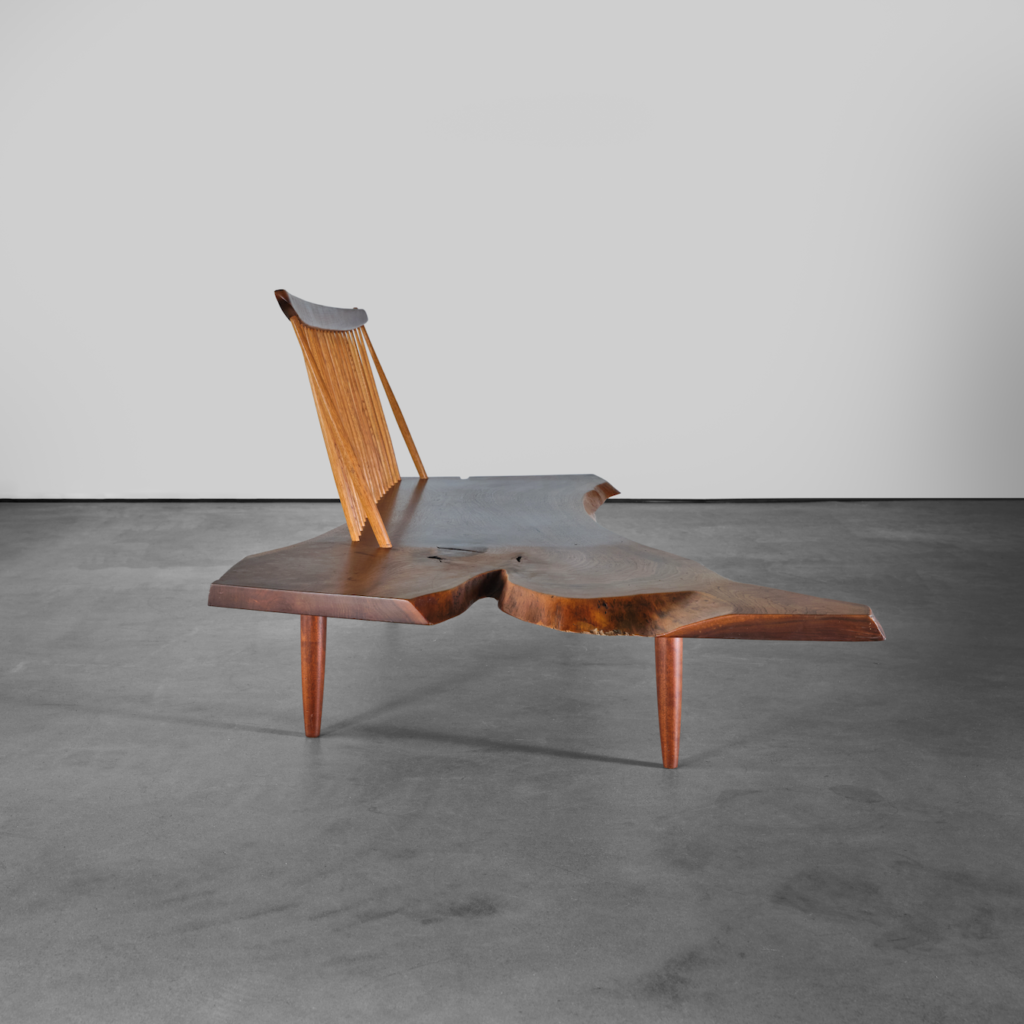
and hickory; height 38 1/2, width 84, depth 29 1/2 inches. Photograph courtesy of Moderne Gallery, Philadelphia.
About halfway through the eternal masterwork that is A Charlie Brown Christmas, our hapless protagonist is dispatched to buy a tree for the school pageant. “A great big shiny, aluminum Christmas tree,” he is instructed. “Do something right for a change!” Accompanied by his preternaturally wise, blanket-clutching friend Linus, Charlie Brown toddles down to the local tree emporium, a luridly lit artificial forest. When they knock on one of the big fake conifers it sounds like a garbage can. Then their eyes alight on a lonely little sprig of pine, affixed to a cross-shaped wooden base. It’s not much, but Charlie Brown decides this is the one. As he tells Linus, “I think it needs me.”
You know the rest. The other kids mock Charlie Brown mercilessly. Linus explains the True Meaning of Christmas. And the tree is magically reborn, becoming lush and green. The children gather round it and sing a carol. It’s a Christmas miracle. And, when A Charlie Brown Christmas first aired, in 1965, it was also a well-chosen metaphor. After two decades of postwar economic prosperity, Americans were feeling anxious about consumerism, distrustful of technocracy, and tragically disconnected from nature. It was a perfect moment to celebrate “the soul of a tree.”
That phrase is not from Charles M. Schulz, of course, but rather George Nakashima, the pioneering studio furniture maker. By the mid-1960s he had become well known for his “free edge” furniture, which features timber boards—usually of black walnut—with at least part of their natural shape left intact. The bark is stripped away but the tree’s contour is still there, dancing along the break between heartwood and sapwood. The organic beauty of the unworked slabs, beloved of all woodworkers, are there for all to see. In his iconic Conoid benches, first introduced in 1960, Nakashima ingeniously emphasizes the beauty of the “free edge” by juxtaposing it with a Shaker-style spindle back. It’s an encounter between the organic and the structural, the found and the made.
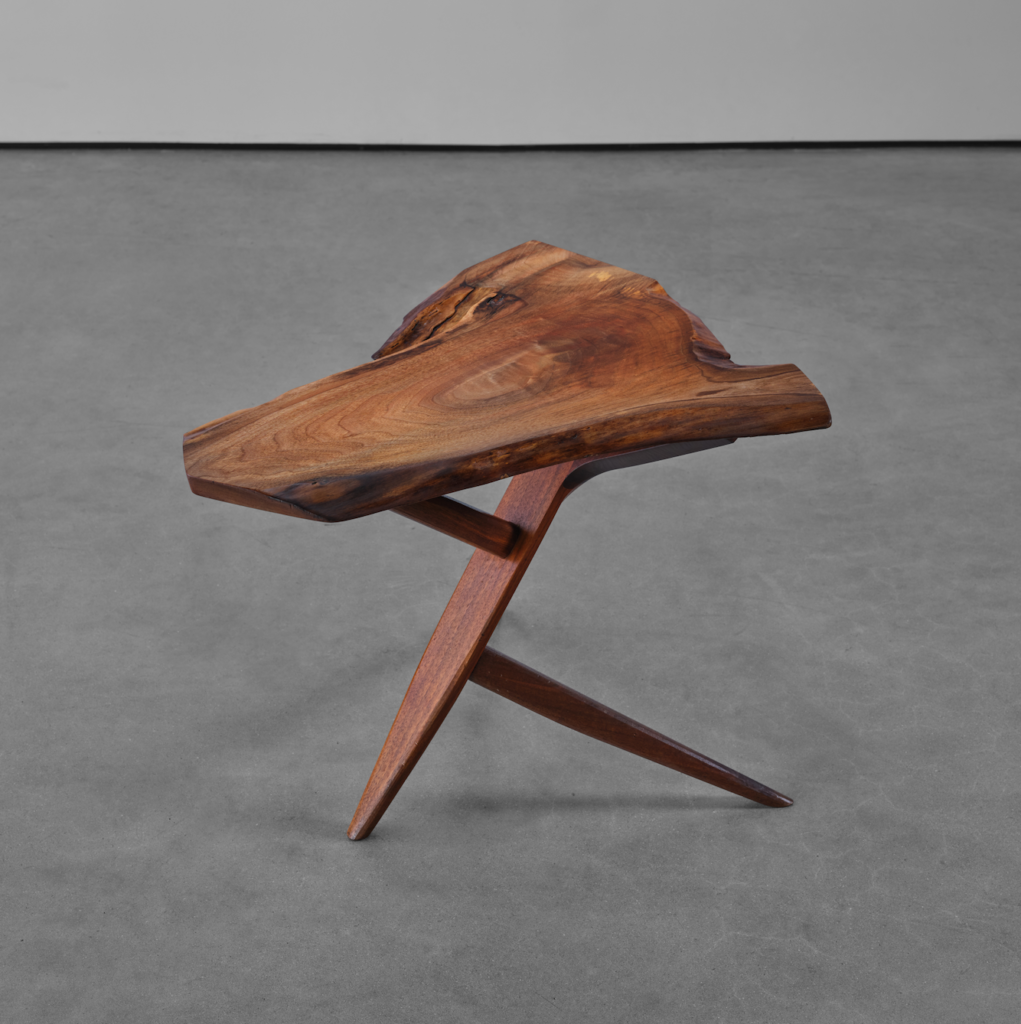
Nakashima’s idea soon achieved escape velocity. By the 1970s the natural-top coffee table had become a cliché of handmade furniture, with vaguely countercultural associations. But there is no denying the originality of his conception. Earlier furniture makers would no more have countenanced a “free edge” than a silversmith would have integrated a lump of ore, or a potter a clod of raw clay. There was, however, one important precedent for Nakashima’s work: so-called “rustic furniture,” in which unfinished tree branches were incorporated into a design.
This improbable innovation was introduced in the mid-eighteenth century alongside chinoiserie, Gothic, rococo, and other fashionable modes. As Morrison Heckscher has explained, it seems initially to have been inspired by Chinese furnishings made from natural twigs, a cultivated taste comparable to the collecting of “scholar’s rocks” (Gonshi). The first appearance of rustic furniture design in print was Matthias Darly and George Edwards’s New Book of Chinese Designs, published in 1754. The idea soon lost this exotic association, but it continued to be used for garden architecture and furnishings—a sort of arboreal extension of the underground grottos that were popular at the time.
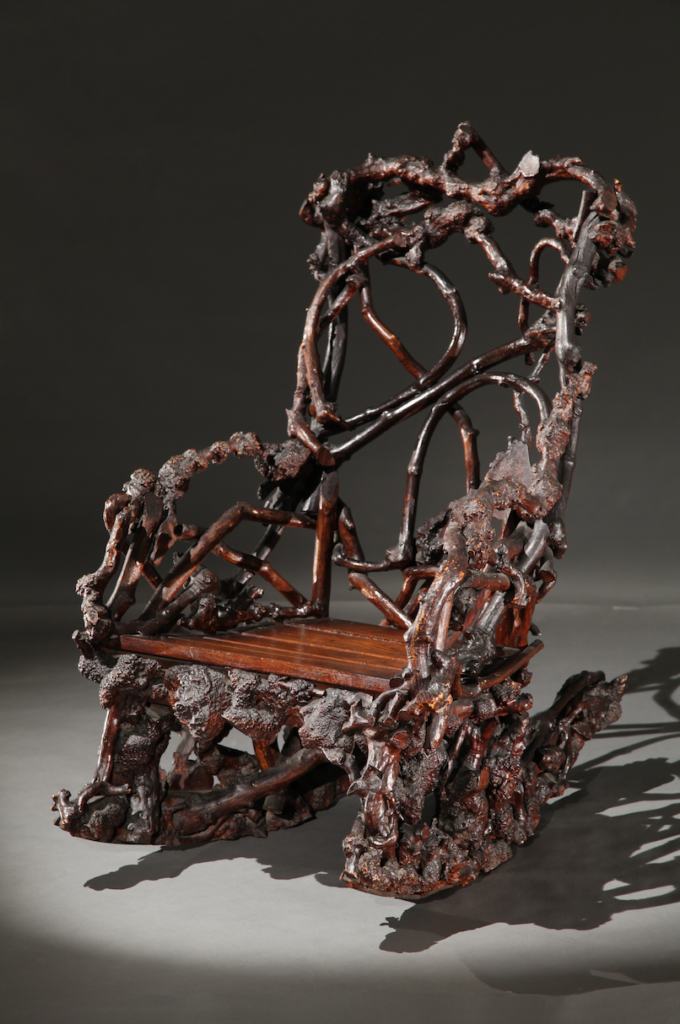
Little survives of the earliest rustic furniture, but there are some truly spectacular nineteenth-century examples, among them a rocking chair now at the Henry Ford Museum made for the wealthy railway and shipping magnate Cornelius Vanderbilt (known as “The Commodore”), probably for a porch or gazebo at his Staten Island residence. Like other novelty furniture made of steer horns and decommissioned spinning wheels, the rocker is emphatically symbolic, in a way that is quite rare in furniture history. In the manner of allegorical sculpture, it represents Nature with a capital N. Other rustic furniture of this era was carved in the generic shape of branches, or cast in iron or concrete. The Vanderbilt chair, however, is assembled from actual knotty roots, as though it had grown spontaneously from the soil.
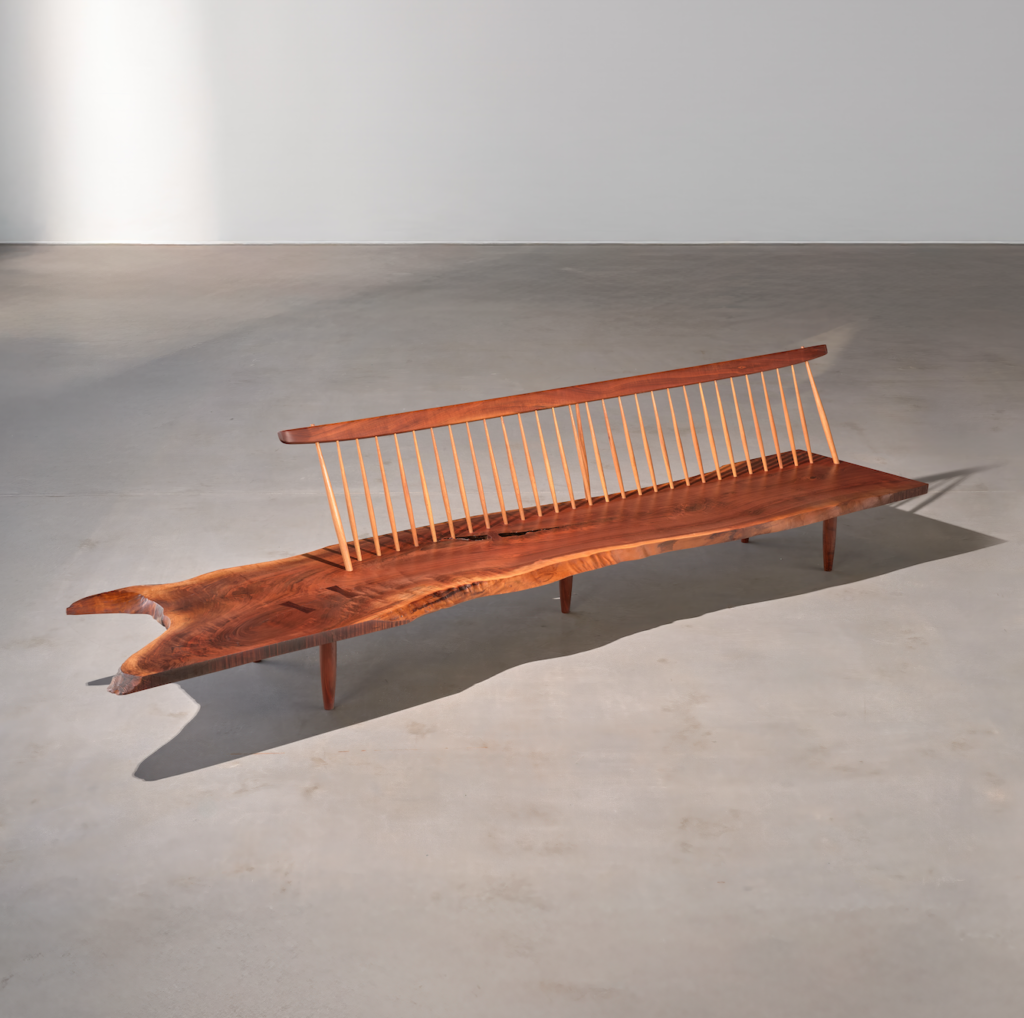
100 inches, depth 29 inches. Moderne Gallery photograph.
It is truly remarkable that a man responsible for the transformation of the American landscape would have owned such an object; one could scarcely imagine a more dramatic expression of control over organic matter. Be that as it may, Vanderbilt might not have taken his chair that seriously. Like the garden follies of a century earlier, it was probably just a novelty, meant to amuse. Nakashima, by contrast, understood his work in serious, even sacred, terms. His choice of the term “live edge” is telling: he knew that his boards had once been living things, and when he rescued an offcut from a scrap heap, he thought of it as an act of rescue, even a resurrection.
Nor was he alone. J. B. Blunk, out in Northern California, carved his own incredible furniture out of huge root structures, the tragic remnants of giant redwood trees left from decades of forest clearcutting. That he used a chainsaw to shape this material was purposeful: it was “the tool that had cut down the forest,” and he wanted to redirect it to generative ends. When he placed his monumental works in public spaces—museums, restaurants, college campuses—it was a reminder of the wilderness still out there, ready to be discovered, vital to be protected.
Nakashima had originally practiced as an architect, and his “live edge” designs differed from Blunk’s massive work, and also from earlier rustic furniture, in their draftsmanship: he was exposing a shape inside the log that would not otherwise have been seen. The meandering lines running along the front of his Conoid Benches are like drawings discovered. This idea has also animated the art of woodturning, which was enthusiastically revived beginning in the 1960s and ‘70s. One of the field’s early leaders was the late David Ellsworth—subject of a forthcoming monograph by Craig Edelbrock—who lived and worked in Quakertown, not far from Nakashima’s Pennsylvania studio.
An earlier generation of turners, including Mel Lindquist, Rude Osolnik, and Bob Stocksdale, had already incorporated naturally occurring shapes in their work, often to define the lip of a bowl. Ellsworth found a dramatic new potential, however, by combining the “free edge” with his hollow turning technique. This involved using specialist curved tools to reach through the mouth of a vessel, then carving it from the inside, balloon-thin using. He soon realized that he could exploit natural occlusions and gaps in the workpiece: as it whirled around on the lathe, his chisel would pare away the wood where it was, and glide right past where it wasn’t.
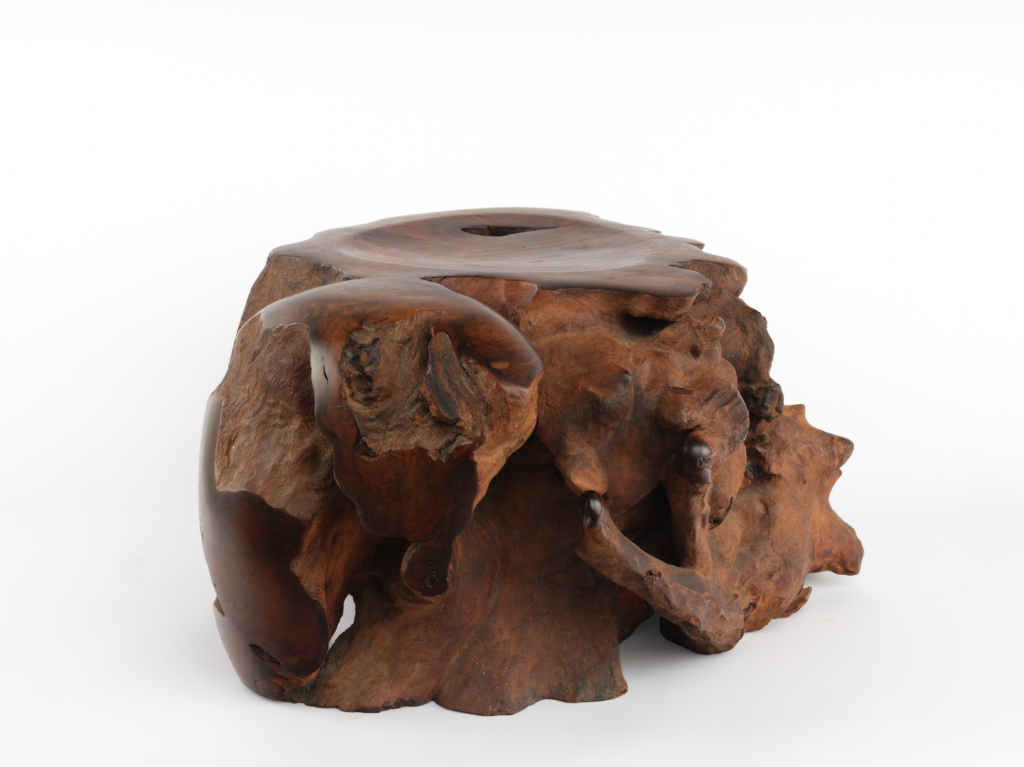
Photograph by Chris Grunder, courtesy of the Blunk Foundation.
Initially, Ellsworth was content to leave small apertures in the sides of his turnings, affording a tantalizing glimpse of their finely honed interiors. As his technique developed, though, he became ever bolder, fashioning large chunks of burl into exquisite abstract vessels, half of which were negative space. Nakashima’s insight that timber’s perimeter could be a drawing in space acquired an additional dimension, as the “live edge” now became a complex curvature.
Ellsworth was generous in sharing his methods, both through teaching at workshops and, eventually, a detailed “how to” publication, and many other turners adapted them to their own purposes. For most of these makers, it was a simple matter of realizing the potential of the wood, finding the best orientation on the lathe, the best size and shape for the vessel. A few, though, found deeper poetry in the “live edge”—none more so than Michelle Holzapfel, subject of an upcoming retrospective exhibition at the Museum of Art in Wood in Philadelphia. Though she does often use the lathe, sometimes just to rough out an initial shape, Holzapfel is primarily a woodcarver, often of still life subjects infused with personal narrative. Natural features in the wood often suggest possibilities to her.
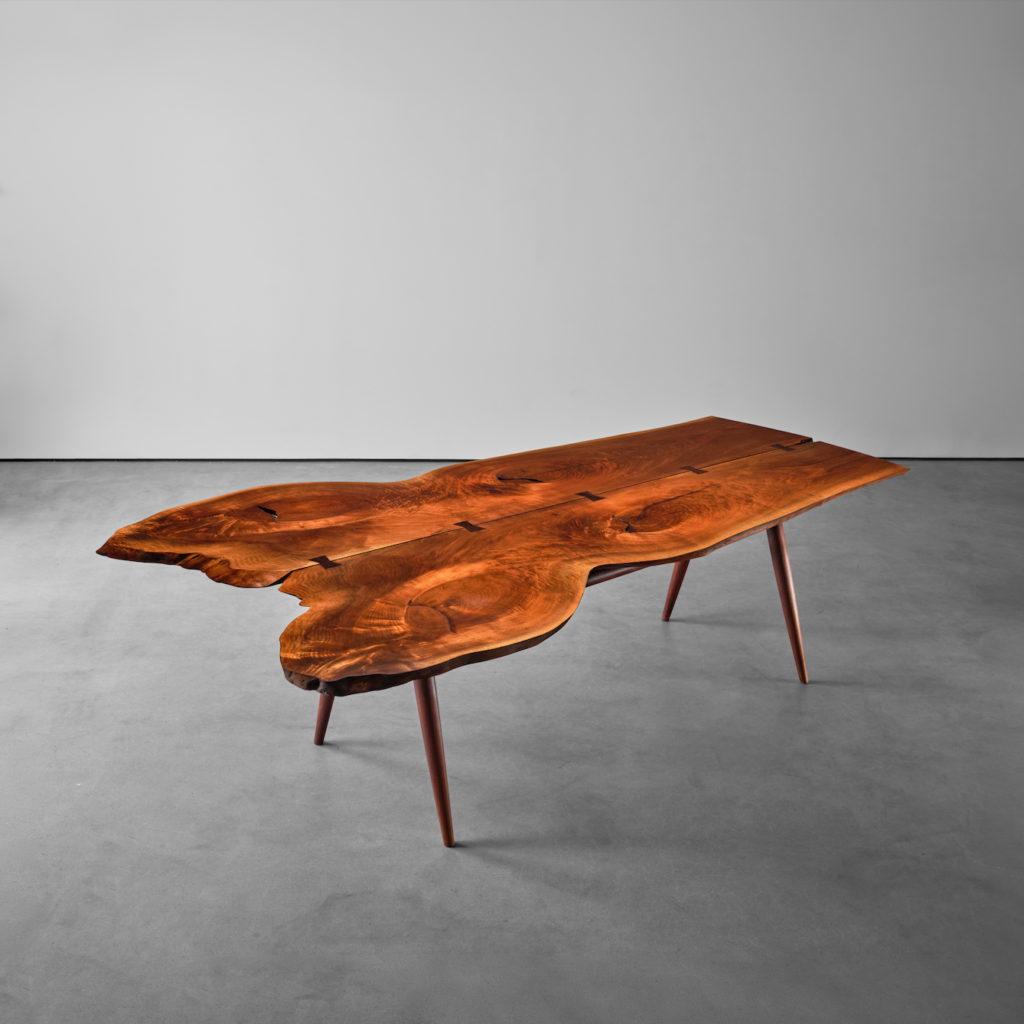
Moderne Gallery photograph.
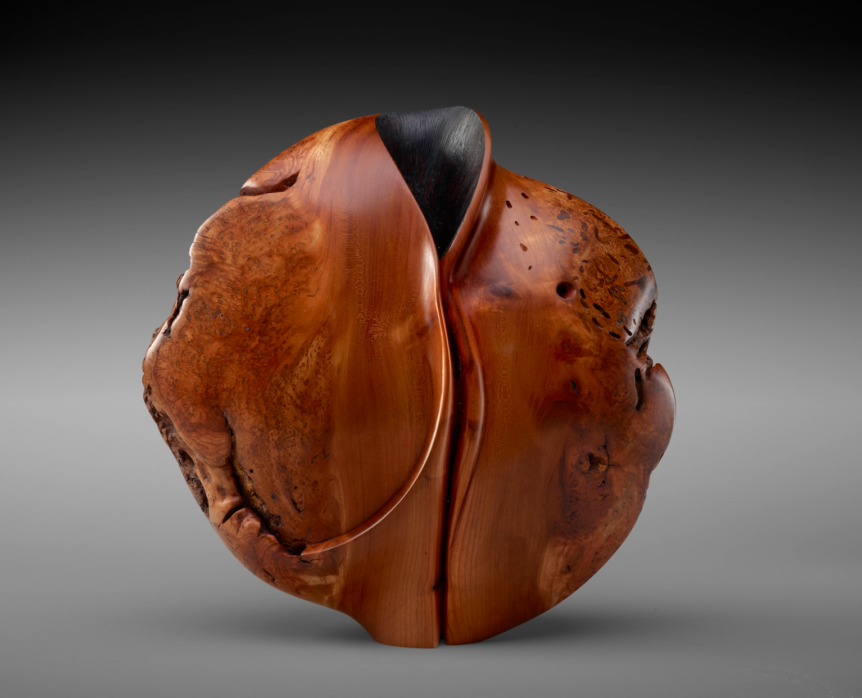
One work in the Museum of Art in Wood show, from 2008, exemplifies this adventitious approach. A tribute to the painter Georgia O’Keeffe, it features a gorgeous fall of rippling lines down its center, somewhat suggesting an open garment; as in the work of O’Keeffe and many later feminist artists, there is also a possible allusion to female sexual anatomy. The exterior silhouette, by contrast, is left entirely natural, its asymmetry establishing a gentle contrapposto stance. The carefully carved composition of the center has all the more presence because of the roughly defined circle within which it unfolds; perhaps Holzapfel’s subject is the birth of form itself.
As this powerful artwork suggests, there is still plenty of creative potential in the “live edge.” George Nakashima Woodworkers is still going strong—since his death in 1990, the studio has been stewarded by his daughter Mira, who produces some of his classics alongside her own designs. (As she remarks, “he left behind a huge pile of wood, and a group of really well-trained craftsmen.”) Meanwhile a new generation is bringing their own perspective, formed under the lengthening shadow of climate change. An especially incisive take is seen in the work of Joyce Lin, who graduated from the Rhode Island School of Design in 2017. There isn’t a “free” inch anywhere in her work, which is painstakingly constructed to produce an effect of hyperreality, but she is fascinated by the iconography of naturalism and the possibilities of its manipulation.
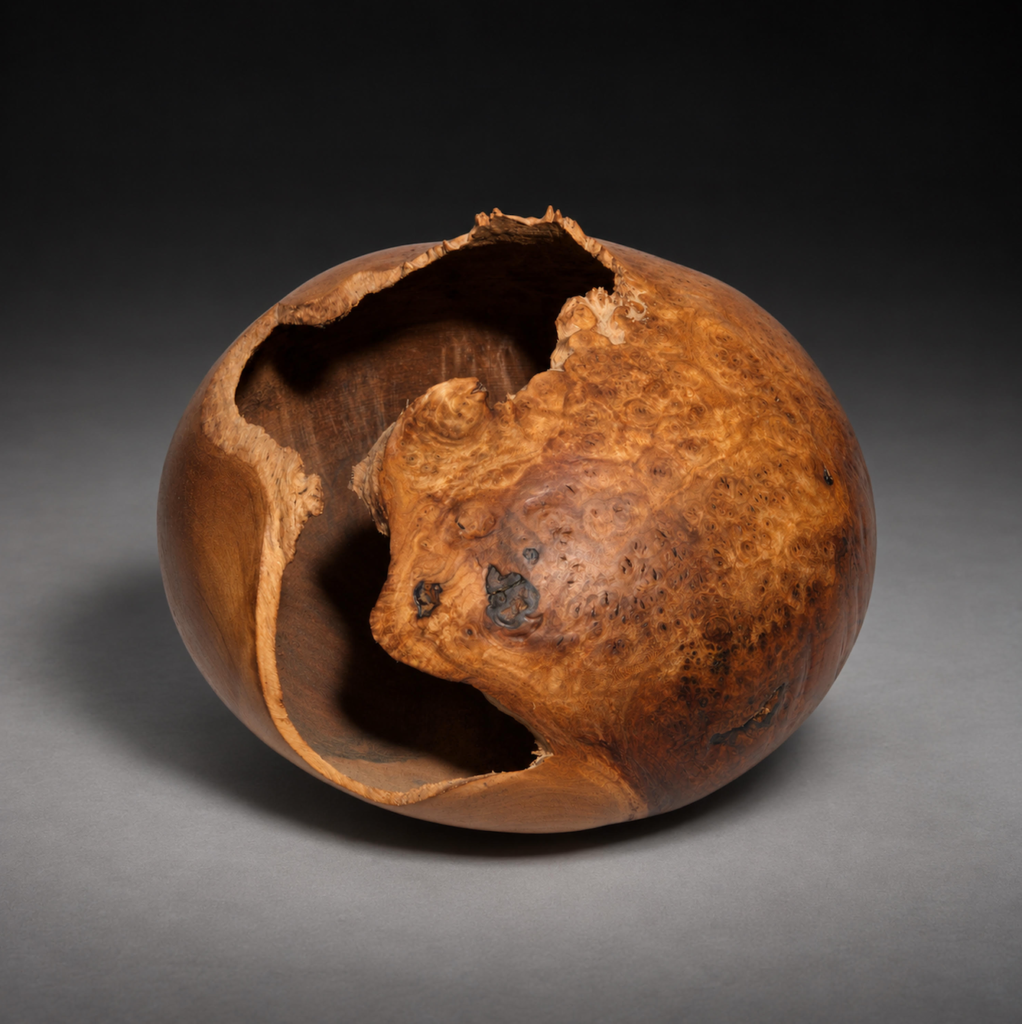
Photograph courtesy of Rago Auctions, Lambertville, New Jersey.
In Surfaces All the Way Down, which has the low stance and rounded contours of Joe Columbo’s Universale stacking chair (1967), Lin presents us with an impossible stratigraphy. White plastic gives way to wood, then aluminum, concrete, brick, rusty iron, gold, and so on, apparently to infinity. Some of the substances are real, some are simulated—never was l’oeil more trompé—so that materiality itself comes to seem like a fictional realm. Though entirely, exquisitely handmade, the object speaks eloquently of the digital era; it is, after all, the literal embodiment of a “deep fake.” At the same time, Lin offers an oblique commentary on the idealism of makers like Nakashima and Blunk, which seems unavailable to the present day. At this point, one has to ask: if trees do have souls, would they want anything to do with us?
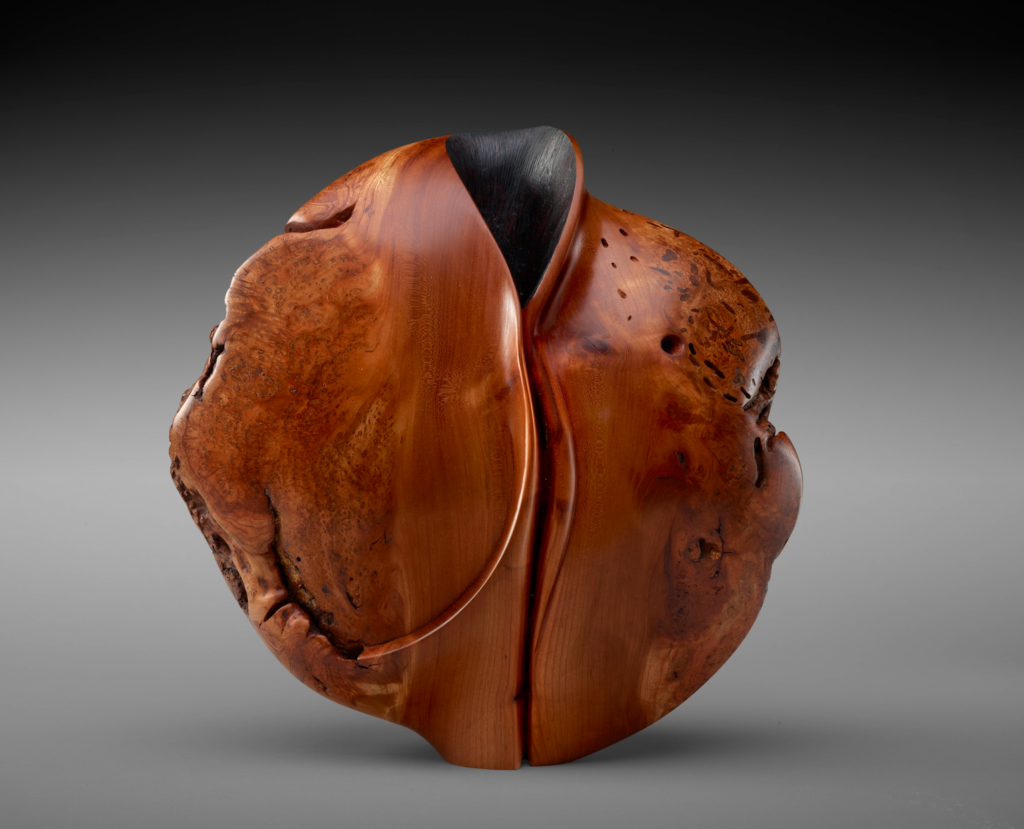
Museum of Fine Arts, Houston, gift of John and Robyn Horn.
Maybe so—if only we could change our ways. Such is the conviction of Alice and Gavin Munro, whose project Full Grown, based in Derbyshire, England, combines the functions of a design studio and a nursery. Put simply (though there’s nothing simple about it in practice), they train and prune willow, oak, and ash trees into the shapes of chairs. This is seriously slow craft—it can take as long as nine years to grow a piece, plus another for it to dry—but the final results are magical, as if the fantastical rustic furniture depicted by Darly and Edwards had leapt into being, fully formed.
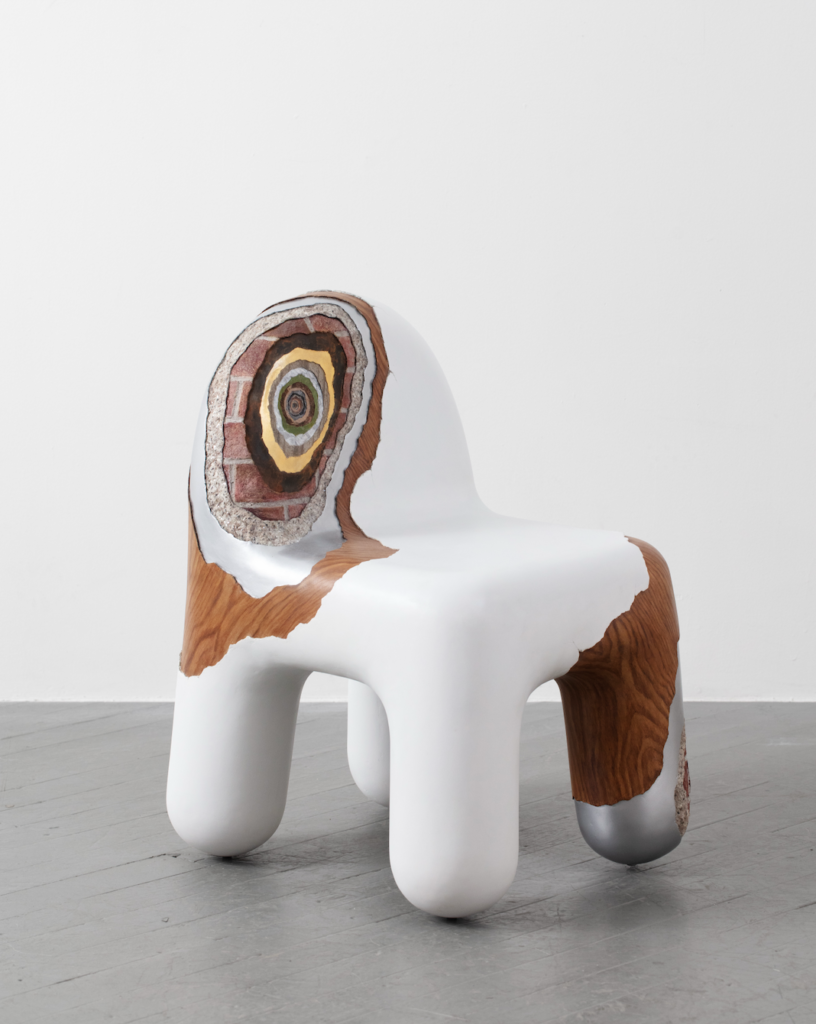
Photograph by Logan Jackson, courtesy of the artist and R & Company, New York.
Full Grown’s creations have something in common with Charlie Brown’s Christmas tree, too, combining as they do the virtues of humility and wonderment, seeming fragility and surprising strength. “Each tree, and each part of each tree, has its own particular destiny and its own special relationship to be fulfilled,” George Nakashima once wrote. It is all too easy to lose touch with that possibility, living as we do in a world of two-by-fours and plywood sheets—a domain of pervasive artificiality, brilliantly evoked by Joyce Lin’s deconstructivist chair. The ongoing vitality of the “live edge” suggests, though, that design isn’t too far gone. As Linus put it, “maybe it just needs a little love.”


