
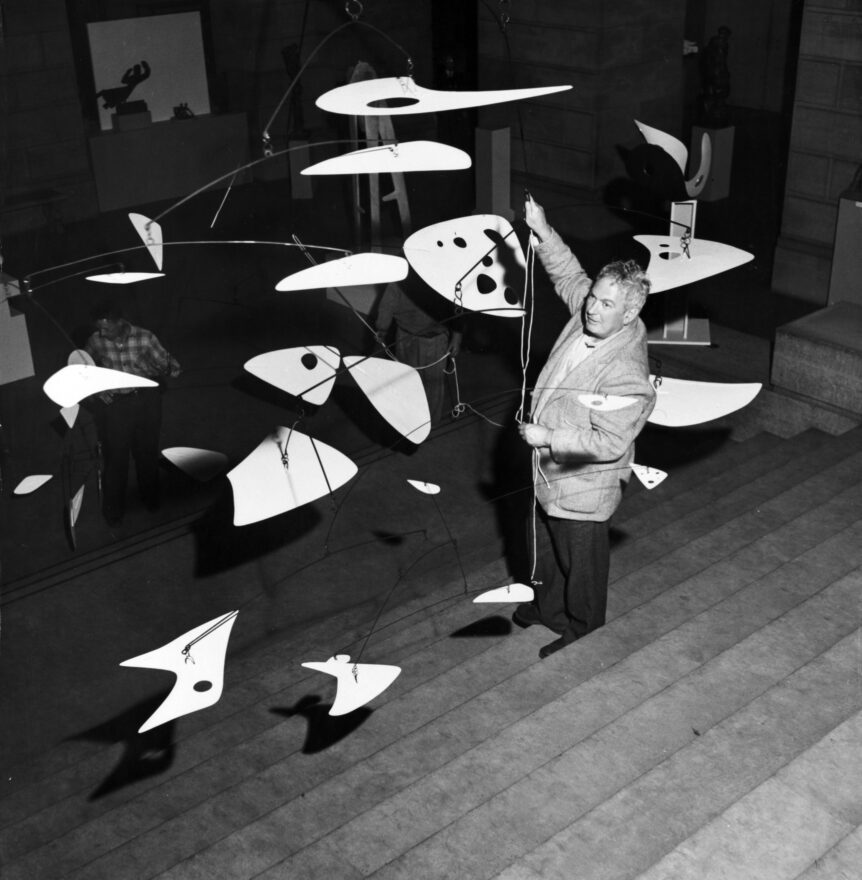
At Philadelphia’s Calder Gardens, mobiles and stabiles animate a new underground museum shaped by light, landscape, and architecture.
America’s City Beautiful movement was well underway from the late nineteenth century when Philadelphia finally cashed in with its bucolic plan for the Benjamin Franklin Parkway, designed in 1917 by French landscape architect Jacques Gréber, who visualized it as an American Champs-Élysées. The mile-long boulevard begins at City Hall and is crested at the far end by the monumental Greek revival architecture of the Philadelphia Museum of Art. Gréber was also one of the architects of the beaux-arts Rodin Museum (1927) on the parkway that, along with Tod Williams and Billie Tsien’s sleek Barnes Foundation next door (2012), both with landscapes designed by Laurie Olin, turned the boulevard into a Museum Mile.
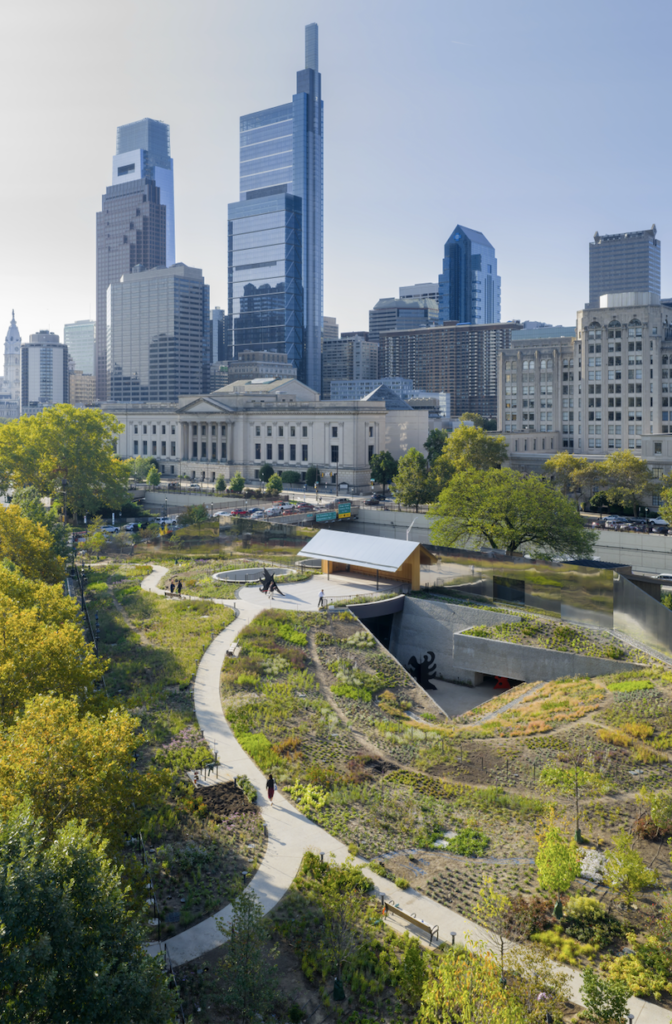
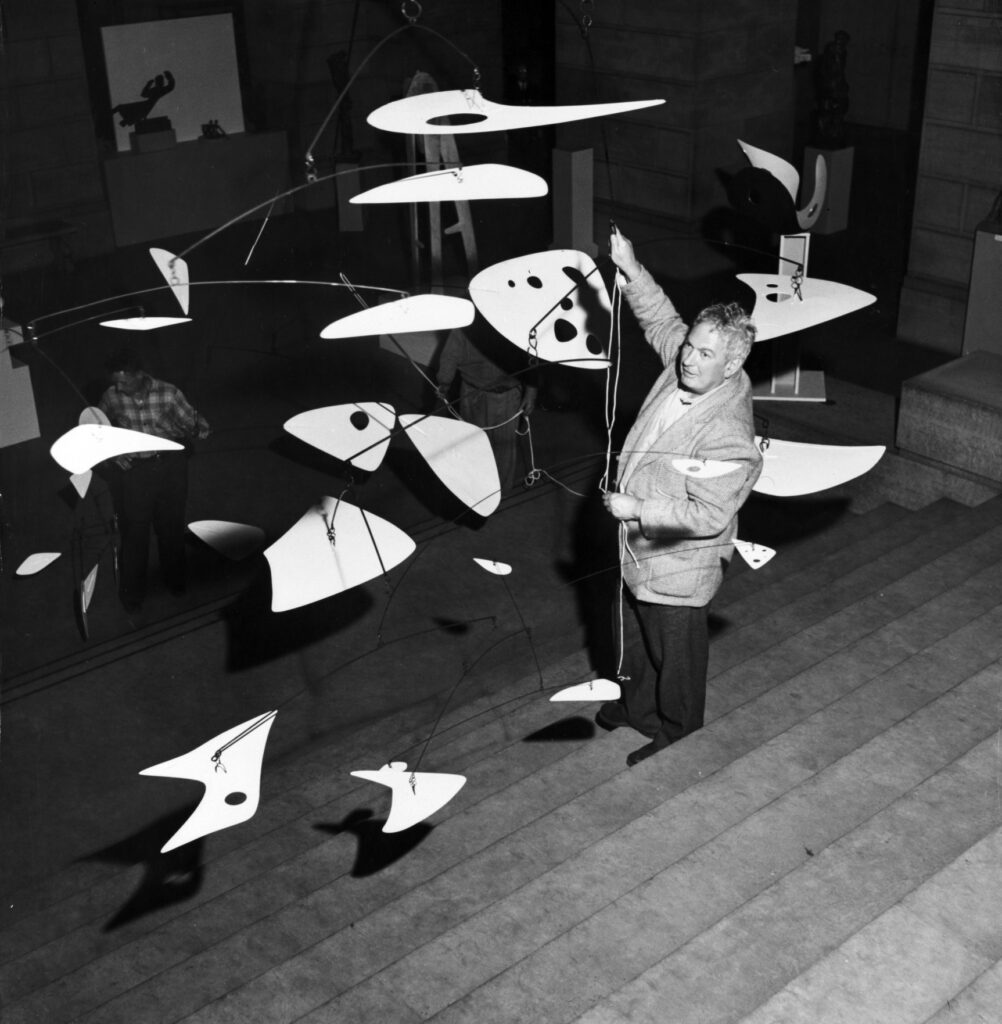
With this cultural geography in view, we come to the parkway’s newest art venue, Calder Gardens, inaugurated last fall on a 1.8-acre trapezoidal plot on the center median across from the last two museums mentioned above. Thanks to the Calder Foundation, galleries here house a major collection of mobiles, stabiles, paintings, and drawings by Alexander Calder, who revolutionized the concept of sculpture into assemblages of sheet metal, wire, and paint that floated through currents of air or into bolted solid shapes of sheet metal that stood firm, inviting spectator movement around them. This diverse collection could be described as a family reunion of his works: some having lived abroad (Brazil and Taiwan), others in American museums (MoMA and the Whitney). The thirty-one works on view cover most of his career, from the early 1930s to 1976, just before his death. (Interestingly, it appears that Marcel Duchamp coined the word “mobiles” for Calder’s floating sculptures and Jean Arp “stabiles” for his standing ones.)
If this were not spectacular enough, the entire project of creating this collection in the city of Calder’s birth has redefined the concept of a contemporary art museum into what its principal architect, Jacques Herzog of Basel’s Herzog & de Meuron, calls “space over form” or “no-design architecture.” In brief, there is no major building on top of the site as a forefront to the art. It is all about Calder.
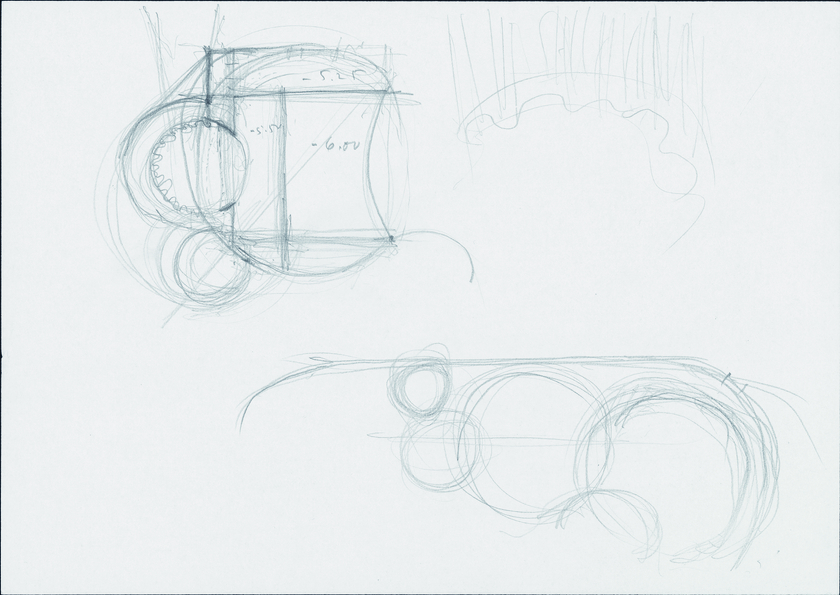
Herzog’s instructive process has been preserved in Calder Gardens (Hauser and Wirth, 2025), containing the drawings he began during 2020 pandemic isolation, first penciled fragments and roof angles above ground and then proceeding to the final underground configurations, “to allow for the works of art to express their incredible diversity and ambiguity within numerous different spatial contexts.”
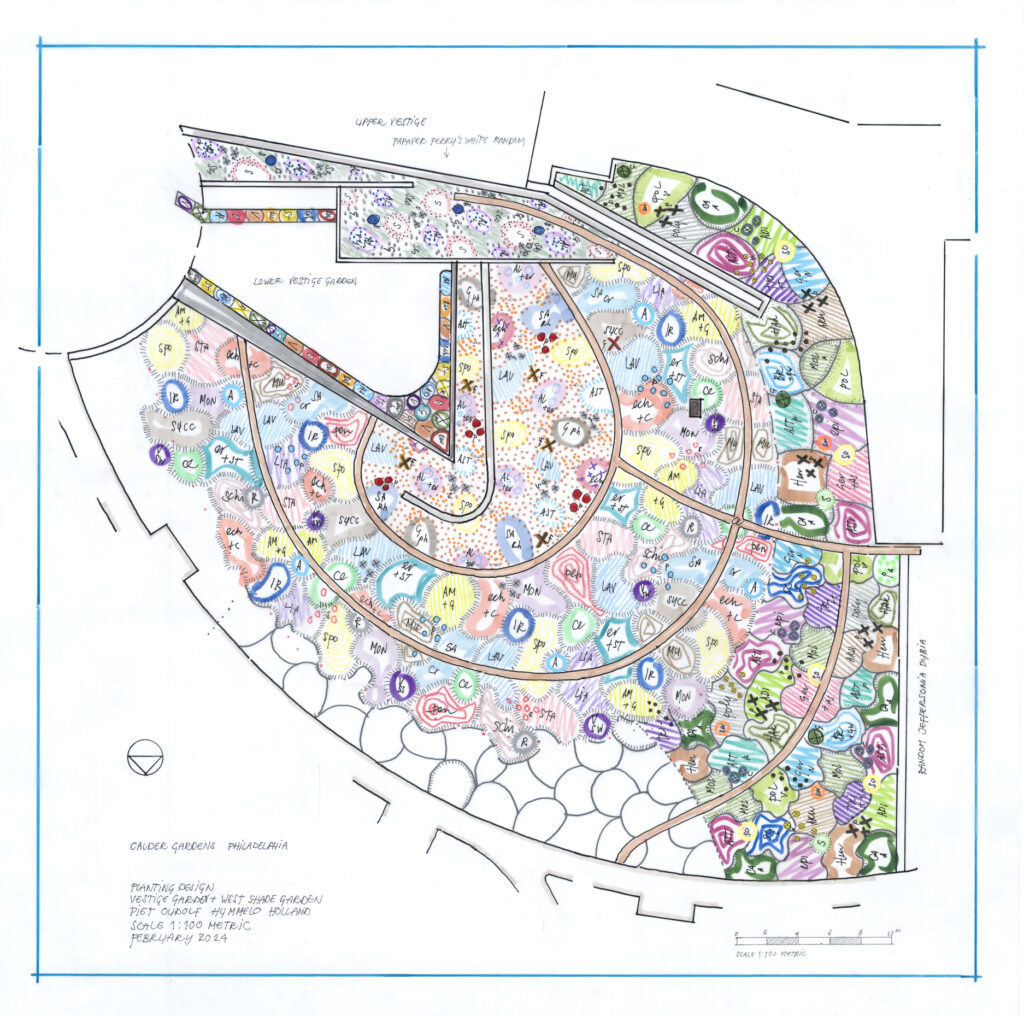
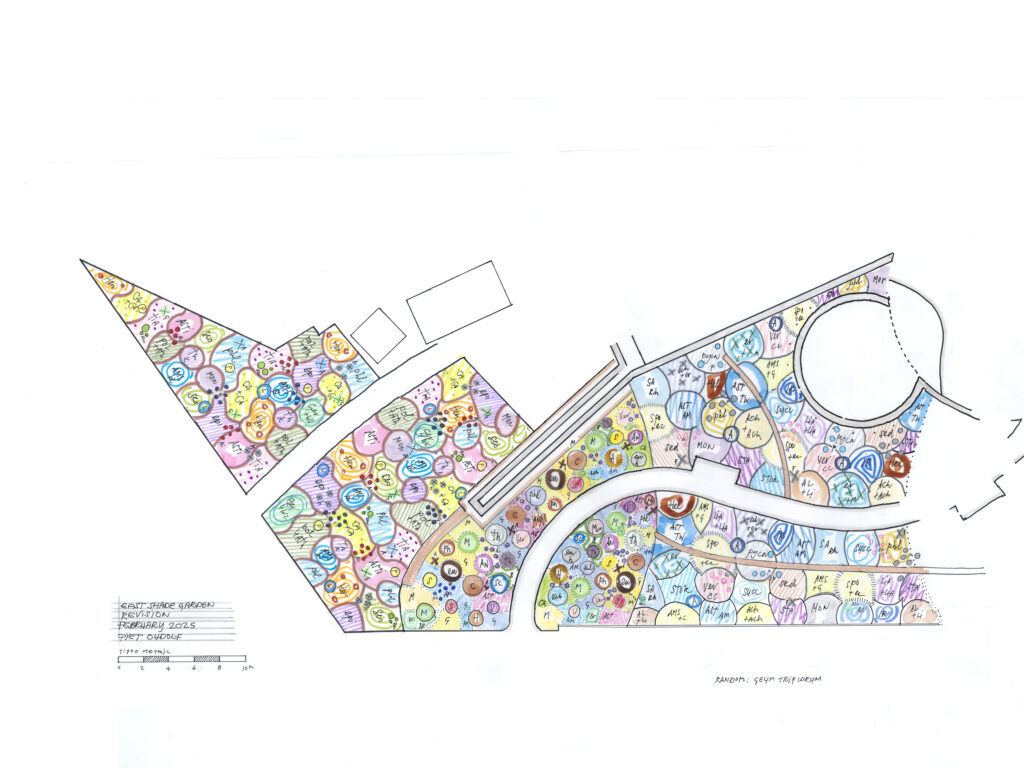
To develop the open land above, the Dutch landscape designer and horticulturist Piet Oudolf was engaged to plant one of his major all-season “New Perennial” gardens combining woodland areas and prairie meadows with some robust borders. Its 250 varieties of plants and thirty-seven thousand perennials feature native species and grasses. Looking forward to returning in spring, I can confirm its beauty in two seasons of visits, autumn and winter, the former with a multitude of colors including popular purple coneflowers (Echinacea purpurea), orange butterfly weed(Asclepias tuberosa—food for monarch butterfly caterpillars—and wands of purple blazing star (Liatris spicata). (Seed packets are available in the shop.) In winter, a panorama of dark browns and beiges features leafy stalks, dried seed clusters, and grasses, with a profusion of red berries on hackberry trees at the entrances providing food for birds.
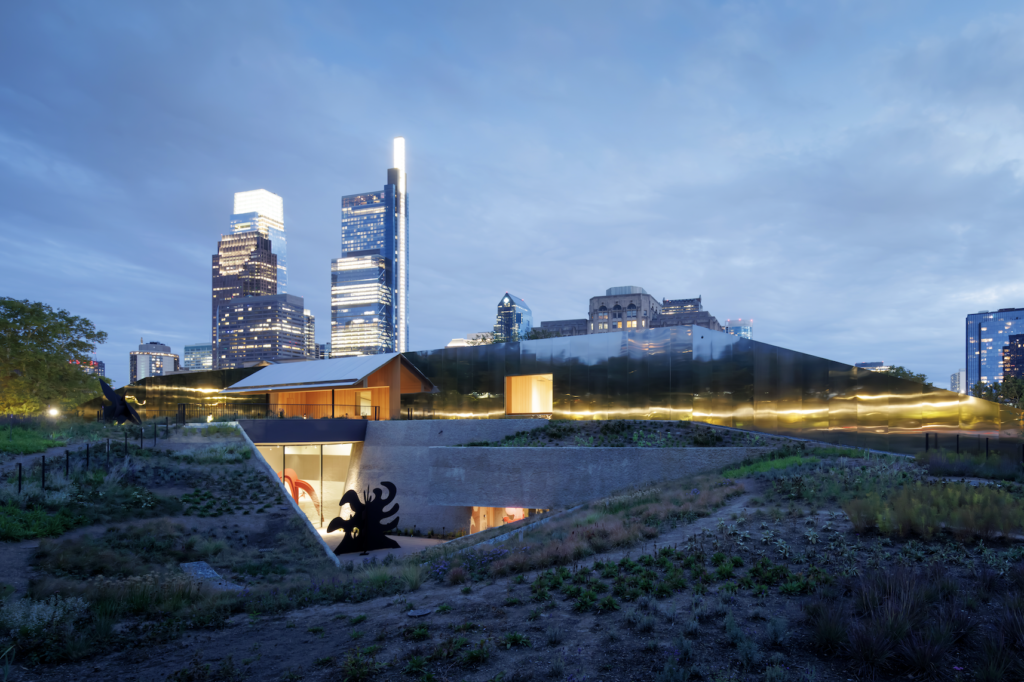
© Calder Foundation, New York/Artists Rights Society (ARS), New York; Baan photograph.
From there, working with his team led by Jason Frantzen, Herzog defined an entrance area to descend into the galleries below. First, a garden wall as it were bisects the full width of the property, while screening the foreground from the Vine Street Expressway below the rear of the property. Clad in smoky reflective metal, the wall gives off a dark hazy image of the gardens and passersby along the paths, doubling the space. The back of the wall, facing the expressway, is blackened wood, replicating the look of Calder’s own Connecticut barns.
© Calder Foundation, New York/ Artists Rights Society (ARS), New York.
Herzog settled on a concrete disc for an entrance plaza, as if it were the seal of an archeological site below. It also serves as the platform for the welcoming sight of Calder’s black jagged stabile The Cock’s Comb (1960). As the final outdoor element, Herzog designed a rural barnlike entrance pavilion that would not shriek architecture, a simple wooden shed with an extended gabled roof and folded metal canopy. Once inside and past the ticketing counter, the shop, and a bleacher set up for group visits, one descends into the dramatic interior of Calder’s world, passing by the architects’ multiple treatments of concrete walls—board-formed, polished, shotcrete, point tooled or with rock aggregates to look like stone.
Baan photograph, © Calder Foundation, New York/Artists Rights Society (ARS), New York.
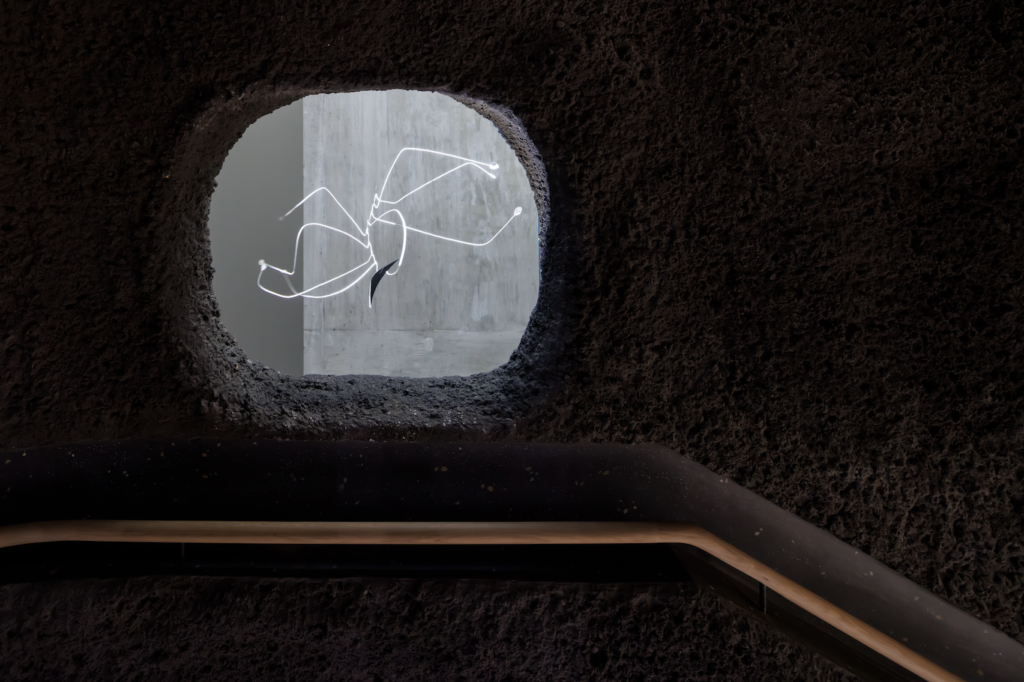
So dark is the final staircase down, with seemingly excavated rough black stone walls, that at every turn one could imagine finding an archeological dig below. Instead, one comes upon a light-well opening with a jewellike gleaming mobile, fragile wire arms linked to one another and a small sound when two elements strike each other.
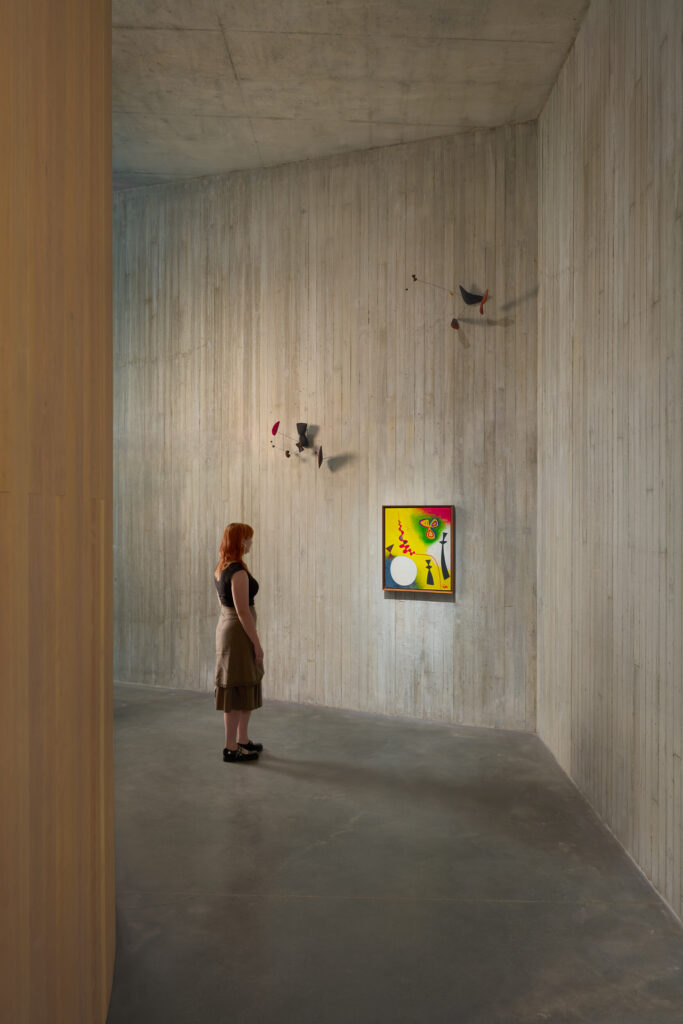
Finally, the high, spacious central gallery below is magically flooded with daylight streaming in through tall vertical windows, not unlike those that surrounded Calder’s own studio. Here they look out to exterior sculpture gardens, one on either side. The land above has been expertly channeled down to admit this light but also gives a rolling effect to the perennial gardens above.
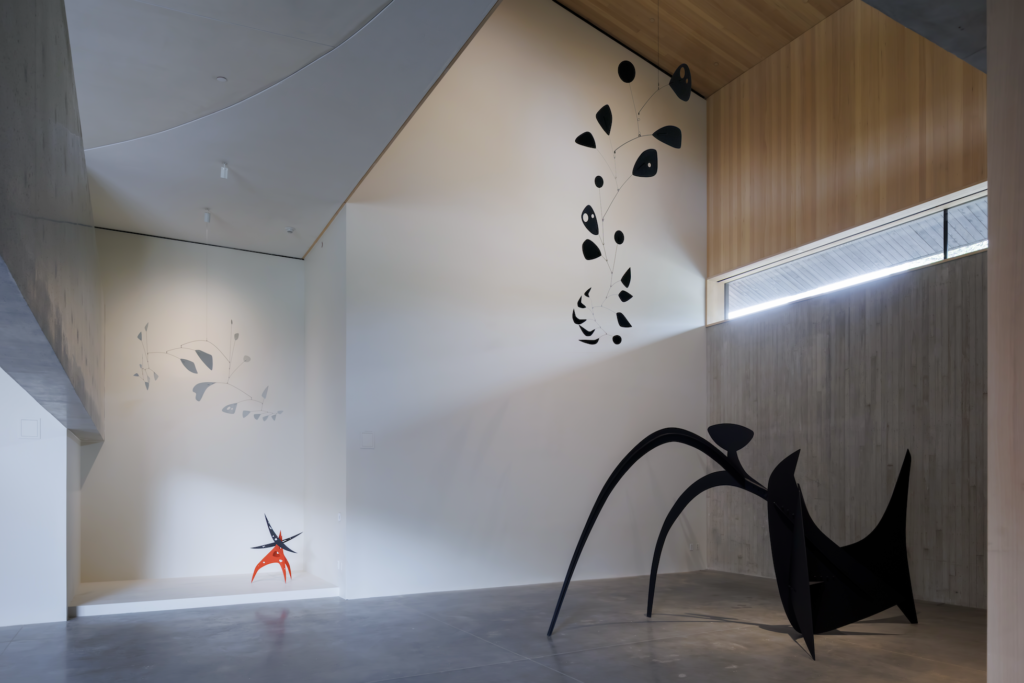
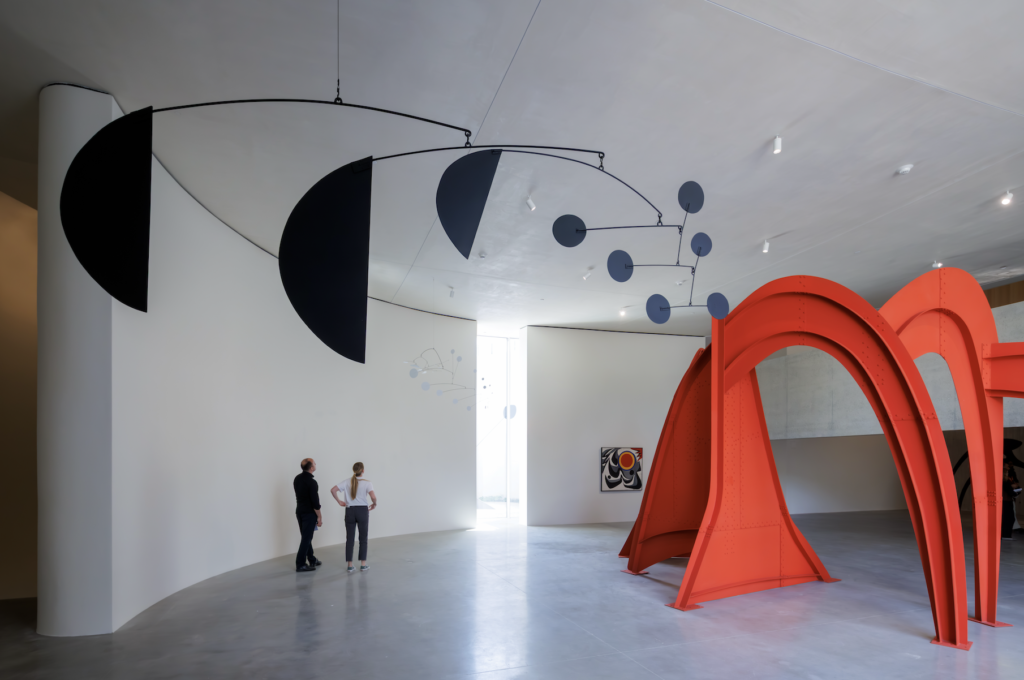
The feast begins with the bright red, arcaded Jerusalem Stabile lI (1976) at the center of the gallery, with others circling around, high or low, singly or in pairs, some in enclosures of their own. Remembering the wavy Black Widow (1959) stabile from its MoMA Sculpture Garden days, it was a joy to see it here under the cascading metal plates of the earlier Black Widow (1948), the mobile above. Nearby, under a lowered ceiling, the stationary mobile Myxomatose (1953), with black-and-white outstretched arms and one red disc, reflects the general black, white, and red palette throughout the collection—with an occasional dab of yellow or blue.
groundcover planting.
Visitors are drawn into galleries filled with Calder’s kinetic energy, especially in an isolated alcove called the Apse, where one long vertical mobile Eucalyptus (1940) appears like a school of fish making headway. The main gallery opens up to the Sunken Garden, a circular outdoor garden inspired by the luscious green setting for its own stationary mobile at the famous Provençal hotel and restaurant La Colombe d’Or. Here the walls are draped with Virginia creeper and clematis in season.
A curved interior walkway around the Sunken Garden displays Calder paintings in hues of vibrant reds and yellows with black and delightful squiggly lines and abstract figures. Also, mounted to the wall are two of the “constellations” he fabricated with wooden forms on metal armatures during World War II when metal was scarce; still, they are evocative of movement stretching outward. A small alcove here is dedicated to artworks by members of Calder’s own family, including a small bronze model (1888) by his paternal grandfather, Alexander Milne Calder (1846–1923), of his own gigantic William Penn statue that tops Philadelphia’s City Hall.
On the far side, the Vestige Garden is a triangular affair with two major stabiles from the 1970s—the bright red Knobs (1976), standing undercover near the interior entrance, and the bold black Tripes (1974). There appears to be a dialogue going on between the two. Tripes with its multiple long arms beckoning could be saying to Knobs, “Don’t stay back in the shadows. Come out and join me.” And why not when the surrounds will be dripping in multiple vines: silvervein creeper, climbing hydrangea, coral honeysuckle, scarlet Radiance clematis, and Amethyst Falls wisteria?
Along with his ingenuity, the point about this assemblage of Calders is that each sculpture displays an inherent personality. Though the works will change from time to time, Calder Gardens will always be a place to interact with them for the sheer pleasure of being in the presence of the artist’s genius to imagine.
As I was leaving, I peered over one of the concrete balustrades above to take in a sweeping look back over the floating mobiles as the flat metal forms swayed, twisted, and turned in the currents of air. Suddenly, I noticed that the movement of the long array of thirteen red pieces dangling before me at eye level were repeated as dark shadows on the adjacent wall, thus doubling the effect, only without depth. I went back down and made the circuit once more, observing these dancing shadows throughout the installations of the mobiles. I remarked how, unlike the more open spaces usually selected to exhibit Calder’s works, here the specific architectural enclosures and focused lighting created an unexpected visual phenomenon that enhances and multiplies the experience of each mobile sculpture. I was reminded then of a favorite phrase from Junichiro Tanizaki’s In Praise of Shadows, his text on the ideal Japanese house: “Whenever I see the alcove of a tastefully built Japanese room, I marvel at our comprehension of the secrets of shadows, our sensitive use of shadow and light.” These shadows add another dimension to Calder Gardens’ perfect harmony of art, architecture, and horticulture.
Powel photograph, © Calder Foundation, New York/ Artists Rights Society (ARS), New York.


