
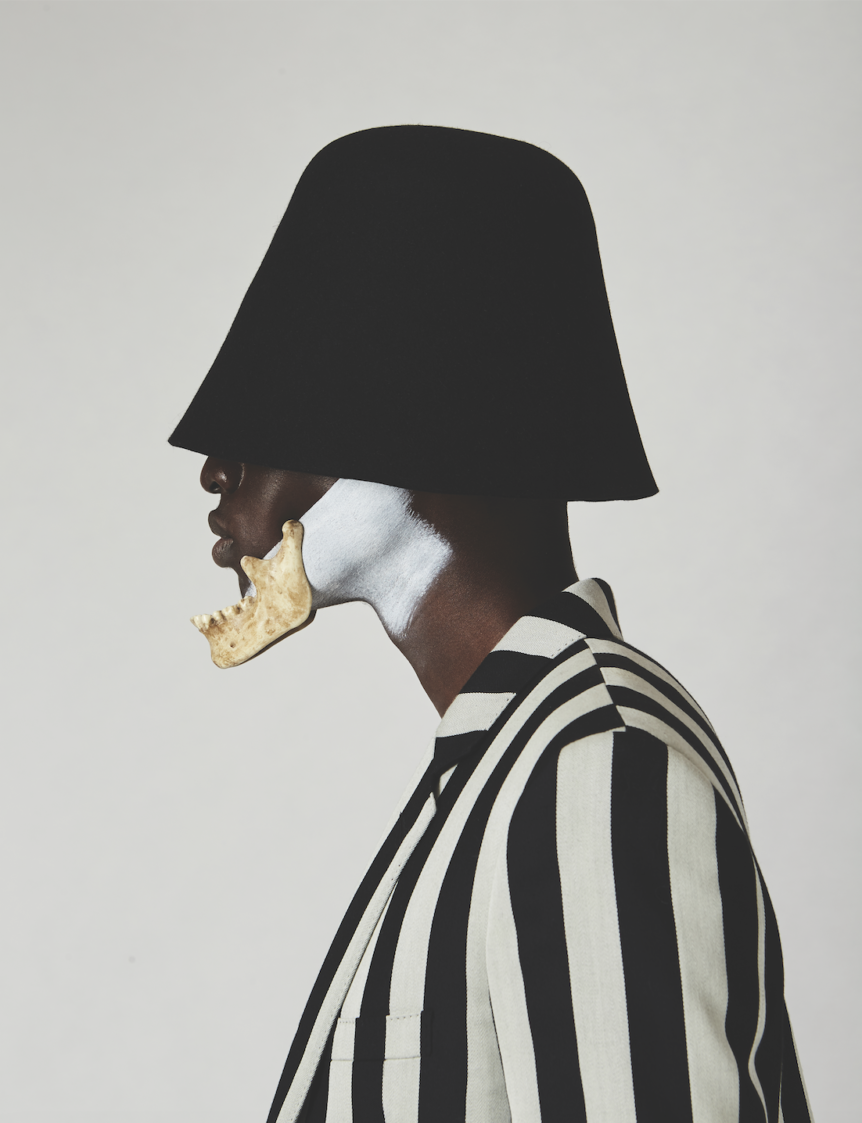
Dario Calmese of the Institute of Black Imagination considers the future of American material culture.
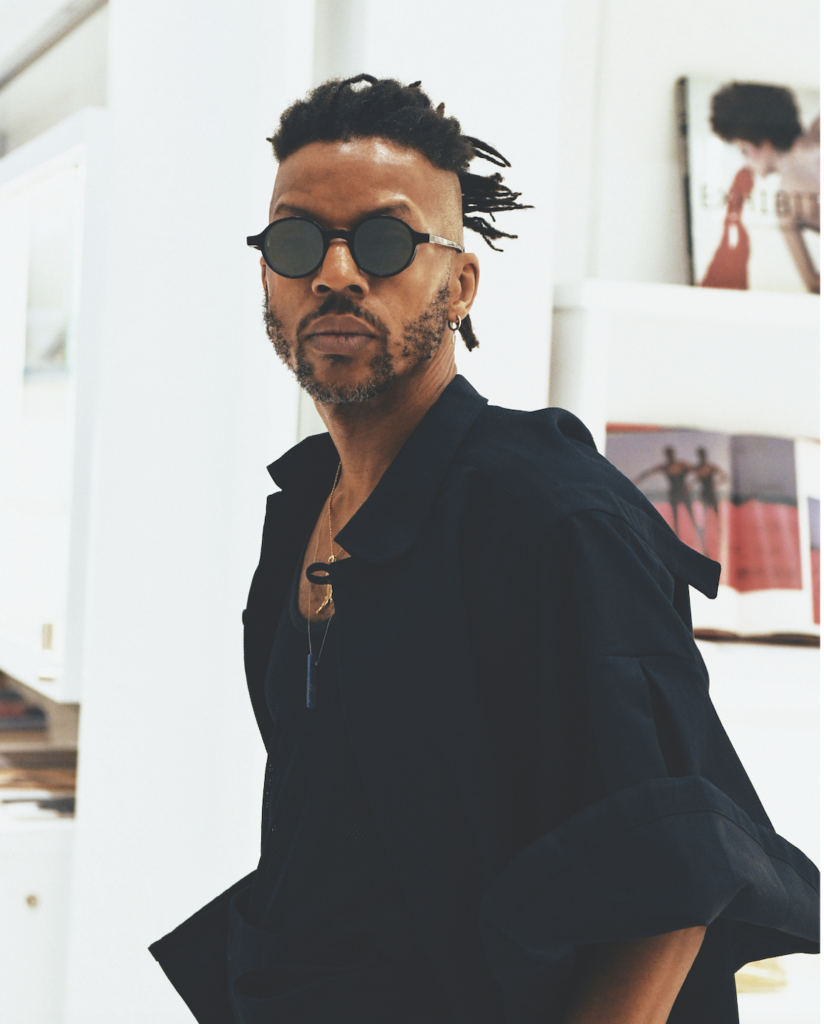
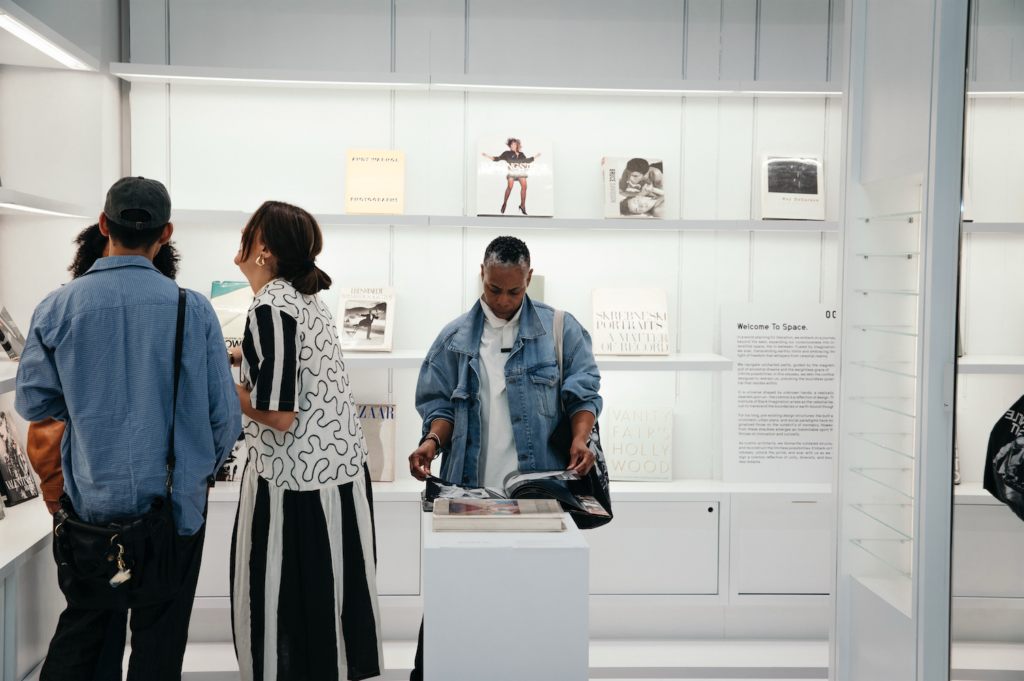
A visitor to the Oculus—the blinding white, sci-fi shopping mall and transport center in lower Manhattan, designed by Spanish architect Santiago Calatrava—might well stop short in front of the Institute of Black Imagination. There, among the chain stores, is a space of unique and unearthly beauty, lined with impeccably chosen garments and product designs. Most days, Dario Calmese can be found there, also impeccable, if also dynamically asymmetrical, in his attire. He welcomes in passersby, explaining that they have stepped into a kind of time capsule of Black creativity, with its own research library and media program. Calmese is also a celebrated photographer and a cultural theorist, with a keen sense of what’s happening now, and what may happen next. And so, to round out our tour of American anniversaries, we thought we’d ask him a simple but difficult question: what might America be like in 2076, and how will it commemorate itself?
Dario Calmese: Commemoration is a form of mark-making, a collective remembering. But by 2076, I think America will more than likely exist as a point of view, an ideology about the way the world should work. I predict the end or massive disruption of the nation-state as we know it: ideology and geography will no longer be coupled. To some extent we already exist in this world; think of the massive presence of Israel in global consciousness, relative to its small size, or of free trade across the seas, and the military-industrial complex that has allowed for this type of exchange to exist. But I would foresee that America will become more and more just a concept.
As we think about the networked or decentralized vision that technocrats have in this moment, it is very much, “vote with your feet.” Live where you feel your values are affirmed, where you can feel seen. There is a desire for a nodal network that is no longer tied to the massive acreage of the land. If we look at, say, Apple, or Google, or Meta, these are already similar to sovereign states. They are of that scale—and have cabinets at the same level of sovereign heads of state. The main difference is that they don’t need land to exist, which is why they’re so powerful. I think that the next fifty years will see a reconciliation of the sovereign entities that already exist: the nation-state and the corporation.
Glenn Adamson: That’s a powerful description of a transformation that’s already underway. In addition to land, though, these companies also don’t have citizens. They have employees, and they have customers. Does your prediction also involve a dissolution of citizenship into these other categories?
DC: It’s interesting, because while I am not an employee of Apple, I am pretty much a citizen there. A digital loyalist. OS versus Android, right? Think about where your data is collected: that too is a form of allegiance. So much of it is about attention, and tech companies have proven that your attention is more valuable than oil. Likewise, being an American citizen ultimately does mean being an American employee. I mean, income tax is the ultimate subscription service.
So we can see these kinds of fealty converging, and then being projected into the cloud—and also into the body. It makes me think about the biblical line, “render unto Caesar what is Caesar’s.” Give the state what the state needs. There’s a part of you that the state will never be able to register, or absorb, or control, or own. But as we project into the next fifty years, I see the state becoming closer and closer and closer. Now Caesar desires your eyes, your retina. Your fate. Your physiognomy.
GA: If that is the case—if America is going to become a state of mind, rather than a nation-state—what does that mean for the future of commemoration? Does it become even more important, because the idea of it is all that’s left?
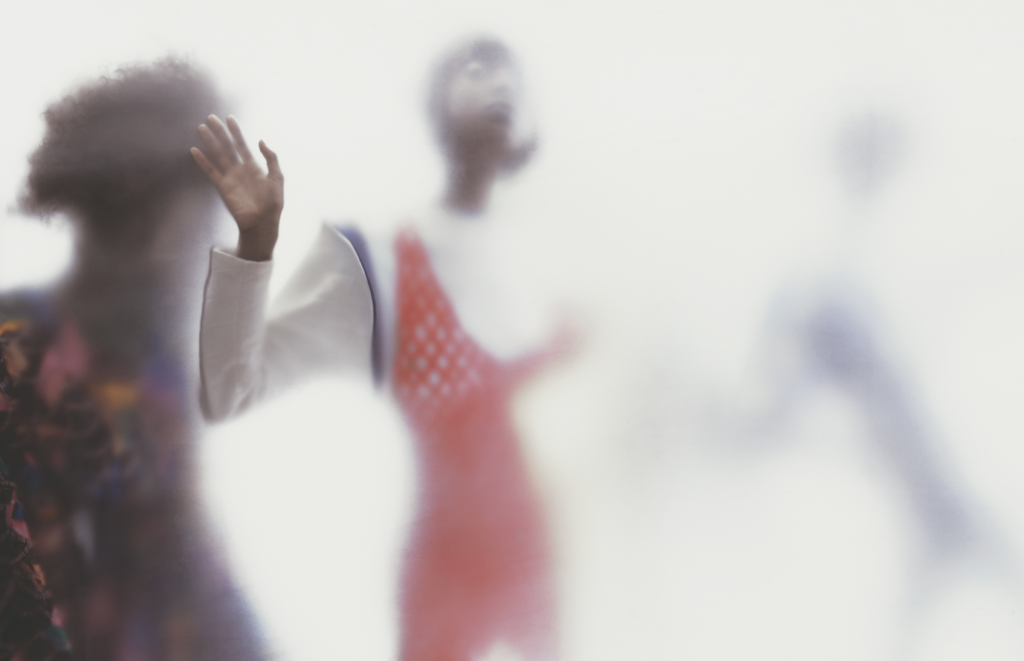
DC: I think that’s what we’re fighting for right now. I think the war we are in is a war of memory, literally down to language, what words can be spoken, what images can be seen. This is society’s dialogue with itself—these constructions, or visual architectures. Think about the Holocaust. So much of how it is thought about, how it is memorialized, has to do with the images that remain, of concentration camps, and famine, and suffering, and families being torn apart. If we’re looking back from 2076 to right now, what images exist today that will make up the story that America can remember about itself. And this is why there is a vast effort to erase a type of history, because the country wants to remember itself in a certain way.

What we witness today, and what we will then be able to recall fifty years from now, is what it looks like to not choose growth. What it looks like to double down on the unnatural, on the inorganic. We’re really at a species-level evolution. Yet we are also getting closer to being embodied consciousnesses, and there are those who understand that: the artists who exist in nature, who study nature and its systems. What I witness is this expansion of what it means to exist at all, and the power each individual has in the manipulation of their reality. I think that is the evolutionary space in which we find ourselves.
GA: What about objecthood? The Magazine ANTIQUES has been around for over a hundred years, busying itself in the appreciation and connoisseurship of objects from the past. What you’re saying implies a narrative of dematerialization. Do you think objects will still play a role, in commemoration and also in general?
DC: I actually think the idea of craft will become even more important. Because craft implies time. And craft implies attention, which is an energizing force. It is what makes reality solid. It comes back to the question of what type of existence do you want to be in, and how much sovereignty you have in choosing. I remember I was at home in St. Louis recently, and I went to White Castle. I love my White Castle. It’s a perfect example of the way that corporations get to you early, and you just go there out of nostalgia later on. I was in the drive-through, and I was already thinking, “no, Dario, you do not need two cheeseburgers and fries.” But I just love the taste!
So I’m there, and I start looking at the building. The actual White Castle. And I realized, this is, the cheapest, most basic version of itself. Not even itself: it hints at being a castle, but really it’s just white cinder block, a couple of windows, and some metal awnings painted with stripes. That’s it. And I thought, if this is how much care you give to the building, what am I doing eating this food? So I just went home. I was like, “you know what, babe? You’ve seen enough.” I bring up that story to say, it will be more of that. It will be more of the hinting at something, on one hand, and then on the other, who gets access to attention, and time, and craft. And I think that those will become even more precious. It’s about who gets to decide what is treasured.

GA: Do you think that the question of memorialization is subject to that same divide, between the cheap imitation and the real thing?
DC: Will we even be in a place where we can access our memories, or will they be programmed for us? That, for me, is the big question. As sovereign beings, will we have unmitigated access to our own memories? Or will they be a series of constructions that are fed to us? So much of my own memory is conditioned by the stories that I’ve been told. This is what keeps me out of the bifurcated game of Black and white identity. My lived experience has been in predominantly white institutions, from elementary school through high school into college. The friends that I made, the people that I care about: that has allowed me to understand that what is said about the world, and the way in which it operates, is just fundamentally not true.
Right now, there’s an exhibition on at the New York Historical, The Gay Harlem Renaissance. It’s fascinating, because it completely rewrites what we thought the 1930s were. Harlem was actually more queer friendly than Greenwich Village. Relationships between Black and white individuals were much more open and free than we realize. So, when we talk about commemoration, we have to realize that it shifts as new information is recalled. What we are creating today forms the potential. Where we are putting our attention today will form the memories of the future. If the time is always now, then we’re already in 2076.


