A photo essay on the unexpected symbiosis between objects of the past and the architectural languages of modernism and contemporary design.
Photograph © Museum Associates/LACMA.
There seems to be a general consensus that the objects within a room and the architectural quality of the room that houses those objects should reinforce one another. This desire for a harmonious balance between the two is often achieved through a meticulous process of sourcing, crafting, layering, and arranging furniture, art, and objects that “match”—things of comparable materiality, origin, designer, and time period. Many of us are, in a way, creating period rooms, whether or not we mean to—perhaps reflecting an innate desire to present our environments, and therefore ourselves, as orderly, noncontentious, and resolved.
While this mutual reinforcement between object and architecture is good practice, the methods used to yield this balance can and should be more broadly considered; in that vein, what it means to achieve a meaningful poise between the two might also warrant its own reconciliation. How an object and its environment support one another extends beyond the question of whether or not they “agree” with one another. A productive tension between a thing and where it has been placed may be as fruitful as visual coherence, and this tension might offer us a more profound frame of reference when encountering them separately, outside of this context.
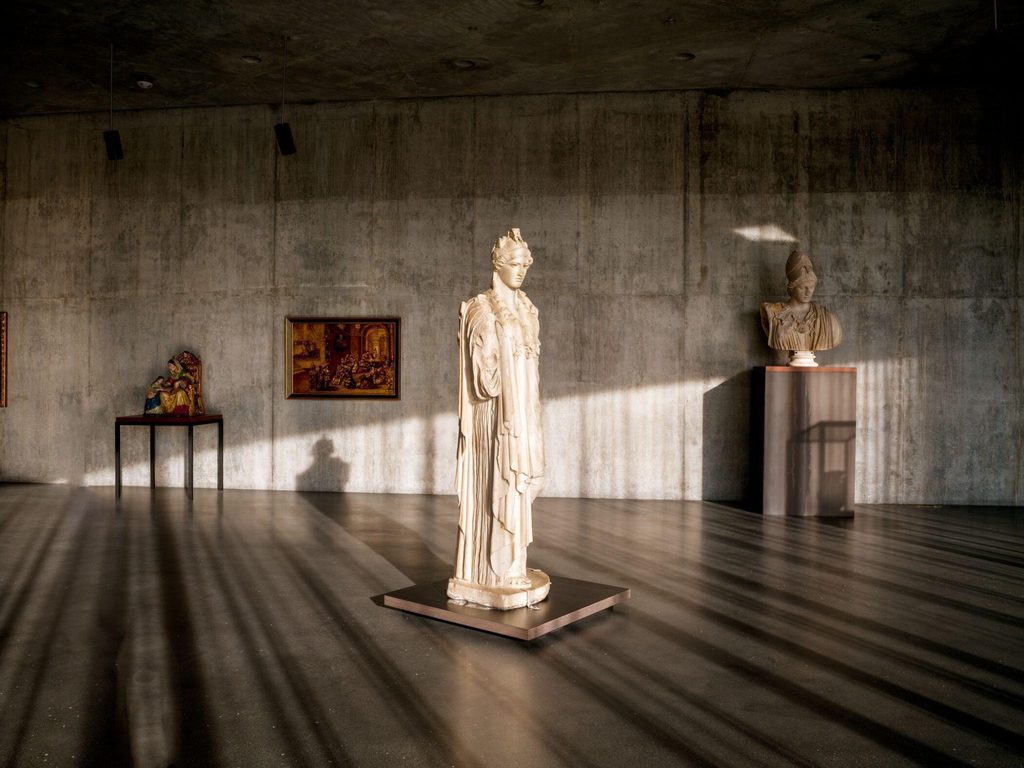
The placement of antiques within objectively modernist interior shells has a surrealistic quality to it. There is an aspect of the “glitch”—at first glance, it appears as if something does not belong, but perhaps you cannot grasp what is actually out of place. Materially, the visual dissonance between an antique and a modernist interior mutually enhances the other. In a calculated tension between the two, the rectilinearity, simplified geometric forms, and honesty of materials associated with modernist buildings all become more transparent. Conversely, an antique’s artistry, ornament, and marks of time are brought into focus. Somehow, their contrast provides a meaningful clarity to each, something we can appreciate and recognize more consciously.
By situating something old in a new environment, you instantly begin to give a patina to the setting. There is a psychological component: by drawing the past into a space, you legitimize it for the present, perhaps so much so that its own longevity can be imagined more clearly in the mind. It becomes associated with the quality of the objects within it, and it becomes associated with the spectrum of time, regardless of its age. A 150-year-old drawing table on its fifth owner arrives at a contemporary home with its own history and its own associations, and that home by nature becomes part of its trajectory. Its provenance is prolonged, and in turn, the home begins to establish a provenance of its own. At the same time, the home offers an opportunity to juxtapose and reinterpret the drawing desk’s associations for the present. There is, without a doubt, an element of symbiosis.
Many of the most compelling interiors originating from the latter half of the twentieth century to today, those we see in design publications and across social media, are not populated by objects of their own time. Perhaps, an antique becomes more legible when situated within a room that is inherently ahistorical. And, the structure of a room itself might benefit from an oddity that challenges its prescribed form. The rooms presented hereafter are individual case studies that might offer insight into this approach.
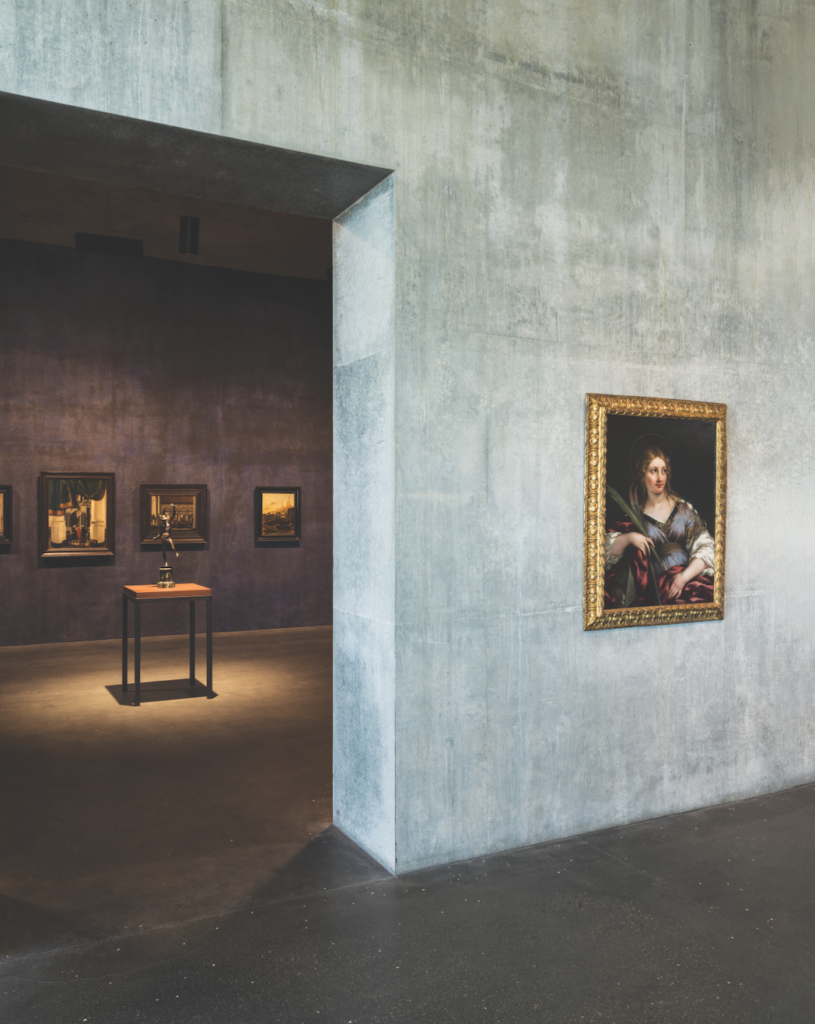
The David Geffen Galleries at The Los Angeles County Museum of Art are perhaps the most publicly influential case study of this approach to space making. The amorphous 347,500-square-foot structure, composed primarily of concrete and hundreds of curved glass panels, stretches across Wilshire Boulevard. Designed by Swiss architect and Pritzker recipient Peter Zumthor with Skidmore, Owings & Merrill acting as the architect of record, the building redefines long-established conventions for how to display a collection within a museum. Approximately two thousand artifacts populate the exhibition level, where forty-five curators have advised on their placement—organized not by culture, era, or medium, but around a framework guided by the Pacific, Indian, and Atlantic Oceans and the Mediterranean Sea and the artistic output that has arisen out of a dialogue between them, throughout history. Visitors to the galleries can view a Qing dynasty court robe to their left and the not-so-distant Hollywood Hills to their right—not only because the galleries abandon the typical closed-off white box approach to accommodate floor-to-ceiling windows, but also because the exhibition level is situated roughly thirty feet above ground. The entire collection of art and antiques, some dating back as far as six thousand years, becomes a part of the contemporary Los Angeles landscape.
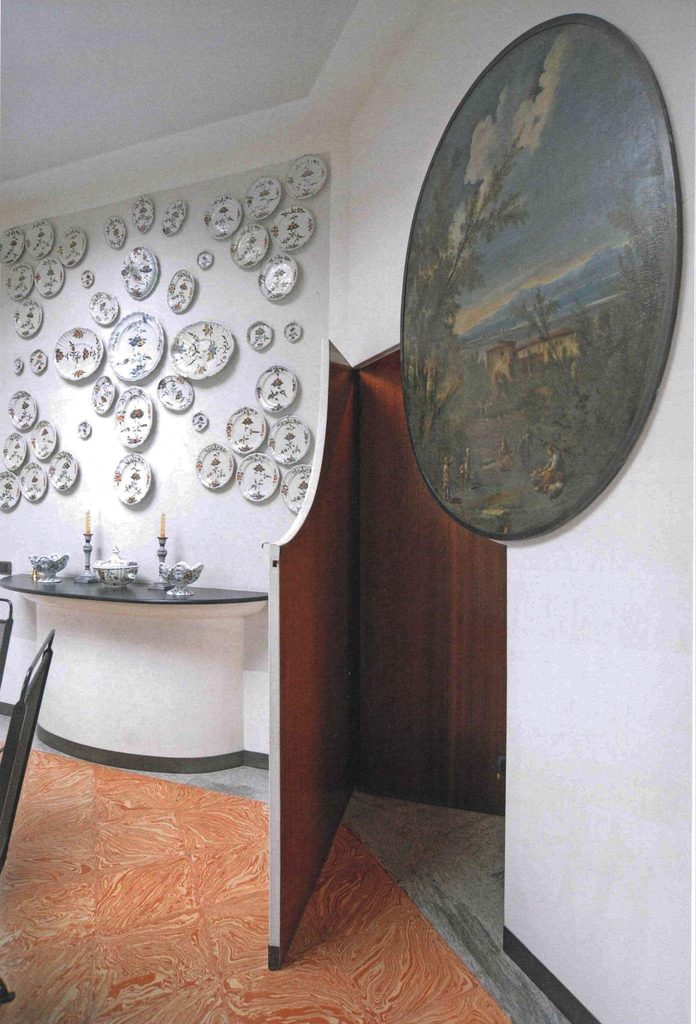
The seminal Milanese modernist Luigi Caccia Dominioni (1913–2016), who worked across architecture, interiors, furniture design, lighting design, and industrial design, is famed for the ways in which these disciplines converged in his work. He was known for his contiguous exploration of the mediums; to him, they were indistinguishable—each contributing to and aiding in a “total interior”. This is perhaps no more apparent than in his renovation and decoration of a small eighteenth-century palazzo for Piero Bassetti, an Italian textile mogul and politician, and his wife, Carla Bassetti. Commissioned in 1960 and completed in 1962, Caccia Dominioni gutted and reworked the layout to accommodate both their large family and Piero Bassetti’s offices. The dining room, seen here, is punctuated by two irregular doorways—their distinctive shapes governed by the shape of oversized oval-shaped landscapes, likely of eighteenth- or nineteenth-century origin, that hang centered. To the left, a myriad of hand-painted porcelain plates and vessels are arranged across the wall and atop an integrated sideboard. Here, Caccia Dominioni goes beyond placing antiques in a modernist interior; he builds them in, and in turn, collapses the distinction between them.
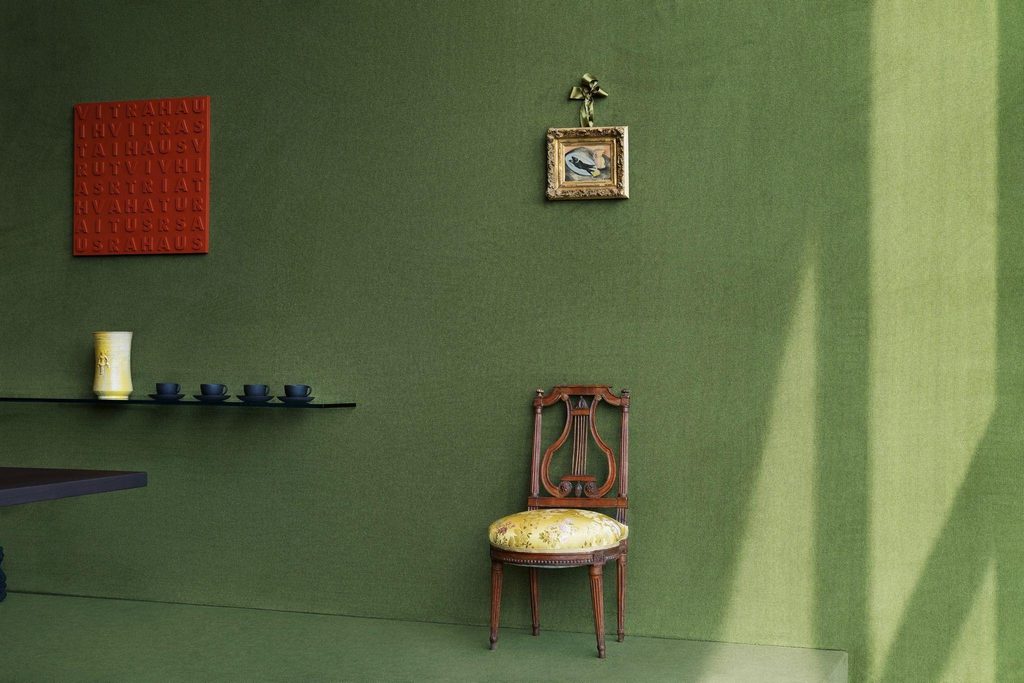
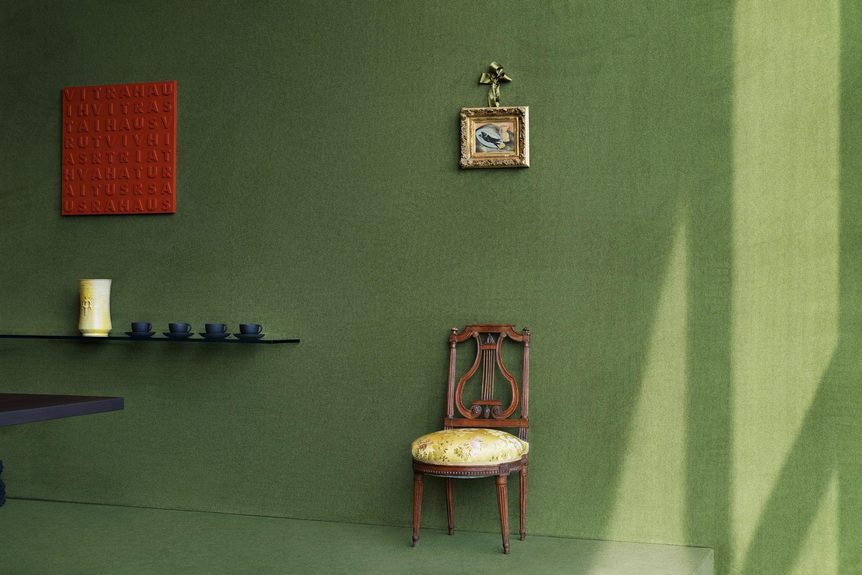
Charlap Hyman & Herrero redesigned the loft of the VitraHaus, the flagship showroom and experimental exhibition space on the Vitra campus in Weil am Rhein, Germany. The building itself, designed by the celebrated Swiss architecture practice Herzog & de Meuron, unfolds as a series of house-like volumes stacked upon one another, intersecting in such a way that each “house” provides a distinctive framed vista of The Tüllinger Hills, Basel, or the Rhine. CHH enveloped the floor and walls in a mossy green carpet, at times sharpening the loft’s architectural forms and at times allowing them to recede. Contemporary pieces by Vitra are situated amongst an array of antique treasures, with furniture and art dotting the space ranging from the nineteenth century to the twenty-first. In the vignette here, a French lyre-back chair upholstered in a chartreuse silk brocade sits beneath a painting by Adam Charlap Hyman hung from a silk ribbon.
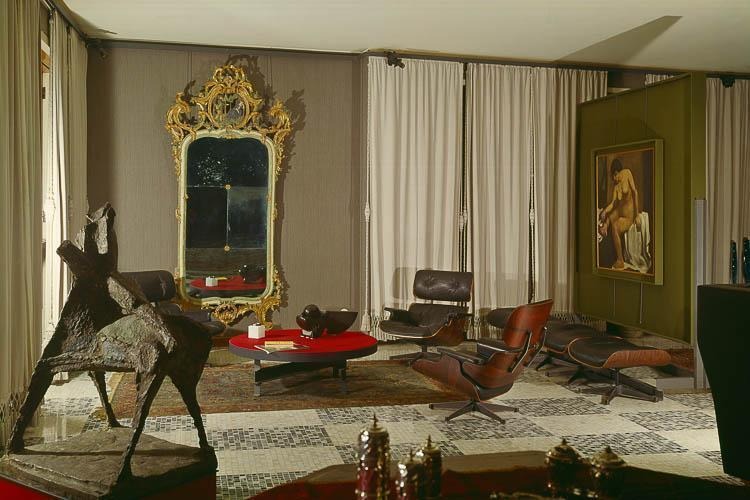
Casa Brion, a Milanese apartment designed in the 1960s by Franco Albini & Franca Helg, establishes itself among a singular group of projects that are difficult to place in history. The pair was tasked with providing a distinctly modernist shell for the Brion family, the lineage behind the Italian electronics company Brionvega, to display their spectacular collection of art and antiques. In the living room, iconic mid-century furnishings like black leather Eames chairs are situated alongside masterpieces by the likes of Mario Sironi, Felice Casorati, Massimo Campigli, and Giuseppe Capogrossi. To the left is Marino Marini’s bronze Cavaliere, a hand-chiseled and painted sculpture that recently sold at Christe’s for nearly $800,000. The apartment has been categorized as no less than a “house-museum,” having merited this title not only for its museum-caliber collection and the architectural composition that houses it, but for its interplay between old and new, and in turn, their reliance upon one another. This reliance becomes clear in another view of the living room: a red cloak worn by Doge Leonardo Loredan in a sixteenth-century portrait hanging on the wall informs the red hue of a custom dining table designed by Albini and Helg for the Brions.
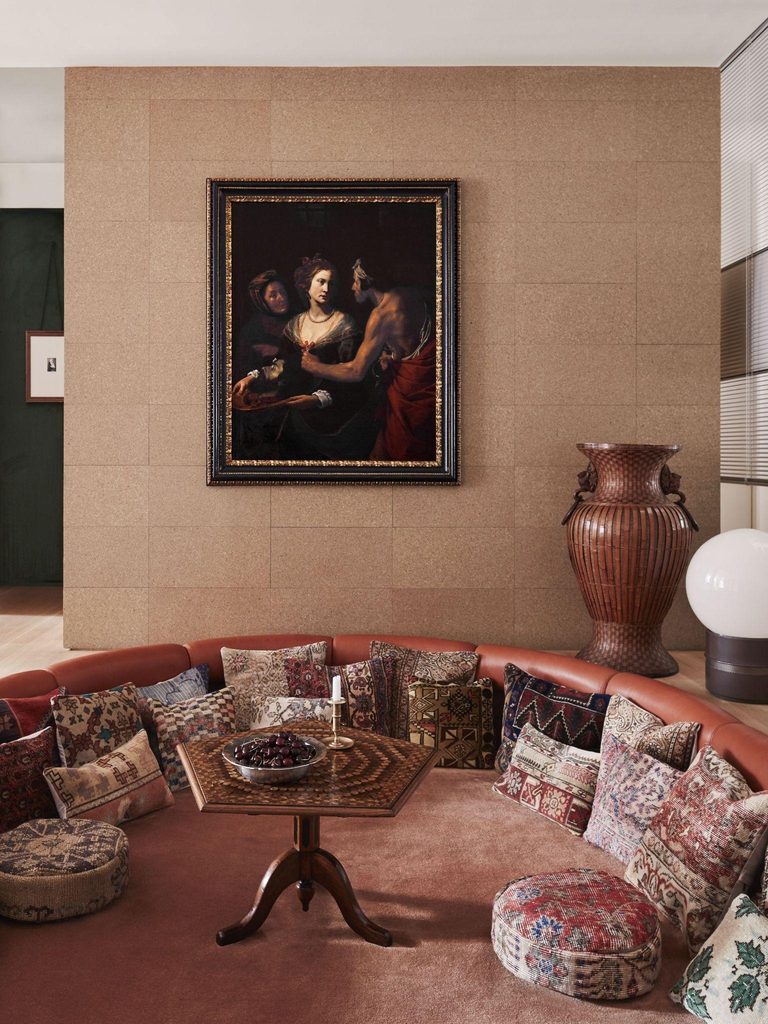
For a loft within a 1920s cast iron building in SoHo, New York, Food Architects and Charlap Hyman & Herrero collaborated to thoroughly challenge the way an architectural envelope and its objects might interact with one another. The living spaces are separated not by walls, but by glass partitions hung with steel blinds to evoke an office from the High-Tech era. Rooms are not enclosed, but function as loose divisions within a single open space. Hanging on a cork wall above a leather conversation pit is a seventeenth-century oil painting by Hendrick de Somer, Salome Receiving the Head of John the Baptist. Miraculous antiques fill every corner of the loft, from an eighteenth-century verdure tapestry, to eighteenth-century etchings by Giovanni Battista Piranesi, to a nineteenth-century pentagonal table previously belonging to Sir John Soane.
Jason Wigginton is a Los-Angeles based writer and editor working in communications at the AD100 firm Charlap Hyman & Herrero.


