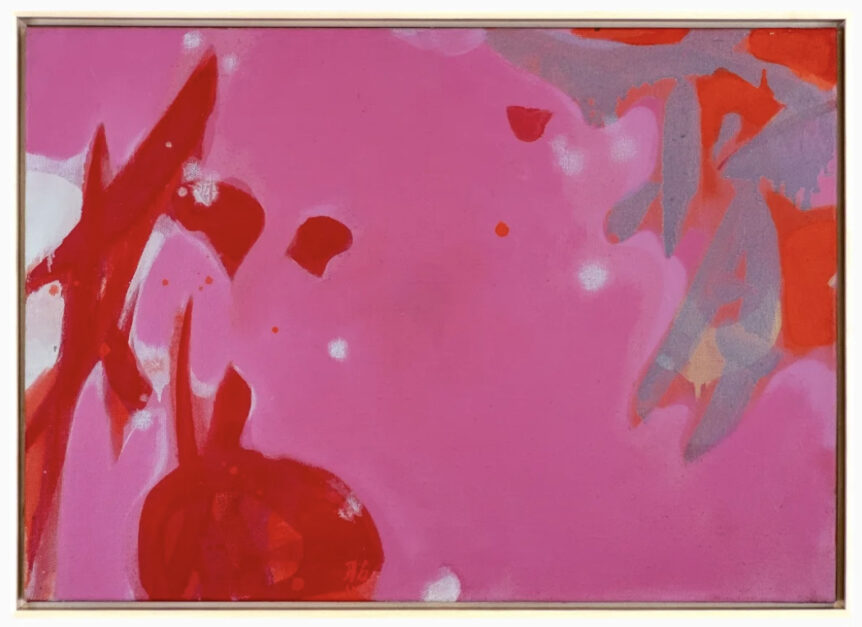
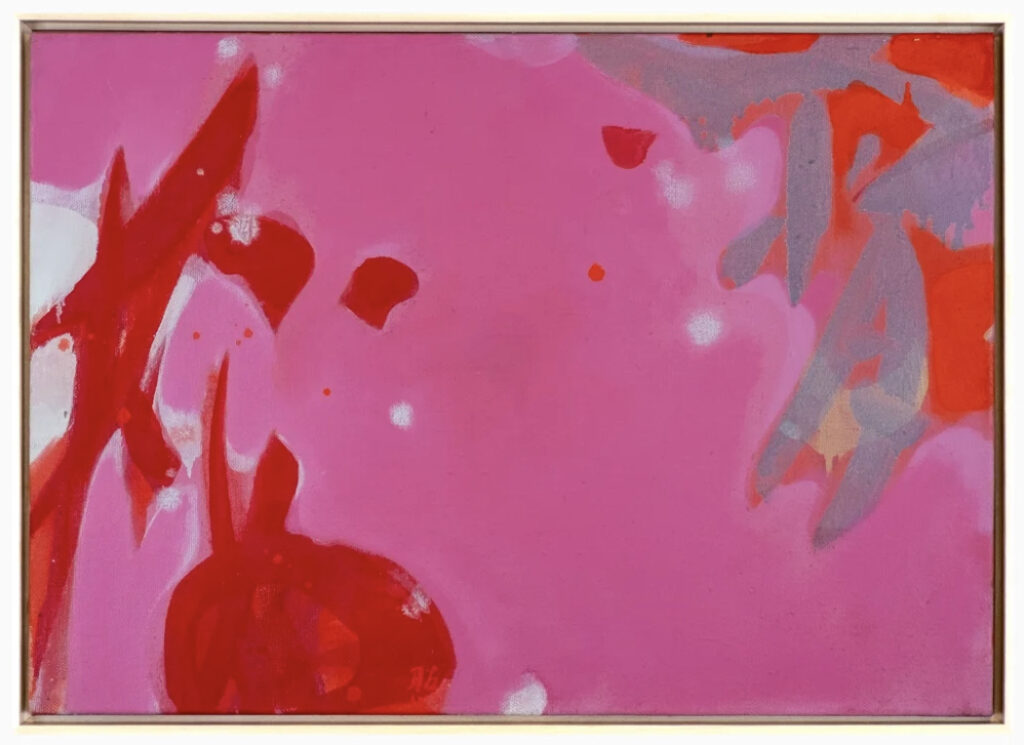
The colorful tableaus of Japanese-born Swiss artist Teruko Yokoi are filled with rich colors and lyrical forms that don’t cross one’s path often. This Fall, Hollis Taggart gallery presents the artist’s second solo retrospective, Teruko Yokoi: Seasons to be on view until November 25, 2026. This exhibition focuses on the painter’s work from her time in New York to her relocation to Bern, Switzerland, two arguably distinct yet significant periods of the artist’s œuvre.
The theme of nature is integral to Yokoi’s work, which can be seen in her earliest paintings as part of this exhibition. As a child, Yokoi would enjoy the wonders of the natural world via walks with her father, a master calligrapher and poet. They would call their walks “haiku hiroi,” which translates to “collecting haiku,” something that the artist translated into her paintings by visualizing the poems that she collected. According to Yokoi’s daughter and custodian of her estate, Kayo Malik, her mother was a very disciplined and organized person, able to take on many projects at once, and successfully execute them to completion. This is evident in the existence of the two eponymous museums in Japan which celebrate the artist’s work and which she aided in designing – the Teruko Yokoi Hinageshi Museum and the Teruko Yokoi Fuji Museum. On a research trip with her mother at another museum, Kayo remembers, “she wasn’t interested in looking at the paintings, she was looking at the architecture and collecting ideas…composition was very important to her…how objects were placed, how everything flowed in her living space and in the way she dressed as well.”
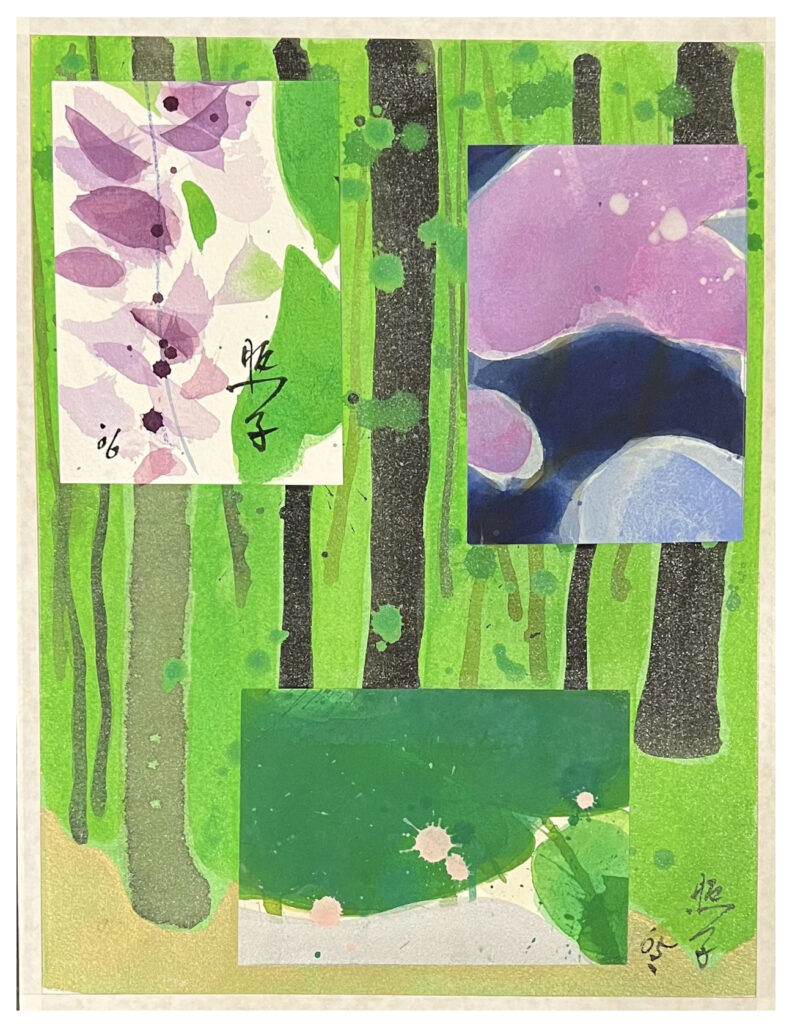
Untitled by Teruko Yokoi (1924-2020), 1993 and 2009.
In the early 1950s, Teruko Yokoi left Japan for San Francisco to attend the California School of Fine Arts after studying traditional Japanese painting. There she had her first rendezvous with European and American abstraction, and shortly after moved to New York in 1955 to study with Hans Hofmann. It is difficult to place Teruko Yokoi’s work in a particular category of art or painting. With a life spanning Japan, Switzerland, and the U.S., her work contains a unique perspective that transcends any genre – placing it in one would be like telling Dalí he couldn’t work in multiple mediums, or Warhol he could only make stacks of Brillo boxes. Never literal, Yokoi was constantly responding to the landscape around her, more so than the tenets of a genre. A notable work featured in Seasons is Pfirsichblumen (“peach blossoms”), created in 1966. It is an evocative expression of the natural world through amorphous shapes. These images, inspired by the landscapes or hillsides from Yokoi’s memory, sing of nostalgia through the canvas in perfect harmony. In her later works after 1990, Yokoi can be seen focusing on the cyclical changes observed in nature, showing her discipline once more through controlled gestures and materials used. Primarily working with egg tempera on paper, collages become part of the artist’s work, providing a contrast of the sharper lines of the cutouts against the more fluid forms of the brushwork.
Rather fittingly, there is no wrong season for Yokoi’s work. This exhibition aims to take the viewer through the evocative mindscape of the artist’s creative genius and a collective landscape in its own right. Hollis Taggart will also be presenting Yokoi’s work at the Park Avenue Armory for the ADAA Fair. We highly recommend taking in the glorious colors, then finishing off your day with a stroll in Central Park — a nod to Yakoi’s love of poetry in nature.


