
How Bridgerton’s Queen Charlotte remixes history and hearsay for a modern audience.
Queen Charlotte: A Bridgerton Story. Photograph © Nick Wall/ Netflix, 2023.
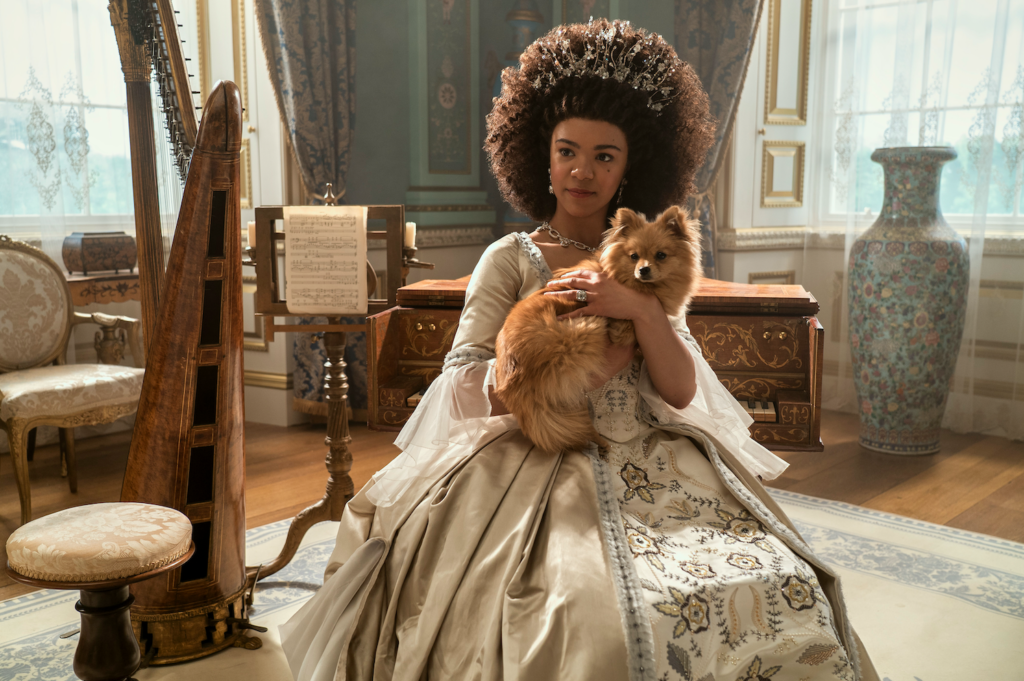
“It’s a masquerade. I have no interest in dressing as someone other than myself!” And with this characteristically intrepid declaration from Shonda Rhimes’s fictional Queen Charlotte, played by Golda Rosheuvel, season four of Netflix’s hit TV show Bridgerton launched a central storyline of hidden identities and clashing social status. Queen Charlotte, in this fictional, alternate universe of a post-racial, post-colonial Regency-era, steadfastly stays above the fray, having no need to conceal her true self. Though working through her own traumas of isolation and loneliness, amidst her husband’s worsening mental illness, the character’s bold costumes and “let them eat cake”–style wielding of authority make her the queen that modern audiences applaud.
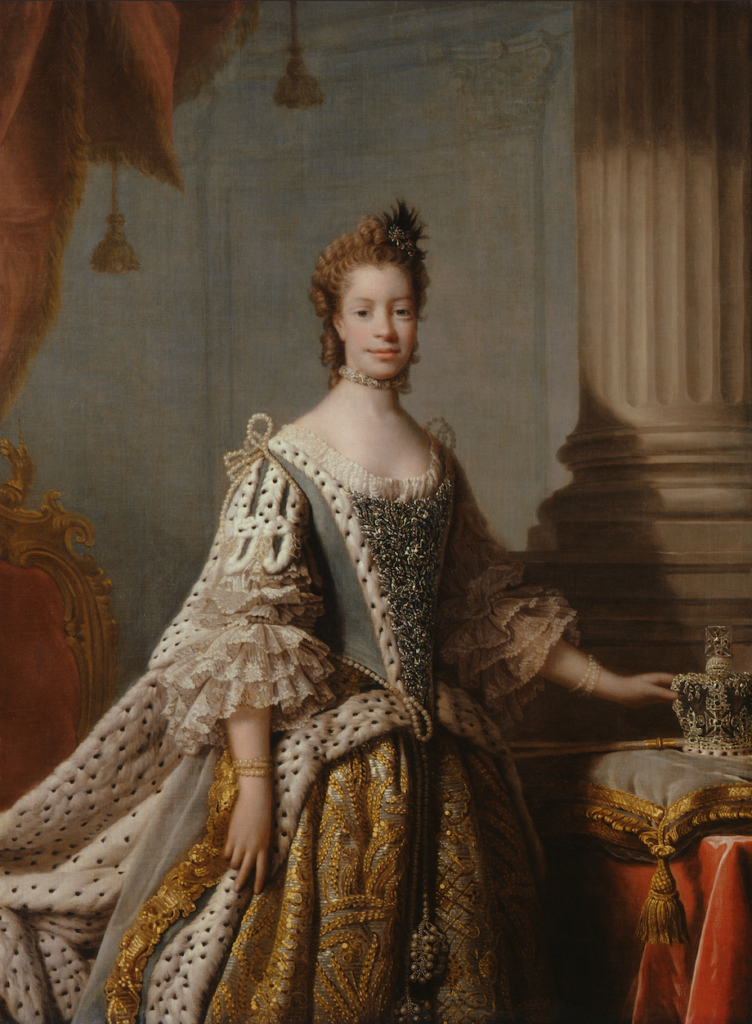
Intriguingly, Rhimes’s larger-than-life interpretation of this dauntless queen plays with a number of Easter eggs that hint to the real-life figure of Princess Sophie Charlotte of Mecklenberg-Strelitz, a girl born to be queen. Hailing from a small principality in Germany, by the age of seventeen, Charlotte was already cherry-picked to be the bride for George III of Great Britain, then twenty-two years old. In 1761 the royal pair wed on the same evening Charlotte had just arrived in England after an arduous three-week journey from northern Germany.
Described as “well-enough” educated, “sensible,” and “remarkably genteel” by contemporaries in Kew Palace’s research, her “lively but equal temper” floated her to the top of the marriage mart and landed her one of the highest positions of the time. According to Kew Palace histories, Charlotte was considered incredibly compliant, and her “most agreeable countenance” and “very pretty eyes” helped the king and his ministers overlook that she was “no regular beauty.”
Her compliantly sweet nature is, perhaps, where one would think Rhimes and Rosheuvel’s Charlotte departs from her real-life counterpart. Bridgerton’s Charlotte is a tour-de-force of temerity, more authoritarian than amiable. Although the show notoriously hinges on an imagined Georgian England, it also paints a nuanced picture of the queen, remixing her true, famously genteel nature with the boldness of fictional Charlotte. In the show, Charlotte is a woman in power who understands when to hold her ground for the things she desires but also recognizes when she must yield to forces larger than herself. It plays with a much more dimensional image of who Charlotte may have been.
National Portrait Gallery, London.
Bridgerton has promoted a new generation’s fascination with the queen consort, much in the pop culture way that Hamilton did for the Founding Fathers. Netflix sought to fulfill that appetite with a fictional prequel, Queen Charlotte, released in 2023, in which Charlotte comes to terms with her beloved king’s “madness.” In the series, she faces his highs and lows with compassion, strength, and a heart-aching, gentle tenderness that pulls from the history of the real Charlotte’s later life, when George III’s health was chronically deteriorating. In this interpretation, Charlotte is that beacon of (sometimes selfish) power, yet curates her compassion for those who need it most around her.
That may be where the similarities end. More than her self-assurance, Netflix’s Charlotte is known for her overt adherence to pomp and ceremony. She dons elaborate gowns, fabulous wigs, and all the avant-garde costumes Netflix’s budget can muster. But, the real first few decades of Charlotte’s queenship were marked with country escapes to Windsor Castle and Kew Palace with the king and their children. Both rural destinations were remarkably informal places for people of such a rank, allowing both George and Charlotte to engage in their hobbies—science and botany—away from the scrutiny of court. Both monarchs were known to prefer modest lives, believing this to be the way royals should live. It is a far cry from the constant opulence and gossip schemes of the on-screen Charlotte. So, why conceal this admirable truth? Why drench the past in technicolor glamor? These creative liberties are not without deliberate deployment.
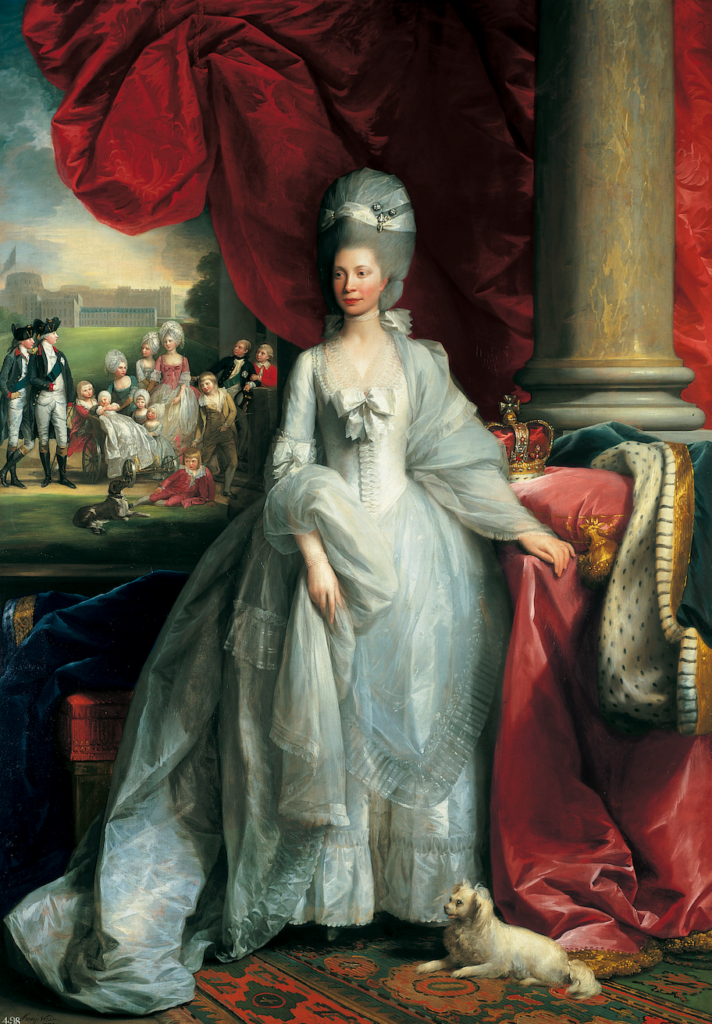
Royal Collection Trust; photograph by Huelam987 on Wikimedia.
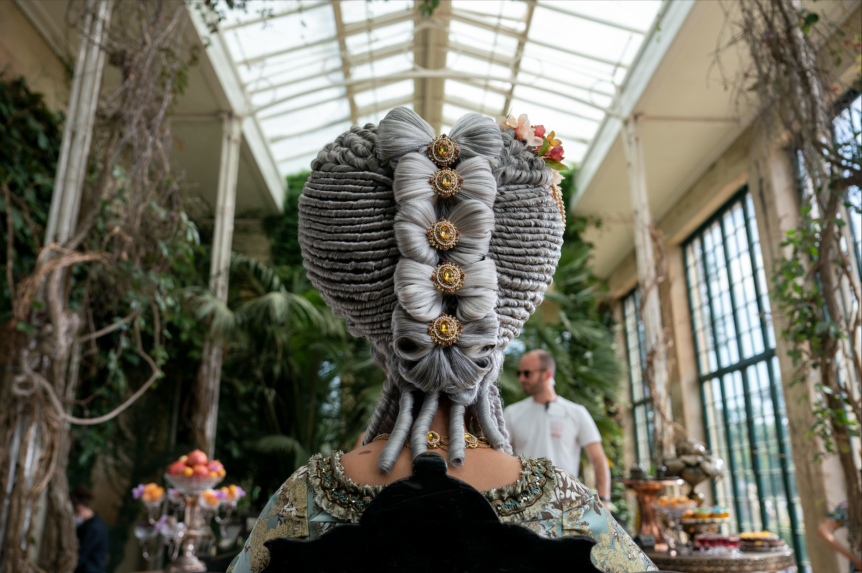
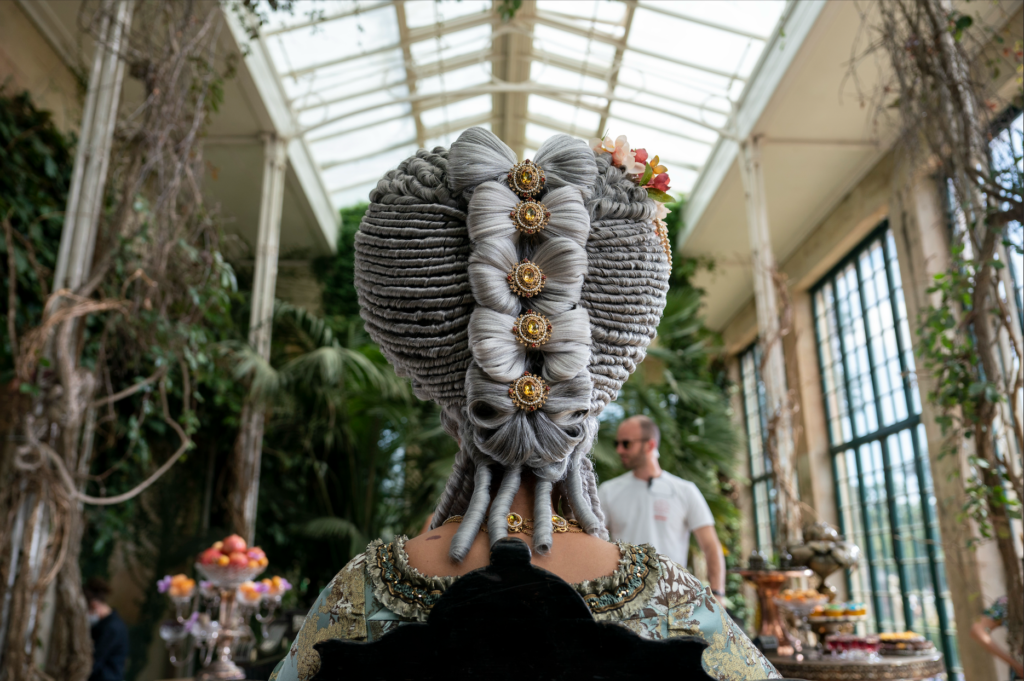
It is a truth universally acknowledged, that Bridgerton’s over-the-top costuming and setworks will frazzle anyone seeking historical accuracy. But Charlotte’s campy and exaggerated ball gowns and, more famously, wig styles, are playful reinterpretations of the real queen’s potential heritage. Fictional Charlotte’s African heritage becomes an important storyline in the 2023 Queen Charlotte prequel, helping to craft the imagined post-colonial and post-racial world in which Bridgerton exists. Her styling is a subtle (yes, subtle in its volume and adornment) homage to the rich history of wig-crafting and wearing in Black and African communities.
With roots in ancient Egypt, wigs carry a long and layered history. In the twentieth-century United States, many Black women wore wigs not as adornment but as protection, shielding their natural hair to navigate racist workplaces and social norms that deemed Eurocentric styles “professional.” Later, that relationship shifted. Black doo-wop girl groups and stage performers transformed wigs into spectacle: towering bouffants and sculpted styles became tools of performance, exaggeration, and self-definition. What began as concealment evolved into creative display—wigs not for disguise, but for show.
Queen Charlotte and its parent series trace a similar arc through the fictional Charlotte’s styling. In the prequel, the young Charlotte appears with her natural hair, visually untethered from the rigid expectations of the British court. As she grows into her role, her wigs become increasingly elaborate. But crucially, they are not instruments of erasure. Instead of masking Blackness, they amplify it. Her later wigs incorporate braided textures and sculptural shapes evocative of natural Black hair, fused with the exaggerated height and powder of eighteenth-century court fashion. The result is neither strict historical re-creation nor simple fantasy; it is a deliberate remix.
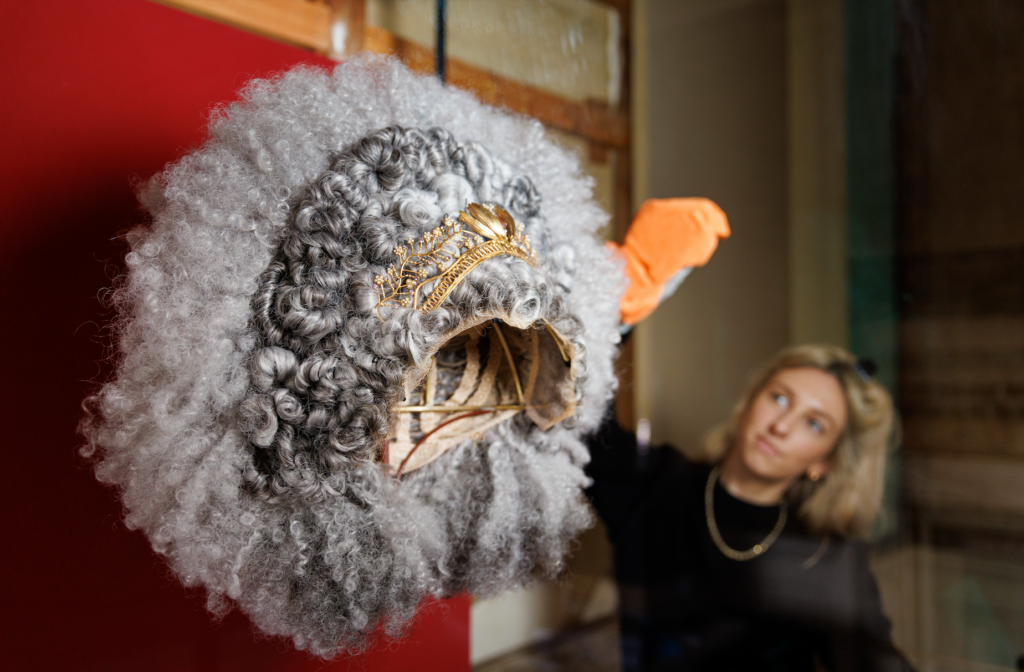
Photograph © Historic Royal Palaces/Netflix.
During the real Charlotte’s life, and in the centuries thereafter, the question of her ethnicity reigned supreme in her legacy. Some historians speculate that Charlotte was a direct descendant of a Black cadet branch of the Portuguese house of Margarita de Castro y Sousa. She was, allegedly, triply descended from the family. Her royal portraits have fueled ongoing debates about the possibility of African ancestry in her lineage. Her visage was also used during the eighteenth century in the name of abolition, as well as a tool of propaganda to recruit enslaved men to the British side of the American Revolution. Bridgerton’s interpretation of Charlotte’s African-European identity draws from these real debates of heritage.
Ultimately, the story of real Queen Charlotte ends in a rather melancholic way; though she was George’s guardian for some years throughout his worsening mental and physical illness, she predeceased him in 1818 at Kew Palace. She was seventy-four. In her final year, she witnessed the weddings of two of her fifteen children, William, Duke of Clarence, and Edward, Duke of Kent. As depicted in the Queen Charlotte prequel, the royal baby race was afoot, and it would be the Duke of Kent who produced a singular, important heir to the throne, Alexandrina Victoria. Charlotte would not live to see the future Queen Victoria born.
George III likely never knew of Charlotte’s death. In fact, the cobblestone courtyards of Kew were covered in straw to absorb the sounds of his beloved wife’s funeral procession. It is a royal love story that serves as the heartbeat of Charlotte’s more vulnerable storylines in the Netflix show. Once again drawing on her real life in a way that remixes truth with nuanced reimaging, Charlotte’s life is richly remembered and celebrated by audiences around the globe.


