
Isamu Noguchi saw art not as something separate from life, but embedded in the playgrounds, gardens, and spaces people move through every day.
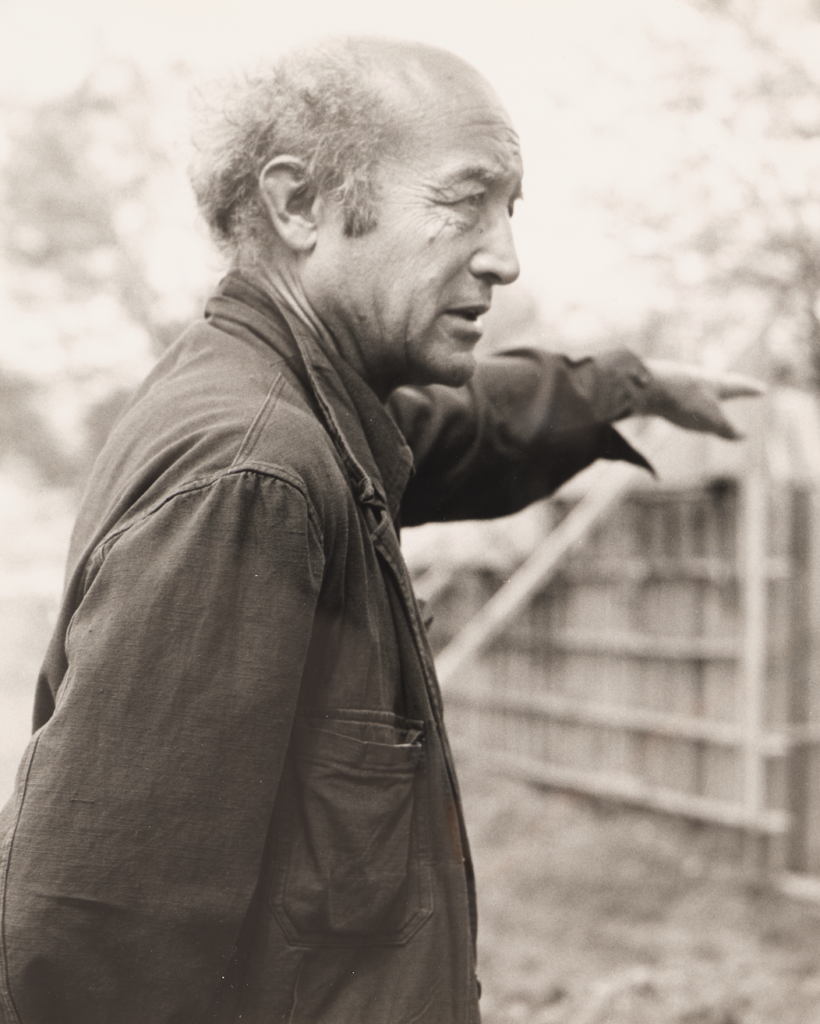
Sculptor, furniture designer, creator of stage decor, fashioner of public spaces, Isamu Noguchi cast a wide net. Always in pursuit of significant form, he didn’t differentiate much between one pursuit and another, asserting “Everything is sculpture.” An ethnic and aesthetic nonbinary (his mother was Irish American, his father Japanese), Noguchi was something of an outlier whose deep engagement with diverse materials, liberal exploration of form and function, and unqualified embrace of the practical and the poetic, challenged cut-and-dried categorization. While a neither-here-nor-thereness pervaded his personal and creative lives and he could be both remote and controlling, Noguchi counted Arshile Gorky, R. Buckminster Fuller, and Alexander Calder among his friends; had intimate relationships with Frida Kahlo, diarist Anaïs Nin, and Chicago dancer Ruth Page; worked with leading architects and manufacturers (including Gordon Bunshaft and Herman Miller); and enjoyed considerable institutional recognition, beginning with a retrospective at the Whitney Museum of American Art in 1968.
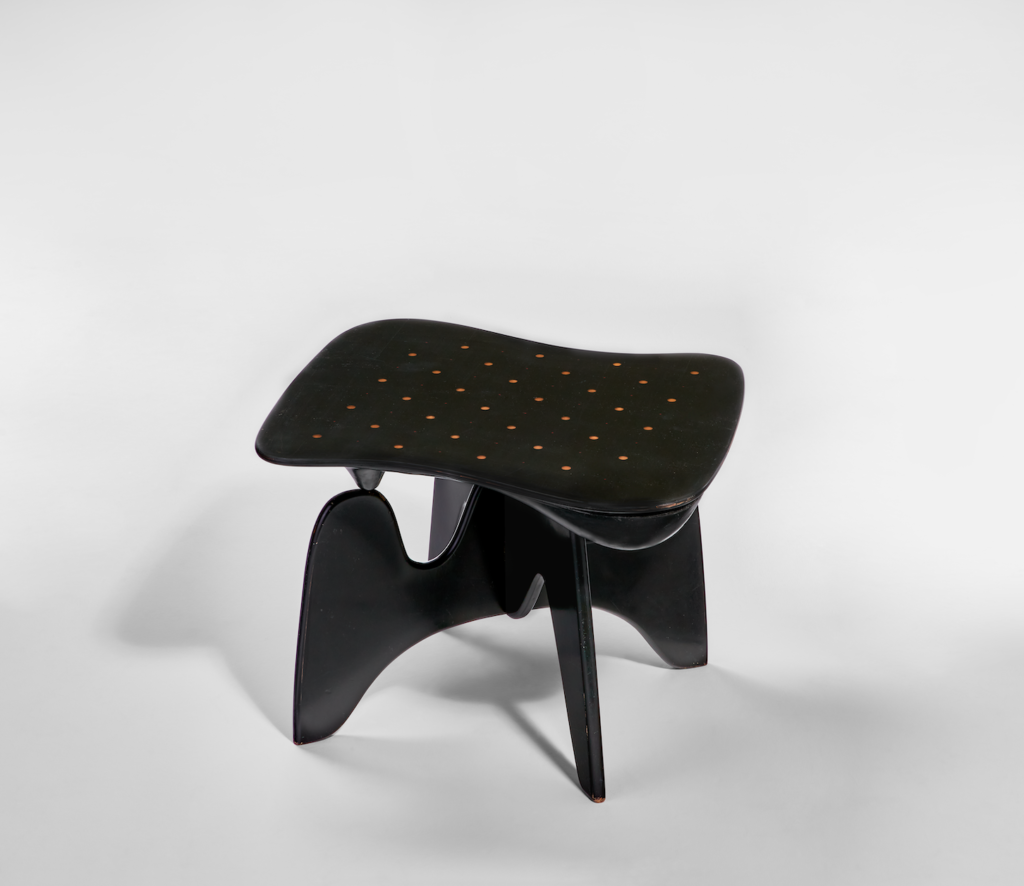
Collection of Robert Munch; photograph © Christie’s Images / Bridgeman Images.
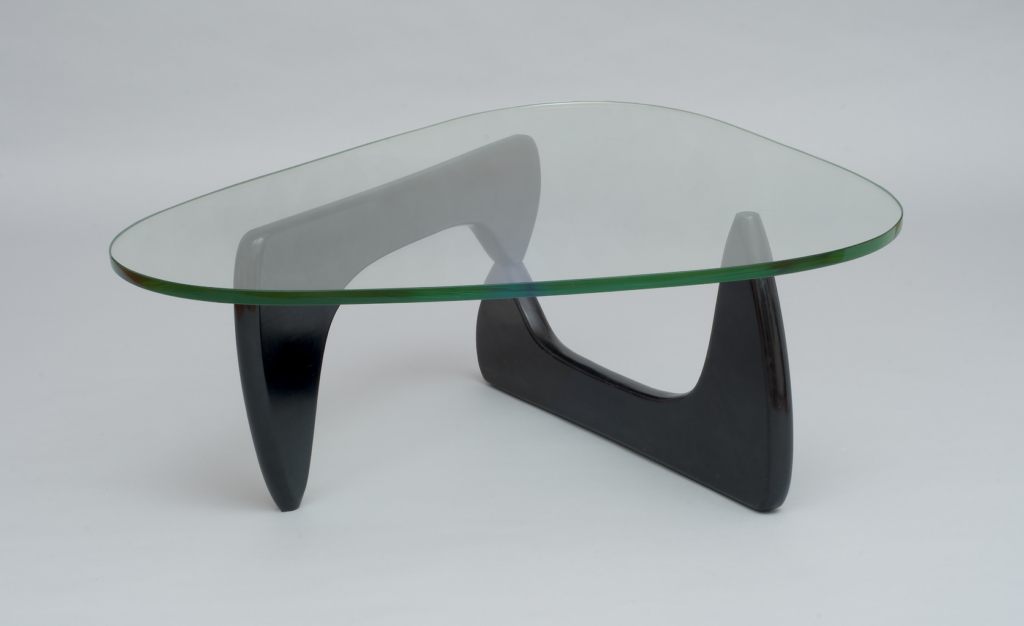
Today, twenty-eight years after the artist’s death in 1988, it’s arguable that people know Noguchi primarily through his sculpture (often via a visit to the Noguchi Museum in New York) or his now classic design pieces, including his glass-topped coffee table and Akari light sculptures, made of washi paper and bamboo. The High Museum of Art’s Isamu Noguchi: ‘I am not a designer’” (on view to August 2) surveys the full scope of the man’s career and coincides with the fiftieth anniversary of his Playscapes, a public space in the city’s Piedmont Park, commissioned by the museum in collaboration with the Atlanta Department of Parks and Recreation in 1976.
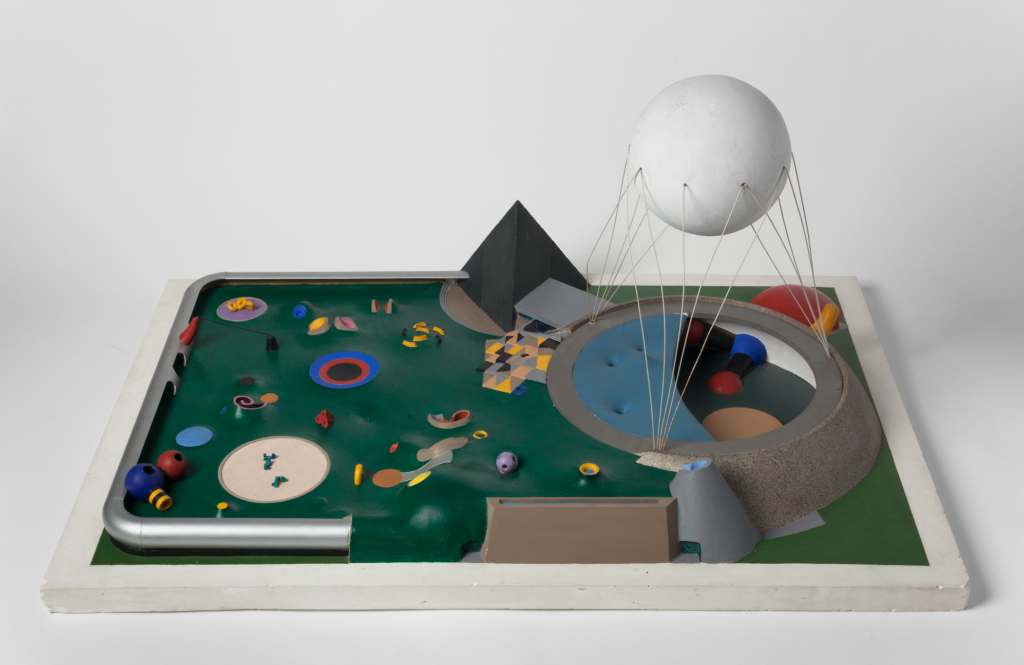
Engaging with landscape and articulating public space was an ongoing concern for Noguchi. In 1933 he imagined a colossal project, Monument to the Plow, an earthwork whose central component was a pyramid measuring a mile across at its base. That same year, he conceived Play Mountain for a site in New York City, which featured topography incorporating a water slide and a slope for sledding, sculptural objects rather than the usual swings and a jungle gym. Noguchi deemed it “an incubated place, a big play object” that could encourage imaginative, self-directed activity. New York City Parks Commissioner Robert Moses thought otherwise. When he was shown a plaster model of the design, the formidable Moses “just laughed his head off and threw us out more or less,” Noguchi later recalled. Though unrealized, the scheme, he asserted, “was the kernel out of which have grown all my ideas relating sculpture to the earth.”
When the United Nations building was completed in 1952, Noguchi was invited to design a playground for the neighborhood and children of the delegates. Again, Moses exerted his control and quashed the project. “The playground was killed by ukase from a municipal official who is supposed to run the parks and who somehow is the city’s self-appointed guardian against any art forms except banker’s special neo-Georgian,” fumed Art News. For several years in the early 1960s, Noguchi—working with architect Louis Kahn—devised a playground for Manhattan’s Riverside Park. After some NIMBY pushback and less-than-robust support from the Parks Department, the project was approved, only to fall by the wayside with the arrival of a new administration in City Hall.
High Museum of Art, gift of the artist for the Bunnen Collection, © Lucinda Bunnen.
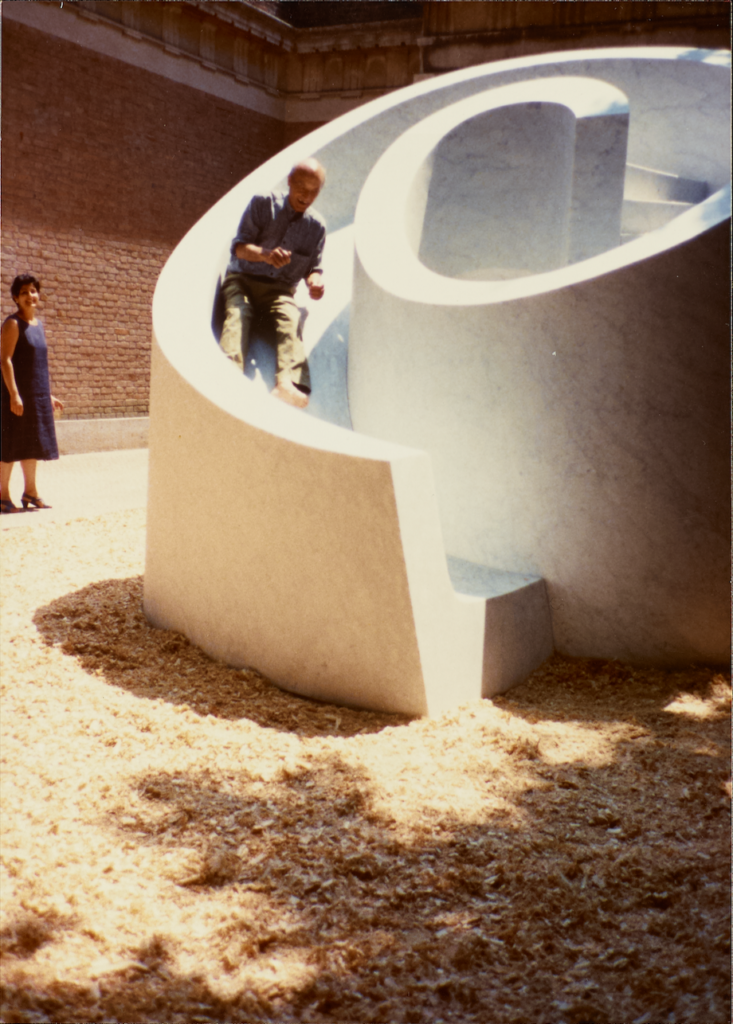
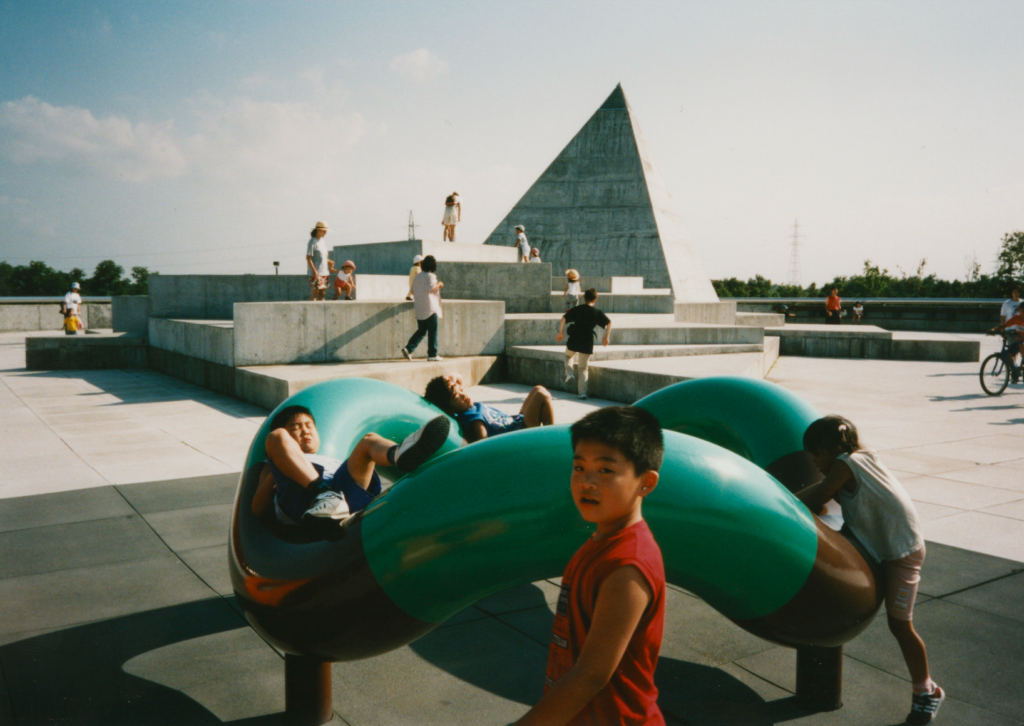
Despite these setbacks, Noguchi remained committed to creating environments tailored to young people, deploying a repertoire that included contoured hardscapes, water features, geometric forms to crawl into, and a slide that reads as a cross between a chambered Nautilus and the swirl of a cinnamon bun. “Children, I think, must view the world differently from adults, their awareness of its possibilities are more primary,” he wrote. “I like to think of playgrounds as a primer of shapes and functions; simple, mysterious, and evocative: thus educational. The child’s world would be a beginning world, fresh and clear.” In 1965 he was invited to design a play space in Kodomo No Kuni (Children’s Land), a park scheduled for construction between Tokyo and Yokohama. In 1988, nine months before he died, Noguchi traveled to Sapporo, Japan where tech entrepreneur Hiroyuki Hattori and local officials were planning on creating a new green space. Noguchi was asked to evaluate three possible sites, settling on a large tract that had served as a municipal dump. He set to work immediately on a design that included a half-pyramidal mountain with a stepped side. The artist died in December, but his longtime collaborator, architect Shoji Sadao, supervised the project’s final planning and construction and Moerenuma Park opened in 2005.
Noguchi Museum Archive.
Atlanta’s Playscapes—Noguchi’s only completed US playground—was a key element in the High Museum’s determination to expand beyond its walls and meet the public in an engaging and less-formal manner. Situated less than a mile from the museum in Piedmont Park—a major green space based on a master plan by Olmsted Brothers—the playground was first proposed by High Museum volunteer Frankie Coxe in 1973. Noguchi visited the site in 1974 and was hired the following year. When Noguchi showed signs of having second thoughts, museum director Gudmund Vigtel assured him, “We are very much aware of the trials which you have endured over the years with projects similar to ours. For this reason we have worked very hard to anticipate and eliminate any possible obstacles.”
While Noguchi’s playground plans were sometimes scuttled, he enjoyed considerable success realizing outdoor spaces for numerous corporate and institutional clients, all of which he referred to as gardens, even when hardscape prevailed, rather than grass and trees. As Marc Treib notes in the High Museum’s exhibition catalogue, “Noguchi preferred garden to the more inclusive term landscape because he felt that a garden was better defined by the emotions it generates than by its constituent elements. He believed that a garden was a self-contained sculpturing of space with whatever medium, be it trees, water, rocks, wire, or broken-down automobiles.”
Although Noguchi welcomed such projects for the opportunity to “work more in more space,” the scale of the assignment and the role corporate and civic planners might play always determined whether or not he would get involved. In the late 1950s, the City of Detroit approached him about doing something with the tons of earth that had been excavated for its new expressway. He passed. Years later, he wrote, “But I may have been timid . . . about getting involved with something so time-consuming and so large as to be beyond my capacity to delimit as art. In fact, I have declined a number of projects on this ground. There are few moments of courage when we do not compromise for the more easily possible.”
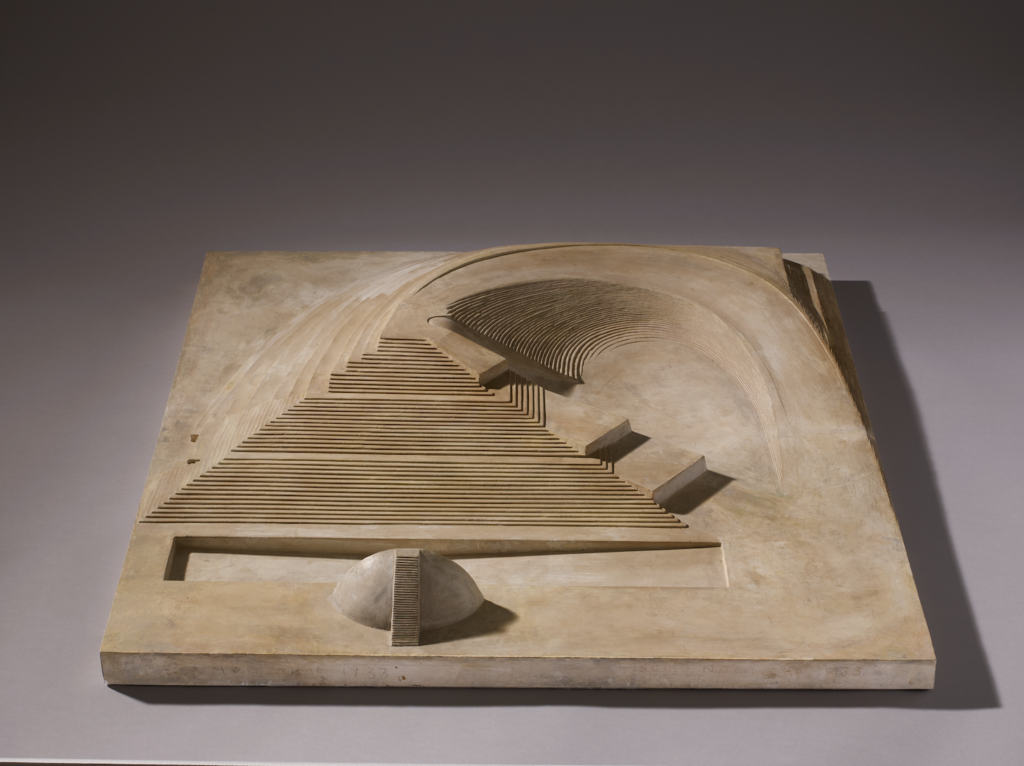
High Museum of Art, purchased with funds from the Decorative Arts Acquisition Endowment; photograph by John Armitage.
By then, Noguchi had already created several significant spaces, beginning with the garden for the Reader’s Digest building (1951) in Tokyo. The project came his way through architect Antonin Raymond, who had assisted Frank Lloyd Wright on the Imperial Hotel and spent much of his career living and working in Japan. Treib describes it as “essentially a topographic work that modeled the soil excavated for the construction of the building into a composition of mounds and valleys, both geometric and more freely shaped. Water features such as a meandering stream and a linear canal animated the static earthen forms and the areas of lawn between them. Stones positioned in key points punctuated the sweep of the landforms and served to link the modern design with Japanese tradition.”
Isamu Noguchi Foundation and Garden Museum; Noble/ Noguchi Museum Archive photograph.
Noguchi was born in Los Angeles in 1904, to Léonie Gilmour, a Bryn Mawr grad from New York, and Japanese poet Yonejiro Noguchi. The father returned to Japan before the boy was born. In an attempt at establishing a familial life, Gilmour moved to Japan when Noguchi was two. Noguchi senior showed no interest in his son, and when Isamu was thirteen, his mother sent him to the US to be educated. Interestingly, Yonejiro, who had not seen his son in years, arrived at the boat and tried to prevent him from sailing.
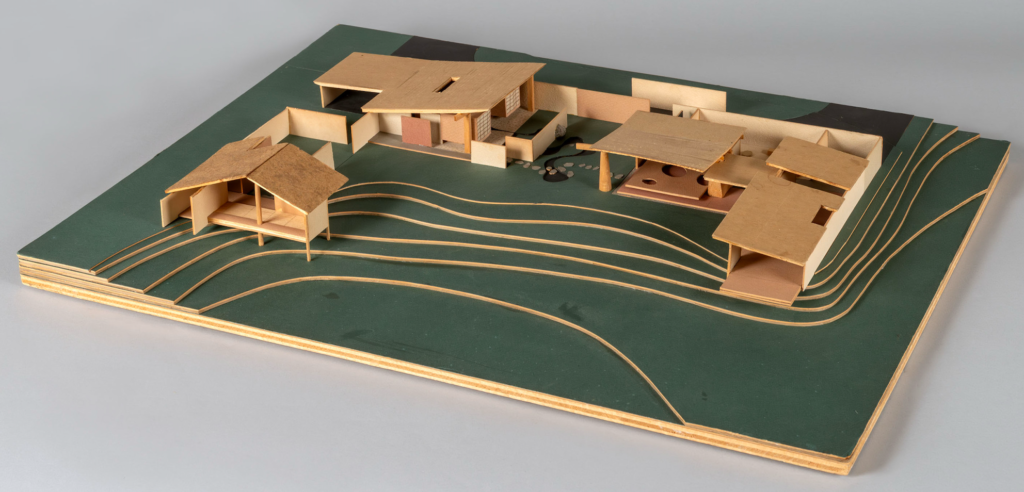
(1913–1992), 1955. Plywood, paperboard, wood, paper, pencil, ink, paint, and stones; height 3 1⁄4, width 20, depth 26 inches.
Oakland Museum of California.
After graduating from high school in Indiana, a mentor arranged an apprenticeship for the youth with sculptor Gutzon Borglum (best known for the presidential likenesses on Mount Rushmore), but this proved to be little more than tutoring Borglum’s son and splitting firewood. An unsatisfying stint as a pre-med student at Columbia University followed before Noguchi directed himself entirely to art, studying at the Leonardo da Vinci School of Art on Manhattan’s Lower East Side and taking on portrait commissions. By then, he wrote, “I had become completely acclimatized as an American. There was no hint of Japan about me.”
All his life, Noguchi felt caught between cultures. As he told Art in America in 1968, “The whole problem of being neither Japanese nor American—that has always been a trouble.” It was not until 1931, after living in Paris (for a time, he was an assistant to Constantin Brancusi) and travels to Russia and China, that he began to reconnect to the culture of his father. After nearly a year in Japan, he returned to New York, setting up a studio on West 57th Street. In November, the Whitney Museum purchased a bronze head, Ruth Parks (1929), the first of his sculptures to enter a museum collection.
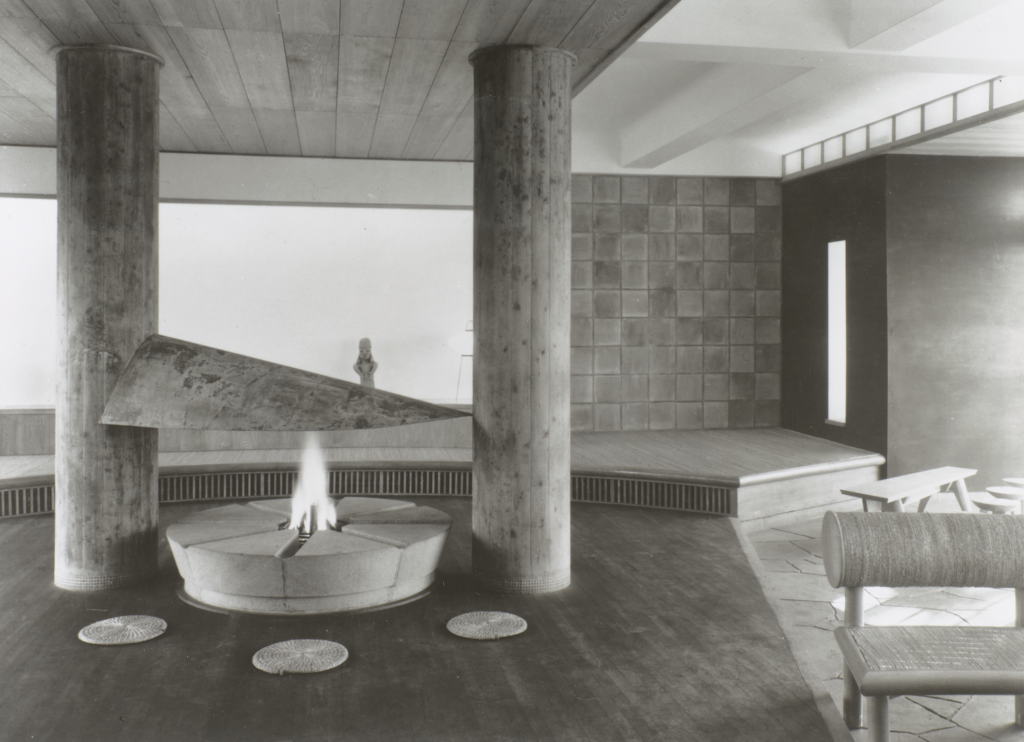
1950, in a photograph by Chuji Hirayama. Noguchi Museum Archive.
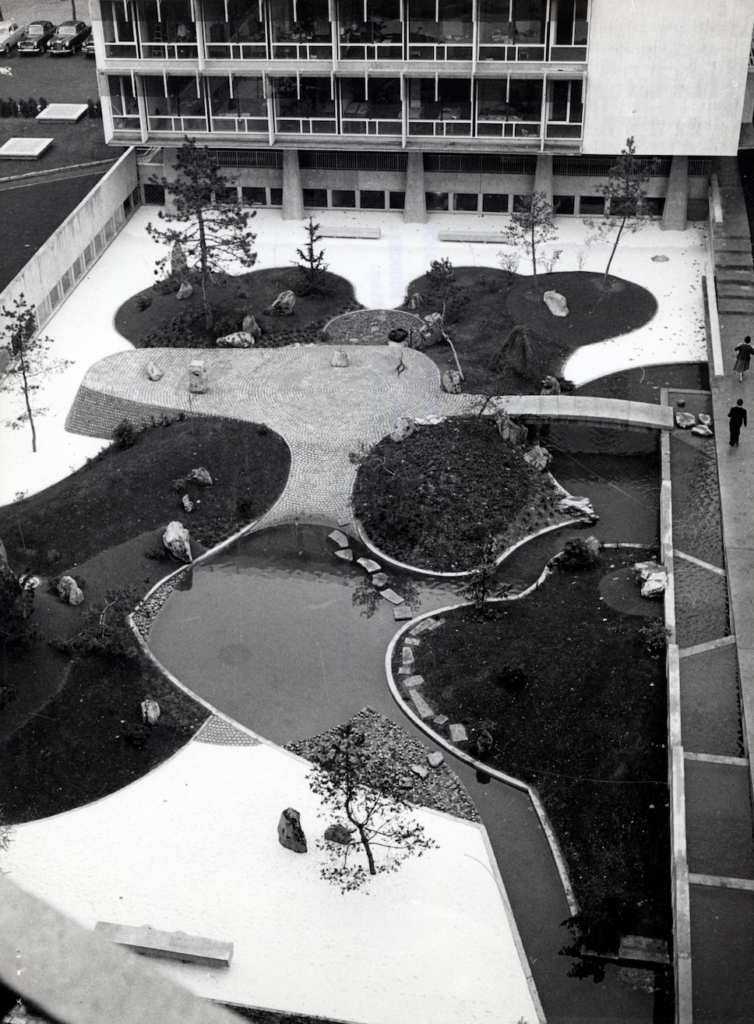
After World War II, Noguchi returned to Japan, and on that trip, took in several gardens in the company of artist and writer Saburō Hasegawa. “Together,” writes Treib, “they visited landscapes of both the karesansui (dry garden) and more expansive and richly planted kaiyū (stroll garden) types; they were enthralled by the moss that carpeted every surface of the garden at Saihōji, the sequenced movement that directed views at the Katsura Imperial Villa, and the borrowed scenery that extended the limits of the garden at Entsūji. From this experience, Noguchi’s idea of what a garden might be increased in scale and evolved formally.” In 1956 Noguchi was commissioned to develop a patio at the UNESCO headquarters in Paris. At his suggestion, the project grew to encompass an adjacent garden, which became identified as le Jardin Japonais, While he often drew on elements and strategies manifest in true Japanese gardens, Noguchi always gave his creations “a personal twist” driven by his inner generative impulse and his response to the site, which often included large modern buildings. “I should say I never wanted to make a purely Japanese garden,” he wrote. But with his considered arrangement of rocks, sculpture, and water, his attention to elevation—to inclining and declining lines—he always honored the Japanese focus on “the quality of leisure . . . an awareness of inner purpose . . . timeliness and the timely weaving together.”
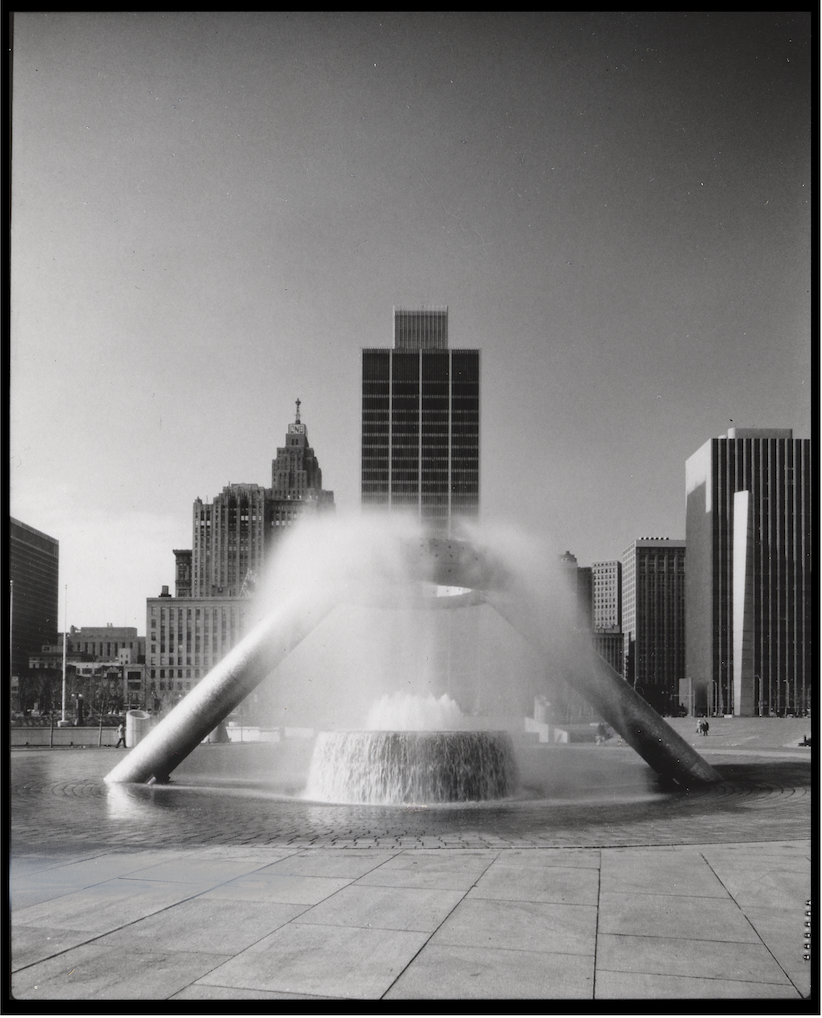
Noguchi Museum Archive.


