In March 2003, The Magazine ANTIQUES published an entire issue dedicated to Hillwood Museum and Gardens, the monumental DC estate of Marjorie Merriwether Post—and its pages are replete with the ornate French and Russian Empire-era masterpieces beloved by the breakfast-cereal heiress. Fabergé was one of Post’s favorite firms, and an ivory and gold table clock by workmaster Michael Perkhin is among the Fabergé objects highlighted in our 2003 special issue. Diminutive but dazzling, this diamond-adorned timepiece is one of sixty clocks and watches in the collections of Hillwood today.
Hillwood’s deputy director and chief curator, Wilfried Zeisler, has long been surveying the museum’s archive of precious timepieces, with an eye to an exhibition, and that exhibition has finally come to fruition. On Time: Giving Form to the Fleeting, which opened on Valentine’s Day, provides a platform for the horological masterpieces beloved by Post—a combination of wrist-worn jewels, elaborate rococo revival clock cases, and astounding automata embedded in tiny pocket watches. Not only is it the first showcase of Post’s clock and watch collection (augmented by loans from the Met, the National Gallery, and the Walters Art Museum, among others), but one of the most impressive assemblages of time-keeping devices in the United States in recent years. It came to be not only through these generous loans, but with the expert consultancy of horologist Brittany Cox, who has deconstructed many of the pieces on exhibit to evaluate, conserve, and record their precise and complex mechanisms.
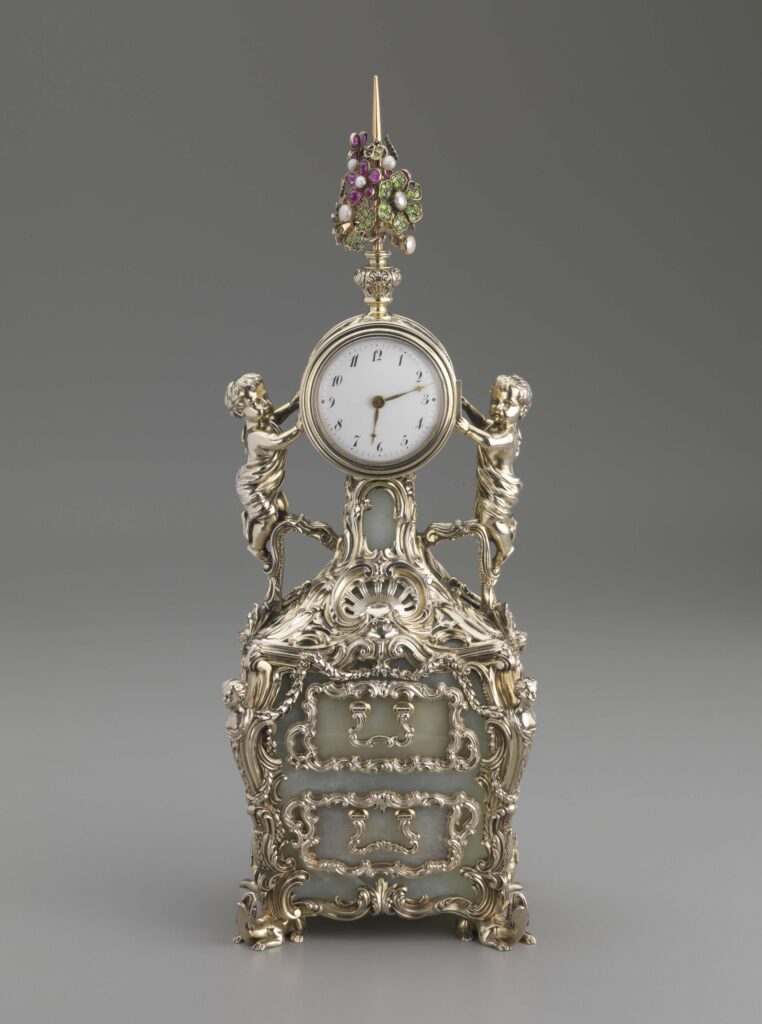
Cox’s work has enabled Hillwood to give visitors an experience without parallel: priceless clocks typically shielded behind glass have been dismantled, photographed, and recorded so that their delicate mechanisms and gentle bells may be seen and heard across time. Several of the objects in On Time are accompanied by QR codes that enable visitors to instantly witness those features from their phones. These horological masterpieces abound with tiny secrets and magical mechanisms. For example, a Fabergé desk clock in the shape of a chest of drawers conceals a hidden memento: not only do all the little drawers actually open, but the entire case, in nephrite jade and silver, can be unlatched to reveal a portrait of Nicholas II and Empress consort Alexandra (it was originally a gift commissioned by Nicholas’s father Alexander III for Empress Maria). So astonishingly advanced was this piece that it was featured at the 1900 Exposition Universelle in Paris.
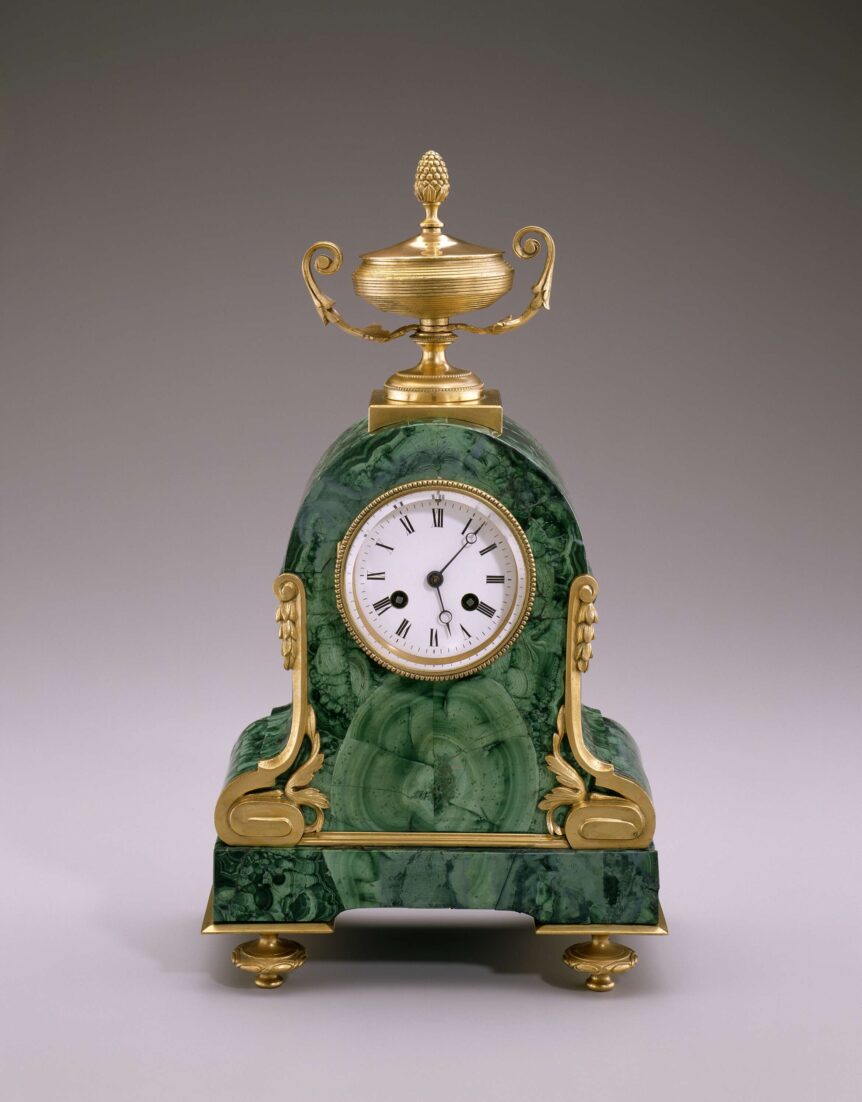
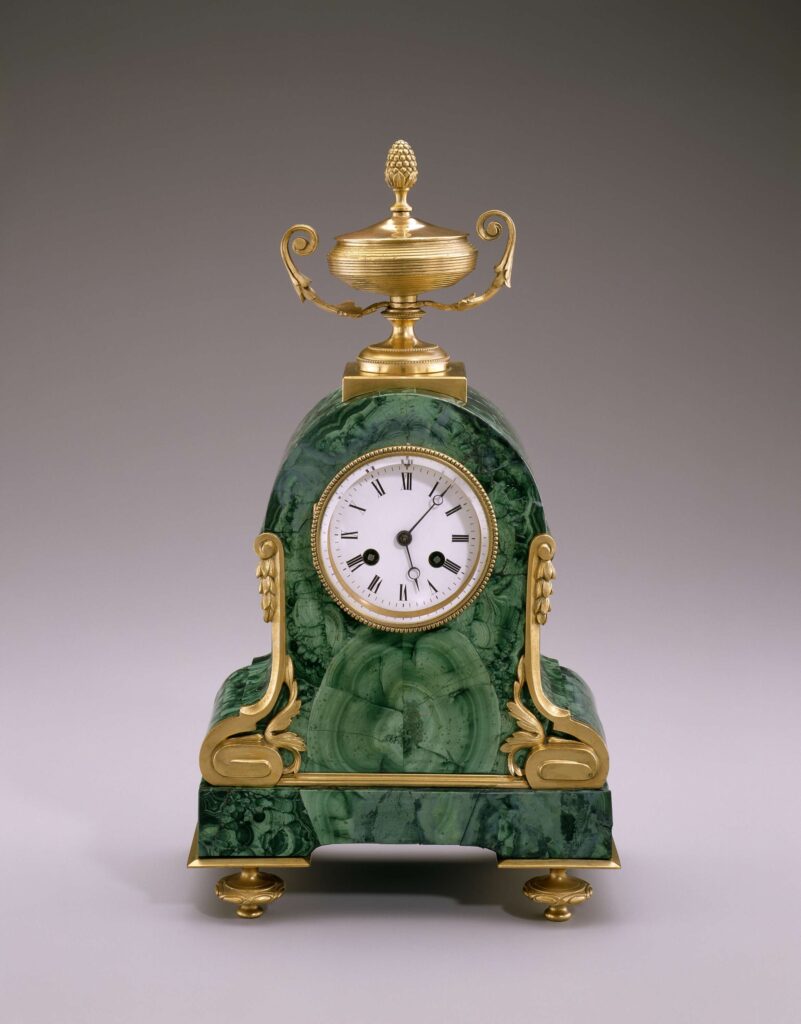
And this is not the only piece in On Time that once sat on such a prestigious world stage —visitors will also be able to view an incredible malachite clock by Hoessrich & Woerffel that was exhibited at the 1876 Centennial Exposition in Philadelphia. Post had a particular affinity for semi-precious hardstones, from malachite to jade and onyx. A massive Fabergé desk clock on a custom white onyx base most recently held pride of place in the opening gallery of Hillwood’s popular Natalie Paley exhibition. It was made for Paley’s father, the Grand Duke Paul Alexandrovich, and features a silver crest bearing his initials.
Yet, the curatorial team grounds this display of toys for the one percent in universal ideas of time, timekeeping, and the passage of years. The exhibition opens with a contemporary artwork by Puerto Rican artist Alexandra Rafael Martínez featuring three hourglasses filled with various substances, including ashes of the artist’s own body residue —a commentary on the impermanence of life. It closes with Shomei Tomatsu’s photograph of a broken watch, forever halted at 11:02, the moment the atomic bomb fell on Nagasaki. In between these bookends are reminders of the sentimentality of the wristwatch, an object packed with value both financial and emotional that is so frequently passed from father to son or mother to daughter. Many of Post’s own watches do not belong to the museum, as they have been passed down within the family. One example, a Tiffany bracelet watch, has returned to Hillwood for this exhibition. Smaller and more delicate pocket watches (often associated with female wearers), the predecessors of the wristwatch, are explored through pieces lent by the Walters Art Museum.
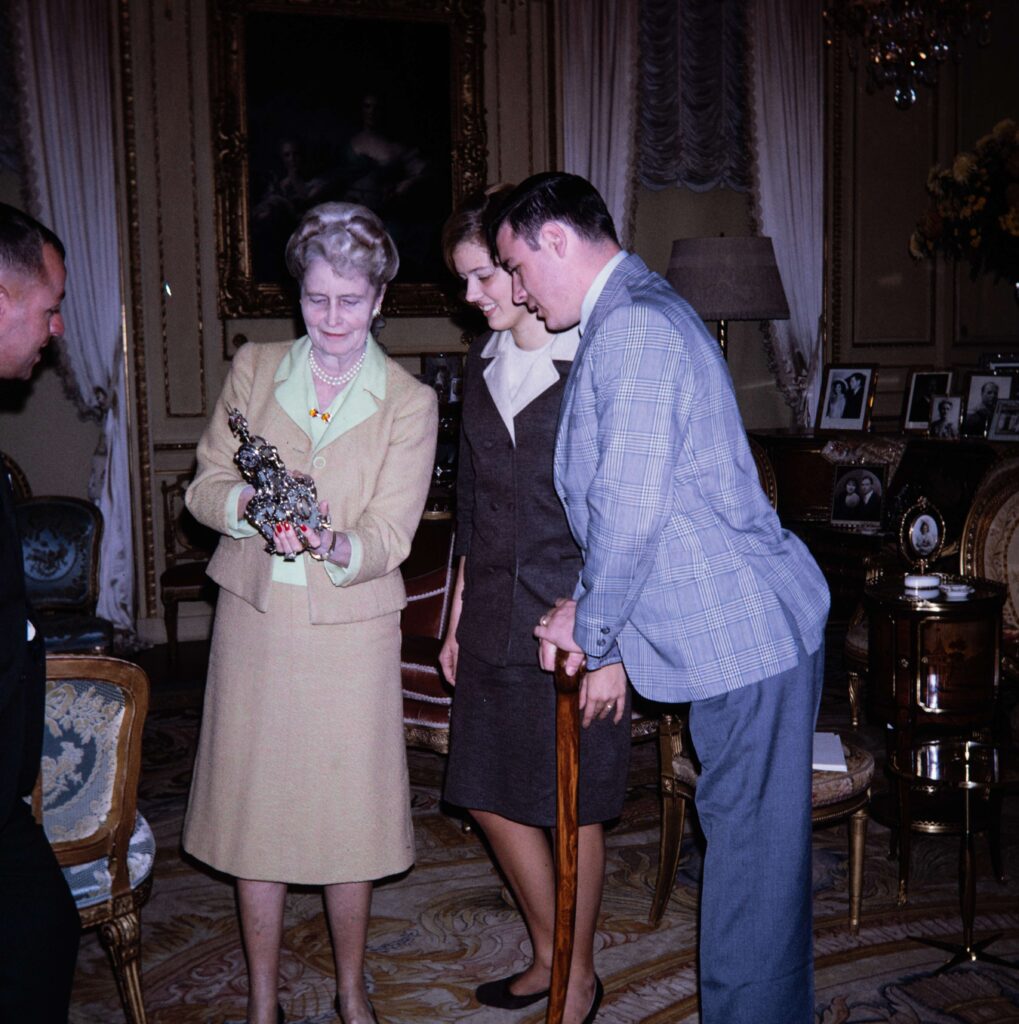
1968.
Further, an exploration of the role of cross-Atlantic trade in the horological industry gives depth to the African likenesses incorporated in French Empire clock cases. The so-called “African princess” clock case owned by Post serves as a complex example of the melding of cultures in the decorative arts of Empire France. The clockface is the actual face of an African woman, with numbers set dramatically into her eyes. Yet, she is adorned in the garb of the Roman goddess Diana, with her bow and arrow recalling the themes of life and death that would have been familiar to European clock collectors. One of the five extant versions of this clock was purchased by Marie Antoinette and remains at Versailles. Post was a feverish collector of Antoinette-related treasures and acquired hers only shortly after seeing the Versailles example. Interestingly, though, Post’s acquisition is incomplete. It is just a shell, with no working mechanism within, so the hours and minutes are simply painted onto the princess’s pupils.
On Time succeeds because it praises these clocks not only as tools of timekeeping and objects that blend function with beauty, but most poignantly, as reminders of our shared responsibility to keep pace with passing time. For all their jewel-encrusted bravura, Marjorie Post’s clocks were never merely vitrined trophies; they were lived with, listened to, and relied upon. An electric clock purchased by Post from the New York firm Caldwell once kept time aboard her yacht, but later, she had a discreet electrical outlet built directly into an overmantel at Hillwood to accommodate it. The jade and silver Fabergé clock—so dazzling it once stunned visitors to the Exposition Universelle—was likewise left out in the open, serving as a table clock in the French drawing room. Time here is not only something to be admired, dissected, or monumentalized; it is something that passes, consistently and steadily, whether we’re sitting aboard a yacht or on a bus, looking humbly down at our wrists. –Sarah Stafford Turner
On Time: Giving Form to the Fleeting • Hillwood Estate, Museum, and Gardens, Washington DC • to June 14 • hillwoodmuseum.org


