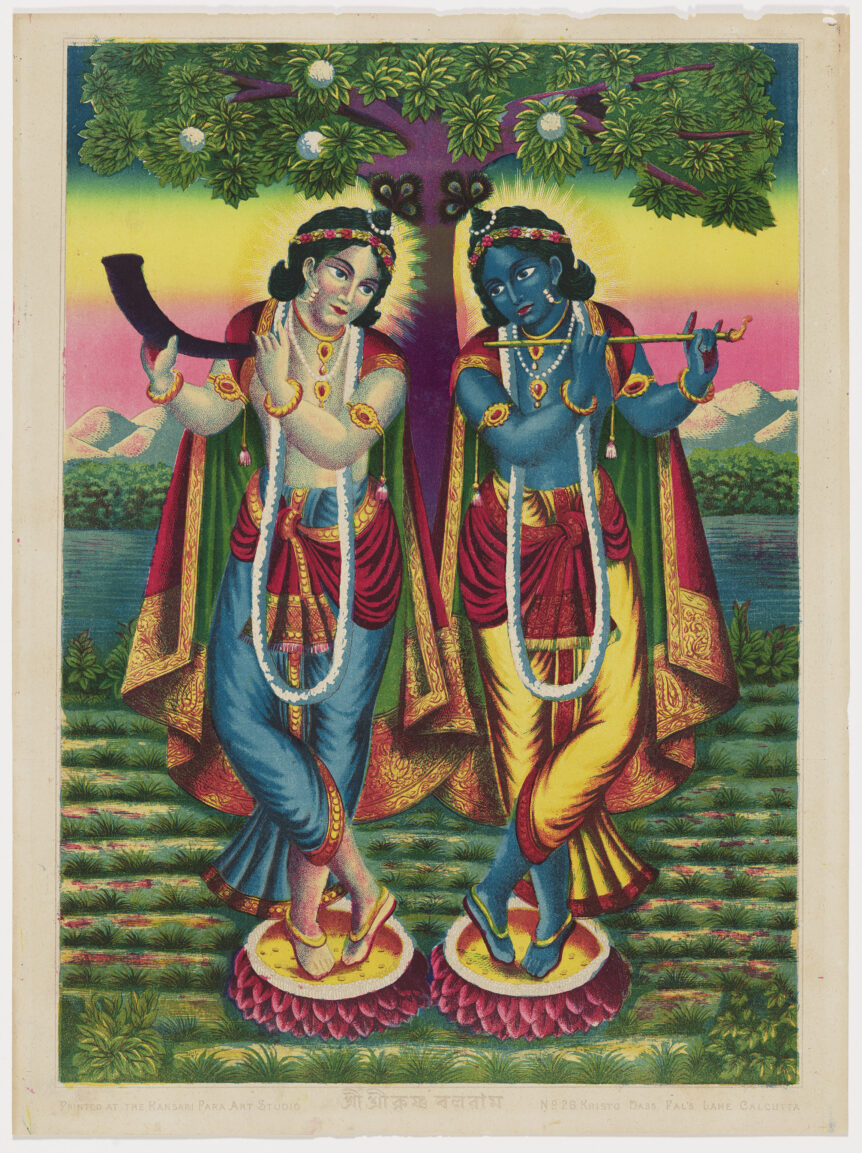
In nineteenth-century India, the gods of the Hindu pantheon arrived in many homes through colorful lithographic prints. They dazzled on walls and transcended economic status—no matter who you were, the gods were welcome in your home. Prior to the availability of such prints, religious imagery was produced by hand in the Calcutta neighborhoods of Kalighat and Battala. In the early nineteenth century, clay or even metal renditions of the gods were the most expensive form of devotional imagery one could buy. For those with more modest budgets, hand-drawn and painted likenesses from Kalighat or Battala were the next option. But that would all change when the lithographic press came to Bengal, then one of the most powerful provinces of British India (and the region in which Calcutta was situated).
In January, the Museum of Fine Arts, Boston inaugurated Divine Color, an exhibition that showcases Hindu devotional imagery in the form of lithographic prints from modern Bengal. Organized by Laura Weinstein, the curator of South Asian and Islamic art at the MFA, the exhibition features selections from the important collection of Hindu devotional prints assembled by Mark Baron and his wife, Elise Boisanté. It is augmented by a catalogue containing five essays, and with a foreword by the museum/s director, Pierre Terjanian. Together with the catalogue, the exhibition tells the tale of a time when scientific invention, political change, and codes of religious iconography came together to create a new artform.
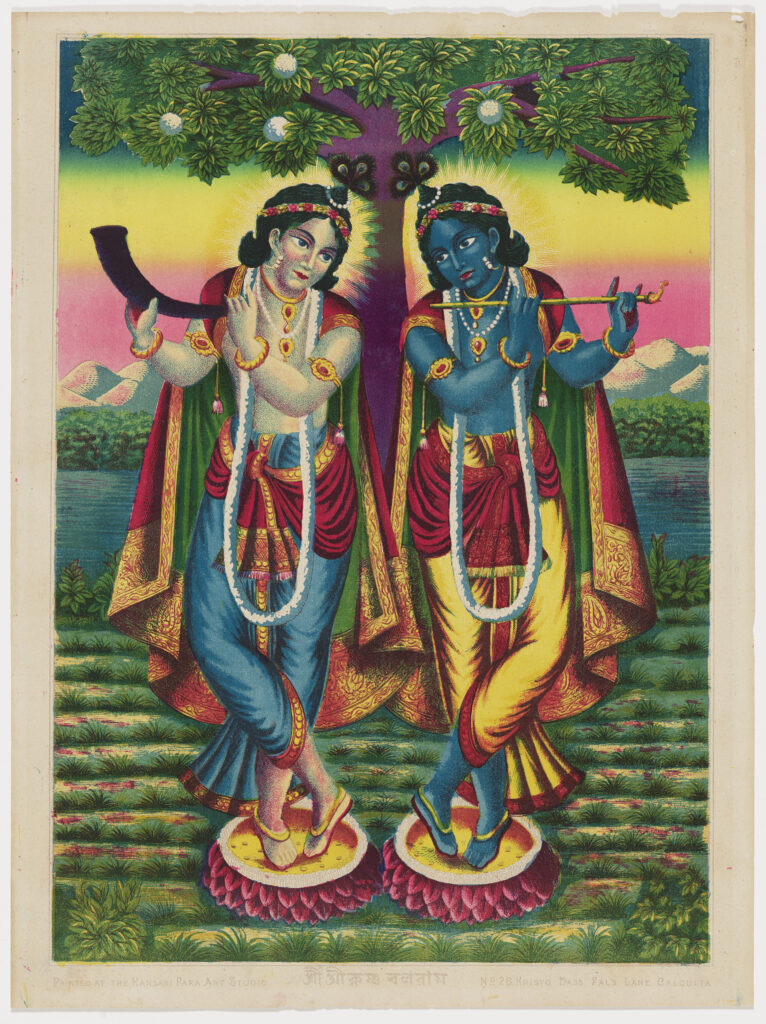
the Museum of Fine Arts, Boston, Marshall H. Gould Fund.
During the seventeenth century, Britain’s East India Company set up shop near the sacred Hugli River in Bengal. This trade center grew rapidly and became the city of Calcutta (now Kolkata). In the nineteenth century, Calcutta was the capital of the British Indian Empire and a site primed for the confluence of global cultures. The first lithographic press was brought to Calcutta in 1822 by James Nathaniel Rind with the intention of producing maps and other administrative documents for the British government. But it didn’t take long for this technology to be adopted to produce religious imagery.
In 1829, the first all-Bengali owned lithography press, called Shura Pathuria Press, was formed. Although no prints from this establishment remain today, its formation represented a sea change for Bengali society, demonstrating how the Bengali people took this artform into their own hands and used it to decorate their homes, spread their stories, and eventually to fight for independence. After the first national uprising against the British in 1857, anti-British sentiment was at its height, and the revival of traditional Bengali religious art through lithography, in itself, was seen as a statement of national pride.
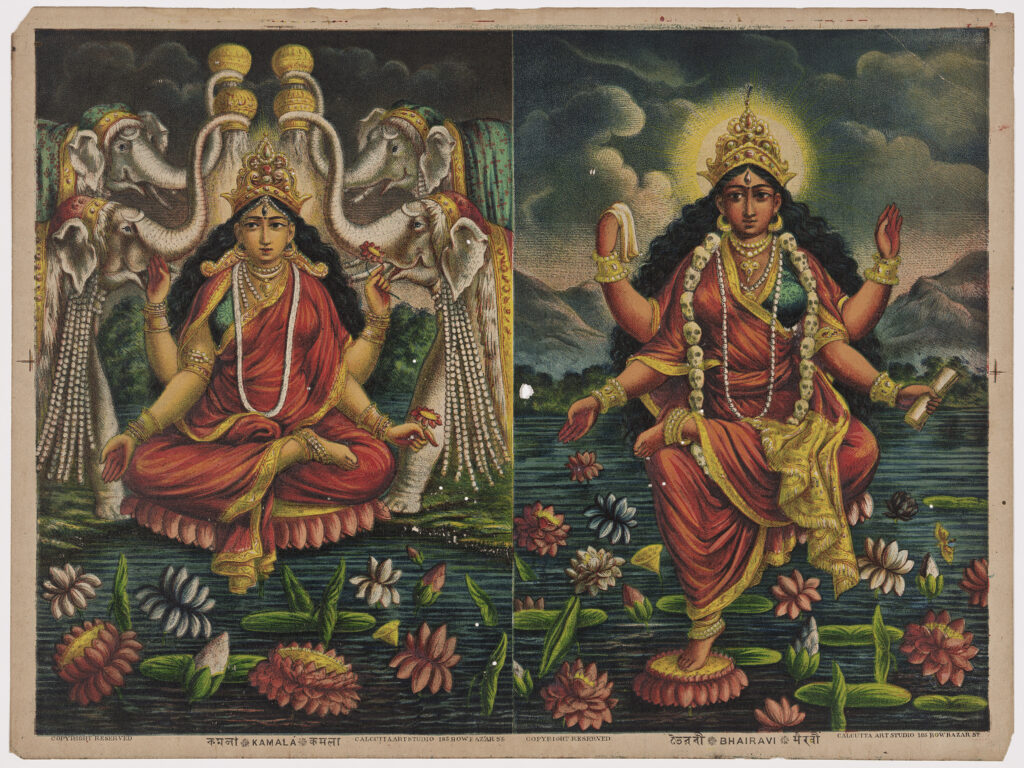
Ironically, though, lithographic prints represented the gods of the Hindu pantheon using Eurocentric aesthetic conventions, such as depth, shadow, and volume, with the subjects placed in front of receding backgrounds. Early on the images were often printed in black and white and then hand painted by traditional Kalighat artists. This made it easier and faster for these artists to disseminate their craft. Production of the devotional calendar prints seen in Divine Color began around 1875
Today, these prints are a staple of Indian material culture with companies traditionally giving such calendars to employees to mark the national festival of Diwali. The calendars contain information about astrological events and the phases of the moon—all significant to the rituals of Hindu worship and an almanac for any related activities. Together, these prints show how lithography reshaped devotional practice in Bengal, allowing the gods to move from workshop and shrine into everyday domestic spaces with unprecedented reach and familiarity. — Urvashi Lele
Divine Color: Hindu Prints from Modern Bengal • Museum of Fine Arts, Boston • to May 31 • mfa.org


