
You have a bug on you.
Most people would jump and shout, “Where?!” But, then there are people who intentionally bedazzle themselves with crystaled creepy-crawlies by way of bug bling.
So when did insects—elsewhere swatted or squished—become glamorous badges of honor? That’s the question I set out to answer in this installment of “Flea Bite,” a column that, fittingly enough, takes its name from one of the most detested bugs of all: the flea (originally a tongue-in-cheek nickname for nineteenth-century Parisian markets selling allegedly bug-infested secondhand furnishings). Not great for branding, but the name stuck and burrowed its way into present-day history.
To help me unearth the truth behind bug jewelry’s enduring appeal, I called Nick Dawes of Heritage Auctions: Lalique expert, longtime Antiques Roadshow appraiser, and friend of ANTIQUES. According to Dawes, there have been several major infestations of insect jewelry throughout history.
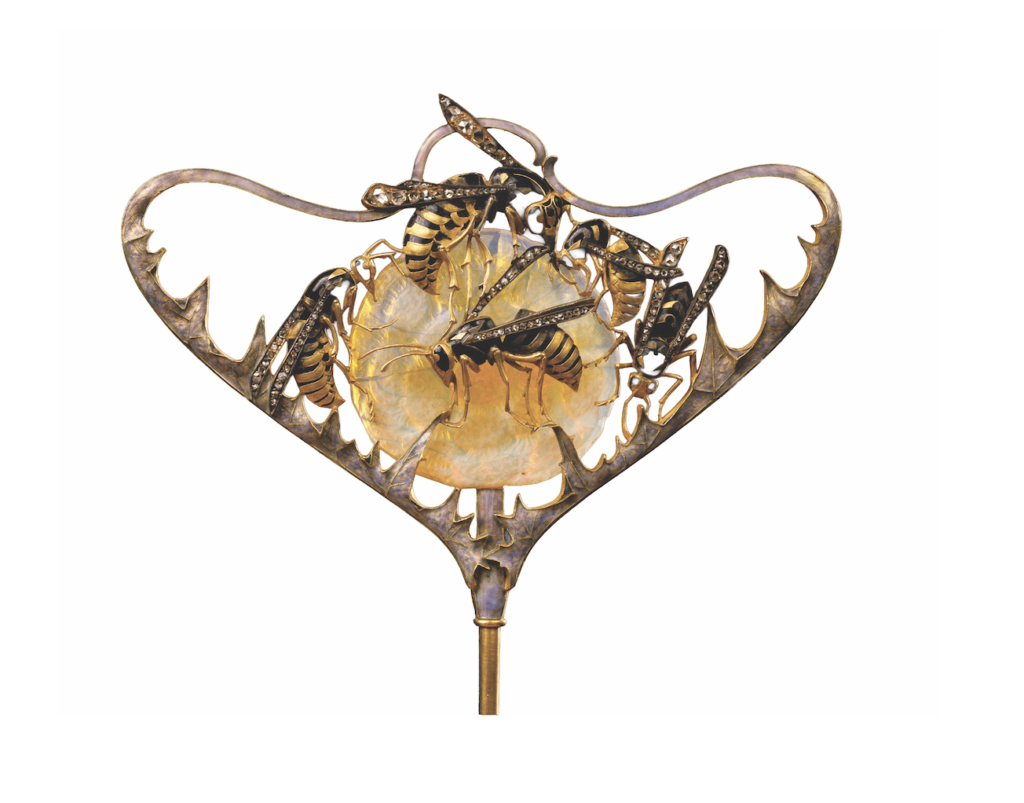
diamonds. Photograph by Pernille Klemp, courtesy of the Design Museum Denmark, Copenhagen.
The first occurred in ancient Egypt, where scarabs and beetles symbolized rebirth and regeneration. A curious biological note deepens the mythology: certain dung beetles roll excrement into balls to lay their eggs. To the ancient Egyptians, the act mirrored Khepri, the god of the morning sun, who rolled the sun across the sky at daybreak.
The second wave came with the Napoleonic era when conquests in North Africa reignited Europe’s fascination with Egyptian motifs. The third emerged with art nouveau, shaped by Japonisme, as insects and natural wonders wove themselves into organic motifs. The fourth arrived during the art deco period, fueled in part by the discovery of Tutankhamun’s tomb. The fifth, and more enduring wave, began in the Victorian era and continues today among those sentimental jewelry-lovers who take to heart the symbolic identities of insects such as hardworking spiders and bumblebees.
Jewelers, Dawes notes, have “favored the beautiful bugs like bees and dragonflies. Flies and moths—less so. Ladybugs symbolize happiness and good luck. Butterflies, across cultures, represent transformation. Flies, on the other hand, tend to suggest pestilence—perhaps explaining the lack of diamond-encrusted housefly brooches.”
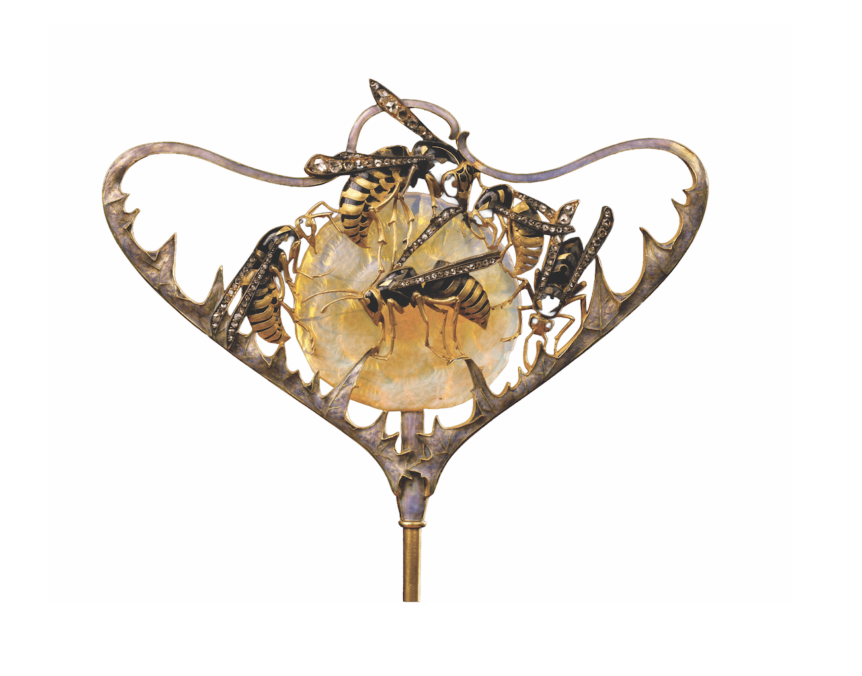
Still, there’s undeniable beauty in the unexpected. When I asked Nick to name his favorite piece of insect jewelry, he didn’t hesitate: a René Lalique hair—or hat—pin set with a mesmerizing central opal, to represent a nectar-laden flower, haloed by wasps. “Imagine it in gaslight,” he said. “It would glow.” Wasps, he explained, are highly unusual in jewelry.
Understanding these historical cycles can help date what you uncover at a flea market today. Dawes says, don’t be too surprised if you find an authentic Egyptian scarab as they were produced in ubiquitous swarms. If you decide to go bug collecting, Dawes recommends looking for gold and silver hallmarks, maker’s marks, and enamel—the unsung hero of insect jewelry—iridescent, and capable of capturing the fragile magic of insect wings.
At the Winter Show in New York in January, I was struck by the painterly effect of enamel in a Victorian butterfly brooch carrying old-mine and rose-cut diamonds, its multi-colored wings set with sapphires and rubies. The brooch rested within the A La Vieille Russie case and was described to me as “en tremblant,” a French phrase meaning “to tremble.” En tremblant refers to a jewelry technique from the eighteenth and nineteenth centuries in which pieces, often diamond-set flowers or insects, were attached to an intricate underbelly of coiled springs or wires—a system set to trigger quavers as the wearer moves.
As for how to wear these antique pieces today, Dawes points out that hat and hair pins are abundant, adaptable, and affordable. They can be worn in your hair or pinned to a lapel. My personal styling tip? Pin a wingbacked creature to your favorite baseball cap for a modern take. There’s something charming about adorning ourselves with insects—creatures that might otherwise cause a stir.
So, break out of your cocoon and pin a piece of poetry to yourself! After all, certain bugs landing on us are said to bring good luck. Whether you’re forging your way to fortune or simply seeking a pesty pet to keep you company, buzzy bling is guaranteed to spark conversation.
In the meantime, I’ll be back at the flea market, eyes trained low, hoping a jeweled insect crosses my path (and no real bugs). Share your bedazzled bug finds, by tagging us @antiquesmag and @christine_hope_hildebrand. I want to see the bee in your bonnet making a buzz.


