
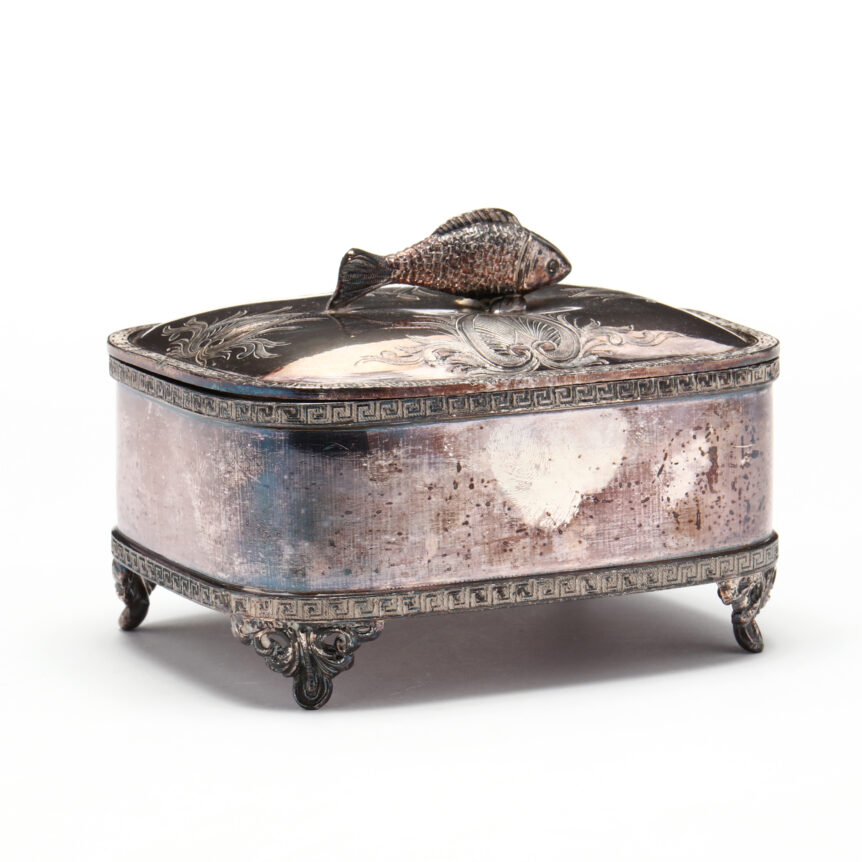
Turns out cult classic conservas—and their accoutrements—aren’t trending for the first time.
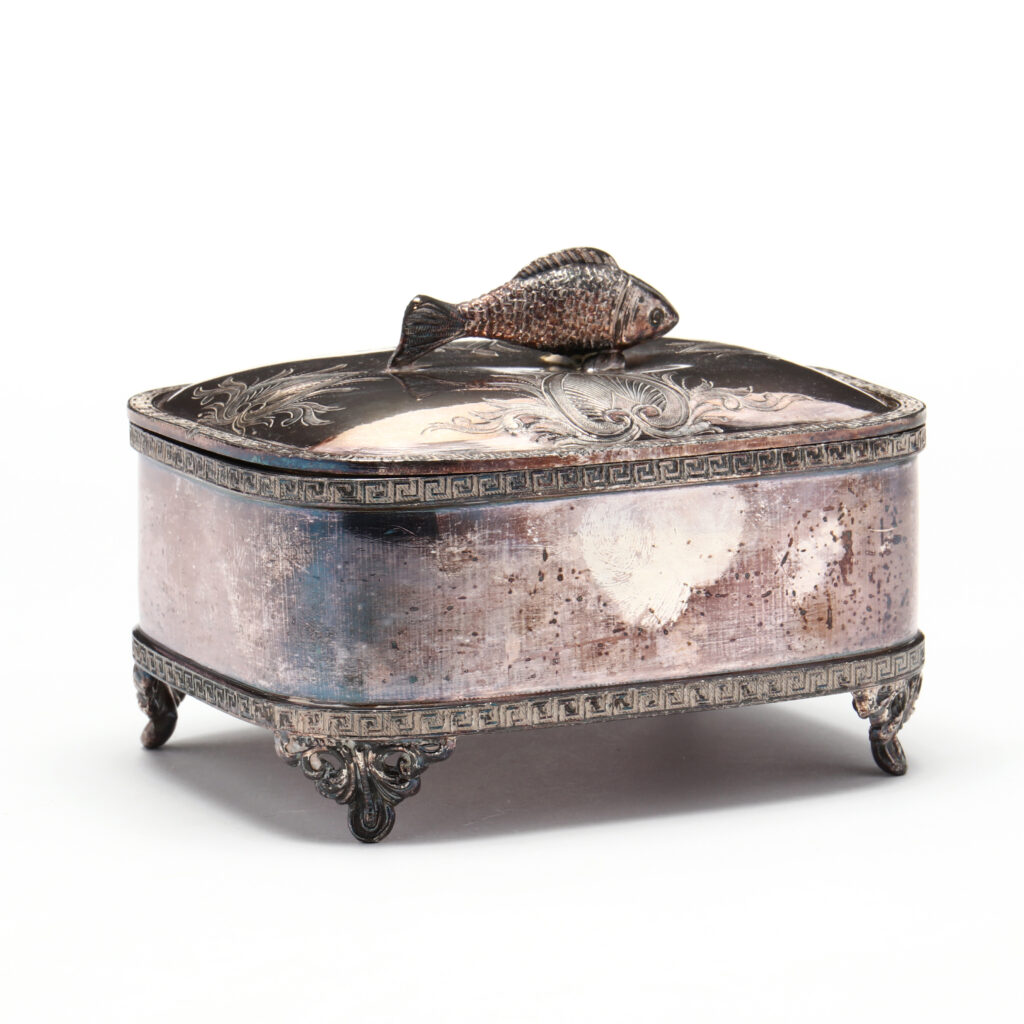
Image © Leland Little Auctions Ltd., Hillsborough, NC.
When I was a young girl, I often slipped up and placed my elbows on the table while eating at my grandmother’s house. As an adult who tries to put her etiquette lessons to good use (Gran did pay for the lessons, after all), placing elbows on the table still feels natural. Yet, I try my best not to, even though she’s not around to catch me.
To be fair, my Gran, Agnes Hope, was born in 1912 and likely was groomed in a similar fashion, raised by proper Victorian parents and grandparents who enforced good manners and embraced objects of specificity. One of my favorite heirlooms from my Gran is a set of silver grapefruit spoons with pointed tips exclusively used to scoop fleshy segments from their peel.
That’s why, when I spotted an antique ceramic dish with a modeled fish handle atop the lid and learned it wasn’t a trinket box, but a way for elaborate Victorian hosts to avoid placing a tin of fish on the table, I laughed and sort of got it. Heaven forbid elbows, a dirty utensil, a drink without a coaster, or a can of smoked rainbow trout or sardines with preserved lemon touch the table. After all, it is said tinned fish is best eaten out of the can!
Unless you live under a rock in a reef, you know tinned fish has undergone a recent glow-up. The latest wave took off around 2022, when TikTok helped popularize “tinned fish date nights,” with salty seafood paired with crackers and pickled accoutrements, charcuterie-board style. Tinned fish has such a cult following in today’s food culture that it’s even earned the nicknames “hot girl food” and “girl dinner,” as seafood’s nutrient-rich benefits meet a decidedly photogenic presentation mixed with zero preparation.
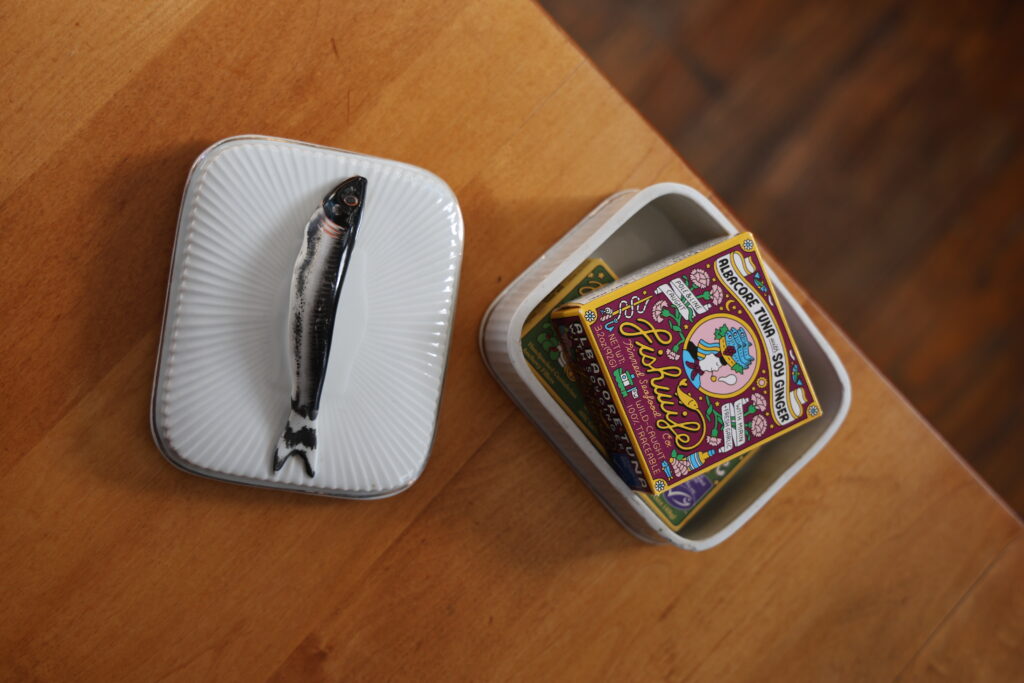
she keeps a tin or two of Fishwife on hand for an emergency snack or convenient “girl dinner.”
Photograph by Christine Hope Hildebrand.
When I first spotted this porcelain sardine box, I thought, “How cute!” My mind quickly jumped to placing jewelry inside it or putting it somewhere on my dresser to hold unforeseen treasures. “Well, your interior style isn’t nautical,” I told myself, and decided to cast the thought of purchasing it aside.
As I typically do, a few days later I thought about the fish dish. “There’s got to be more of a story there.” After all, the hand-painted, arched sardine handle was painted in great detail, making the fish scales seemingly sparkle.
Come to find out, my hunch proved right. As it turns out, Victorians were pretty into tinned fish, too.
Food preservation was changing rapidly in the nineteenth century. Nicolas Appert developed a method of preserving food by heating it in sealed containers; Peter Durand patented the use of tin containers in 1810; and Pierre-Joseph Colin is generally credited with commercializing sardines in oil in Nantes in 1824. Sardines, once highly perishable, could now be preserved and transported far from where they were caught. Suddenly, this humble little fish was something of a novelty.
In the mid-nineteenth century, canned sardines were high-end imported delicacies. But you couldn’t just put the tin on the table. Decorative sardine boxes emerged in porcelain, majolica, glass, and silver, some elaborately painted, with three-dimensional fish doubling as handles. The fishiness was the point.
This tasty tin-to-table meal delivers flavor, Omega-3s, and a side of European romanticism, given the fact that sardines and seafood have been cultural staples in countries such as Spain, Portugal, and France for generations.
Today, the elevated experience of eating tinned fish isn’t so different from the Victorian one. A can of these fruits de mer can fetch ten dollars or more, and tinned sardines, anchovies, mussels, and other preserved seafood are showing up at dinner parties, on “seacuterie” boards, in lunch boxes, and even at my local wine bar, where tinned fish and chips with a glass of Vinho Verde is a hard combination to beat.
Conservas—the Spanish and Portuguese tradition of preserved seafood, often packed in premium olive oil, brine, vinegar-based escabeche, or other preparations—have long been part of Iberian food culture. Canned fish also became an important food provision for ships, armies, and the working class because of its portability, low cost, and long shelf life. Its history has traveled a curious path: from luxury to economical, to everyday staple, and eventually back to a tinned-fish revival delicacy. Today’s bougie bites pay homage to an old tradition of conservas through quality ingredients and packaging that draws on nostalgic recipes, processes, and graphics of old-school manufacturers. Not to mention, modern brands like Fishwife embrace nostalgic and eye-catching branding, making tinned fish a pretty pantry staple.
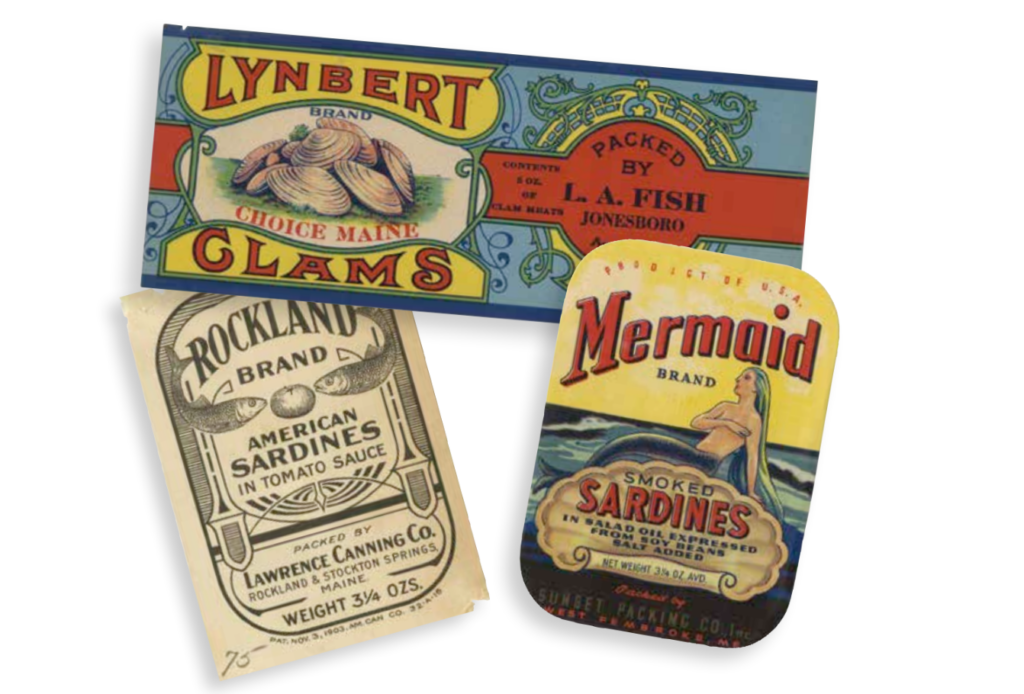
made Maine seafood delicacies feel fun and friendly to Americans across the country.
Photographs courtesy of the Tides Institute & Museum of Art, Eastport, Maine.
Once you grow your school of antique sardine boxes, keep an eye out for accompanying tongs and forks, too. There is always another little piece of the story hiding nearby. My fish dish was under $45, while others, typically older and more decorative, require you to dive deeper into your pockets to shell out a pretty penny.
I guess the lesson here is this: the next time you’re out antiquing, try not to judge a dish by its cover. Lift the lid. You might find a bit of glimmering history hiding inside. And, well, if you happen upon an antique sardine box? I’d reel it in.


