
At the American Folk Art Museum, objects from across centuries reveal how patriotism, memory, family, faith, and dissent are crafted, contested, and carried.
The objects illustrated are in the collection of the American Folk Art Museum, New York. Gift of the Hirschhorn Foundation.
As the American Folk Art Museum marks its sixty-fifth anniversary in the same year as the country’s Semiquincentennial, we have been reflecting on the formation of American identities through the lens of folk and self-taught art, both as a range of artistic practices and as evolving collecting categories. In this spirit, the museum’s 2026 exhibition programming provides three exciting opportunities to reconsider intersections between American history and the history of the field.
Looking ahead to this fall, AFAM will be presenting Locating Girlhood: Place and Identity in Early American “Schoolgirl” Art, a major loan exhibition exploring the often-overlooked contributions of girls and young women to the shaping of an American sense of self between about 1750 and 1850. Our current exhibitions—Self-Made: A Century of Inventing Artists and Folk Nation: Crafting Patriotism in the United States—also take up the question of how art and identity have influenced one another across time. Self-Made focuses on the individual agency of the artist in the twentieth century and is discussed by colleagues Valérie Rousseau and Suzie Oppenheimer in this issue. Folk Nation takes a broader look back at objects in AFAM’s collection from the eighteenth century on. The pages that follow highlight selected works from the exhibition, bringing into dialogue recent acquisitions and beloved treasures of the museum’s collection.
Americans have long crafted and preserved objects as a way of telling stories about themselves. Especially after the Revolutionary War, and with renewed energy around the time of the 1876 Centennial, people turned to all kinds of early American artifacts to construct a national history and express a patriotic spirit. Expanding on this legacy, collectors, dealers, curators, and artists began applying the term “folk art” in the early twentieth century to champion a wide range of forms of American creative production from the 1700s onward. Covering a kaleidoscopic array of genres produced outside the academic art world—from weathervanes and trade signs to quilts, carvings, and painted portraiture—the idea of folk art was put forward as a symbol of authenticity, ingenuity, independence, and patriotism, representing key values perceived to be at the heart of American culture.
But concepts of folk art were often romanticized, idealizing a homogenous citizenry and a nostalgic, incomplete view of both the past and the present. Especially beginning after World War II and continuing into the present, advocates in the field have pushed for a more inclusive, intentional framing of the folk art category. Extending our perspectives allows for a celebration of a greater breadth of creative traditions and enables a fuller acknowledgment of moments of darkness, as well as pride, in the American story.
width 15, depth 2 inches. Gift of Jerry and Susan Lauren.
On view in AFAM’s Audrey B. Heckler Gallery, Folk Nation offers an opportunity to look anew at the ways Americans have defined themselves through the making, collecting, and passing down of vernacular objects. Organized to emphasize key themes in American creative expression—including not only patriotism but also dissent and grief, family and heritage, personal and collective memory, spiritual vision and faith—the works on view demonstrate how folk art has been used as both a mirror and a tool, reflecting and also giving shape to a multiplicity of American identities across the centuries.
When the idea of American folk art first rose to popularity in the early twentieth century, it was idealized as evidence of a distinctly American artistic heritage. Admirers underscored the symbolic value of “simple,” “pure” American craftsmanship supposedly untainted by academic, European trends—conveniently serving the project of constructing “a usable past” for a still young country advocated by literary critic Van Wyck Brooks in 1918.
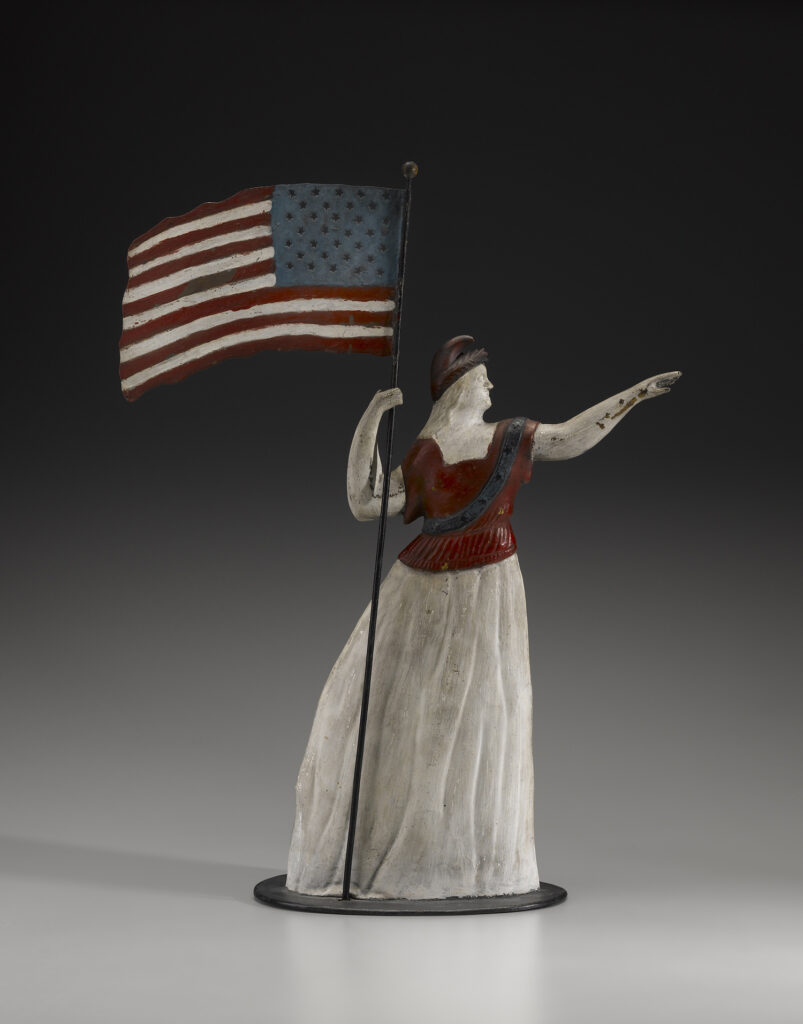
Direct expressions of patriotism were especially well aligned with these points of emphasis. A range of exuberantly designed objects in Folk Nation testify to the breadth of mediums and visual vocabulary employed by makers, as well as later collectors, to express love of country: for instance, an “Uncle Sam” whirligig bedecked in red, white, and blue or a woven coverlet with the Capitol and the eagle of the Great Seal repeated along the border. Relying on well-known emblems to decorate everyday objects, makers created enduring references to a common sense of national pride, rendering patriotism visible throughout the American material landscape.
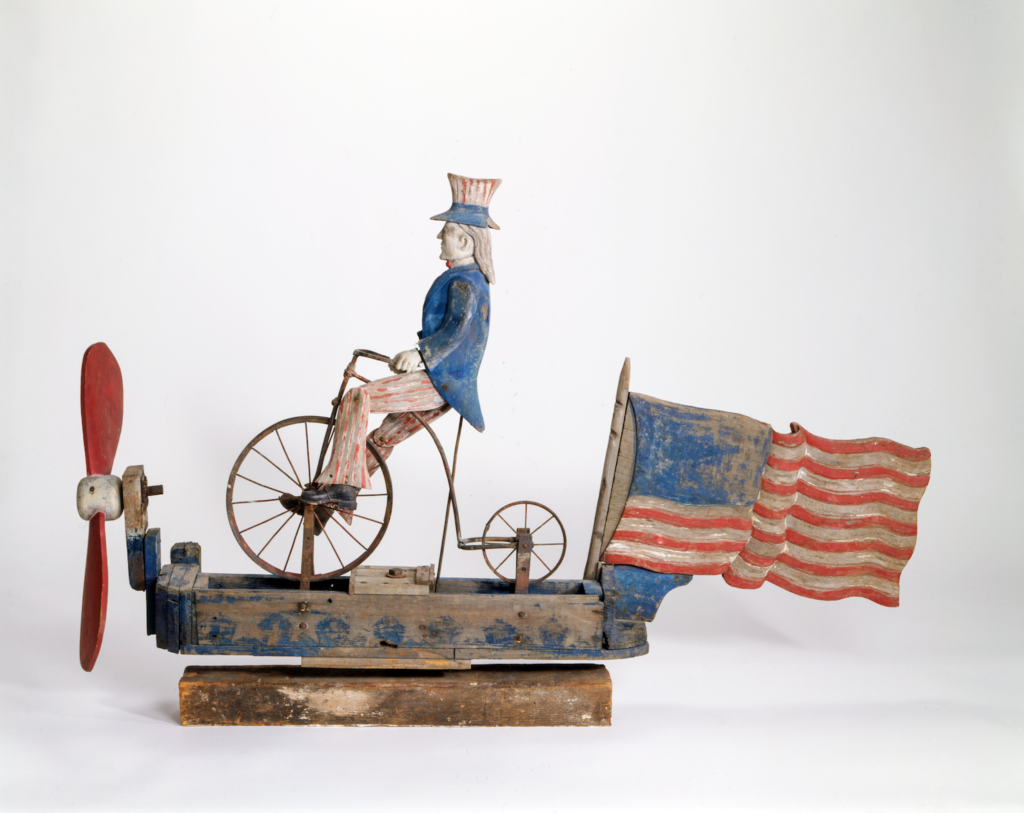
Gift of Dorothea and Leo Rabkin.
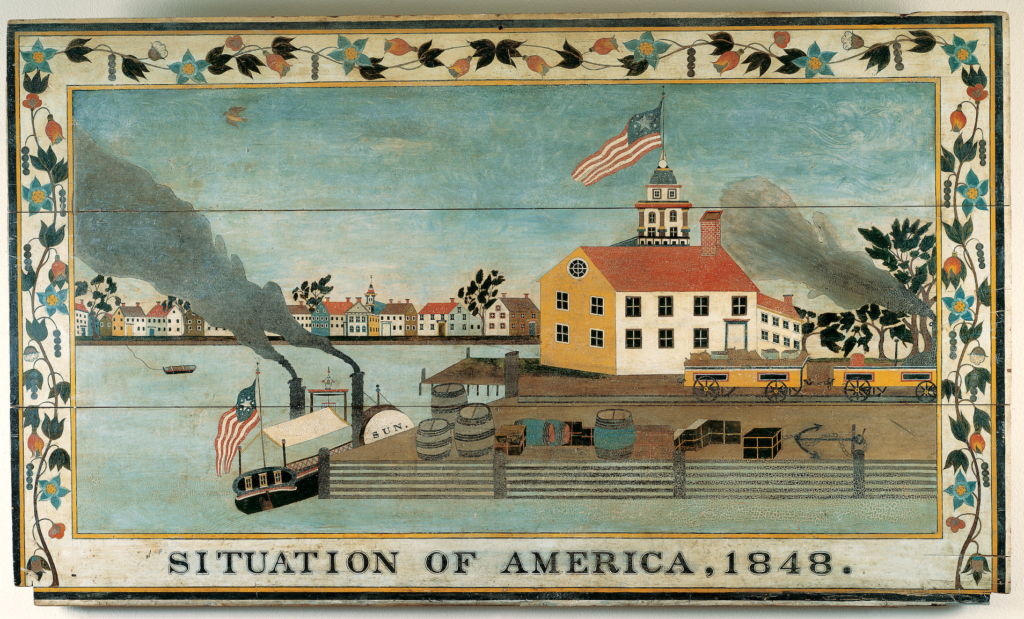
Even in the context of such outwardly celebratory objects, Folk Nation’s interpretation challenges oversimplified narratives of American patriotism through historical background and the encouragement of close looking. In the now canonical nineteenth-century overmantel painting Situation of America, 1848, the New York City waterfront presents an optimistic vision of urban and industrial progress, topped with a waving flag. But the bright colors and ordered layout are darkened by the presence of billowing clouds of steam emanating from a freight train and a paddle wheeler, foreshadowing the environmental costs of industry. Simultaneously, a decorative border of cotton blossoms hints at the brutal reality that gave shape to American affluence: the country’s reliance on enslaved labor.
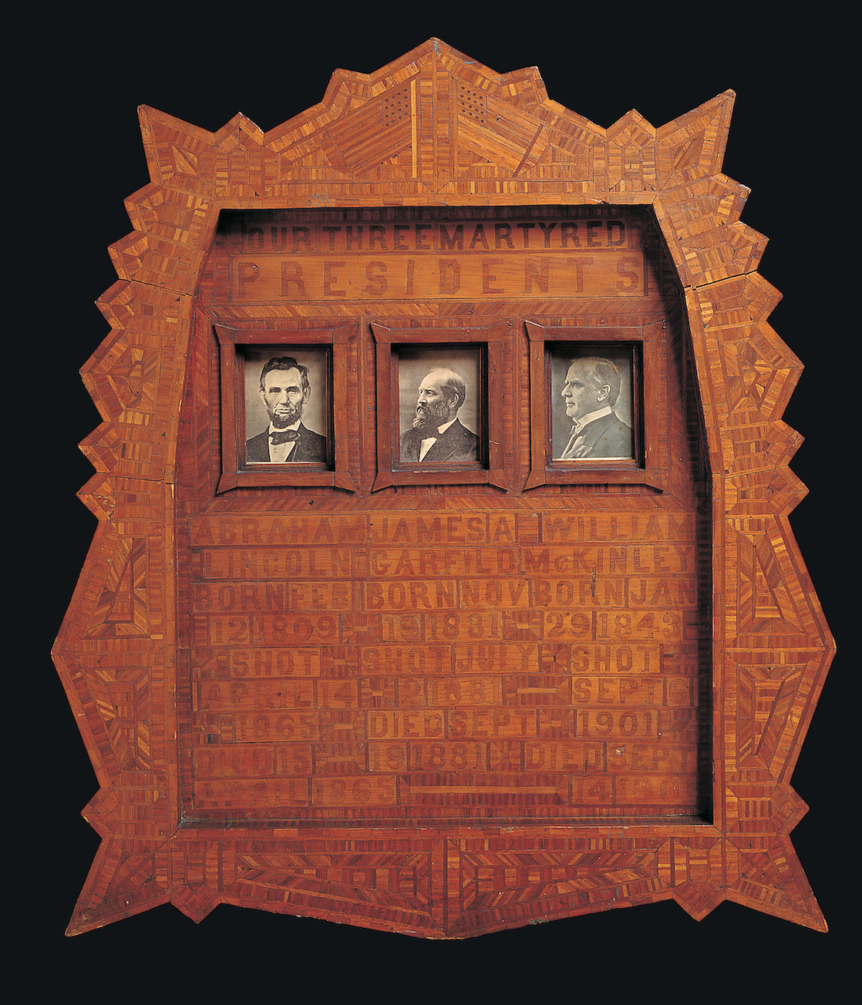
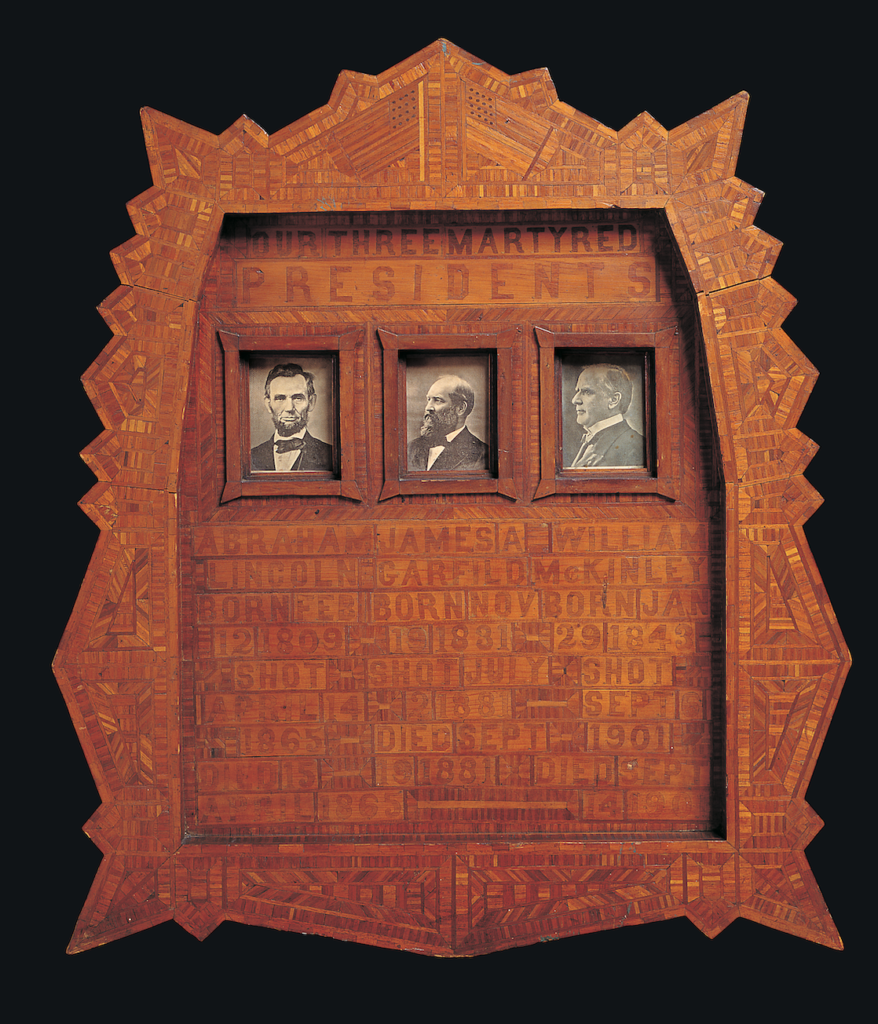
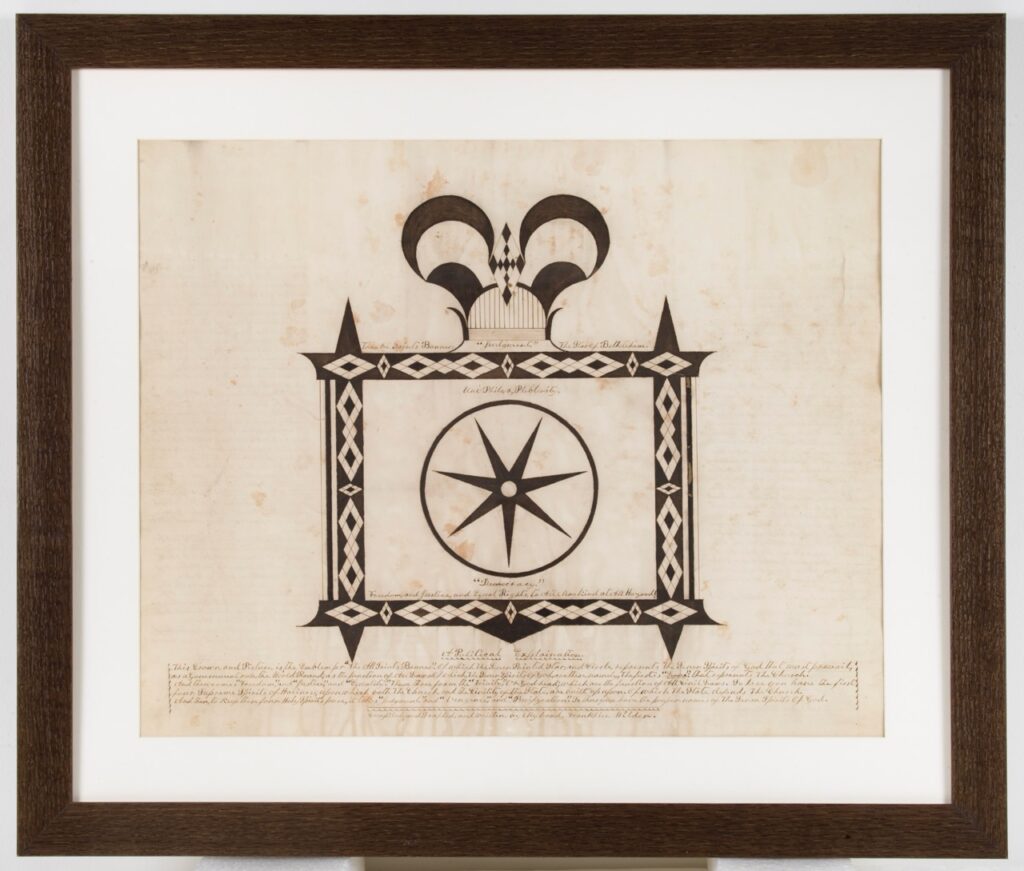
While these details are subtle and now carry significance that was likely unintended by the artist, several works on view engage explicitly with political topics, providing creative outlets not only for national pride but also for dismay, anger, and dissent. A memorial seen here incorporates photographs of Abraham Lincoln, James A. Garfield, and William McKinley—three presidents assassinated over the course of just thirty-six years. The painstaking craftsmanship of the inlaid wood frame gives literal weight to the sense of grief over political violence and loss of leadership. In a hand-drawn condemnation also seen here and its companion piece (to be placed on view later this year), Franklin Wilder makes use of his freedom of speech to rail forcefully against governmental and social injustices, including slavery, war, and the Ku Klux Klan.
A number of other key themes in Folk Nation emerge from the importance of creative production in everyday American life. Family and heritage have historically been central to how Americans have imagined themselves and their place within a changing nation. Objects selected for the exhibition show how early American artists and artisans gave tangible form to kinship and family identity by creating material records that joined personal relationships with public ideals. As new markets for portraiture and printed designs expanded, Americans embraced opportunities once reserved for the elite, generating likenesses and other visual affirmations of their place in a shifting social order.
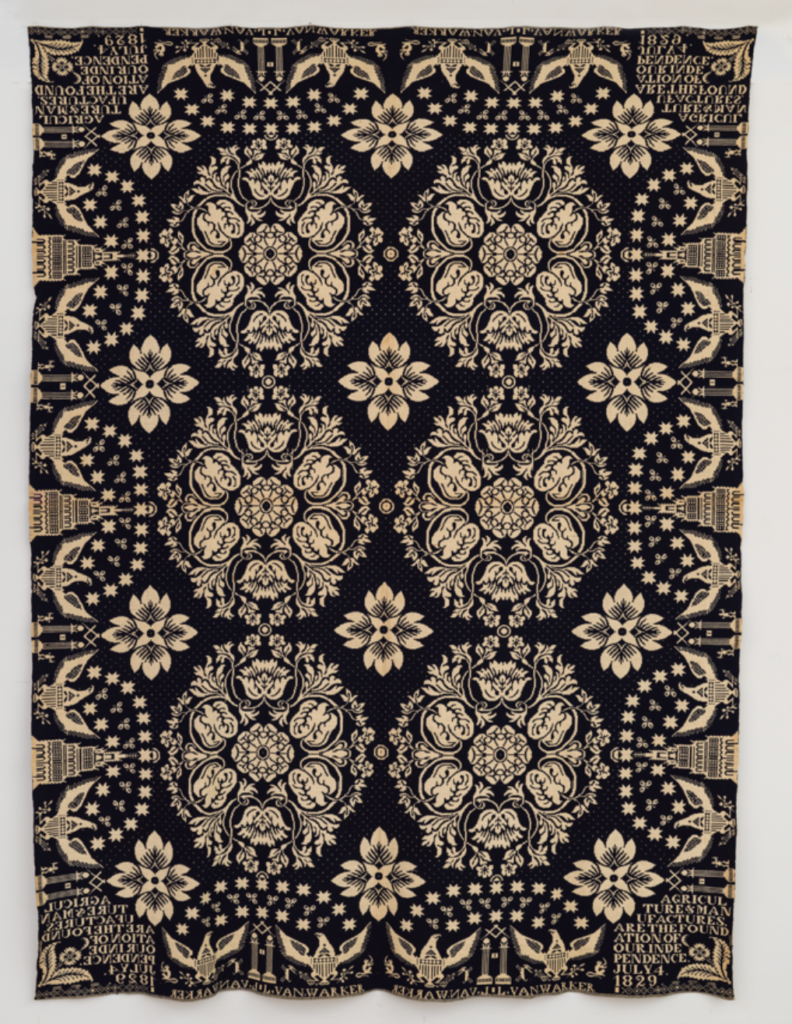
Gift of Birgit Lorentzen.
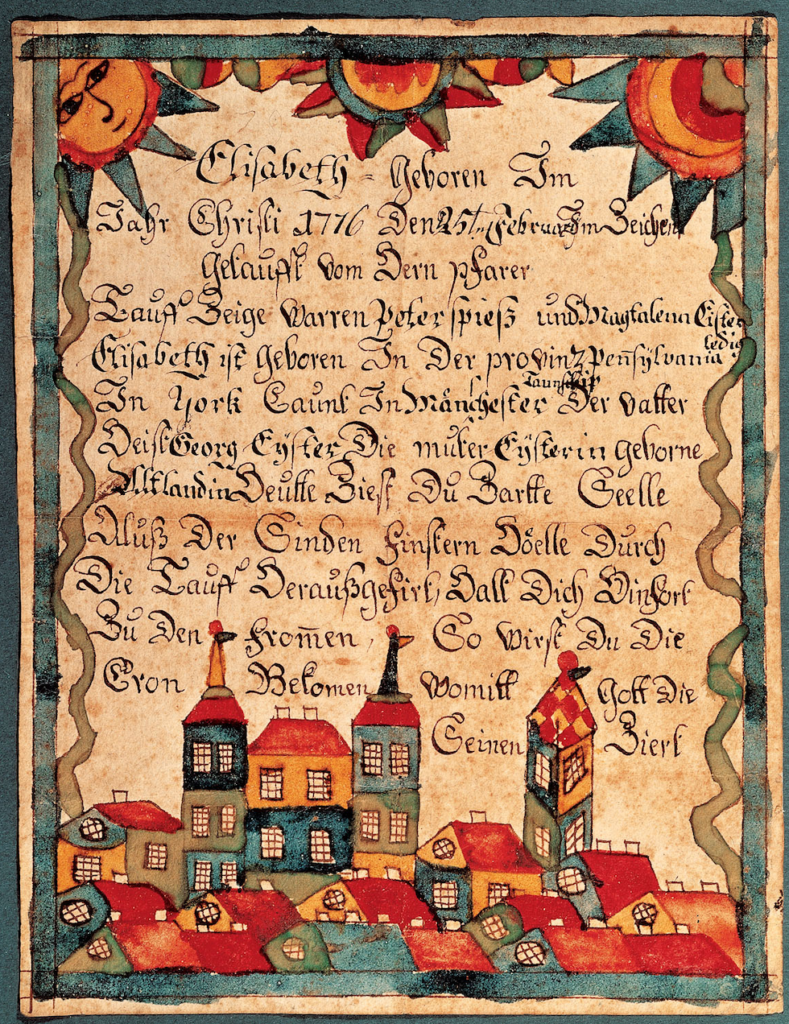
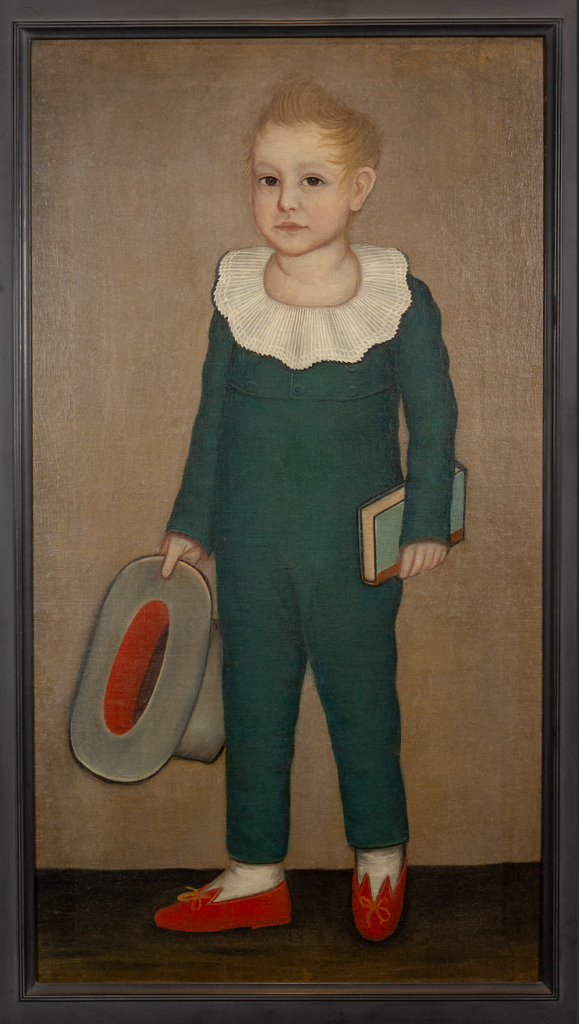
Portraitists like Ammi Phillips offered their services across rural communities, representing the aspirations of a growing middle class. Artists also documented family relationships, transforming lineage into ornament through hand-drawn records such as a Pennsylvania German Taufschein, or baptismal certificate. Needlework and other childhood art projects offered girls and young women ways to visualize family structures and social rites of passage such as courtship. Even as many Americans, including families of color and those who were less affluent, remained limited in their participation in such art forms, these works trace the beginnings of a democratization of family imagery in an age of emerging national self-definition.
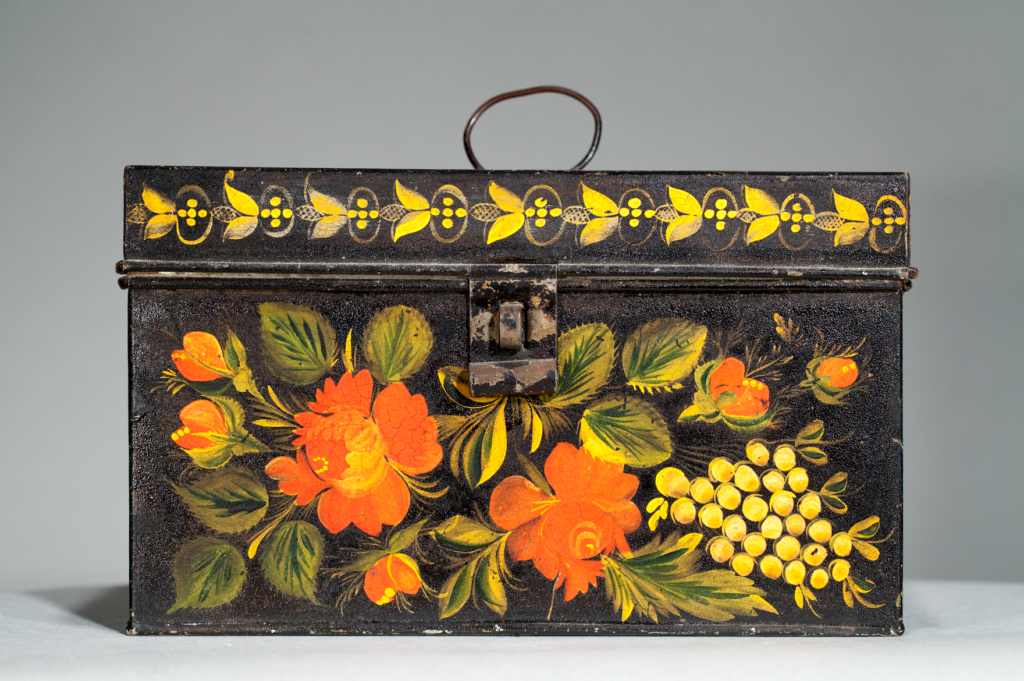
Gift of the Historical Society of Early American Decoration.
Collectors of folk art have often infused less clearly personal objects with a deep sense of the past, reflecting powerful links between American identity and historical memory. For instance, a paint-decorated tinware trunk both gestures to domestic life and industry in early nineteenth-century Maine and captures the semi-mystical connection felt by a later, twentieth-century owner, Americana scholar Esther Stevens Brazer. Herself a practitioner of traditional decorative painting techniques, Brazer expressed awe upon discovering her family connection to tinsmith Zachariah Brackett Stevens, her great-great-grandfather. As she recorded in undated autobiographical notes now in the papers of the Historical Society of Early American Decoration: “Perhaps this inheritance is responsible for the pride I take in matching the skill of old-time craftsmen.”
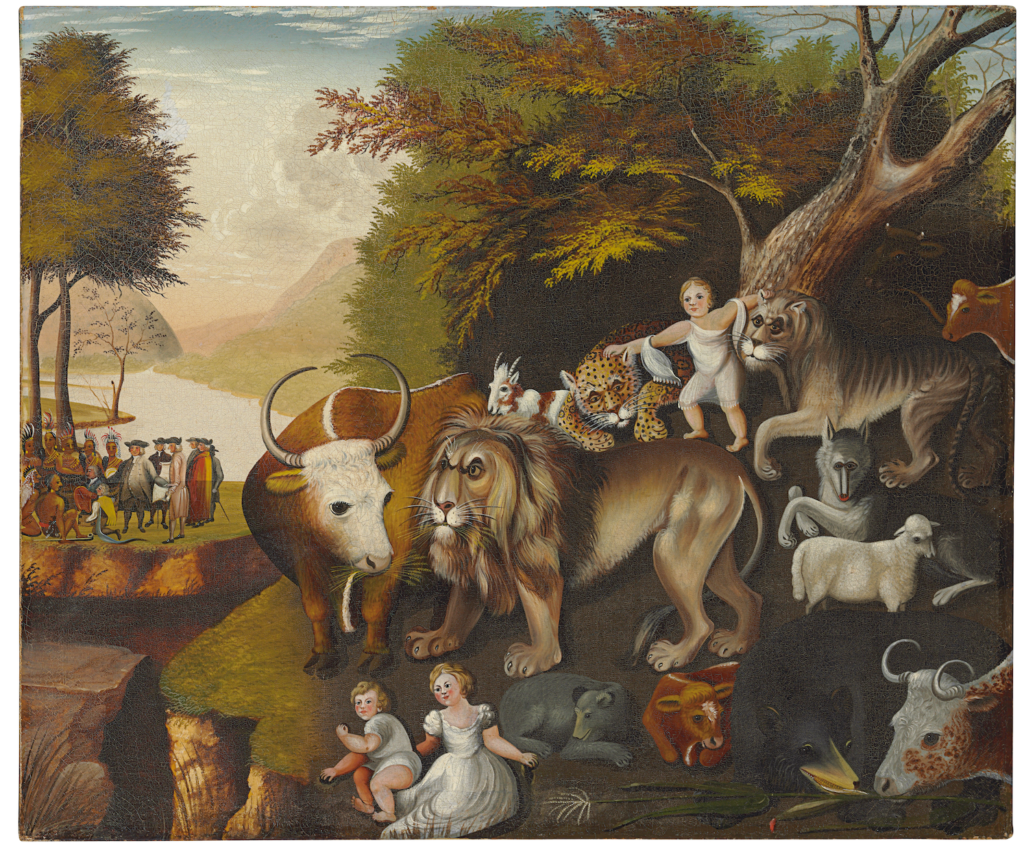
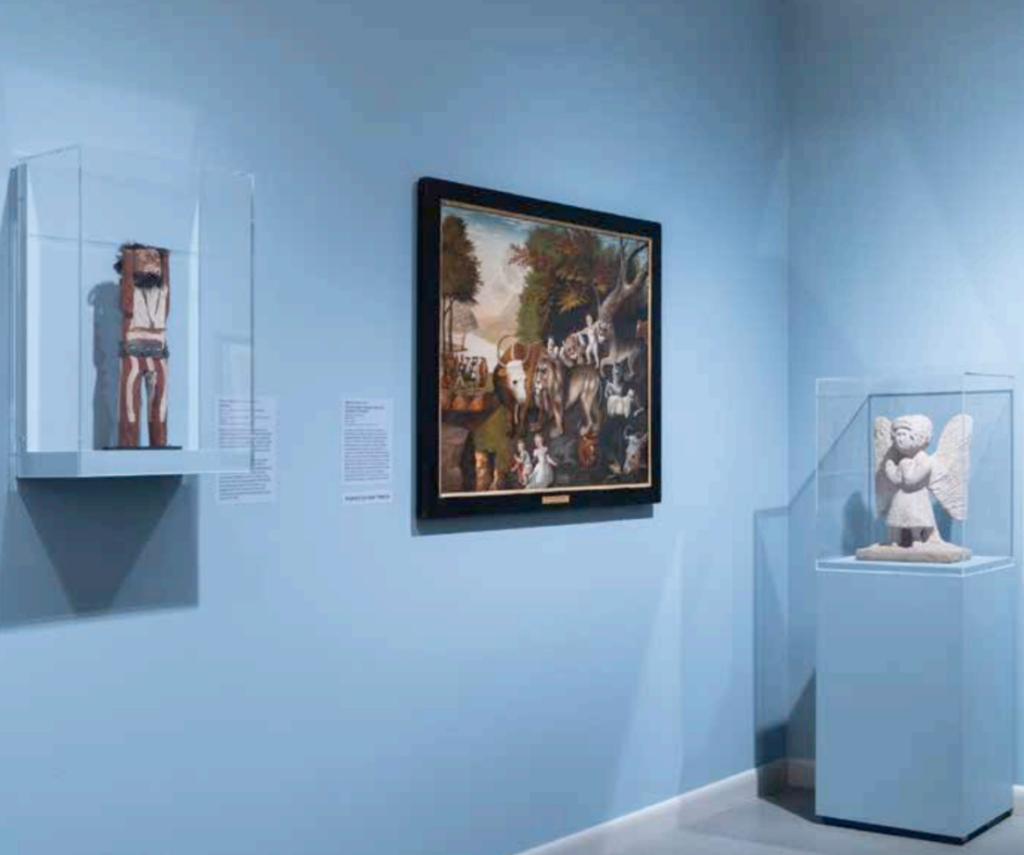
Spiritual traditions have of course also directly shaped the production of American folk art. Across cultures, artists have transformed raw materials into vessels of devotion—using art to materialize their faith, to heal, and to connect earthly experience with the divine. Edward Hicks’s The Peaceable Kingdom provides an iconic example. A Quaker preacher and commercial sign painter, Hicks created more than sixty variations on this subject. Inspired by the biblical prophecy in Isaiah 11:6–9, the scene depicts harmony among all living beings: lions and lambs, children and bears. In the background of the example here, the Quaker leader William Penn concludes a treaty with Tamanend, chief of the Lenape Nation, an event that came to symbolize the founding of Pennsylvania—though its spirit of coexistence was later betrayed by broken promises and the dispossession of Native land. By linking this earthly moment of concord with a heavenly vision of peace, Hicks envisioned a distinctly American ideal of moral balance and hope—an aspiration that continues to resonate in times of division.
Gift of Kendra and Allan Daniel.
A sculptor of gravestones, garden ornaments, and other figurative works, William Edmondson was also deeply motivated by religious beliefs. He began carving at age sixty after, as he recalled, Jesus “planted the seed of carving in me.” Working with discarded limestone and using repurposed tools, such as chisels made from railroad spikes, his stone sculptures were born of his enduring Christian faith. In 1937 Edmondson became the first African American artist to receive a solo exhibition at the Museum of Modern Art—a landmark project that introduced his work to a national audience. Today, Edmondson’s art remains foundational to the recognition of twentieth-century Black southern makers within the American canon of artists working outside the academic mainstream. Almost sixty-five years ago, soon after its founding, the American Folk Art Museum honored Edmondson with its first monographic show, and his work is especially fitting as a capstone to Folk Nation.
In addition to its thematic explorations of artistic production and American identity, Folk Nation serves an important purpose as an introduction to AFAM’s holdings and the ideas that shape our mission. We look forward to continuing opportunities to deploy the Audrey B. Heckler gallery as an orientational space for our visitors, welcoming longstanding admirers of the folk art world as well as newcomers to our recently renovated space.
Barbara L. Gordon Collection.
EMELIE GEVALT is the Deborah Davenport and Stewart Stender Deputy Director & Chief Curatorial and Program Officer at the American Folk Art Museum.
CAROLINE CULP, formerly the Warren Family Assistant Curator at the American Folk Art Museum, is the Brock Curator of American Art at the Chrysler Museum of Art in Norfolk, Virginia.


