
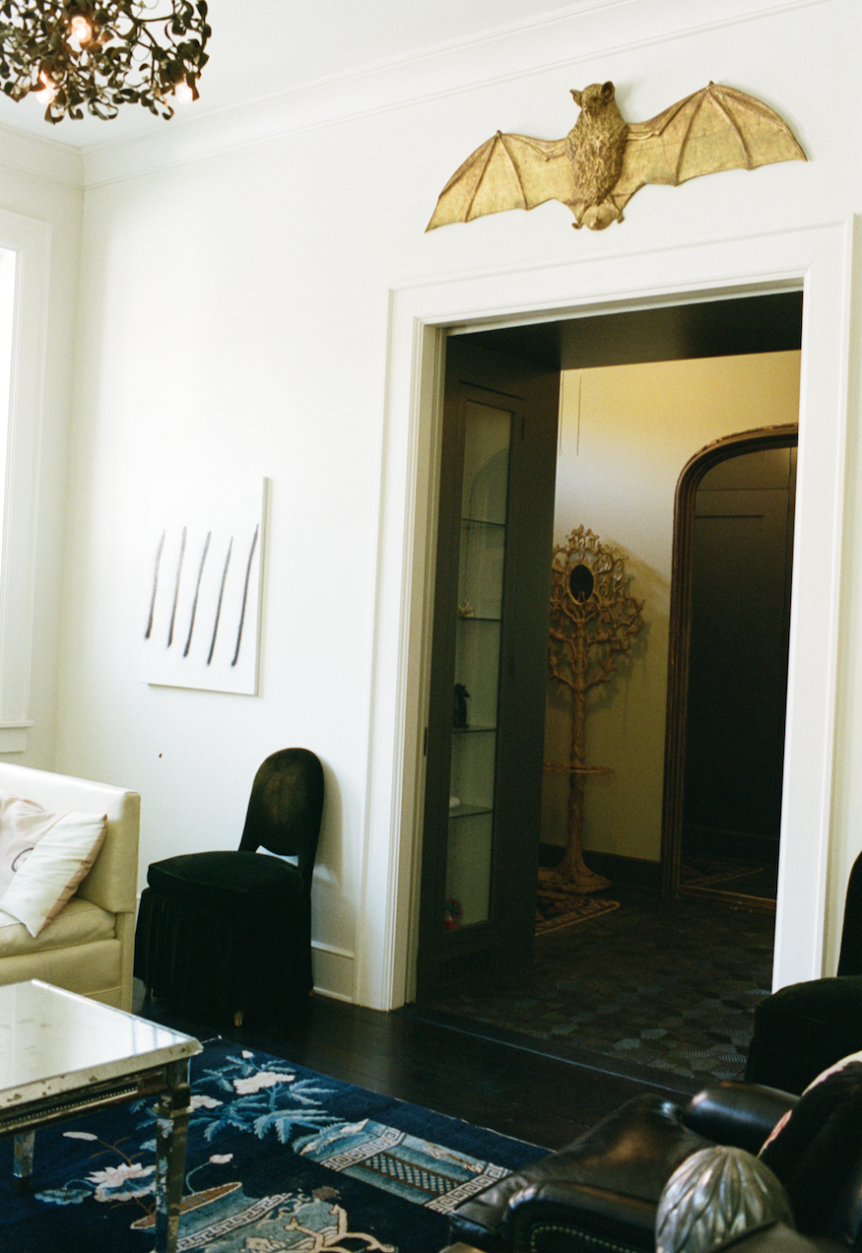
The story of how Robert de Montesquiou’s gilt bat made its way to the West Village town house of gallerist Matthew Marks and writer Jack Bankowsky.
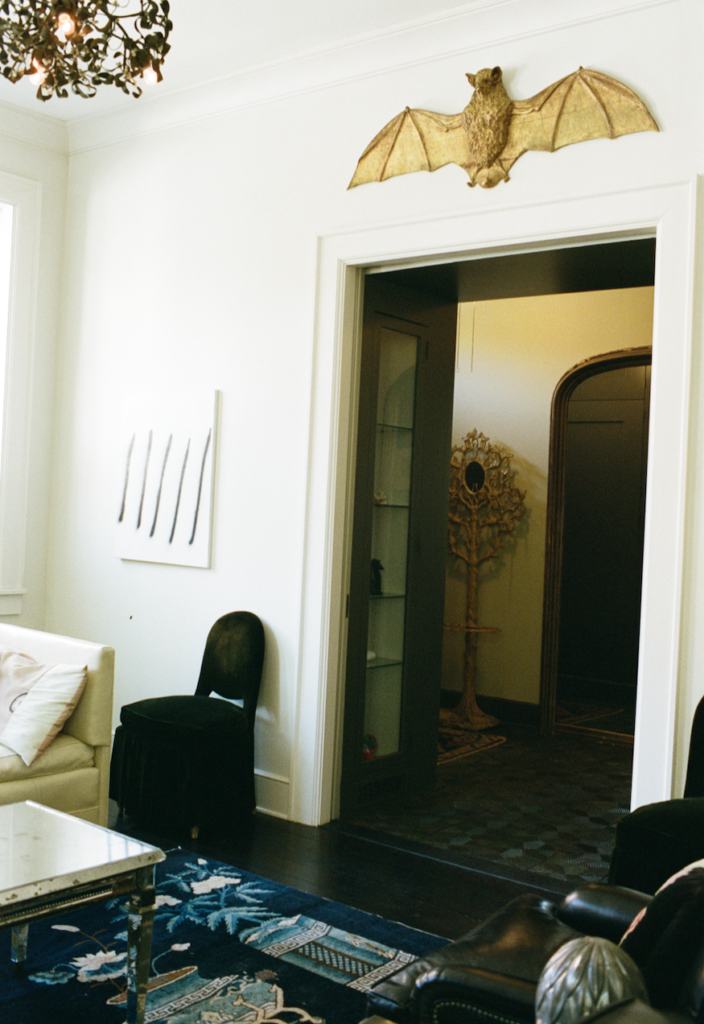
previously owned by Robert de Montesquiou (1855–1921) and Frederick W. Hughes (1943–2001) above the door and one of
Misia Sert’s “strange widows” at left. Photograph by Dominique Nabokov.
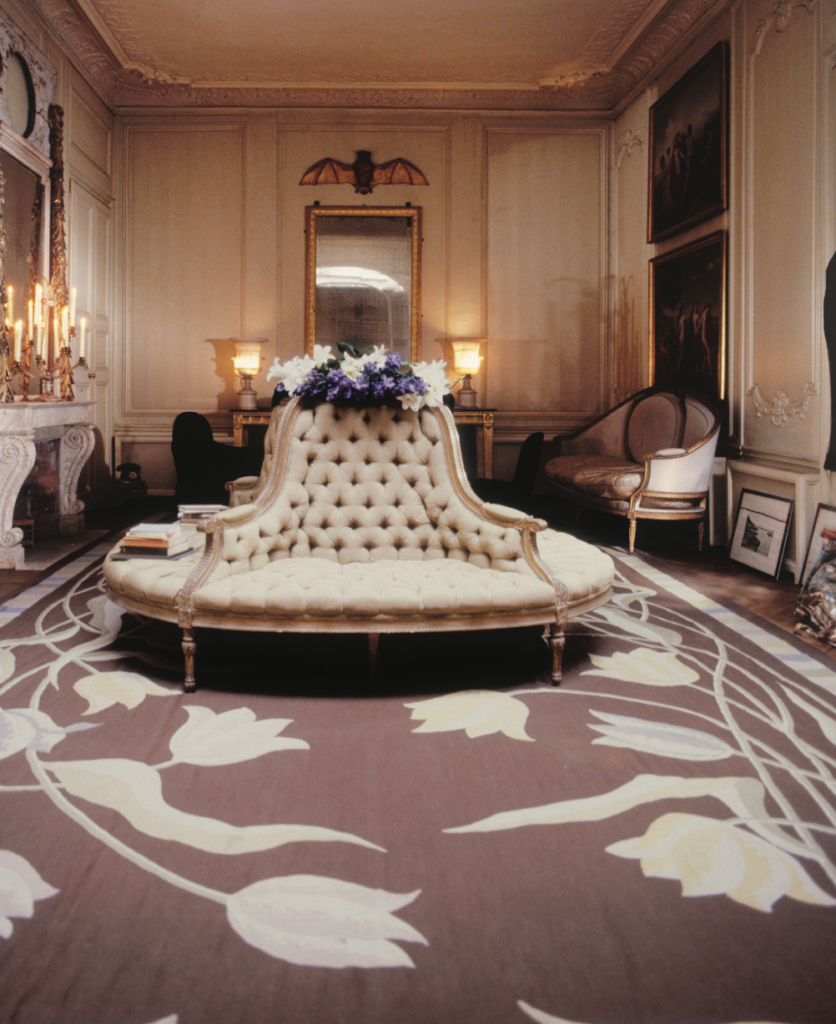
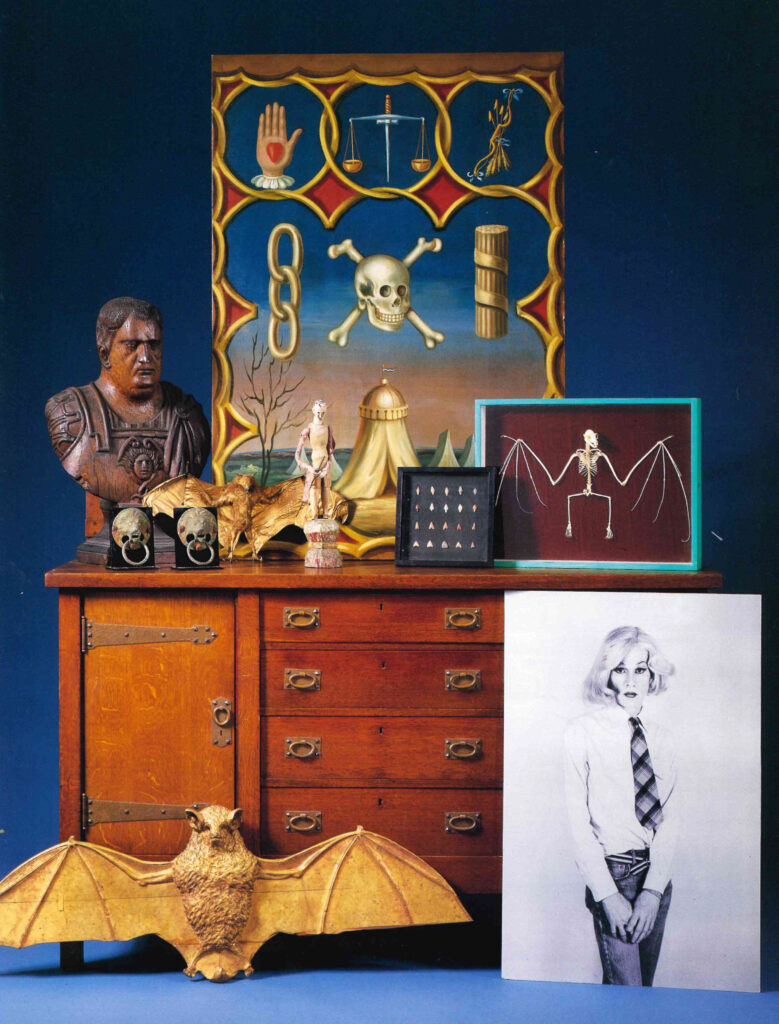
Last winter at a holiday party in Manhattan’s West Village, I came face-to-face with an object that would come to crystalize so much about my own taste that I had never been able to put into words. Catching up with Jack Bankowsky, in the warm front parlor of the house he shares with his partner, Matthew Marks, something gilt caught my eye above the doorway behind him: a bat. I recognized the large, sculpted creature—wings outspread—from an eerie image that had struck me years before of a paneled Parisian interior belonging to Fred Hughes, the business manager of Andy Warhol. In the image, the bat hangs above a mirror over two Empire consoles, piled with books, a broken bust, and lit by glowing alabaster urns. I did not know what to make of its presence in my host’s house, but I could tell this shimmering creature-of-the-night was something special, if only for the sense of the macabre it radiated.
And it was, indeed, special. Our story starts with Robert de Montesquiou, the fin-de-siecle aesthete who was known in his time as “the bat.” The model for Proust’s Baron de Charlus and Huysmans’s Des Esseintes, New Yorkers will recognize him as the subject of a captivating full- length portrait by James McNeil Whistler at the Frick, portraying the count in eveningwear, a cape draped over one arm, cane in hand. In letters between the artist and his subject, they playfully address each other as “the bat” (cher bat) and, for Whistler, “the butterfly” (cher butterfly).
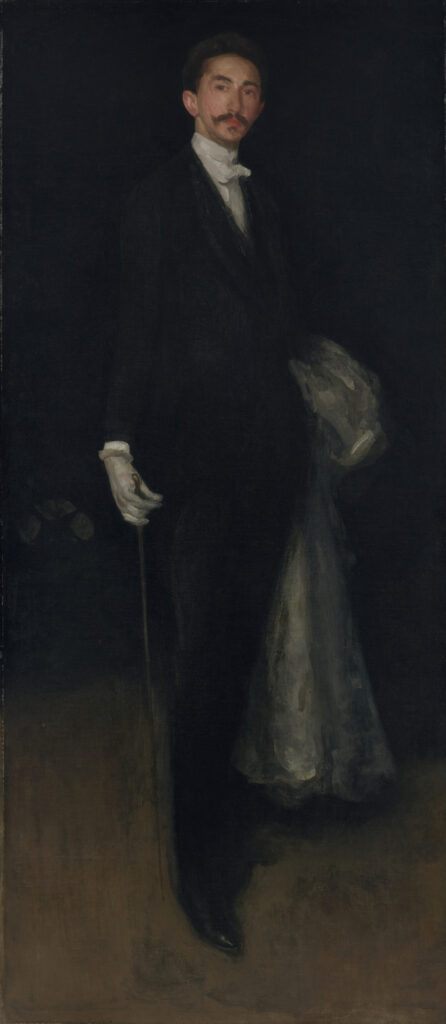
(1834–1903), 1891–1892. Oil on canvas, 82 1/8 by 36 1⁄8 inches.
Frick Collection, New York; photograph by Joseph Coscia Jr.
Montesquiou, a writer, poet, and painter in his own right, had a complex relationship with the myths that surrounded him, but he deliberately engaged with the process through which he was transformed by other artists into material for their work. The status of unattainable muse, molded with determination and precision into a form of self-expression, was a concept he borrowed from the much-worshipped Countess Castiglione. The reclusive courtesan, once a mistress to Napoleon III, pioneered the use of photography to artistically construct identity, and later became an important touchstone for the surrealists. Though they never met, it was not for Montesquiou’s lack of trying, and he collected dozens of her sought-after photographic portraits by Pierre-Louis Pierson and hunted for her scattered possessions after the countess’s death in 1899.
If the Countess Castiglione’s medium was photography, Montesquiou’s was room-building. The worlds he created in his houses became the most potent element of a persona around which he has been immortalized. It was the eleven tiny rooms, or boyaux (intestines), as he called them, that he occupied at the top of his family’s hôtel particulier from the ages of nineteen to thirty-three, which Stéphane Mallarmé visited in 1878. Joris-Karl Huysmans acknowledged them, as later described to him by Mallarme, as the inspiration for the house to which his protagonist Des Esseintes retreats in self-imposed exile in the Decadent novel Á Rebours.
Beyond the front door, with a knob fashioned from the repurposed handle of a rococo cane, the thébaïde raffiné splayed out in every direction. The foyer was draped in verdure tapestries with a moss-green rug on the floor, scattered with Chinese bronze animals, and processional lanterns hung above at varying heights. The bedroom was clad in a shimmering wallcovering that gradated from mauve to night blue to lilac, as if to suggest the changing colors of the sky from day to night to dawn and carpeted in a deep violet. His bed was apparently fashioned from fragments of a carved Chinese Buddhist altar, assembled in the form of a Chimera. Montesquiou liked the play of words between his submerging into “Un sommeil enchanté” and of waking up again “dans sa chimère,” or in his dream. But it is in the “moon room,” with its life-sized fish painted on walls under layers of translucent silk mesh evoking an illusion of water, that we may glean something of the origins of our gilt “chauve-souris.” Montesquiou described this space as, “a very ordered jumble, penetrated with symbols” and indeed, nocturnal animals abound in every medium: panthers, owls and countless . . . bats.
Unlike Des Esseintes, however, who creates a house as an escapist distraction, Montesquiou sought to poetically engage with his rooms, generating new sensorial experiences and symbolist expressions. “I consider these fantasies of walls and furniture as writing, both literary and musical,” Montesquiou says in Les Pas Effacés; Mémoires. The synesthesia he sought in room-building can be understood as part of a larger arc of artistic production, something he, himself, did not differentiate from his poetry, paintings, and decorative arts objects. From the marquetry chest of drawers Montesquiou designed with Émile Gallé (with a hydrangea motif) to the spectacularly embossed binding of his books, Montesquiou’s practice was elastic, shaped by what he termed “thematic correspondences,” in the spirit of Baudelaire.
Robert de Montesquiou died in 1921 and was buried in a grave he designed next to his companion of twenty years, Gabriel de Yturri; his many possessions scattered to the wind via auctions and inheritances. Half a century later, Fred Hughes purchased a two-bedroom apartment in the 7th arrondissement of Paris from the estate of Violet Trefusis. Though ostensibly for Andy Warhol to use, and with the large bedroom on the main floor reserved for his employer’s very infrequent stays, the apartment became associated most strongly with Fred, who took over the small maid’s room located up a flight of stairs. He got to work renovating the flat with Andrée Putman, with whom he and Andy shared a burgeoning taste for 1920s design, and installed a brown marble Jean Michel-Frank–inspired bathroom and a deep green kitchen with a glass block screen, à-la-Pierre Chareau.
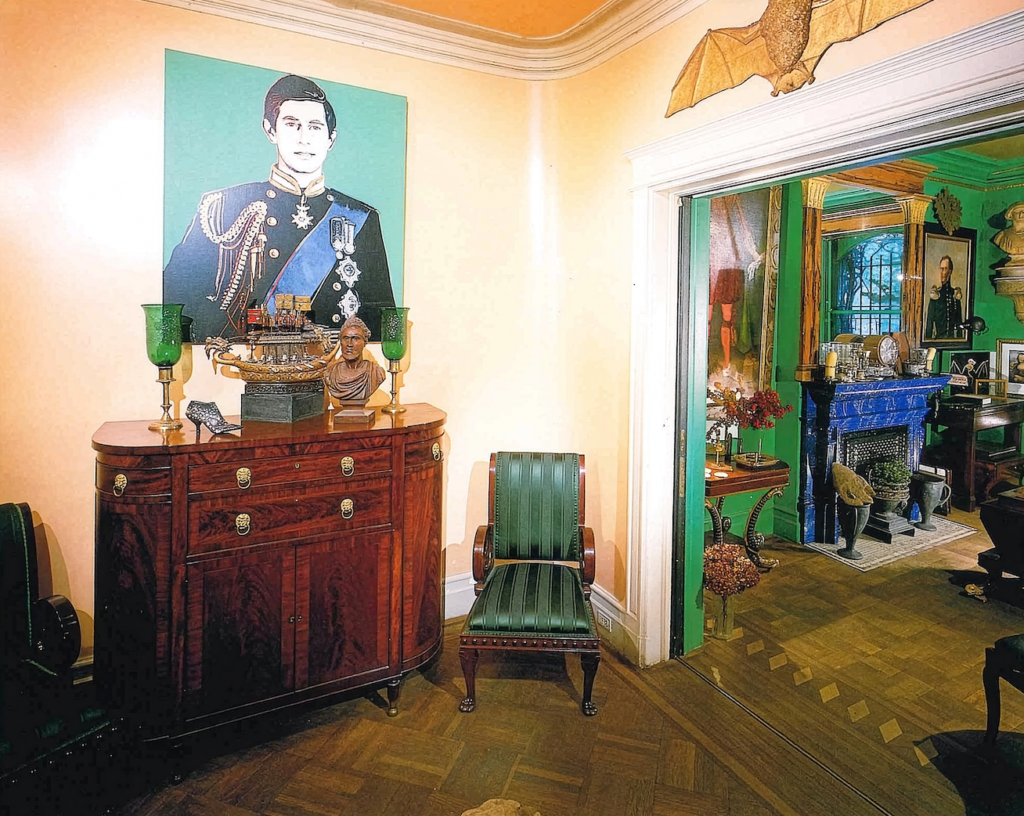
The image from which I recognized the gilt bat in New York that holiday party turned out to have been part of a suite of haunting photographs taken by Jean Kallina for a piece by Ingrid Sischy in the July 1989 issue of House & Garden, entitled “The Hands of Time.” Sischy describes “Mr. H” as having traversed the antiques shops and flea markets of Paris with discernment, quickly snapping up this and that for the flat. It was during this process that he ostensibly acquired our gilt bat, which, while without documentation to prove it, was tacitly understood by all who visited him there to have once belonged to Robert de Montesquiou.
Matthew Marks, who stayed there several times in the 1980s, shared, “The place was very alive, very peculiar—the living room, where the bat was located, was a sort of murky cave, lit by a skylight above and without any other windows—kind of magic” He described casually opening a drawer while looking around one day, and finding it stuffed to the brim with unframed Man Ray photographs and that, in fact, every drawer and every closet was filled with incredible stuff. In Kallina’s images, we can see a cheap rococo revival sofa, purchased from the auction of a New York hotel, centered on a spectacular Ernest Boiceau rug. Scattered around are a suite of little chairs that the article tells us once belonged to Misia Sert, Coco Chanel’s closest friend, decorator, and the mistress of Éduoard Vuillard, in whose paintings we can find some of the only records of her profoundly influential work. Fred Hughes apparently referred to these chairs, which he had received in their original dark green dress-weight velvet, supplied by Chanel herself, as his “strange widows.” The space is mysterious and charmingly unresolved; any spookiness dissected by wit. When asked by Sischy to describe his decorating style for the article, Hughes replied, “ghost chasing,” an approach he believed was “lost in the 1960s when everything went minimal.”
Warhol’s kindred spirit, Hughes was obsessed with iconography—seemingly less concerned with the emotional configuration of a personality and more with the way an individual is represented or represents themself through images and objects. That he is credited with architecting Warhol’s lucrative portrait commissions (one for $25,000; two for $40,000), seems less indicative of a genius business sense and more the organic extension of the way he saw people: a network of symbols vividly collapsing person and persona. One of his many ghost-chasing strains strikes me as particularly able to distill his motivations for collecting and in life: several hundred eighteenth- and nineteenth-century cut-paper silhouettes of tony Americans, many of which resemble Hughes himself and his friends.
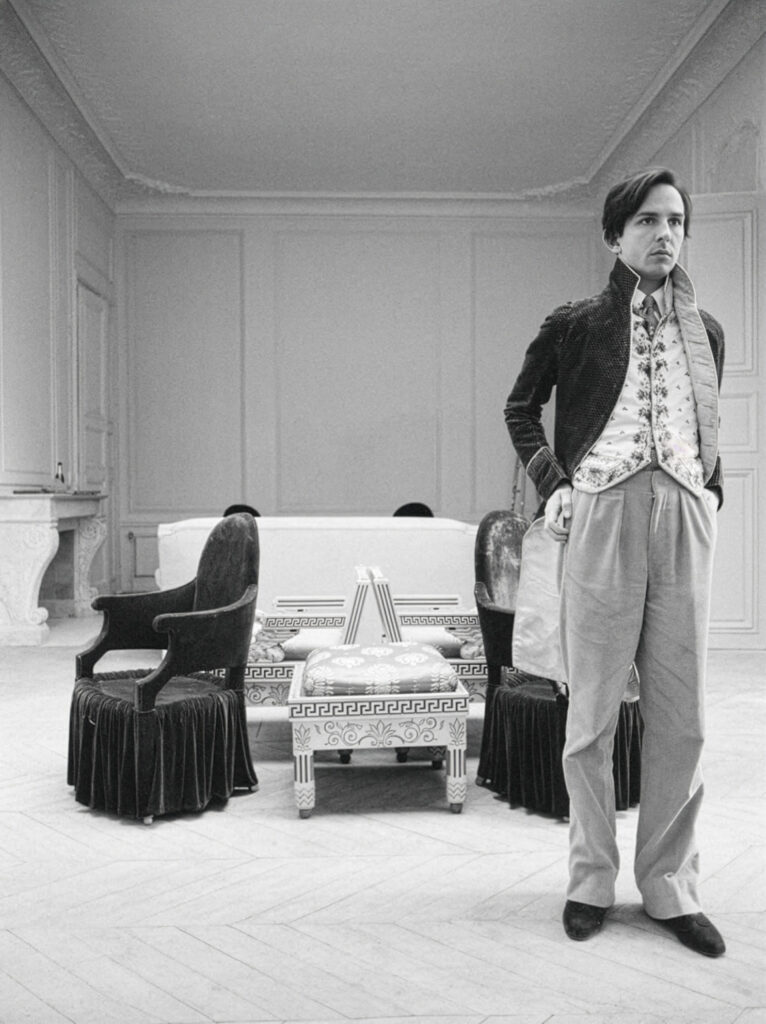
Vincent Fremont, the vice president of Andy Warhol Enterprises, Inc. at the time, didn’t remember Hughes ever having had a boyfriend that he knew about, explaining that he was in a passionate love affair with his things. When he was ill with multiple sclerosis, he was still collecting from bed, directing Vincent on what bids to place at auctions, which he would then call on Fred’s behalf. The period of his decline in his forties and fifties has been characterized by those who knew him as devastating to watch, not just because of his relative youth, but also because he was a person who liked to be in absolute control of his appearance and surroundings. It was at this time that he relied on friends to pack up and sell the apartment in Paris. Collecting until the bitter end, auction items won days before Fred passed away showed up at his town house in New York for months after.
As soon as I started paying attention, traces of Mr. H started showing up around me. It was not entirely surprising therefore when a friend texted me a photo of the fine Jacob-stamped sofa sitting under a frescoed ceiling in the splendor of Cy Twombly’s Gaeta compound. Or when I practically bumped into his most cherished cut-paper silhouette (of which I now am the proud owner) at an antiques store on the Upper East Side. Fred’s possessions had been auctioned off in two sales: one at Sotheby’s, and one at AUCTION HOUSE in YEAR. It was at the former that Matthew Marks, who runs the revered eponymous gallery, and Jack Bankowsky, the longtime editor of ArtForum, acquired the nearly four-foot-long gilt bat.
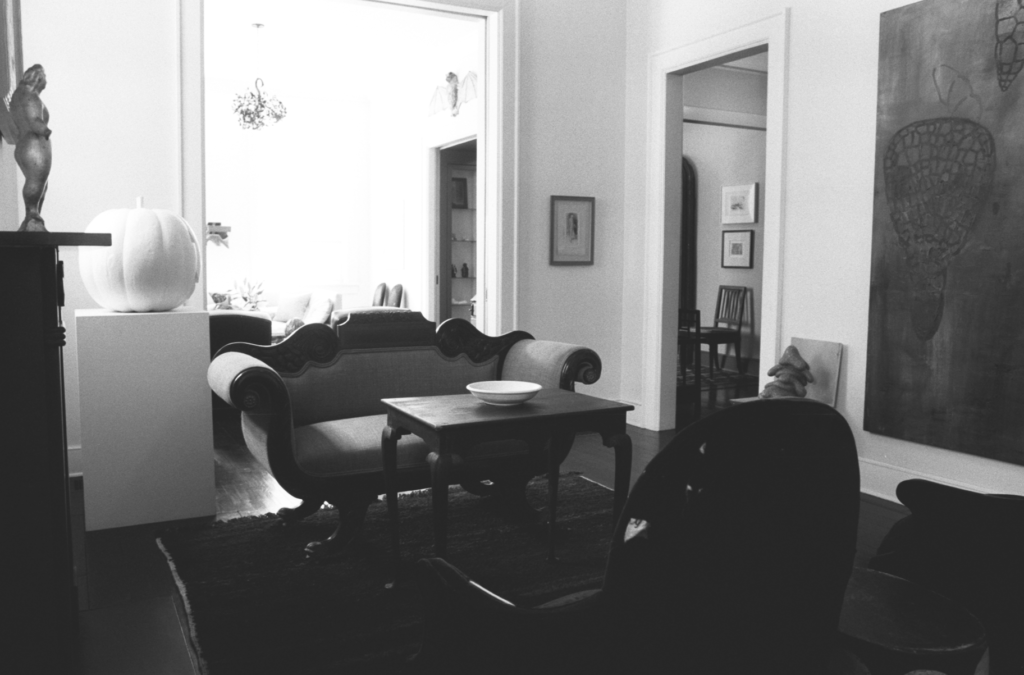
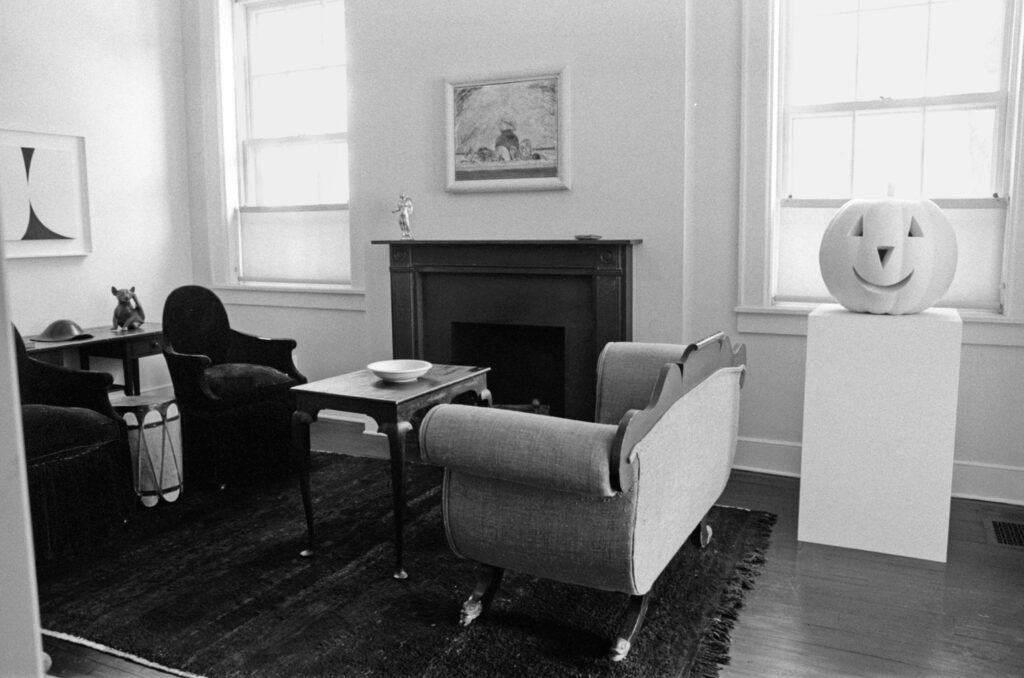
The pair arrange their white rooms in a confident and precise way. Spectacularly, a few of Mr. H’s “strange widows” that Matthew bought when the Paris apartment was being sold, made it here and are used as occasional seating during parties. Somehow the ensemble is neither macabre nor melancholic. A low mirrored coffee table by Frances Elkins sits in front of a crackled white/cream leather sofa that once belonged to Marlene Dietrich and a breathtaking de Kooning in a pink-painted frame hangs over the mantel. An exquisite diorama by Joseph Cornell might easily go unnoticed in all of this, quiet and indecipherable, but so alluring. In the adjoining parlor, a drawing of Robert de Montesquiou by Whistler—a study for the painting at the Frick—is hung in a corner protected from direct sunlight. And, above the fireplace a still life of shells by that rarest-of-painters James Ensor is mounted beside a precious Elie Nadelman maquette (confirm that it is a maquette). An American Empire sofa that was bought from the auction of Charles H. Carpenter Jr., recently reupholstered in a bright blue linen, stands on a mostly black Berber rug that, as Matthew says, “just works.”
The spaces at first feel light and delicate, as if their contents might start to drift away, but this fades along with that first impression: they have the most beguiling stability, as if held together by an imperceptible web of pins and strings. Over time spent here, one becomes aware of a poetic geometry to the placement of each object, such that it is hard to imagine shifting any item even one inch and the rooms looking as perfect as they do. Slipping through the mind’s eye like water through your fingers, Matthew and Jack’s sensibility is elusive—hard to hold onto as an image but fully fleshed out as a feeling that is impossible to forget.
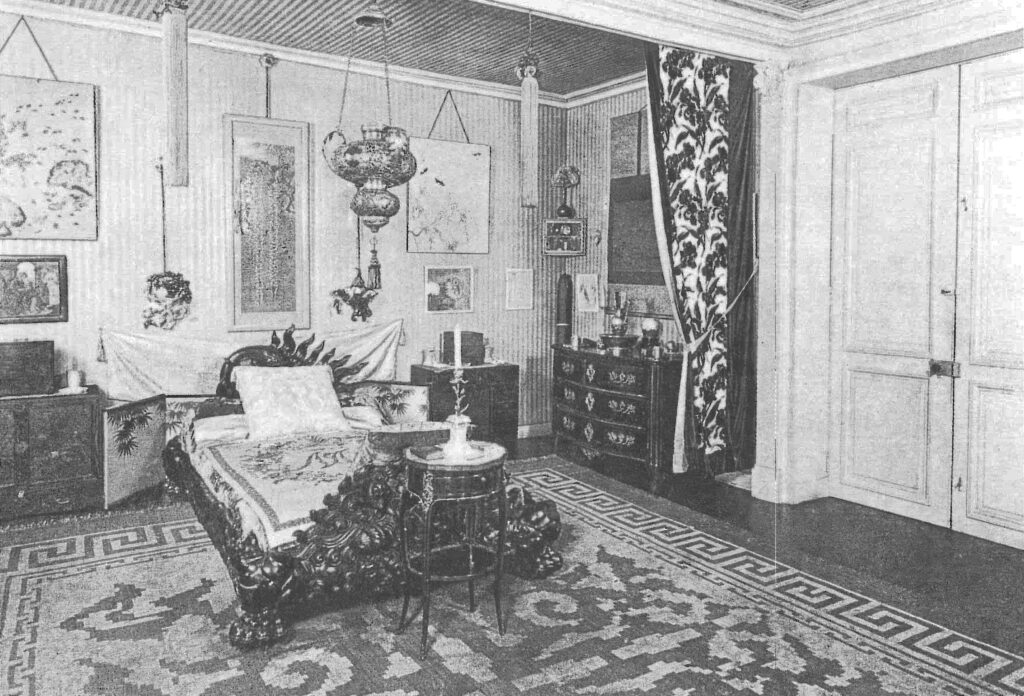
Ghost chasing is, as I see it, the act of hunting down things that have belonged to people you wish to have a kind of spiritual and energetic contact with, across time, via the material world. Some might think of it in terms of provenance, but I believe it is more fluid—more conversational. In a letter to Montesquiou, Maurice Barrès wrote of his boyaux as a “précieux endroit où les choses parlent,”’ a precious space where objects speak. Do objects have a voice? If so, then this is a story about people who listen.


