
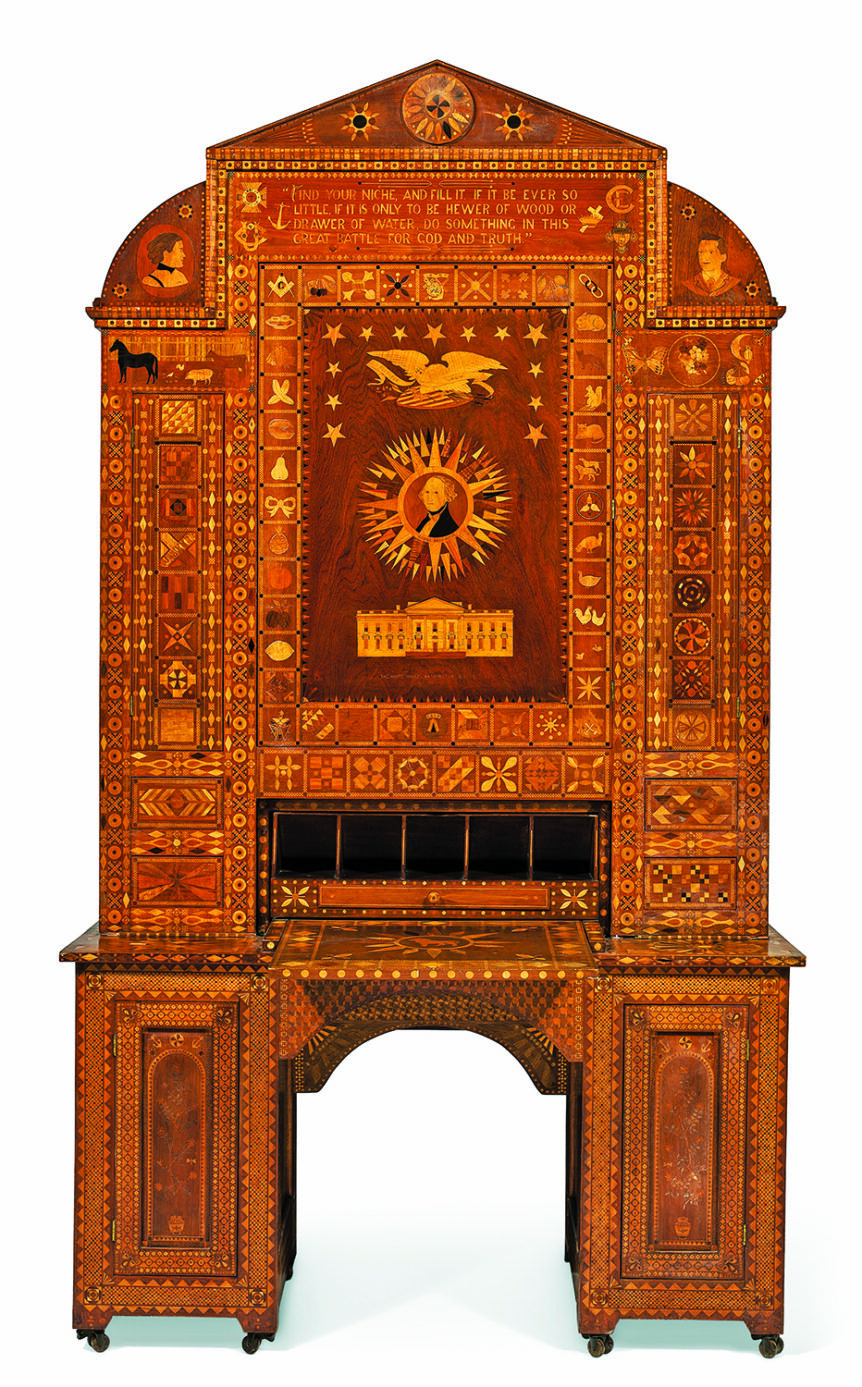
Like many Americans in 1893, Uriah Eberhart, a barber from Savannah, Ohio, traveled to Chicago to attend the World’s Columbian Exposition. In the Guatemala Building there he encountered an inlaid center table. Inspired, and despite a lack of experience in the craft, he declared his ambition to make the most extraordinary piece of inlaid furniture in the world. From that point on, during his spare time between shaves, he sketched designs and experimented with wood inlay.
Eberhart practiced with small wooden blocks before progressing to side tables and a bedroom suite for his wife, Anna. With the basic skills in hand, he turned his attention to what he called his masterpiece—the parquetry and marquetry inlaid walnut secretary shown here. According to an inscription on the back, the work took three years and eight months to complete, from November 17, 1896, to July 31, 1900, and was composed of 135,341 pieces of wood from 537 species of trees.
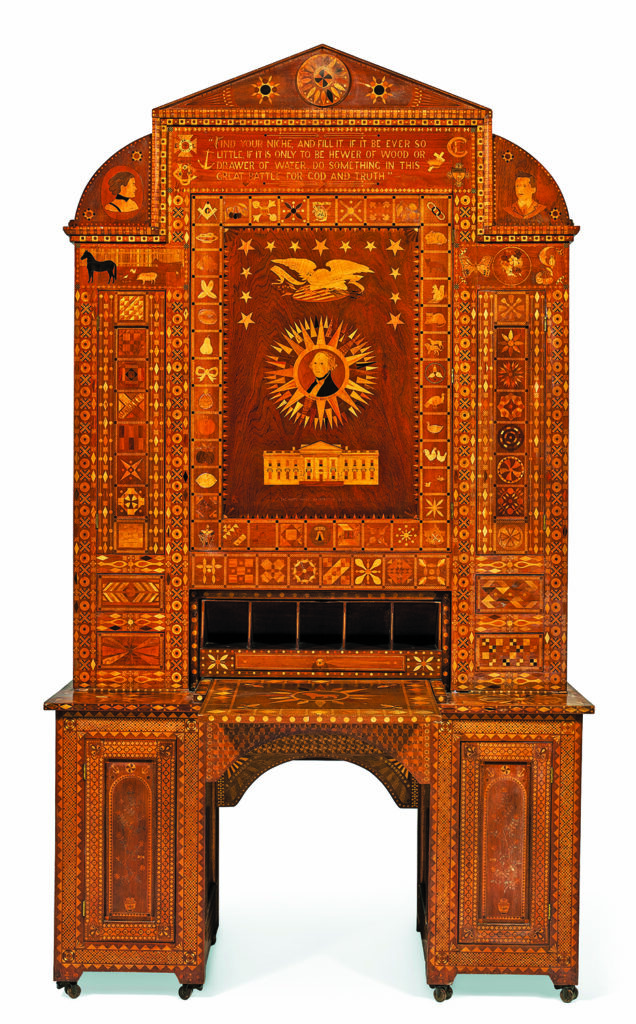
Eberhard kept meticulous records. Not only was the sheer number of pieces impressive, but he also aimed to incorporate more types of wood in his secretary than in any other known piece of furniture. A religious man, he engaged a network of missionaries to collect wood samples from all forty-five then-US states (as of 1900) and thirty-one foreign countries and territories. Among the hundreds of specimens are kamani from the Hawaiian Islands, persimmon from Japan, and pawpaw from Ohio. He also received samples with historical significance, such as fragments from Abraham Lincoln’s childhood home in Illinois and from the USS Maine, which sank off Havana Harbor in 1898. Eberhart selected relic woods that he believed enhanced the secretary’s cultural value by containing tangible links to the nation’s past.
As if driven by a horror vacui, Eberhart covered the entire surface of the secretary with geometric patterns and figures, making sure that no two designs were alike. On either side, near the top, are portraits of Eberhart and his wife. They flank a quotation, just under the pediment, from from English preacher Charles Haddon Spurgeon (1834–1892): “FIND YOUR NICHE, AND FILL IT. IF IT BE EVER SO / LITTLE, IF IT IS ONLY TO BE HEWER OF WOOD OR / DRAWER OF WATER, DO SOMETHING IN THIS /GREAT BATTLE FOR GOD AND TRUTH.” The central panel features the most striking images: a variation of the American coat of arms, a portrait of George Washington, and a depiction of the White House. Surrounding it are forty squares featuring fruits, flowers, animals, fraternal symbols, and quilt-block patterns, each representing a different state or country. Handles and knobs do not intrude into the design; all doors and drawers open using hidden spring-loaded mechanisms.
Eberhart always believed the secretary belonged in a museum. He toured it throughout Ohio at county fairs and hosted viewings in his home before initiating conversations with Ripley’s Believe It or Not! Unfortunately, he passed away in 1937, before Ripley’s short-lived first New York Odditorium opened to display the secretary in 1939. When the Odditorium closed in 1940, the secretary was returned to the family, who eventually sold it at auction to American marquetry collectors Robert and Marjorie Hirschhorn. Through another auction in 2025, the secretary found a permanent home at the Toledo Museum of Art—fulfilling Eberhart’s vision of its rightful place in a museum.


