
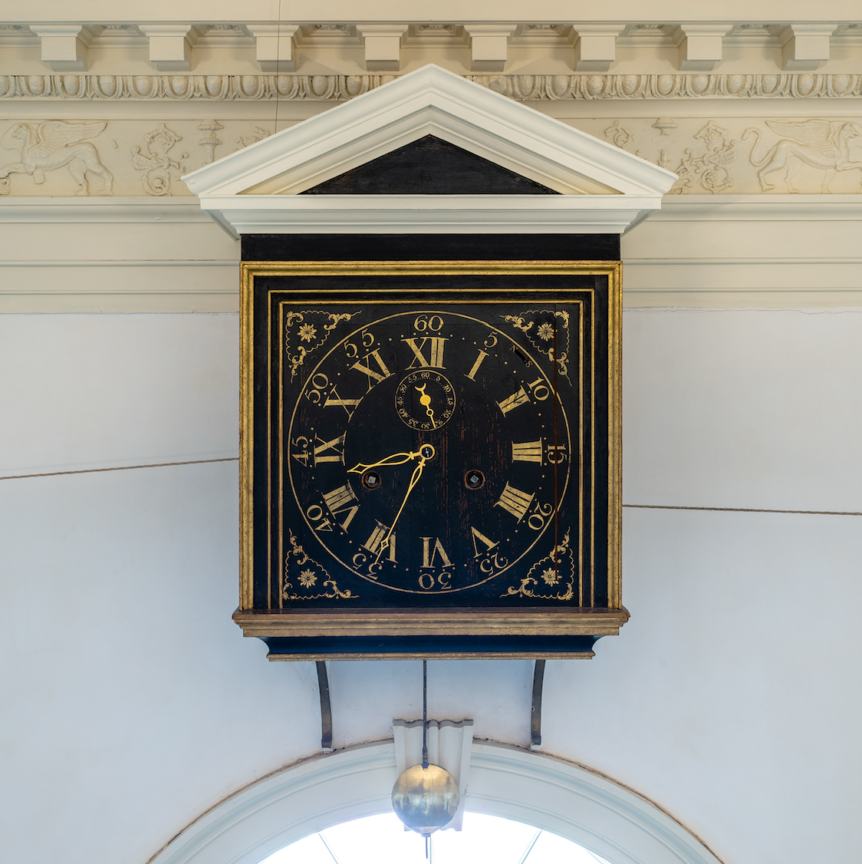
Monticello’s Great Clock reveals how Jefferson used timekeeping, sound, and design to regulate labor and extend control over enslaved Black lives.
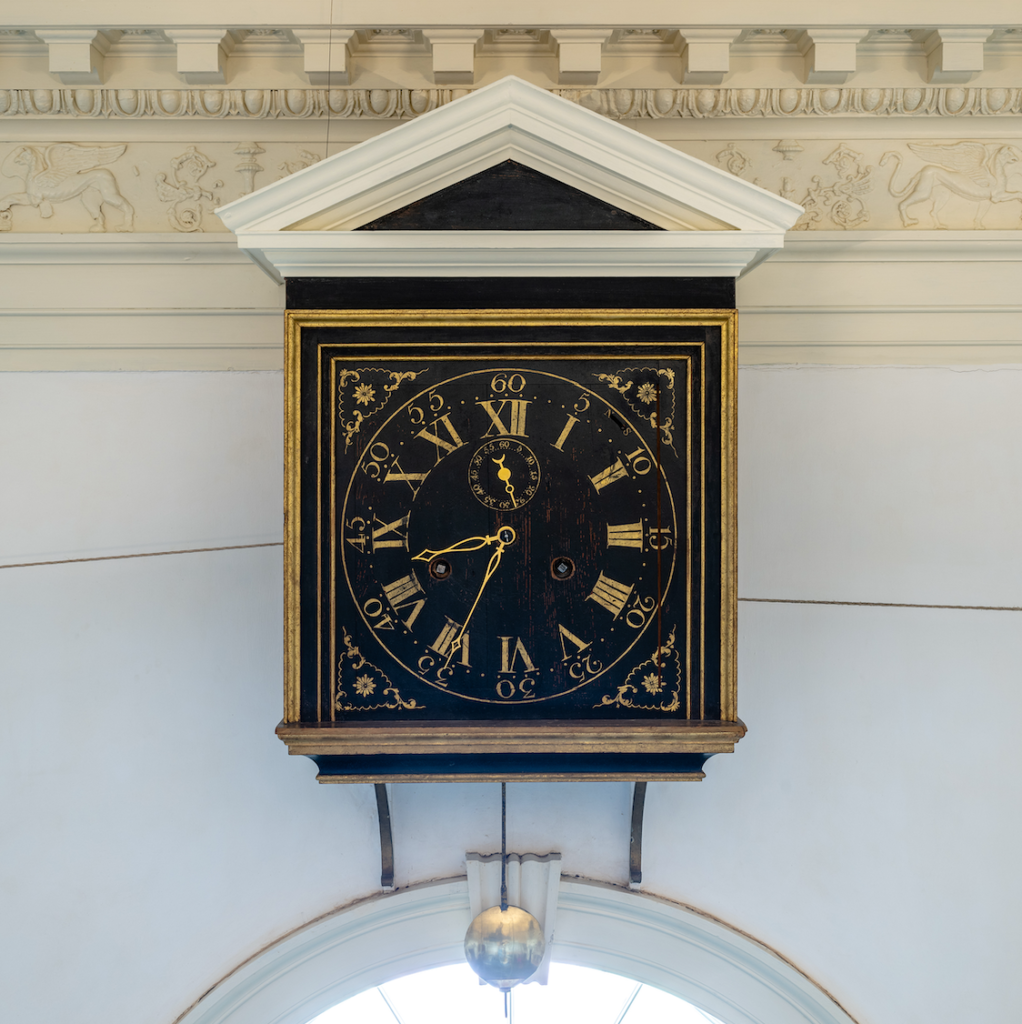
Designed by Jefferson in 1792 and made by Peter Spruck of Philadelphia, the clock was installed at
Monticello in 1804. Photograph © Thomas Jefferson Foundation at Monticello.
Monticello needs no introduction. The home and plantation of Thomas Jefferson claimed its fame within and beyond his lifetime, from its Palladian architecture to its interior furnishings that are as striking as its surrounding experimental gardens. Embedded in its construction, one object is as notable as the home itself.
It was the dead of summer when I first heard the ringing of the Great Clock. The deep, steady resonance of its gong felt as though it could knock the sweat from my back. Its hammer, now muffled but still forceful, struck three low reverberating notes, telling me that my three o’clock tour had begun. The double-faced Great Clock has long been a signifier of Jefferson’s creativity and ingenuity, in addition to his well-known achievements as a self-taught architect, scientist, statesmen, and author of the Declaration of Independence. However, what is only recently considered in conjunction with his inventive personality is his relentless practice as an enslaver. In his lifetime, Jefferson enslaved more than six hundred Black men, women, and children, their labor spanning several residences in New York, Philadelphia, Paris, the President’s House, and his Virginia plantations. Monticello in Charlottesville and Poplar Forest, seventy miles south, in Bedford County, Virginia, were the most prominent, with a combined ten thousand acres of farmland and over two hundred people enslaved simultaneously across both plantations in any given year.
For too long, scholarship and conversation about Jefferson, like countless other founding fathers, privileged his political accomplishments and creative endeavors as a matter divorced from his position as an enslaver. It must be recognized, in the 250th year of our nation’s founding no less, that enslavement is an essential context within which America and all its successes exist. The ongoing oppression of Black people cannot continue to be an afterthought. The decades-long construction of Monticello, the home’s everyday functions, the wealth derived from its farmed land, and the bodies that bore and cared for the Jefferson bloodline were all dependent on the institution of slavery. Despite the multiple statements he made in opposition to enslavement in his lifetime, Jefferson’s reliance on slavery can be read into every aspect of his life and legacy, including numerous timepieces he commissioned and favored. Monticello’s Great Clock is an important entryway to understanding Jefferson’s notions of time, efficiency, production, and desired control of Black people’s bodies.
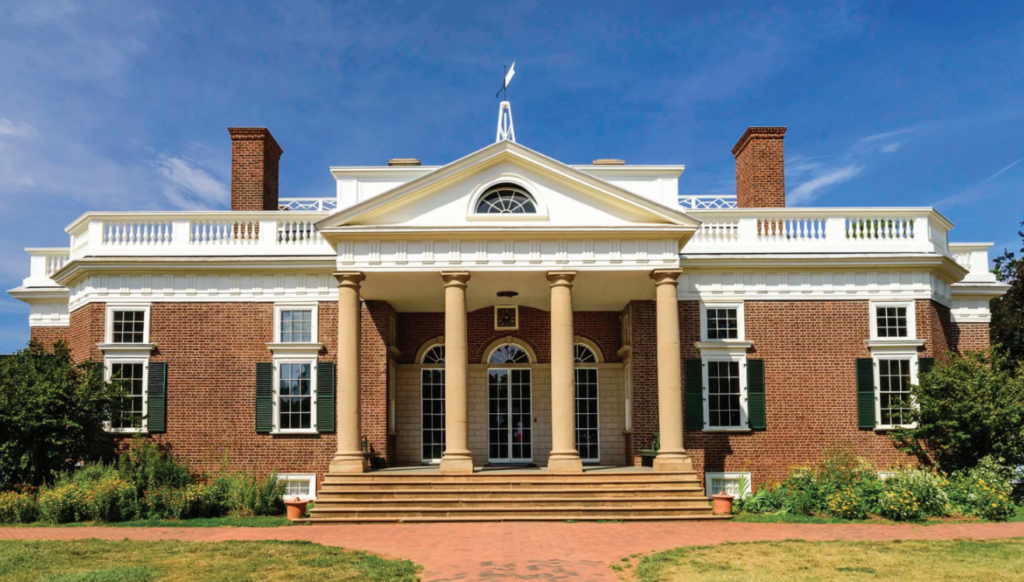
The Great Clock’s exterior face greets contemporary visitors from the shadows of Monticello’s temple-like entrance, guiding them toward the glass doors of the east front. I
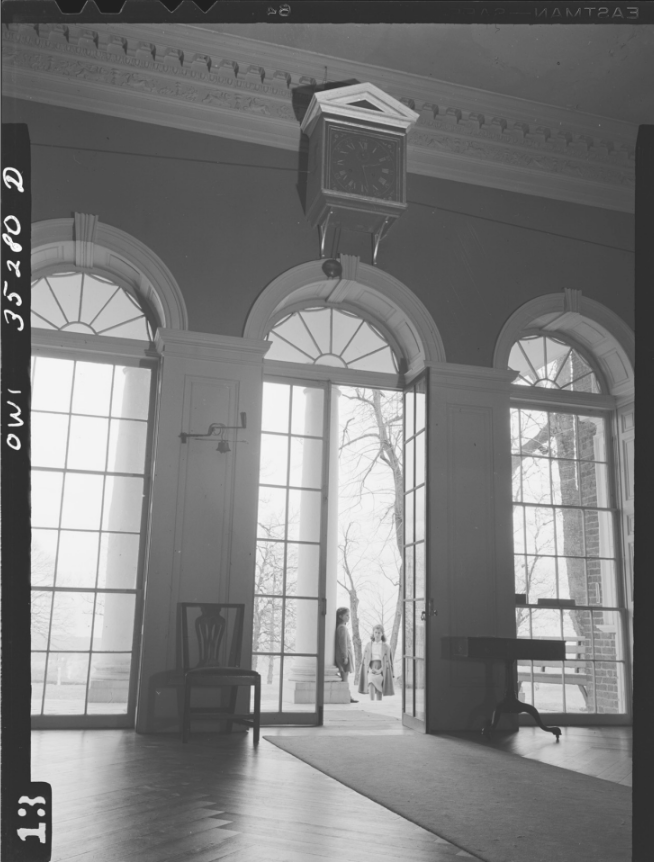
& Photographs Division; photograph by John Collier Jr.
Among an array of collected, commissioned, and curated objects in what Jefferson called his “Indian Hall,” the clock stands out in scale and design. Inside, its interior face presents the exact time of day through a visible hour, minute, and second hand, as well as a pendulum that swings the half-second. The cannonball-like weights that power the Great Clock are positioned on either side of the front door, where they gradually descend along day markers affixed to the wall. Measuring five feet in height, three feet in length, and nineteen inches in depth, the clock looms over guests as an imposing and permanent fixture.
Its exterior face, however, displays only a single hour hand. In his directions for the clock’s construction, Jefferson notes: “There need be no minute hand, as the hour figures will be 6 [inches] apart. But the interspace should be divided into quarters and 5. minute marks.” The denotation of minutes is implied by stylistic spacing of painted quadrants, but to see and read them would require proximity to the clock’s face that its raised position does not allow with ease. The heightened position does, however, allow for maximum resonance of the gong that is attached to the Great Clock, and housed on Monticello’s roof. Encased in a simple wooden structure, the gong is hammered out to just shy of two feet in diameter and five inches deep.
In a 1792 letter to his private secretary, Henry Remsen, Jefferson acknowledges “[t]he Chinese have a thing made of a kind of bell metal, which they call a Gong, and is used as a bell at the gates of large houses…I wish for one to serve as the bell to a clock, which might be heard all over my farm.” Remsen replied that a Chinese gong could be acquired that would be suitable for Jefferson’s purpose.
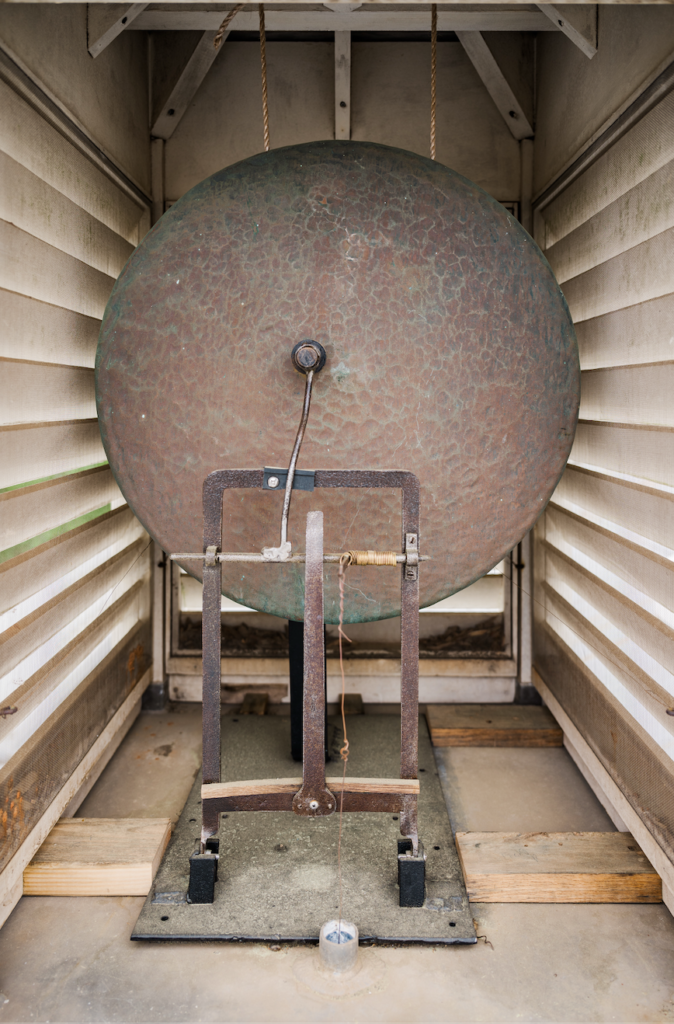
Monticello’s roof. Photograph © Thomas Jefferson Foundation at Monticello.
The life that consumed Monticello’s quarter farm below the little mountain was defined by Blackness. From the people who lived out their days on the adjacent Tufton, Lego, and Shadwell quarter farms, to those living and working a mere three hundred feet from the main house along Mulberry Row—Monticello’s production hub with living quarters for enslaved artisans and domestic workers—many were within the Great Clock’s reach. Its sonic range was essential, indicating when a typical day’s work began at dawn and ended at dusk, when meals were to be served, and the commencement of allotted “free” time for enslaved Black laborers. The calculated range of the Great Clock symbolizes Jefferson’s desire and attempts to control Black people he enslaved from a distance, whether he was at home at Monticello or traveling across the Atlantic. The ringing of the gong was, and still is, audible throughout the day and night. In our day, as in Jefferson’s, its striking is a marvel to Monticello visitors. However, for Black enslaved residents, its ringing carried a resounding edict that their time was not their own. Peter Fossett, one of the over four hundred Black people enslaved at Monticello over its history, reflected on his years there while spending the rest of his days as a free man in Cincinnati, specifically remembering the Great Clock’s “ponderous voice” that could “be heard six miles away in the valley below.”
While an exemplary time-telling device, both visually and sonically, the Great Clock initially functioned without its remarkable gong. In 1793 Peter Spruck began construction of the clock, which was likely first installed in one of Jefferson’s Philadelphia residences before being transported to Virginia in 1794 when he returned to Monticello, and finally installed in 1804. Construction of Monticello as it stands today began in 1796, when Jefferson expanded his initial 1770 plan from three floors and fourteen rooms to four floors and forty-three rooms. The expansion, executed by several enslaved Black artisans including woodworker John Hemmings, was not completed until 1809.
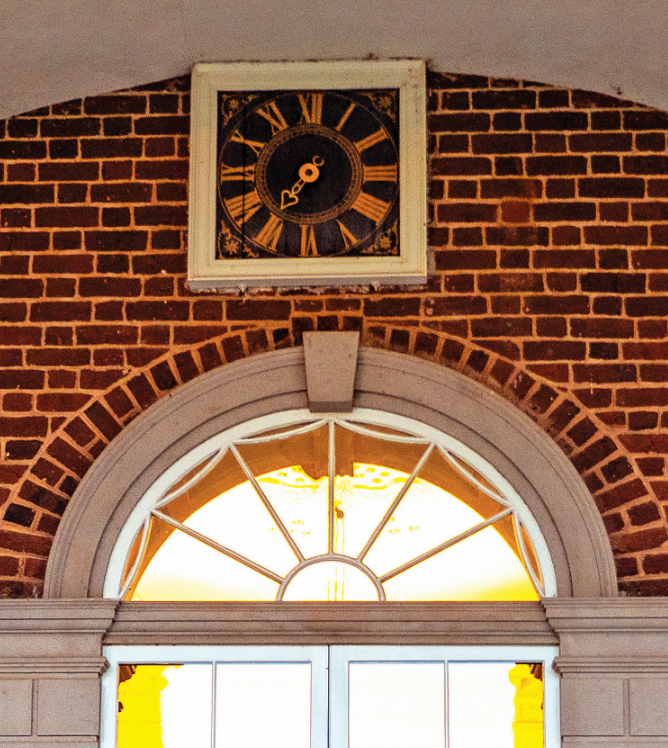
Photograph © Thomas Jefferson Foundation at Monticello.
Reflecting on this timeline reveals that Jefferson’s commissioning of the Great Clock, including seeking a gong to serve as its bell, predates the remodel of Monticello. Locating a sound to serve as an extension of his demands for timeliness and order may have taken precedence in his work as a designer and architect. This display of temporal power was also not limited to the Great Clock. Jefferson, being a man heavily influenced by the Age of Enlightenment, regularly noted his disdain for idleness. His regard for time as both linear and irretrievable may have been behind his interest in and proliferation of timepieces, such as his act of gifting a gold pocket watch to each of his “legitimate” grandchildren (several of his grandchildren were born into slavery), a tradition he noted in his will and testament must continue after his death. It has also been stated that at one point, Jefferson owned enough timepieces to have one in every room at Monticello. This would include several clocks placed near centers for Black labor, specifically, a case clock in Monticello’s kitchen and a shelf clock in the far more compact kitchen at Poplar Forest.
Jefferson’s compulsive and detailed documentation of his life, work, and management of his several farms and plantations leaves little room to assume he made any decision without reason. His strict perceptions of time are, however, ultimately a fallacy; a system of artificial regimentation determined by his own preferences and schedule. Such a system managed the days of Black people across Jefferson’s properties without regard for the ways time was measured, passed, felt, or escaped by those individuals.
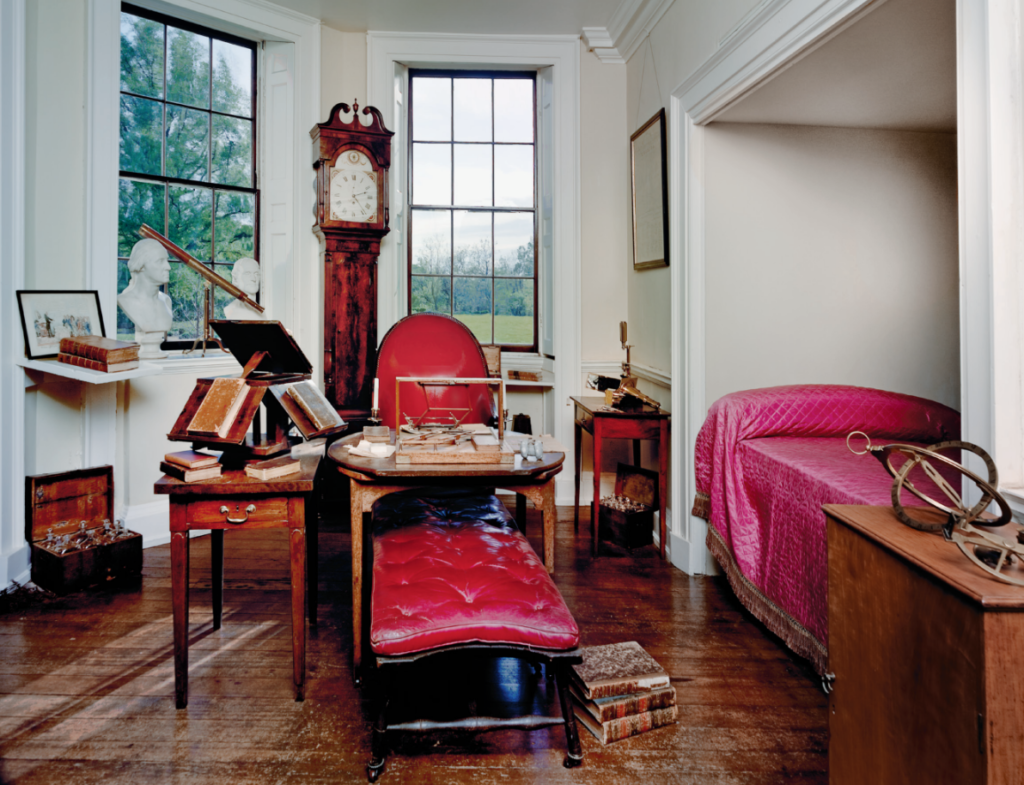
Jefferson may have perceived time as a factual regulator of work and daily activities, but, in fact, it was manipulated through the design and function of his clocks to exert control over the hundreds of people he claimed to own. In governing Black labor, he suppressed the personhood of enslaved workers, relating them instead to mechanical and predictable tools of his estate. Despite his “enlightened” influences, the foundation of Jefferson’s revolutionary technology was a desire to police Black people’s bodies. Any claim to the Great Clock’s greatness is inseparable from the legacy of enslavement and the constant presence of Black labor and life that sustained it.

Photograph by Mrsiannuzzi, Wikimedia.
MYA ROSE BAILEY is the 2025-26 Curatorial Research Fellow with the Preservation Society of Newport County, and a Spring 2025 William L. Thompson Collections Fellow with the Richard Hampton Jenrette Foundation. They hold a Master’s degree in Decorative Arts, Design History and Material Culture from the Bard Graduate Center, and a Bachelor’s degree in Art History from the State University of New York at New Paltz.


