Tucked away in a private studio on Madison Avenue, the family of jeweler Oscar Heyman, trained in a Fabergé workshop, carries on his legacy of legendary craftsmanship.
For over a century, Oscar Heyman has occupied a special niche in the jewelry world. Sought after by jewelry collectors and touted by auction houses, who value the firm’s recognizable aesthetic centered around brightly colored gemstones and superior craftsmanship, the brand has never had a retail store. They are a manufacturing concern that has created jewels for the most important American jewelry houses including Tiffany and Co., Marcus and Co., and Cartier, New York.
In 2022 an incredible art deco strap bracelet created by Oscar Heyman in 1927 and retailed through Shreve, Crump, and Low, surfaced at Sotheby’s in Geneva. Known as “Birds in Flight,” the gem-set jewel depicts tropical birds against a background of flowers. It ranks among the most important art deco jewels in the world and sold for $1.4 million. Frank Everett, vice chairman of Sotheby’s Jewelry in New York, says the “bracelet is a masterpiece of design and craftsmanship, outstanding in every way.” He continues, “Above all, Oscar Heyman stands for the highest quality material, workmanship, and design.”
Born in Latvia in 1888, Oscar Heyman was the second oldest of nine siblings. At the age of thirteen, along with his older brother Nathan, he traveled to Kharkov in present-day Ukraine to apprentice at his uncle’s jewelry workshop, where the renowned firm of Peter Carl Fabergé was the major client. The brothers subsequently traveled to New York with a wave of immigrants escaping the unrest in the Russian empire. Because of Oscar’s credentials and ability to work platinum, Cartier hired him as the first non-French craftsman in its New York workshop. When Oscar and Nathan, joined by their brother Harry, opened Oscar Heyman and Brothers in 1912 on Maiden Lane, Cartier became their most important client. The rest of their siblings came to New York, and over time eight out of the nine worked for the firm. (“Brothers” was dropped from the name in 2021.)
Heyman became known as “the jewelers’ jeweler” — an appellation the brothers loved — at the 1939 World’s Fair in New York when four out of the five glittering displays in the House of Jewels contained pieces from the firm: Cartier, Udall and Ballou, Marcus, and Black, Starr, and Frost-Gorhamn. While the fifth jeweler, Tiffany and Co., did not include pieces by Heyman at the fair, the two maintained a close relationship over the years.
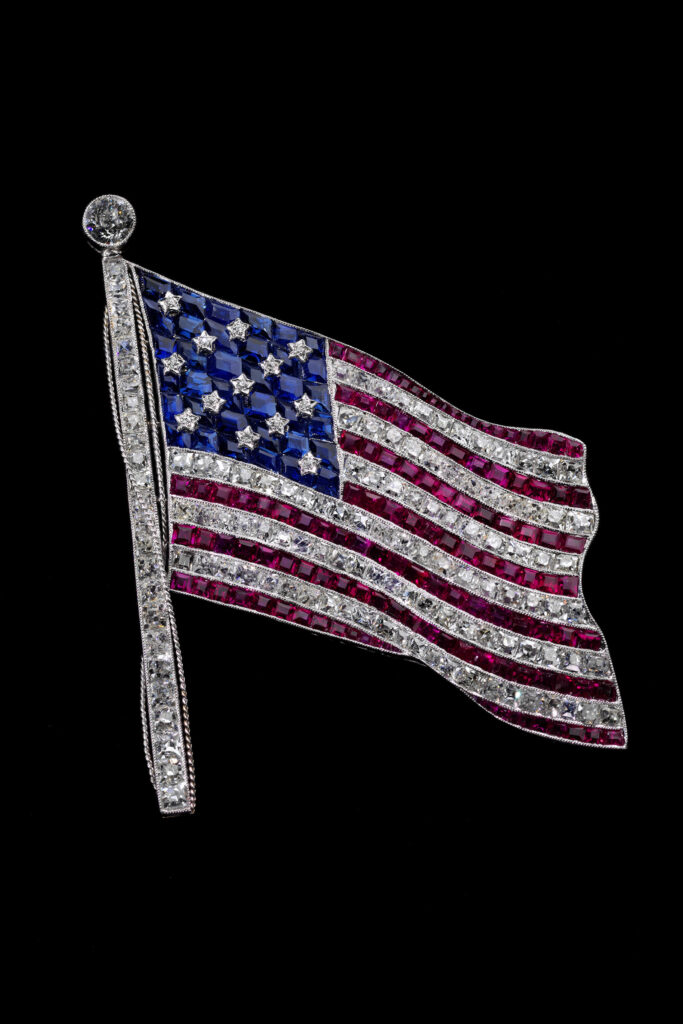
Two of Heyman’s pieces at the Museum of Fine Arts, Boston today demonstrate the company’s range. The first is a waving American flag brooch, created with ruby and diamond stripes and a sapphire field set with diamond stars, and retailed by Black Starr and Frost in 1917. Flag brooches have been a regular motif (and a favorite at Tiffany and Co.), particularly after major events like Pearl Harbor and throughout World War II, when the company converted half the shop to making precision airplane instruments and the other half to patriotic and military jewels.
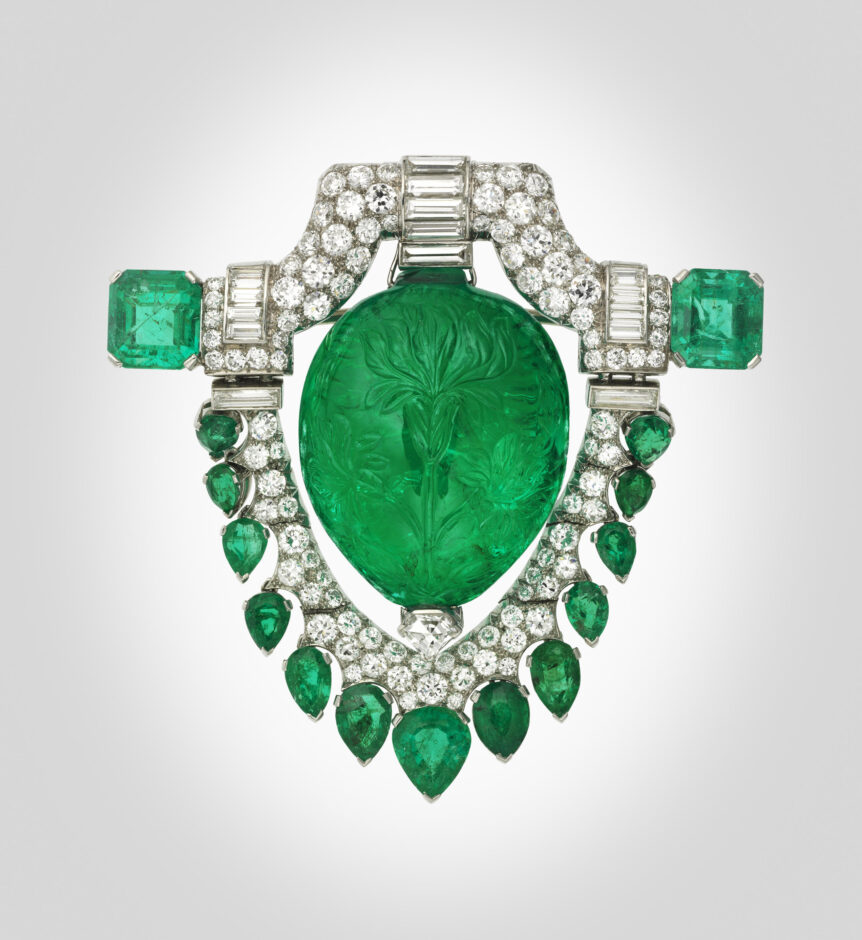
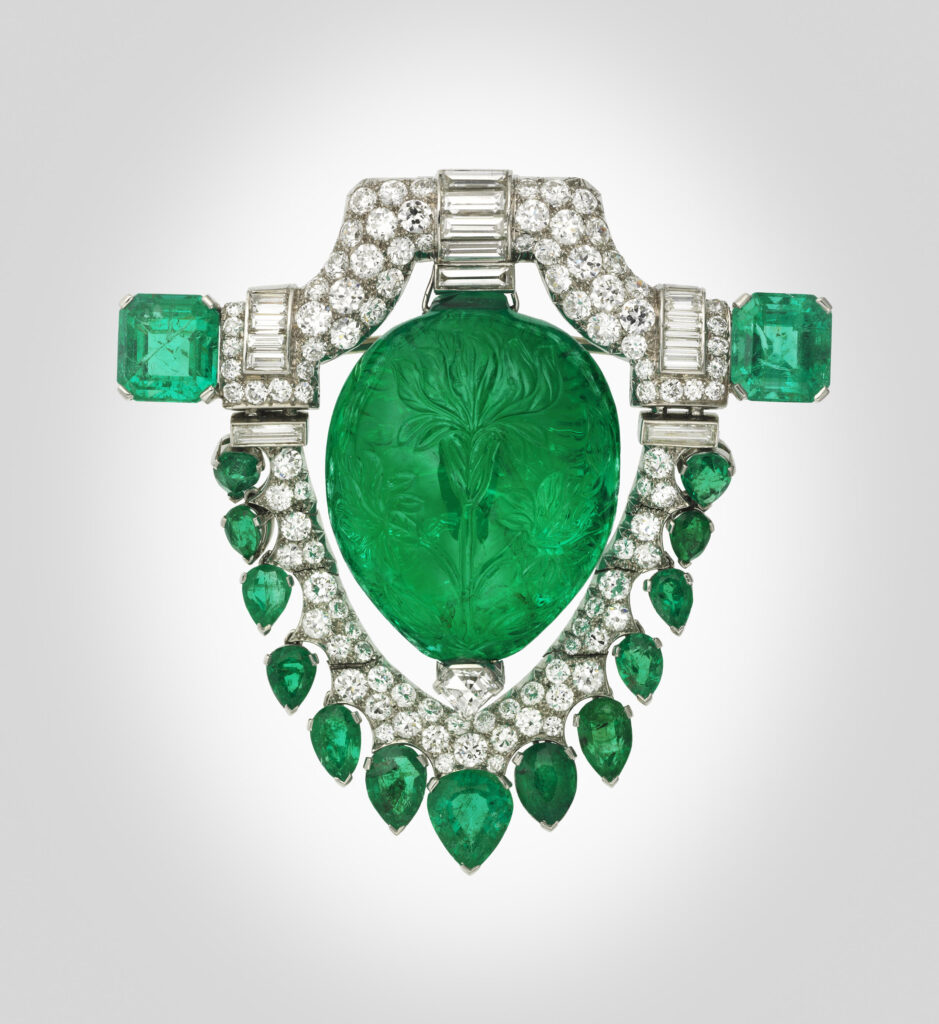
The MFA’s showstopping Post brooch, owned and worn throughout her life by heiress Marjorie Merriweather Post (1887-1973), was created for Marcus in 1929. It features an enormous 60-carat central carved emerald surrounded by a diamond-set art deco frame surrounded by a fringe of pear-shaped emeralds set with their points down, as though dripping from the jewel.
Today the firm operates with three Heymans at the helm (Adam, Lewis, and Tom) in the same Madison Avenue space they’ve occupied since 1969 with one of the oldest tool and die workshops in New York. With forty employees, each piece is meticulously crafted and can pass through a dozen hands before leaving the floor. They work closely with a network of retail concerns. If you are lucky enough to visit, according to Tom Heyman, “it is strictly at the invitation of a retailer who works with us.”
Tom speaks with pride about the many important commissions that have come through the workshop, from Cartier asking the company to set the Taylor-Burton diamond in a necklace for Elizabeth Taylor to the handshake deal Van Cleef and Arpels New York made to purchase all their invisibly set jewels from Heyman—a deal that lasted for decades. He tells me Jimmy Carter wore a pair of their flag cufflinks when accepting the Nobel Peace Prize, and of the Apollo 16 brooches that went to the moon. He says, “How do you put a value on something that went to the moon? It’s not the components that’s the value, it’s the history.”


