

My entire curatorial career—thirty-seven years—was spent at a single institution. Needless to say, my perspective on what art is and what a museum should be has been profoundly influenced by the place that gave me my first job: the Newark Museum (now the Newark Museum of Art), in New Jersey. When
the Newark Museum was founded in 1909, its first acquisition was a collection of twenty-four hundred Japanese objects in all mediums, purchased with a grant of $10,000 from the City of Newark. The museum’s founding director, John Cotton Dana, liked Japanese art because it was not encumbered with the sort of hierarchical problems that European art presented—no notion of “fine” art overshadowing the applied or “domestic” arts. Japanese art, no matter how elegant or well-crafted, was the art of everyday life.
The Japanese material was first exhibited in 1910, the same year the new museum hosted a loan exhibition of hundreds of ceramic objects titled Modern American Pottery. The loans came from art pottery workshops all over the country, but also included decorated porcelains from Trenton’s Lenox company, founded by Walter Scott Lenox as the Ceramic Art Company in 1889. Lenox himself donated several objects from his company’s archive, including a snazzy little footed coffee cup, elaborately hand-painted and gilded in the beaux-arts style.
These two inaugural exhibitions made the point that Dana’s museum would draw no line between domestic things of everyday use and art that was hung on the walls or put on pedestals. The museum was to be accessible and useful to the people of Newark.
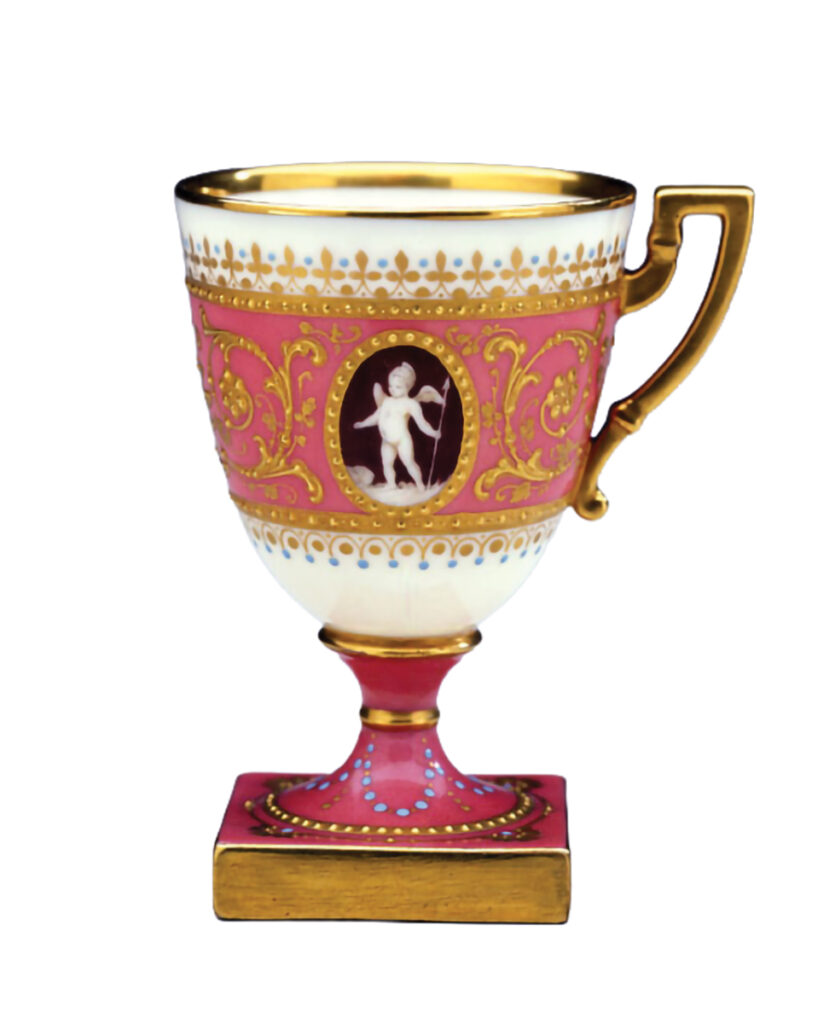
Newark Museum of Art, gift of Walter Scott Lenox.
It was no palace in a park filled with rare treasures. In Dana’s mind, everything could be art, and art
was to be for everyone. Although I was trained at the Yale University Art Gallery and at Henry du Pont’s Winterthur Museum, it was at Newark that I learned to look beyond connoisseurship to the contextual and cultural meaning of a thing. I quickly came to understand that the museum’s visitors often entered my exhibitions as blank slates—no real knowledge of what was on display, but also no deep-seated prejudices as to what was “museum quality.” My job was to make these visitors care about things that I already cared about.
Accordingly, the team of scholars I invited to write for this issue of The Magazine ANTIQUES represents the kind of ever-evolving approach to the idea of the “art of every-day life” that so infused my own career.
We have three essays that focus, more or less, on single objects—a clock, a thimble, a kitchen jug. Such simple things certainly exhibit design and craftsmanship, but it is the story behind these things that might matter most to an audience.
Then we have the two “group” essays that discuss a type of object over a broad arc of time —quilts and silver. Once again, design and craft are balanced with story, to explore not just the “what” of a domestic artifact, but to look deeper into the “why” of its existence.
Finally, there are the two essays that focus on creative personalities and the motivations that fuel domestic design. In one we have a brilliant woman, an engineer and inventor, who seeks to transform the American home in the twentieth century. In the other essay a famous modern sculptor and designer of the postwar era faces the challenge of designing public spaces.
In a world where museums are being—rightfully—pushed toward democratization and inclusion, the curatorial mind still comprehends that it is the thing itself—its art, craft, story—that is forever at the core of all human interaction with objects.


