
After a decade as a dealer in contemporary art, and three dealing in antiques, here’re a few things that the author couldn’t bear to sell —and why.
What wouldn’t I sell? The answer to that question has changed over the years. In the 1980s, as a private dealer in contemporary art, if I held something back—a Sigmar Polke, a Richard Prince, a Rosemarie Trockel—it was because I expected the price to escalate. And since the art market was booming, so too was my income, which allowed me to furnish my first New York apartment with antiques—an Italian neoclassical sofa, a Charles X ormolu chandelier, a pair of Jean-Michel Frank wing-back armchairs. At that time the furniture wasn’t for sale, but it wasn’t as if my clients were exactly clamoring to buy it, which was fine by me, since it was a striking foil for the art, and distinguished me from my colleagues who favored glass-topped coffee tables and Barcelona chairs. But I became exasperated by the military-industrial-contemporary-art-world complex and increasingly attracted to the wilder shores of art and design, which is to say, the older things I’d studied as an art history major in college and graduate school, and as a museum curator. And so it dawned on me that a career change was in order. The upshot was a stint as the world’s oldest intern in Old Master Paintings at Sotheby’s, and the realization that the antidote to art-world hype is the straightforward beauty and functionality of design. Not that everything I traffic in is best characterized as beautiful, in the conventional sense, or functional, since I’m drawn to the unusual and sculptural, rather than the utilitarian and comfortable. Neither am I put off by the fragile, since antiques are often that. In any case, the upshot of my pre-mid-life crise was that in 1994 I hung out my shingle as an antiques dealer.
Not knowing if the venture would succeed, or wanting to be humiliated publicly if it didn’t, rather than opening a shop, I decided to continue dealing privately. But since my apartment was too small to present furniture as clients would live with it, and I didn’t relish the prospect of living amidst the clutter of “ye olde antique shoppe,” I signed a lease on a larger town house apartment off Park Avenue, where I could present my wares from a recent buying trip, and number of things I purchased in Paris from the artist Pierre Le-Tan, a friend, future mentor, and obsessive collector who occasionally sold to free up space for his growing family and keep creditors at bay. As that shipment cleared customs, I addressed envelopes for the opening invitation, illustrated by Pierre, when another crise set in, this one sentimental. To my distress, I couldn’t bring myself to price what I’d been living with, which was half my inventory. Then, a young friend telephoned to say he wouldn’t be attending. He’d just bought a one-way ticket home, finding himself in rapidly failing health after being diagnosed with AIDS. That sobering call put things in perspective. I sat down and priced every last thing, and never looked back, until now.
Some thirty years later, sentiment has reared its head once again, leaving me unwilling to part with a variety of things for a variety of reasons. Some of these things have been in my inventory for years without selling, and may be of slight monetary value, yet all are worthy in their own way. And since worthy things have personalities of their own, when it comes to placing them, they seem to know where they should go, which is as likely to be in my by-appointment gallery as at home, which can be frustrating to clients, and embarrassing for me. But there we are. And so, here, on the pages that follow, are a few of those things…
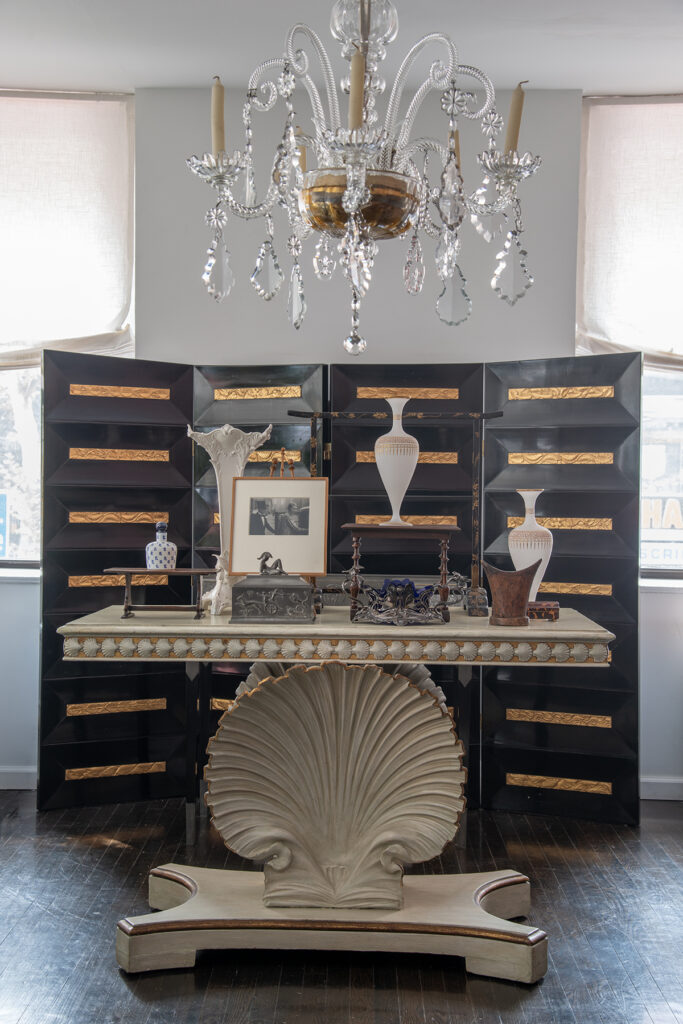
^ Sometime in the mid-1980s, when I was still an art dealer, I paid my first visit to Pierre Le-Tan at home and admired this 1930s English console, which came to appear in many of his drawings. He’d just purchased it at Sotheby’s London, where it was said to have come from a Colefax and Fowler interior. My interest increased when I became an antiques dealer, but since it was a useful display table for Pierre’s objects (the use I put it to now in my gallery), he wouldn’t sell. Fast forward to 2000 when he rang to say he would, having acquired a recamier that could only go where it stood. Arriving in a large shipment that was still being unpacked, the first person to come and see the new things was Catherine Cahill, a smart-as-a-whip socialite then decorating the Southampton getaway she and Bill Bernhard, her husband, had just purchased. About an hour after she made out a check, Mario Buatta sailed in, fell for it, and became enraged when I said it had sold. Since he’d been a friend and admirer of John Fowler’s, who probably designed the table and painted its faux finish himself, I felt badly. Many years later, yet altogether too soon, I spoke at Catherine’s memorial service, and then, a few years after that, when Bill sold the house, he sent it to me following Catherine’s wishes.
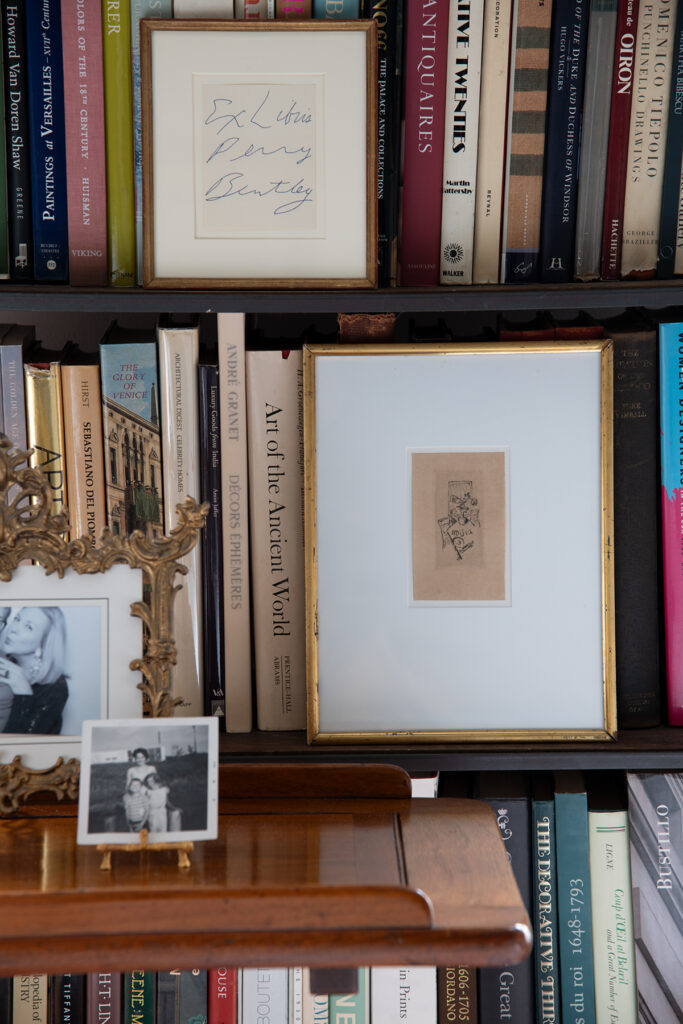
^ Mario referred to my first gallery as “The House of Provenance” because of my obsession with it. So it follows that I prize some books in my library for their bookplates, including those of Ogden Codman, the Duke and Duchess of Windsor, and the decorating firm of Jansen. I also have two plates that came without books, now set in antique giltwood frames.
One was drawn around 1980 by Cy Twombly for his great friend Perry Bentley, a now-deceased Dallas friend, who had it engraved and printed at Tiffany and Co. Around that time, I met Perry when working with Texas clients. He was about my age, good-looking, drove a vintage Bentley, and lived in an unpretentious building that was, nevertheless, known to be chic. On my first visit we chatted over iced tea as he finished ironing his linens, which were actually linen. I admired an ancient Roman bust, a Donald Judd progression, a slew of Twombly drawings, and an arrangement of birds’ nests under a giltwood console. A characteristically Perry touch: a patch of gold paint on the ceiling under a curl of paint, creating the impression that the entire ceiling was gilt beneath a coat of white paint.
The other bookplate was etched around 1920 by Pierre Bonnard for Misia Sert, a concert pianist who later made magical miniature trees from glass beads and coral. Her curvaceous beauty entranced artists, ranging from Pierre-Auguste Renoir to Cecil Beaton, just as her personality enchanted Serge Diaghilev, Jean Cocteau, and Gabrielle Chanel, whom she introduced to opium. For Sert’s bookplate, Bonnard depicted a table with a potted flowering plant set for just one in her country house dining room. As an haute-bohème celebrity, her first name — Misia – sufficed.
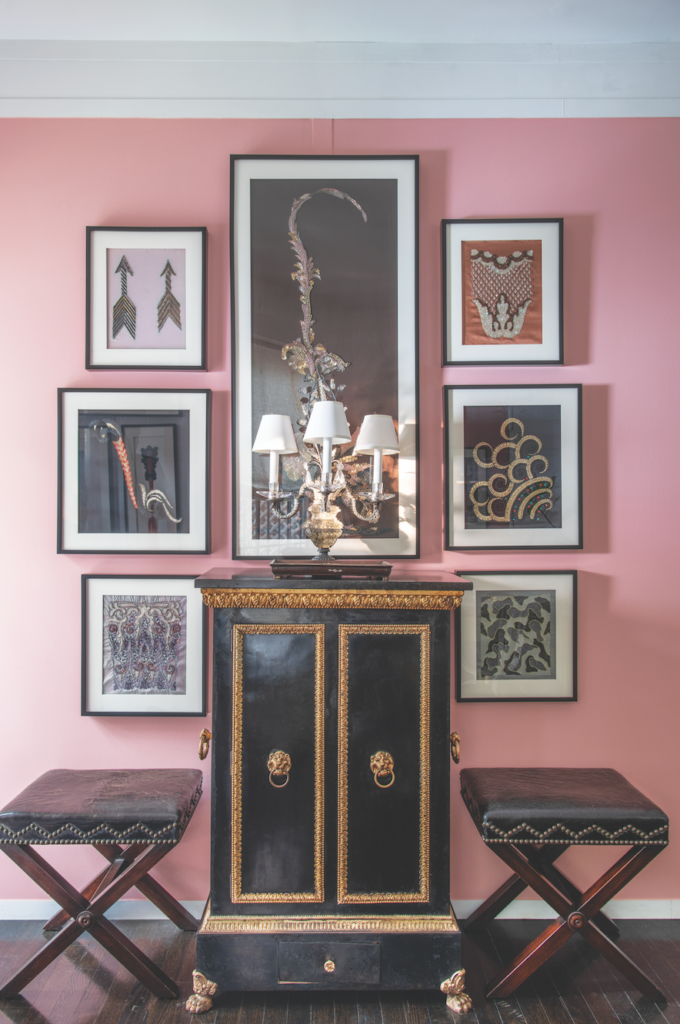
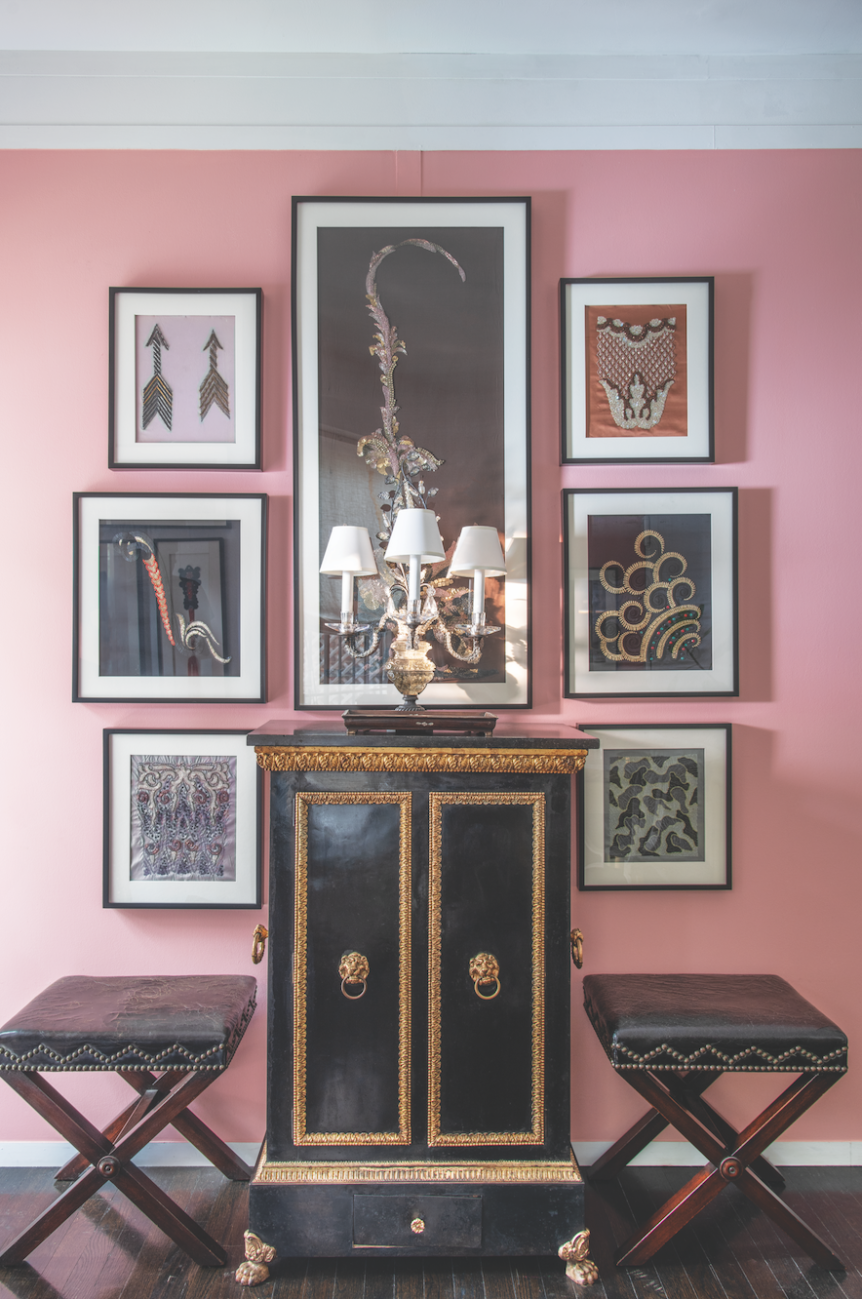
^ Hailing from a prominent Swiss family, he studied painting at the École des Beaux-Arts in Paris and the Munich Academy, when the arts and crafts movement broke the barrier between the fine and decorative arts. No wonder he opened an embroidery studio, and collaborated with the couture house of Worth. He then branched out to design furniture and interiors and launched a line of rugs (including one of parrots and parakeets, which came to roost on Yves Saint-Laurent’s sitting room floor). I also have a desk by him and a collection of fifty-seven Boiceau-embroidered panels and tassels, some framed, that are for sale. But since I’m selling the embroideries as a group, they might as well be collection privée.
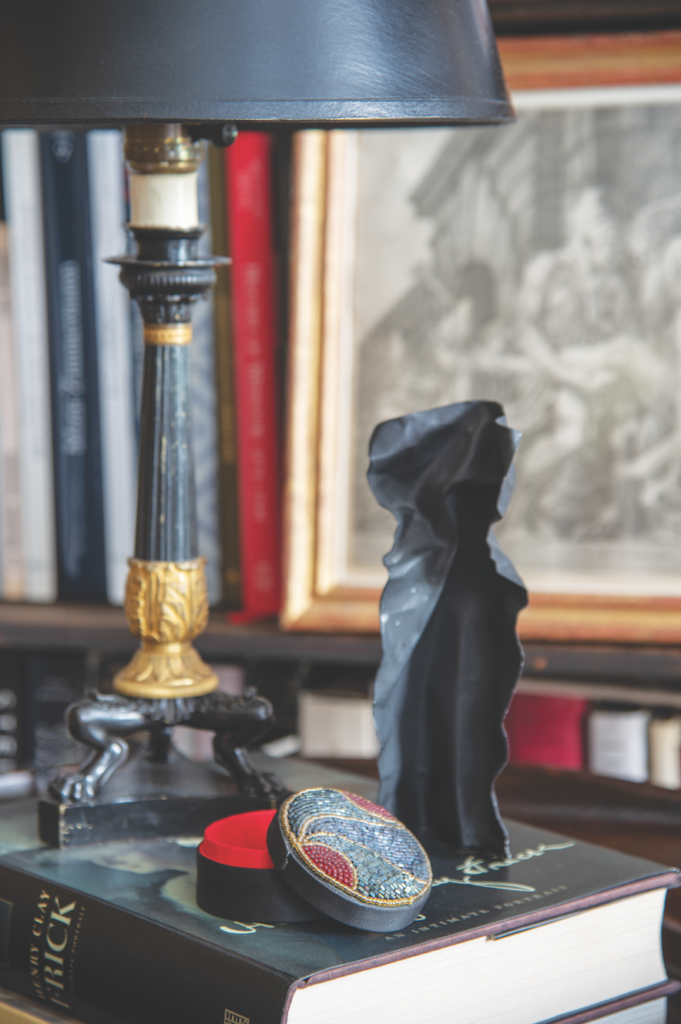
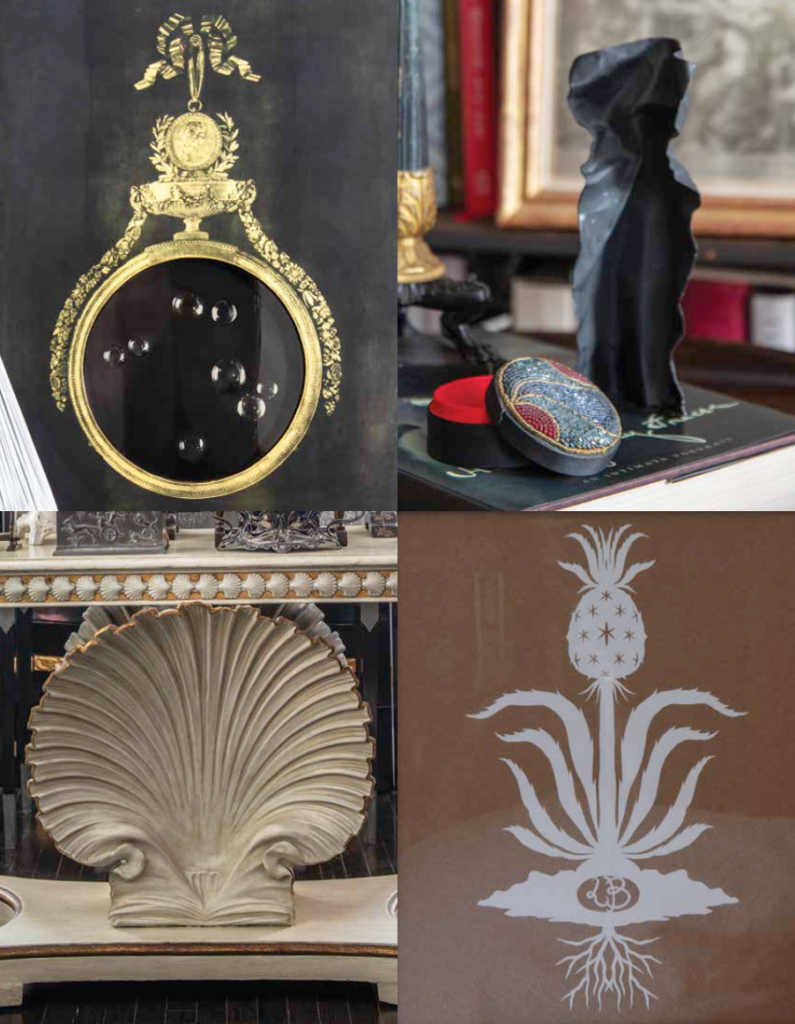
^ The small black maquette for a seven-foot-tall sculpture was given to me by Rosemarie Castoro, a conceptual, minimalist, and performance artist. She called these sculptures “Flashers,” because they resemble open raincoats minus the dirty old men. In the 1980s I arranged for a temporary installation of them in the lobby and plaza of a Midtown office building, where they were placed singly and in groups to mimic the tenants and passersby in a frozen moment of time. After determining the form of each with a maquette, she gripped the large steel sheets with a vise in each hand to wrest them into shape. Despite her enviable biceps, being clad in black leather, and looking like a chic biker girl, she was a gentle soul. I miss her now that she’s gone to that big foundry in the sky.
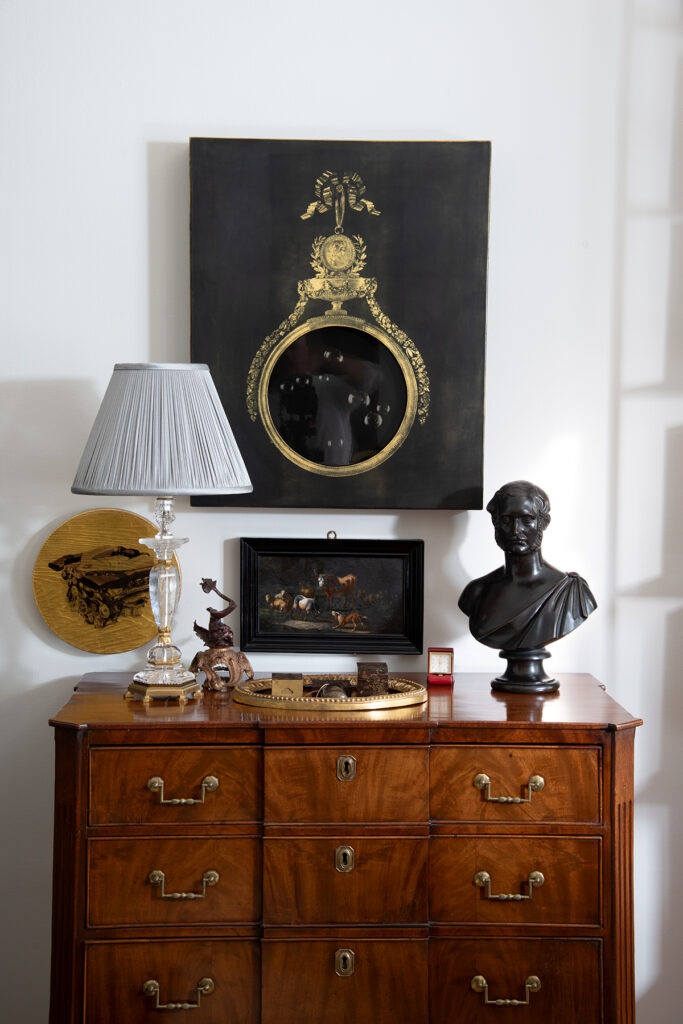
^ On my birthday one year, I sat down to dine alone at a Mexican restaurant because the friend I was to meet canceled at the last minute after getting a better offer. As a tear was about to fall in my margarita, she miraculously appeared with Justen Ladda, her artist boyfriend. Horrified that she had changed plans, he made her change them again and came himself, with a painting he inscribed “Happy Birthday Louis!” In the intervening years she peeled away from my life, and his, but a few girlfriends later, he and I remain close. German by birth, Justen moved to New York in 1978, and soon won acclaim for The Thing, an illusionistic painted installation of the comic book character spanning the auditorium of an abandoned South Bronx public school. In his “mirror” paintings he continued to explore issues of perception. One group consists of shallow wooden boxes with images of an antique mirror frame enclosing a recessed image on a highly lacquered ground that reflects the viewer. These images are printed in an obscure nineteenth-century photographic technique and depict something ominous—a suit of armor, a carnival mask—or, on the verge of effervescing, a wisp of smoke, droplets of water, and the soap bubbles seen here. When he made them the art world was being decimated by AIDS. And when I observed that they were memento mori he was taken aback, but later concurred. His AMG Mirror that hangs below to the left is ominous too, in depicting an obscenely expensive Mercedes-Benz engine, a consumer culture must-have that takes the place of the divine being found in the medieval gold-ground paintings that inspired him.
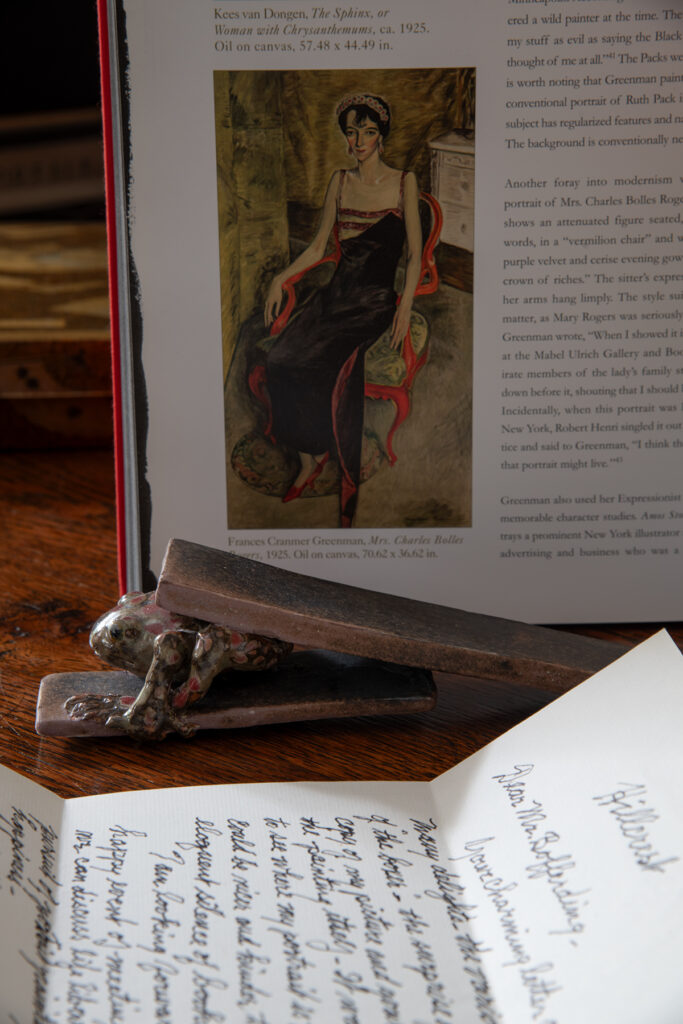
^ In 1976 I organized La Mode de Paris: 1908–1925, an exhibition at the Minneapolis Institute of Arts, which included a 1926 life-size portrait by Frances Cranmer Greenman of Mrs. Charles Bolles Rogers, a local grain heiress, wearing Paris couture and a diamond-and-ruby parure. A portraitist, Greenman studied painting in Paris, Munich, and New York. One day in the gallery, I heard a crescendo of clanking bangles that signaled the approach of a striking woman in black wearing a sculptural hat. She stopped dead before the portrait and exclaimed, “That’s my painting!” I followed up by mailing her photographs of other Greenmans in the collection, and she wrote back about the pleasure of encountering her portrait and proposed meeting again “to discuss life, liberty, and the pursuit of portrait painting and happiness.” Half a century later I found the portrait on Instagram, posted by Nancy Pierson, the sitter’s granddaughter. A talented ceramicist, she sent me an unpublished biography of her grandmother’s husband written by Greenman, and I sent her photos of the dress in the portrait that I tracked down in a museum collection. Since then we’ve become friends without ever meeting, and I’ve come to admire her work, although it was painting that she studied, exhibited on both coasts, and taught at the Otis Art Institute. But in 1993 she put her brushes aside to raise a special-needs son. Two decades later, with stability at home and a kiln nearby, she resumed her art practice. Animals in distress is her subject, visual metaphors for her long exile from the studio, domestic entrapment, and angst. As a gift she sent me this frog, squished between unforgiving slabs.
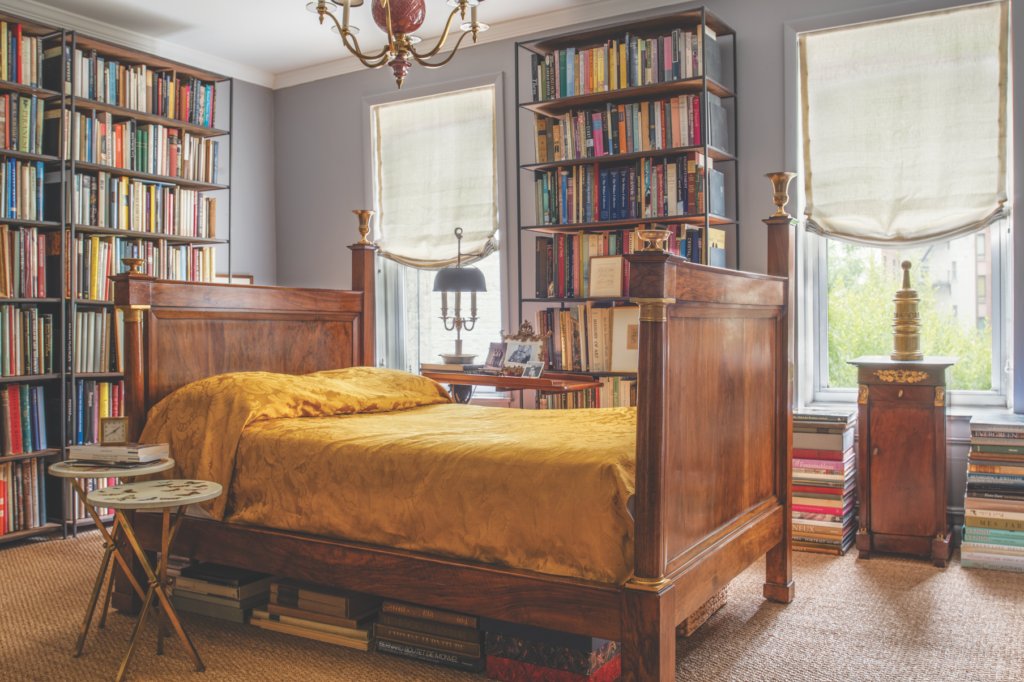
^ When just starting out as a contemporary art dealer, I moved into my first apartment without a stick of furniture. As I didn’t want to “make do” with anything that I wasn’t willing to live with for the rest of my life, I furnished the place piecemeal. My first purchase was a set of Biedermeier chairs, and the second, an enormous giltwood baroque candlestick turned into a lamp, which I found in Rome. Meanwhile, I was spending the nights on the floor in a borrowed sleeping bag cushioned by bubble wrap. Eventually, when in Houston on business, I found an ormolu-mounted mahogany French Empire bed. Years later, after moving to my next apartment, I came across another bed of walnut in Fontainebleau. This one was provincial, but I preferred its animated silhouette with urns and tazzi. I set it up in place of the other, which I hoped to sell, but found no takers. I now have one in my bedroom for sleeping, and the other in my living room for reading. Antique beds, you see, are difficult to sell since many are put off by their small size, and the thought of others having slept, made love, been born, and died in them. I’ll admit that I once felt the same, but now think otherwise, because they connect me to others in the past, as they will to others in the future. We are all, au fond, ghosts or ghosts in the making.
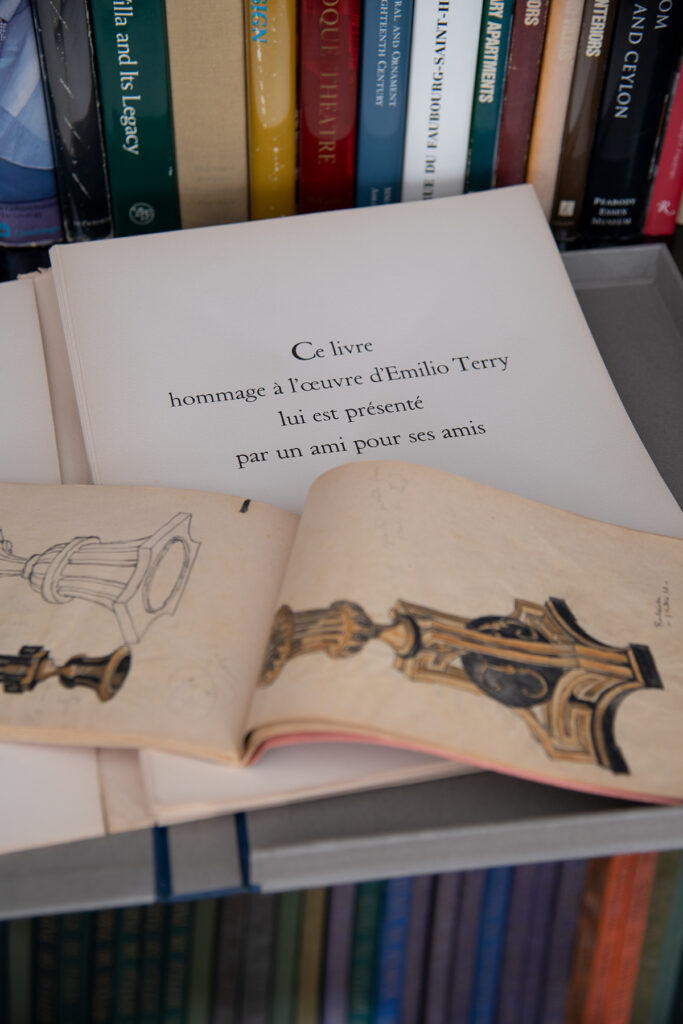
^ When dealing in the art of the present and reveling in that of the past, I discovered the architect-designer Emilio Terry, who drew no line between modernism and historicism, and appeared in MoMA’s 1936 exhibition Fantastic Art, Dada, Surrealism. At the time there was only one limited-edition book on him, published in 1969 on the occasion of his death, which was impossible to find. Over dinner in Paris a friend’s wife said she might be able to help, working as she did for Jean Fournier, the contemporary art dealer who published it. When I arrived for an appointment with Fournier, he led me to an empty gallery with a high stool next to a drafting table, and the entire staff gathered round. Asked to page through it and comment, I did so in my high-school French, sweating bullets. On finishing, he put the book back in its slipcover and into my hands. Assuming I passed the test, I asked how I should pay. He then reopened the book and pointed to the printed dedication, “présenté par un ami pour ses amis,” and took a pen to write another, “A Louis, en souvenir d’Emilio Terry.” Thus did three decades and six degrees of separation collapse to make Terry and me friends. Shortly after that, Pierre rang to say some Terry sketchbooks were coming up at auction. I asked him to buy one for me. On my next visit I took possession of this unassuming notepad, suitable for grocery lists, with candlestick designs and evolving floorplans, ushering me into Terry’s mind. In the event of a fire, these will be tucked under my arm as I head for the door.
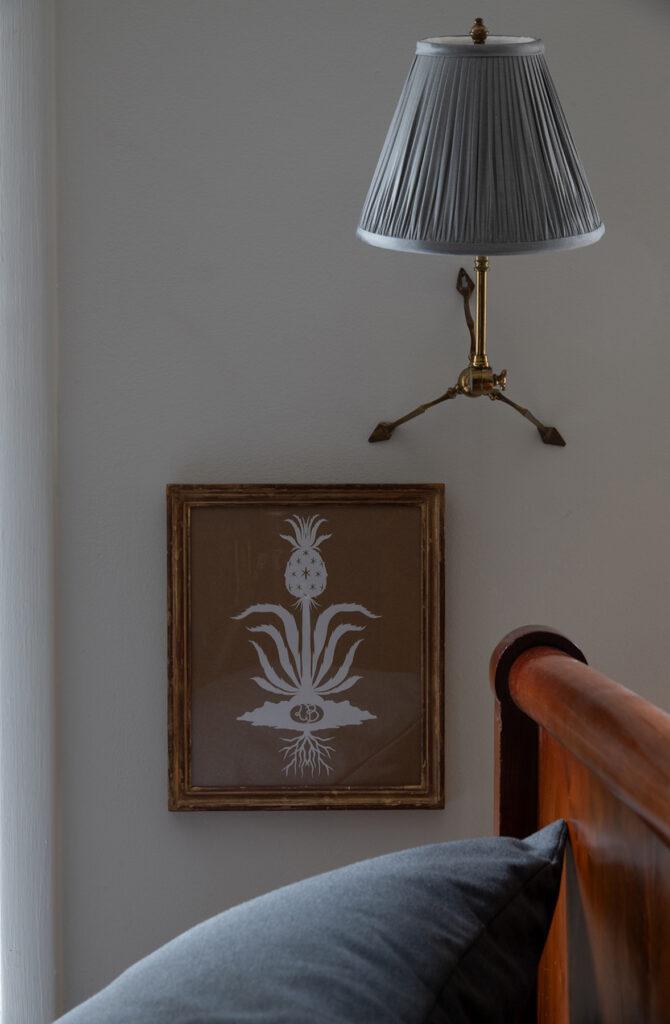
^ In 2015 Carmen Almon, who sculpts delicate botanica from sheet metal, told me that her nephew, Adam Charlap, then a design student, followed the ever-changing décor of my apartment in shelter magazines. I told her to send him by the gallery, and eventually he came, but you could’ve knocked me over with a feather a few visits later when, as the world’s youngest decorator, he bought a mirror for a client. Like most lasting friendships, ours evolved slowly. Many purchases and dinners later, I was touched when Adam, who’s talented in more ways than one, gave me this cut-paper silhouette that incorporates my intertwined initials. Since he’s also obsessed with Emilio Terry, my quixotic quest for a book now seems like destiny, as it led to the collapse of their six degrees of separation to a mere one, me.
Louis Bofferding is a former contemporary art dealer and museum curator, now dealing in art and design from antiquity to the present.


