

The roles of immigrant craftspeople in the making of the American South.
I’m notorious for trotting out Thomas Leitch’s View of Charles Town. Normally, the prospect of the city comfortably hangs over a mantel in one of our thirty-three galleries at the Museum of Early Southern Decorative Arts (MESDA), holding court over a room filled with pre-Revolutionary Charleston furniture and decorative arts. “Skied” like a second-rate work at the Royal Academy of Arts, its distance from the viewer makes me strain to make out all the seemingly infinite details of the panoramic scene, the sliver of house and building portraits wedged between the weight of sky and churning sea, a preposterously large Royal Navy frigate that looms on the foreground, dwarfing the diverse assemblage of men who pull in boats and loaf about with telescope in tow at the bottom edge of the canvas. Any chance I get, I bring it down to eye level.
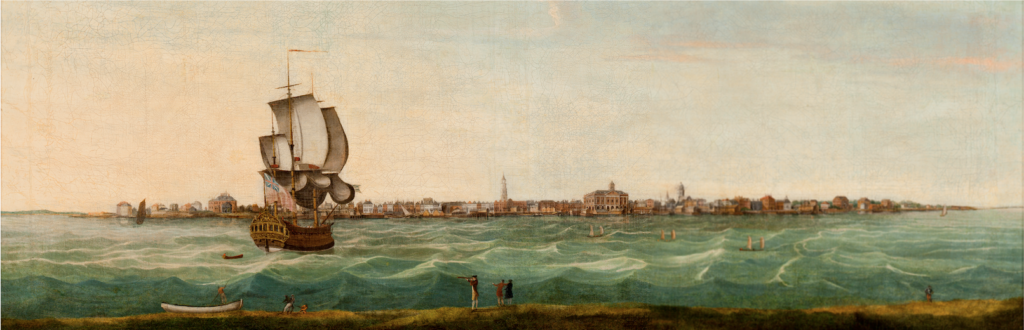
Through the end of this year, it will be the first thing to greet every visitor to our special exhibition, Lately From: Immigrant Craftspeople and the Making of the American South. Not because it is strictly the work of an immigrant craftsperson: the maddingly elusive painter Thomas Leitch (also spelled Leech), was only in the city from 1773 through 1776, just long enough to make the perspective painting and try to woo subscribers to the printed version.
But that view. Looking across the waters of Charleston Harbor toward a city that positively teemed with people who were “lately from” somewhere else. It is the perfect portal into the world I want our visitors to encounter in the gallery.
Lately From is an attempt to recover some of the individual lives of eighteenth- and nineteenth-century craftspeople whose existence spanned continents and oceans. It relies, as much as possible, on their own handwritten words: letters, inscriptions, autobiographies, account books, advertisements, and even drawings. When brought together with the other work of their hands, the objects they created, we can begin to understand the human experiences encoded in our material world.

Charleston is by no means the exclusive focus of the exhibition, though admittedly it has an outsized presence among the seventeen objects I’ve selected. MESDA’s physical collection and research resources (the fully digitized and online craftsperson and object databases) are similarly rich in the story of the city.
To the left of Leitch’s View as visitors enter the gallery is a delicate lady’s desk, writing surface extended, on which we have opened a copy of Thomas Sheraton’s 1791 Cabinet-Maker and Upholsterer’s Drawing-Book. Both the desk and the book are labeled by Robert Walker, a Scottish-born cabinetmaker who immigrated to New York in 1793 before establishing a major workshop in Charleston by the end of the decade. Walker brought with him his training and his knowledge of the latest fashions.
Walker’s workshop became a place where that craft knowledge was imparted to other men who were immigrants—some by choice and others by force. Men like Rob, Simon, and Charles, who were born in Africa in places unnamed in the surviving documentary record. They were all enslaved by Robert Walker. Rob was a sawyer, Simon a skilled cabinetmaker, and Charles a young boy of about ten. We know their names because they pursued freedom—sometimes more than once. The desk in Lately From is likely from the period when Simon was a cabinetmaker in the Walker workshop.
The individuals whose lives we explore in Lately From came to the southern colonies and later states for many reasons: for economic opportunity, as apprentices, convicts, or indentured servants; to escape religious oppression, as soldiers, preachers, or teachers. But for hundreds of thousands of individuals, there was no choice. Forced immigration through enslavement and the transatlantic slave trade is core to the making of the early American South.
Lately From is a small exhibition. Those seventeen objects in the gallery cannot encompass the enormity of the story of forced and free immigration in the early American South. It is intended to change the way we see those seventeen objects and the hands that made, used, and saved them. A chance to focus at eye level.


