How one collector’s childhood discoveries grew into a mission to reunite historic objects with the families and places to which they once belonged.
I grew up living next door to a Quaker meeting house built in 1724, in a community largely composed of descendants of those who worshiped there three hundred years earlier. I began my interest in collecting antiques when my parents restored the house I grew up in. It was built in 1739, which meant my brother and I could find all sorts of things to discover around the property. We dug up thousands of artifacts as little kids including redware, stoneware, shell edge, clay pipes, bottles, and so much more, artifacts that gave us a direct tie to those who had lived in our house before us. I started collecting things related to the sherds we had discovered, but over time I began to collect things that had local histories related to our community. My collecting gave way to me becoming an antiques dealer operating my shop, East Nottingham Antiques, out of my parents’ barn.
graphs by Jeffrey Ricketts.
Over time, as families sell off their heirlooms, and periodically at auctions or from other dealers, I can acquire objects and return them “home.” The biggest boost to my “local collection” came in 2020 when I cleaned out a house about a mile down the street that had been occupied by the same family for over 150 years, and they had seemingly never gotten rid of anything. Every room was full of the family’s heirlooms, portraits, furniture, ceramics, textiles—and the current owner didn’t want a single thing anymore. I was fresh out of high school, so I couldn’t keep everything; but I sold enough to be able to keep the things I really “needed.” Since then, I have been able to share pieces with different descendants of the people these objects had belonged to.
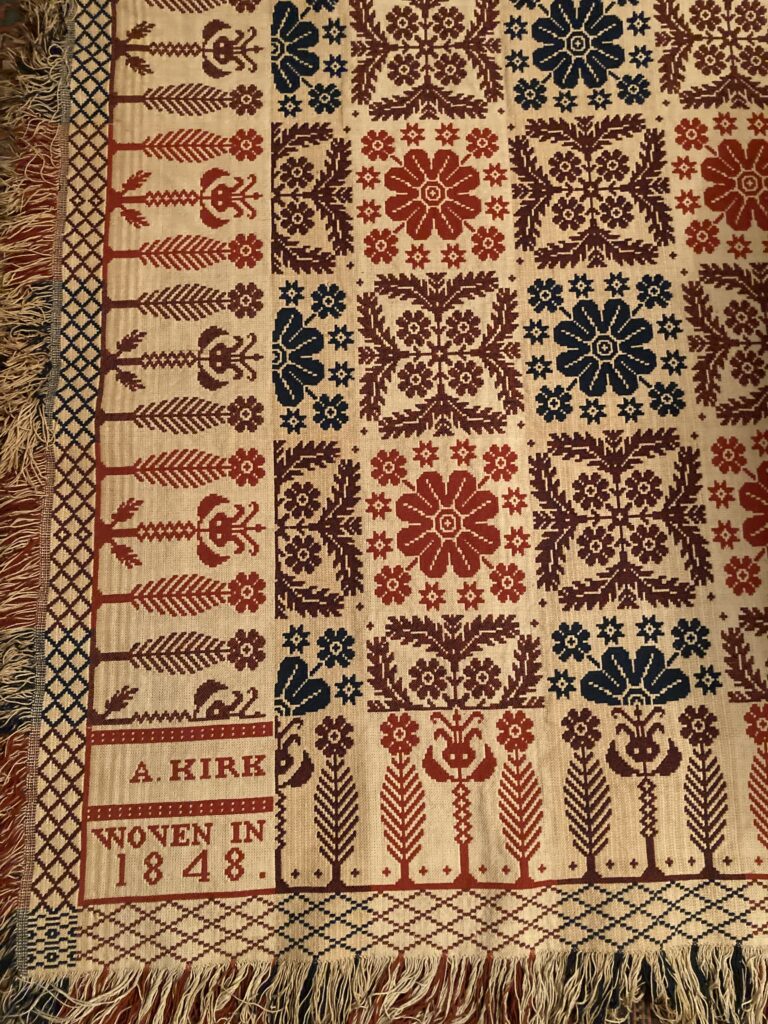
possibly for Abner Kirk(1822–1881).
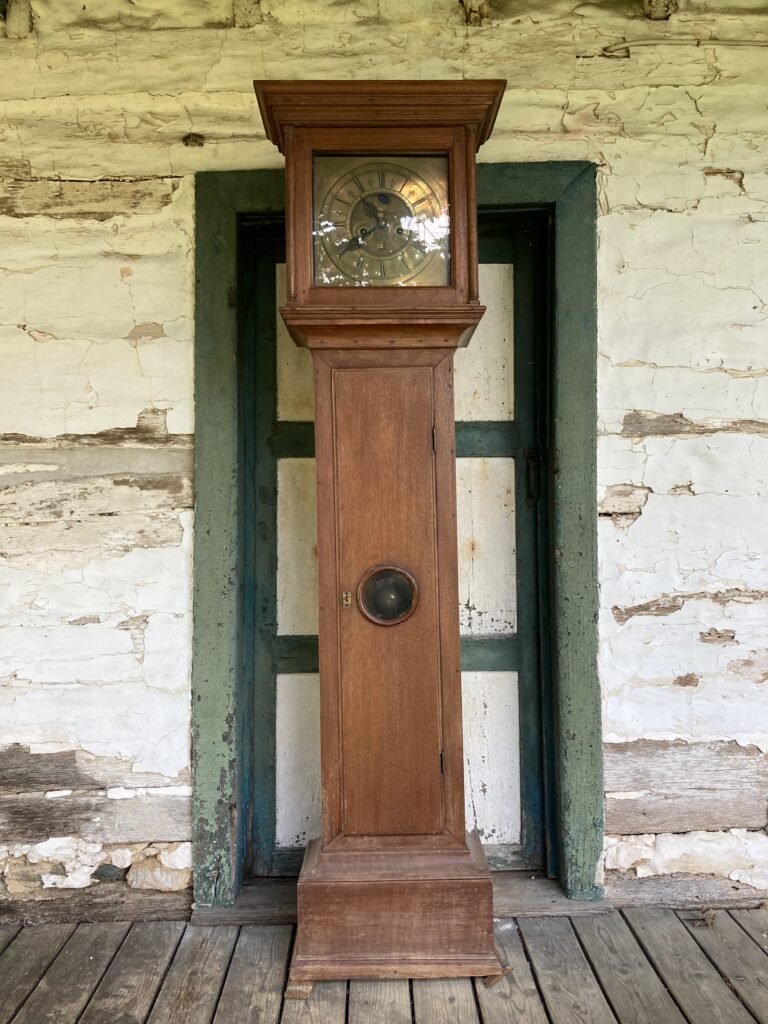
With my shop being next door to the Brick Meeting House, every so often I will get a call from a distant descendant preparing to make a pilgrimage to see their ancestors’ place of worship and hoping to see anything else related to their family. In the spring of 2025, a man from Ohio called me because he was coming to see the meeting house and wanted to know what else he could see in the area related to his family. On his arrival at my shop, not only was I able to greet him with a variety of things I had collected over the years that had belonged to his family, but I was also able to guide him down the street and point out buildings they had inhabited centuries ago. Sadly, just a few months after his visit he passed away, but he had been able to make leaps and bounds in his genealogy search. Later in 2025, a man from Tennessee was making a journey to our area as he had descended from John Churchman, a well-known eighteenth-century Quaker minister. When he visited, I was able to show him a tall-case clock that had belonged to his tenth great-grandfather, which I had purchased several years prior from Lisa Minardi of Philip Bradley Antiques.
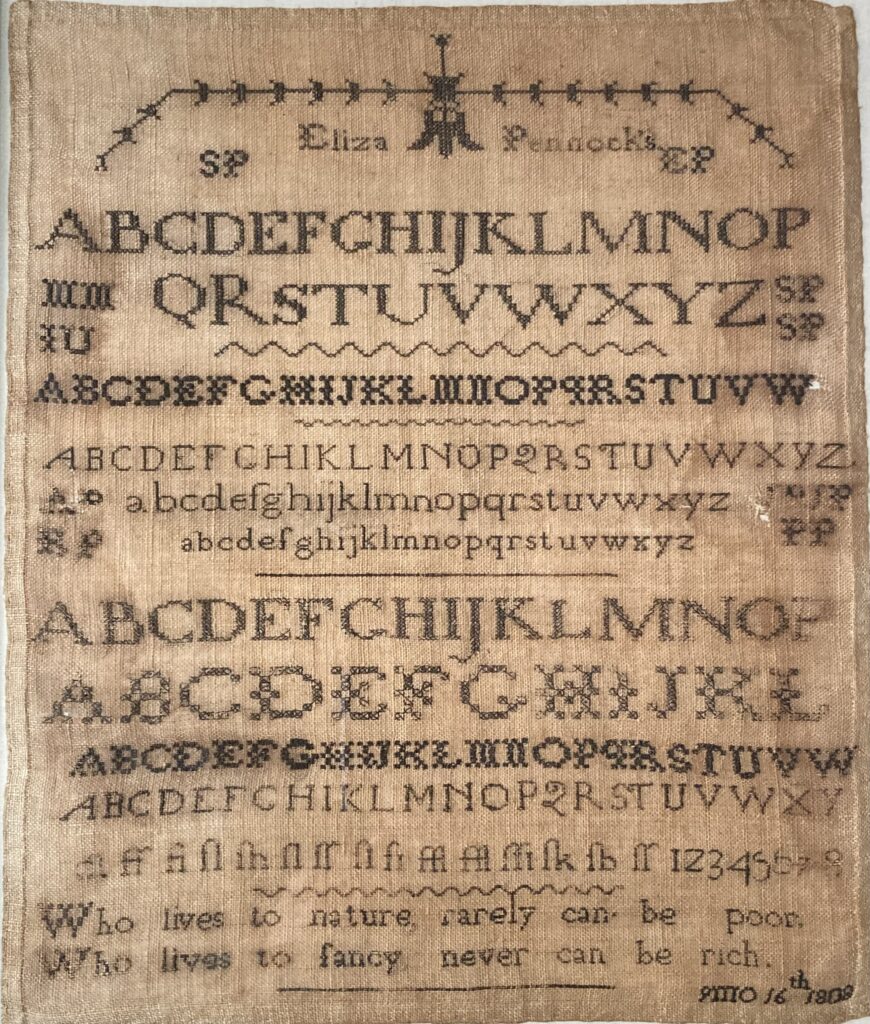
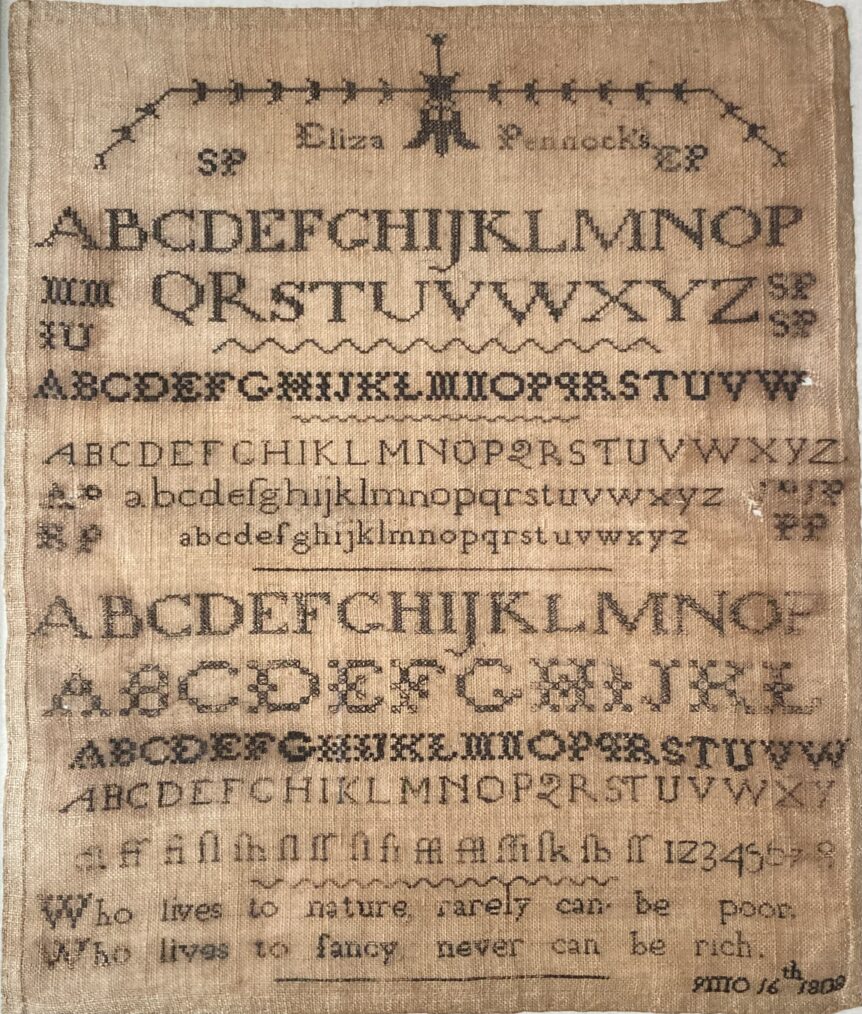
Another benefit of collecting a community’s objects is being able to relate them to each other. Sometimes I also get to relate things to the house I’m currently restoring called Mullen’s Folly, which once served as a general store located in northern Cecil County, Maryland from 1789 to 1823. Recently I purchased a large collection of eighteenth- and nineteenth- century needlework samplers—several English, but mostly American examples, and a few local ones from Cecil County. Out of the fifty-eight I purchased, only four or five were for my collection. A friend helped me research and identify the makers. One southeastern Pennsylvania example I had initially decided to sell, but when she figured out who the maker was, and identified all the initials incorporated in the designs of the piece, I got chills and knew I had to keep it! The sampler was made in 1808 by Eliza Pennock from London Grove, Pennsylvania. Her mother was Elizabeth Johnson Underhill Pennock—the same Elizabeth Underhill who owned my house from 1823 to 1838!
The main reason many of us collect anything is because it brings us joy. For me, finding something from here that’s been away for over a century and bringing it back brings me the most joy. Sharing my collection online, and at various local history events has helped to draw more interest in local historic preservation, interest in the education
of local history, and increased community support for local historical efforts. Historical societies have the same sort of effect in preserving a community’s heritage, but often lack the funding to acquire objects, and rely solely on donations. However, with building a collection with this focus, I am able to loan objects for exhibits and displays at the Historical Society of Cecil County to help fill gaps in its collections. Being able to help give a more complete glimpse into the lives of a community from centuries ago helps create greater and greater interest in preserving our local history.


