

A sweeping exhibition explores how the Declaration of Independence traveled the world, shaping revolutions, civil rights struggles, and global visions of liberty across 250 years.

All images courtesy of the Museum of the American Revolution, Philadelphia.
John Hancock’s bold signature is one of the most iconic features of the Declaration of Independence. At the end of January 1777, Hancock also penned his signature on a series of letters that transmitted a new printing of the Declaration to each of the new states and expressed a prediction about the Declaration’s impact. Hancock wrote, “there is not a more distinguished event in the History of America, than the Declaration of her Independence—nor any that in all Probability, will so much excite the Attention of future Ages.”¹
American Jewish Historical Society, New York.
In the twenty-first century, the Declaration of Independence continues to excite attention here in the United States and around the globe. In fact, the Declaration has become one of the most important documents in modern world history. More than one hundred nations since 1776 have issued a declaration of independence.² Civil rights and human rights movements in the United States and abroad have borrowed the Declaration’s language and drawn inspiration and justification from it. Back in 1777, Hancock foresaw the Declaration’s sustained importance, but he might not have imagined just how influential it would become.

Revolutionary War, and in 1785 was first Black person ordained as a Congregational minister. Museum of the American Revolution.
The 250th anniversary of the Declaration in 2026 is an opportunity to celebrate and reflect on the document’s effect on the world. At the head of its commemorative efforts for the momentous occasion, the Museum of the American Revolution in Philadelphia opened the special exhibition The Declaration’s Journey, presented by Griffin Catalyst, on October 18, 2025. Through the display of about 120 artifacts, documents, and works of art from forty lenders and the museum’s own collection, the exhibition explores the history and legacy of the Declaration from 1776 to today. International in scope and arranged in four chronological sections, The Declaration’s Journey includes declarations of independence issued by countries such as Ireland, Haiti, India, Mexico, and Korea, supported by examples of material culture that represent the people involved. The result is a rich and dynamic global history of the Declaration of Independence that will be on view until January 3, 2027.
To immediately signal to visitors that the exhibition covers much more than 1776, The Declaration’s Journey opens with the display of two pieces of seating furniture from different contexts and time periods linked by the Declaration. One is the Windsor chair that Thomas Jefferson is believed to have used while drafting the Declaration in Philadelphia in 1776, on loan from the American Philosophical Society. The other is the metal bench from the jail cell where Martin Luther King Jr. was imprisoned in Birmingham, Alabama in April 1963. In that cell, King wrote on scraps of paper what would become known as the “Letter from Birmingham Jail,” one of his most famous written works. The bench, on loan from the Birmingham Civil Rights Institute, is a reminder that the Declaration of Independence has had a long and varied influence. In his letter King reflected on Jefferson and the Declaration as he responded to critics who were telling him to cease and desist in his civil rights efforts. He argued that he was engaged in pushing the United States to strengthen its commitments to its founding ideals of liberty and equality. With this opening display, visitors are immediately pushed to consider what the Declaration has meant and continues to mean to the nation.

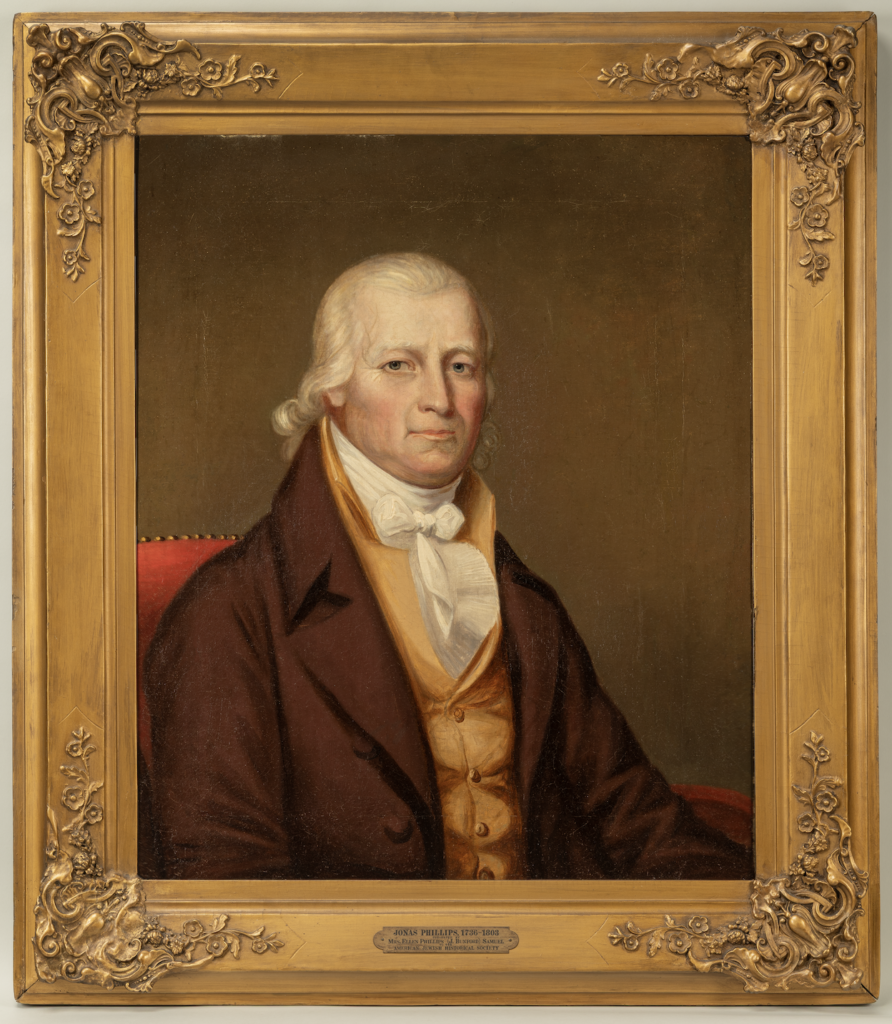
The Declaration traveled both physically and metaphorically in the years following 1776. It initially spread through a variety of first printings of the text, such as a broadside created by Philadelphia printer John Dunlap on the night of July 4 into the morning of July 5, 1776. Of the hundreds of copies printed by Dunlap that night, only twenty-five are known to survive. In late July of that year, a Jewish merchant in Philadelphia named Jonas Phillips acquired the broadside on display and attempted to mail it across the Atlantic enclosed in a letter (written in Judeo-German) to a business contact in Amsterdam. Phillips’s mailing, however, never made it to its destination because the British captured the ship that carried it. The Dunlap broadside Phillips mailed, along with his original letter, have returned to Philadelphia for the first time since July 1776, on loan from the National Archives of the United Kingdom.

The Declaration’s Journey also highlights examples of the first translation of the Declaration, printed in German as a broadside in Philadelphia in July 1776. With this translation, Philadelphia’s significant German-reading population could have access to the text of the Declaration. The example in the exhibition is on loan from Gettysburg College. Other “firsts” include the first newspaper printing of the Declaration (the July 6 edition of the Pennsylvania Evening Post) and a rare broadside of the Declaration printed by Mary Katharine Goddard in January 1777.

While these early printings and translations spread the Declaration’s ideals to diverse audiences, they also set the stage for debates over who was included in the promise of equality—debates that would shape the nation’s struggle with slavery and civil conflict. The battle over the future of slavery in the United States is one of the most significant legacies of the Declaration of Independence. Many Americans celebrated the spread of rights and independence movements abroad in the 1800s, but others called out the United States for supporting liberty and equality beyond its borders while Americans enslaved millions of people of African descent. In a speech in 1852, known today as “What, to the American slave, is your 4th of July?” abolitionist Frederick Douglass put the contradiction into words: “You are all on fire at the mention of liberty for France or for Ireland; but are as cold as an iceberg at the thought of liberty for the enslaved of America.”³

The Declaration’s Journey also includes an 1863 printing of Abraham Lincoln’s Gettysburg Address, which reminded Americans that they lived in a nation founded on the “proposition that all men are created equal.” Displayed nearby is the Confederate uniform of George Wythe Randolph (Thomas Jefferson’s grandson) who fought for a cause that justified secession on the “consent of the governed” principle of the Declaration of Independence. Through January 2026, the museum displayed what historians consider the earliest written abolitionist response to the Declaration of Independence: a manuscript essay titled “Liberty Further Extended.” Black New Englander Lemuel Haynes wrote the essay in the fall of 1776, and he quoted the second paragraph of the Declaration, including the phrase “all men are created equal,” on its title page. Haynes declared slavery to be incompatible with the new nation’s founding principle of equality. Together with the writings of Richard Allen, Absalom Jones, and James Forten, Haynes’s manuscript reflects how Black American leaders of the late eighteenth and early nineteenth centuries mobilized the Declaration’s language to challenge slavery and press for equal civil rights.

In the decades surrounding the American Civil War, women used the language of the Declaration to explain their efforts to secure greater civil rights. Elizabeth Cady Stanton, who authored the Declaration of Sentiments, a product of the 1848 Seneca Falls Convention, wrote that “all men and women are created equal.” She dedicated her life to combating prejudicial treatment of women. An oak desk she used late in her career is on loan to the exhibition from her great-great-granddaughter, Coline Jenkins.
New York Public Library, Rare Book Division.
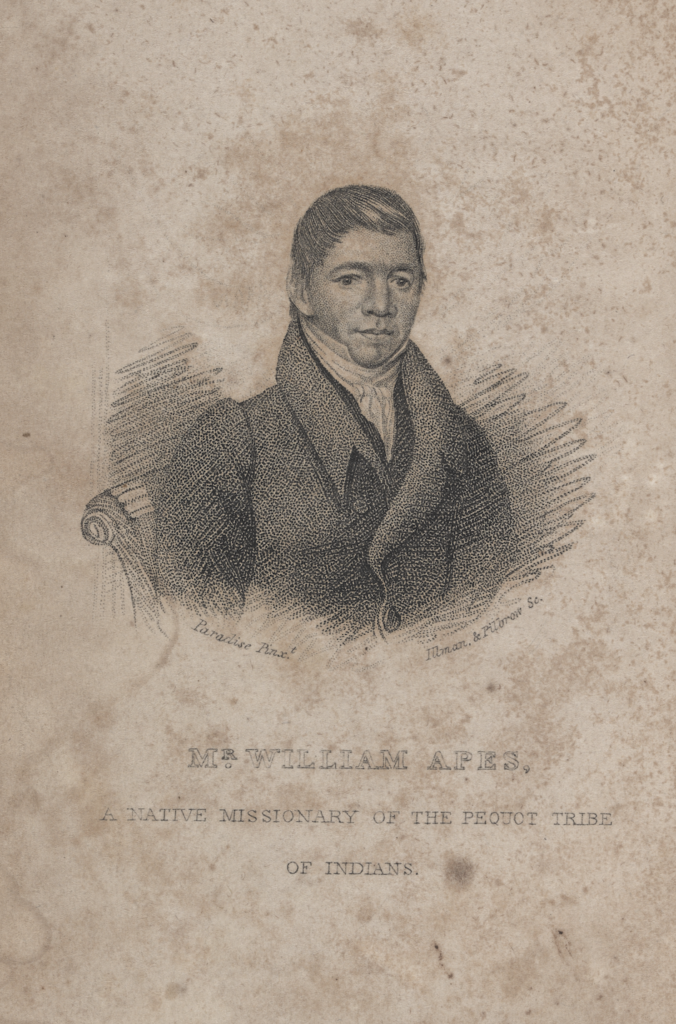
Native American nations, by issuing statements regarding their sovereignty, deployed the Declaration’s language as well. In 1833 the Mashpee Wampanoag tribe in Massachusetts declared its independence. Frustrated by Massachusetts laws and conflicts with citizens of the state, the Mashpee petitioned the governor. Echoing the Declaration, they resolved, “that we, as a tribe, will rule ourselves, and have the right to do so; for all men are born free and equal.”⁴ An 1835 printing of the Mashpee declaration is included in the exhibition, on loan from the American Antiquarian Society.
Collection of Ila Jasani Good.
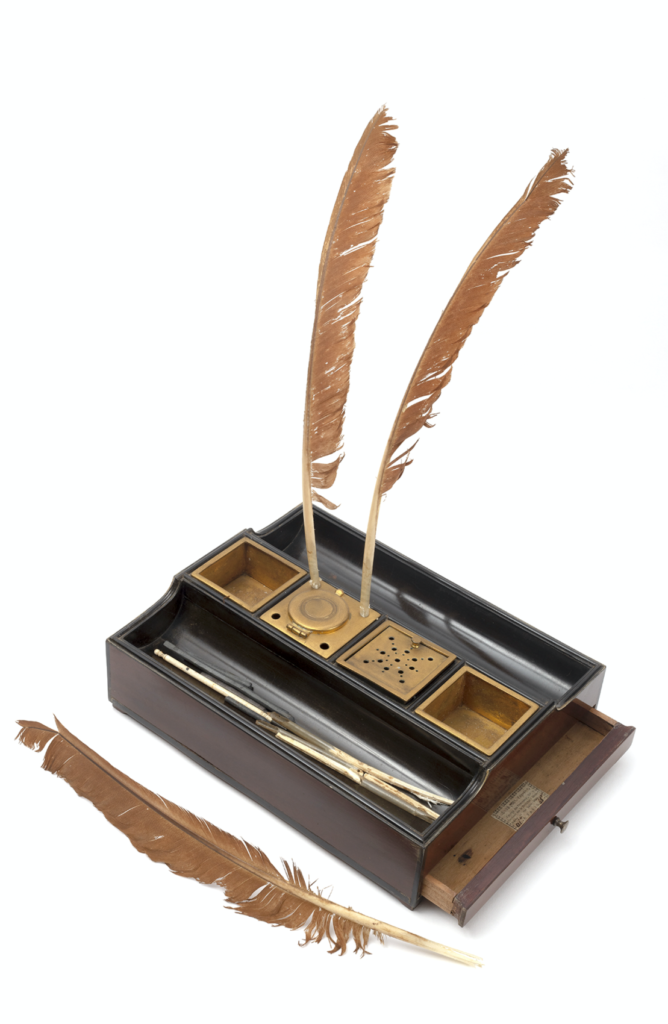
In the late eighteenth and early nineteenth centuries, the ideas articulated in the Declaration intersected with the French and Haitian Revolutions and with independence movements across Latin America and central Europe through the 1840s. The marquis de Lafayette and his drafting, alongside Thomas Jefferson, of the French Declaration of the Rights of Man and of the Citizen in 1789, come into focus through loans from the Musée de l’Armée and the Fondation Josée et René de Chambrun in France, including a piece of the Bastille carved with Lafayette’s face and the writing set Lafayette used late in his life. A manuscript copy of Haiti’s 1804 declaration of independence, on loan from Duke University, also highlights this part of the story. Discussions of Jean-Jacques Dessalines, who issued the Haiti declaration, and the display of a French-cast cannon that was in Haiti during the revolution paint a fuller picture of the independence movement that abolished slavery in the former French colony and created the first Black-led republic.
Two artifacts underscore the far-reaching influence of the Declaration across the Americas: a printing press associated with Chile’s independence movement and a military uniform worn by Vicente Guerrero, a central figure in Mexico’s fight for independence. Sent to Chile in 1811 by a group of New Yorkers eager to advance revolutionary ideas in South America, the press was the country’s first, helping to disseminate the principles of independence in print. The following year, the country’s first newspaper, Aurora de Chile, was printed on the press, a signal of Chile’s independence from the Spanish Empire. The press is on loan from the Biblioteca Nacional de Chile in Santiago. In contrast to the spread of revolutionary ideas through print, Vicente Guerrero’s military uniform represents the role of armed struggle in nineteenth-century independence movements. Guerrero wore the coat during the final years of Mexico’s war for independence from Spain, culminating in 1821. A key military leader who helped unify insurgent forces, Guerrero later became one of Mexico’s early presidents.

In the 1900s, the Declaration’s journey extended in all directions. New communication technologies in an increasingly connected world meant that the Declaration’s influence was captured in radio and television broadcasts and international meetings, reaching more people than ever before. The Declaration’s language and concepts continued to appear in the declarations of new nations, with an even broader geographic scope. But the Declaration also influenced calls for universal rights that transcended national boundaries. For the first time, fundamental human rights were acknowledged and protected across the world.

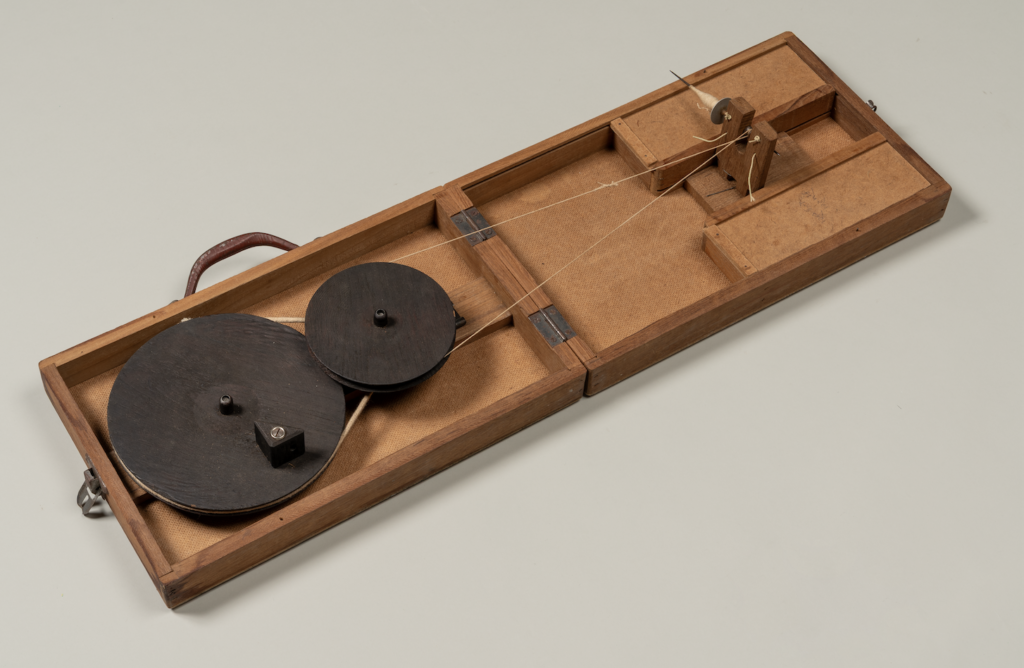
Over the past century, the Declaration’s ideals have continued to resonate around the world, inspiring movements for independence, human rights, and social justice. From Philip Jaisohn’s efforts to link Korea’s 1919 declaration of independence with the United States, to Mohandas Gandhi’s use of the Declaration’s principles in India’s struggle against British rule, to Eleanor Roosevelt’s contributions to the United Nations Universal Declaration of Human Rights in 1948, its language has guided generations seeking freedom and equality.⁵ Even in the United States, Martin Luther King Jr.’s “I Have a Dream” speech demonstrates the enduring power of the Declaration to shape civil rights and national conscience. Together, these artifacts show that the Declaration of Independence is not just a historical document—it is a living force that continues to inspire the pursuit of liberty across the globe.
Today, thanks to generations of revolutionaries who have been part of the Declaration’s journey, we can decide what the Declaration means for ourselves and our future. The exhibition at the Museum of the American Revolution provides a prompt to think about the past, while considering the next 250 years of the story. The exhibition shows how the Declaration has and will continue to “excite the Attention of future Ages.”
Special thanks to co-curators Philip C. Mead, Emily Sneff, Amy Noel Ellison, and the scholarly advisory committee for The Declaration’s Journey.
MATTHEW SKIC is director of collections and exhibitions at the Museum of the American Revolution. He served as project director for The Declaration’s Journey.
Endnotes:
____
¹Letter from John Hancock to Delaware Assembly, January 31, 1777, Straus Autograph Collection (C0077), Box 1, Folder 39, Princeton University Library.
²For a more complete accounting of declarations of independence around the world, see David Armitage, The Declaration of Independence: A Global History (Cambridge, MA: Harvard University Press, 2007).
³ For the full text of Douglass’s speech, see Frederick Douglass, Oration, Delivered in Corinthian Hall, Rochester (Rochester, NY: Lee, Mann & Co., 1852).
⁴The Mashpee declaration is printed in William Apes, Indian Nullification of the Unconstitutional Laws of Massachusetts, Relative to the Marshpee Tribe (Boston, MA: Jonathan Howe, 1835).
⁵The full text of the Universal Declaration of Human Rights is available on the website of the United Nations, https://www.un.org/en/about-us/universal-declaration-of-human-rights.


