
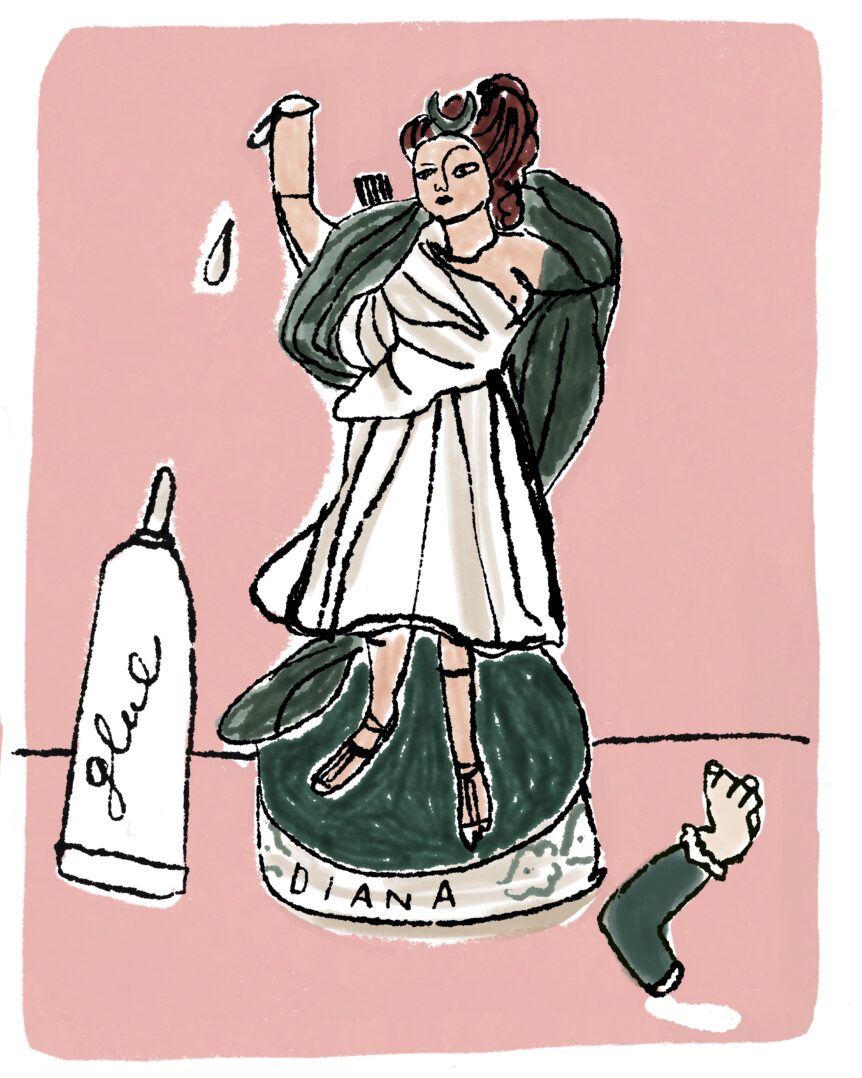
In which the author copes with his collection of chipped Meissen figurines.
Anamaria Morris, a Brooklyn-based designer, recently gave me hope for the future. More specifically the future of my inherited collection of Meissen figurines. I’ll return to Ana shortly. But first a bit about the collection and the many curious ways it finds to break my heart.
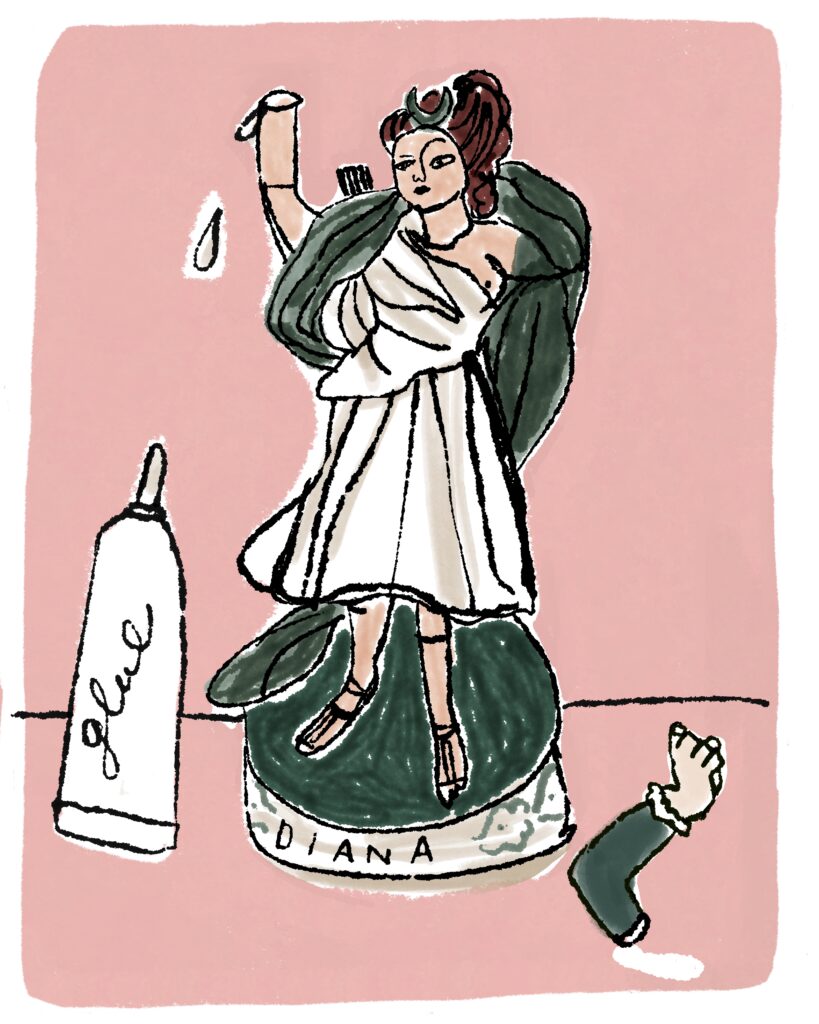
It wasn’t until I sat down to write this column that I stood right back up and decided that I ought to take inventory, since I’d never done so before. Between those in a cabinet in our dining room, a veritable forest of figurines in our basement, and several other specimens spread around the house—including not one but two blue and white three-tiered, filigreed Meissen cake stands—I count approximately sixty objects. And that doesn’t include the dozen or more I bestowed upon the “broom sweep” who emptied my parents’ apartment in lieu of payment after he claimed that he lost money on the job.
Don’t ask me about the provenance of all these frolicking putti, whimsical farm animals, and garlanded maidens beyond the two generations that preceded my own. Meissen was the default gift my grandmother presented to my mother, her daughter-in-law, on birthdays and anniversaries. Where my grandmother acquired the porcelain—whether from antiques shops or through her own inheritance—I have absolutely no idea.
The most puzzling aspect of my collection is how nicked it is. Hardly a piece has
survived intact. Just when I pick one up to admire its artistry, I’m depressed to discover that a cherub’s delicate wing is chipped, surely inhibiting flight; that a court jester’s rattle has gone missing; or that a maiden’s handsome young suitor has lost a couple of fingers or worse, making him less marriageable. The damage makes no sense to me. I handle the pieces with the utmost care. And before I inherited them, as far back as memory allows, they resided, largely untouched, in matching vitrines in my parents’ dining room.
When I visit museums such as the Met, the Frick, or the Clark Art Institute in Williamstown, Massachusetts—whose collection boasts the stunning Meissen Allegories of the Four Continents: Africa, America, Asia and Europe (c. 1750)—I’m awestruck and envious. Less because of their exquisite craftsmanship than because these delicacies have navigated the centuries without losing a single lion’s tooth, horse’s hoof, or serpent’s tail.
When I have nothing better to do, and occasionally when I do to my spouse’s dismay, I attempt to repair my damaged porcelain. Frankly, I had a selfish motive for writing this column. I was seeking tips from the pros about how to restore my array to respectability. Or at a minimum not to make them any less marketable, though I have no plans to seek a buyer. I take some pride in the steadiness of my hand and skill with a glue nozzle. Sometimes I’m also trying to reverse the damage wrought by my father who had a heavy hand when it came to adhesives, and much else in life. Still, I’m under no illusion that I have any idea what I’m doing.
Thus, I sought an audience with Rebecca Gridley, a partner in the private Art Conservation Group. Rebecca has worked with the Met and the Frick, where she recently led a team as part of the museum’s renovation and expansion in restoring the eight-foot, thousand-pound limestone caryatids that grace the mansion’s facade. Rebecca, who is also capable of working on a more modest scale, gave me encouragement—not that I could accrue the expertise to repair my porcelain to museum standards at this late date—but by revealing that those radiant specimens behind glass in the Met’s European Decorative Arts galleries, for example, may be less flawless than they appear.
She referred me to work that she did on a Staffordshire earthenware teapot for the museum’s British galleries. Shrewdly created for the American market around the time of the Revolution, it came decorated with the protest message “No Stamp Act.” “It was horribly, horribly stained,” Rebecca recalled. “These things were put into service.” She removed the stains using poultices. Today it looks brand new. “It was a really magical process to watch,” she says.
She has also replaced teapot spouts and handles using synthetic materials that appear invisible to the naked eye and that can be reversed if future generations come up with better techniques. Unsurprisingly, Rebecca cringed when I confessed that my go-to adhesives have names such as Elmer’s and Gorilla. However, we bonded over employing the laws of gravity to our advantage—propping a figurine upside down, say, so that its reattached arm doesn’t drop off as the glue dries. “We’re not using a dish rack,” she said, referring to my favorite workspace. “But a huge part of repairing or joining anything is how you can jig it using Ethafoam—an archival foam that you can carve and cut into nicely—or sandbags made out of washed linen so that gravity is working in our favor rather than working against us.”
Now back to Anamaria Morris and how she gave me hope that millennials may lead us into a new age of enlightenment. Ana also owns a piece of Meissen. In fact, it once belonged to me. I gave it to my daughter Lucy, who gave it to Ana, one of her best friends. I was flattered that Ana desired it. But I felt obligated to point out to her that the figure—a maiden gathering flowers in her apron—was standing on a damaged pedestal.
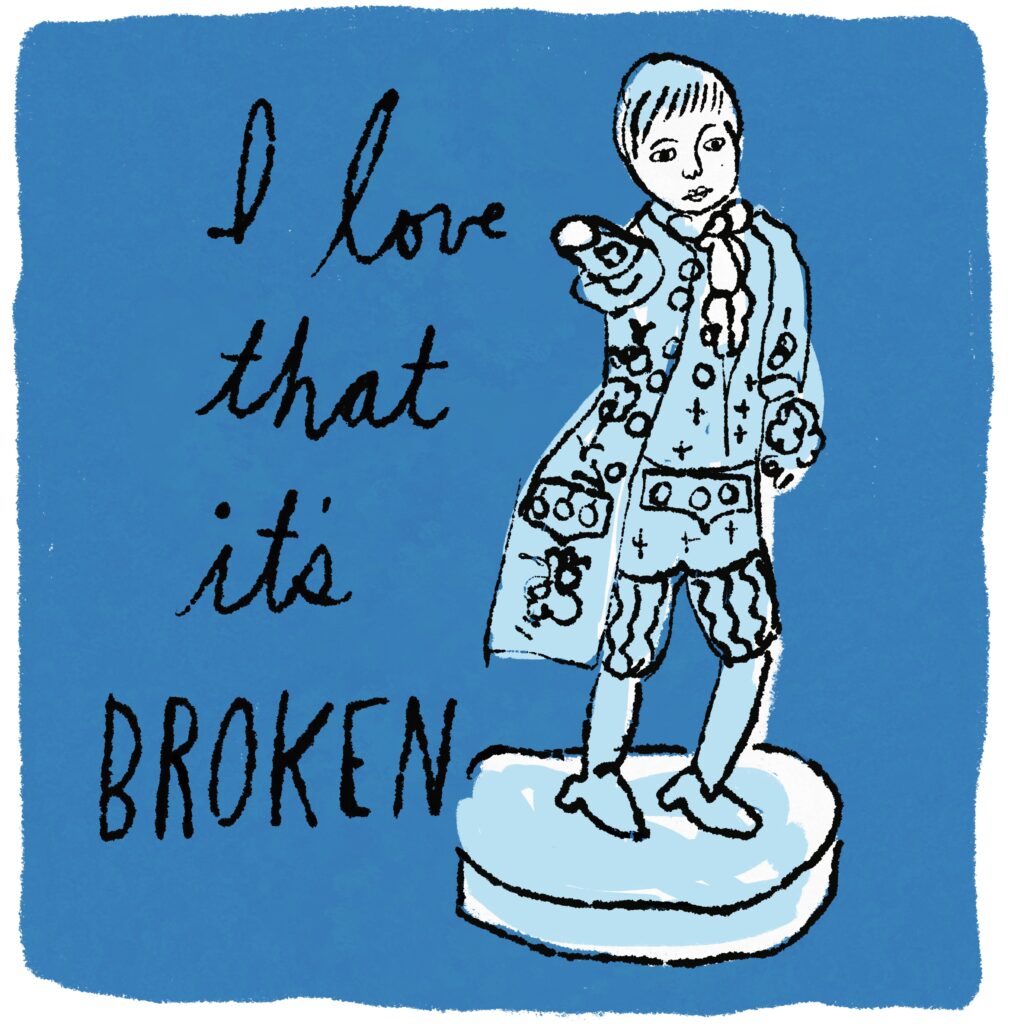
Ana didn’t consider the damage disqualifying. To the contrary. She believed it intrinsic to the young lady’s charm. “I love that it’s broken,” she told me. “I feel like there’s a story there that I’ll never know. Also, that it’s had a life.”
I was encouraged that Ana’s friends were as smitten with Flora, as she calls her porcelain companion, as she was. “I think there’s an appreciation for decorative objects again,” she says. “People are so into their own spaces and interior worlds. Anything unique and special and precious is something you want.”
Ana placed her injured figurine firmly in the Japanese tradition of wabi-sabi: finding beauty in imperfection. Apparently, I’ve been looking at my collection’s nicks and chips and cracks all wrong. Ana directed me to Instagram posts where practitioners drew attention to imperfections by filling cracks with materials such as gold dust.
Perhaps my bumbling repairs are wabi-sabi. One of my proudest interventions was to replace a bisque donkey’s ear with a porcelain donkey’s ear. Different material. Different color. Obviously, different donkey. The figurine—three small children gleefully hitching a ride on the bobble-headed beast—had been relegated to the basement. But after my encouraging conversation with Ana I’m considering restoring it to a place of honor in the dining room cabinet.


