
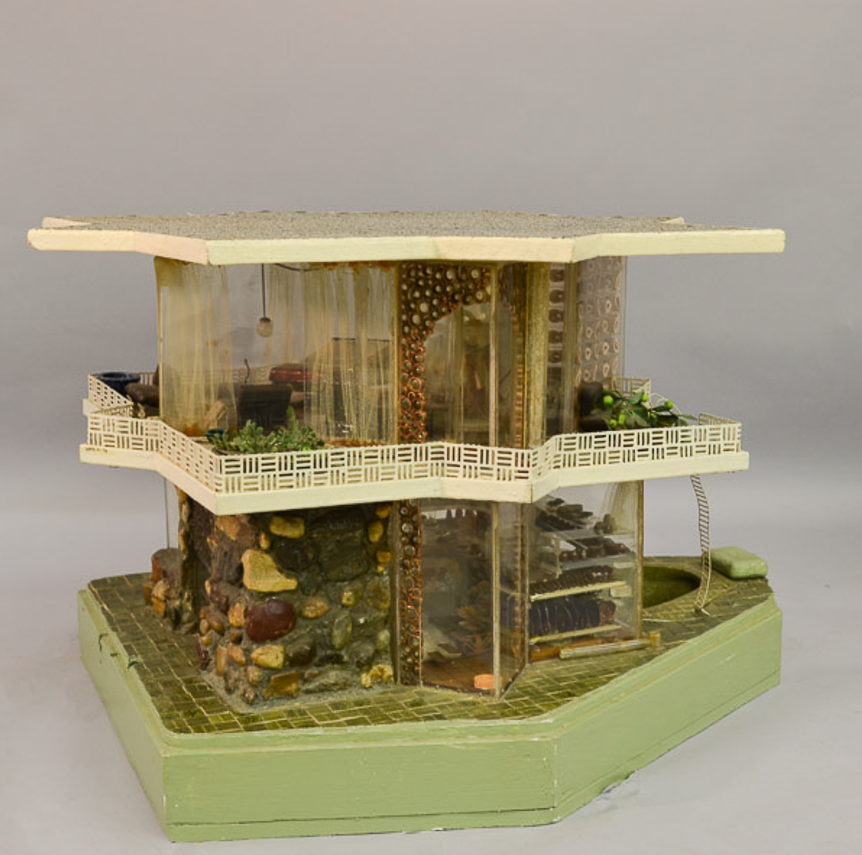
Through her visionary self-cleaning house, Frances Gabe embraced technology to empower women at home.
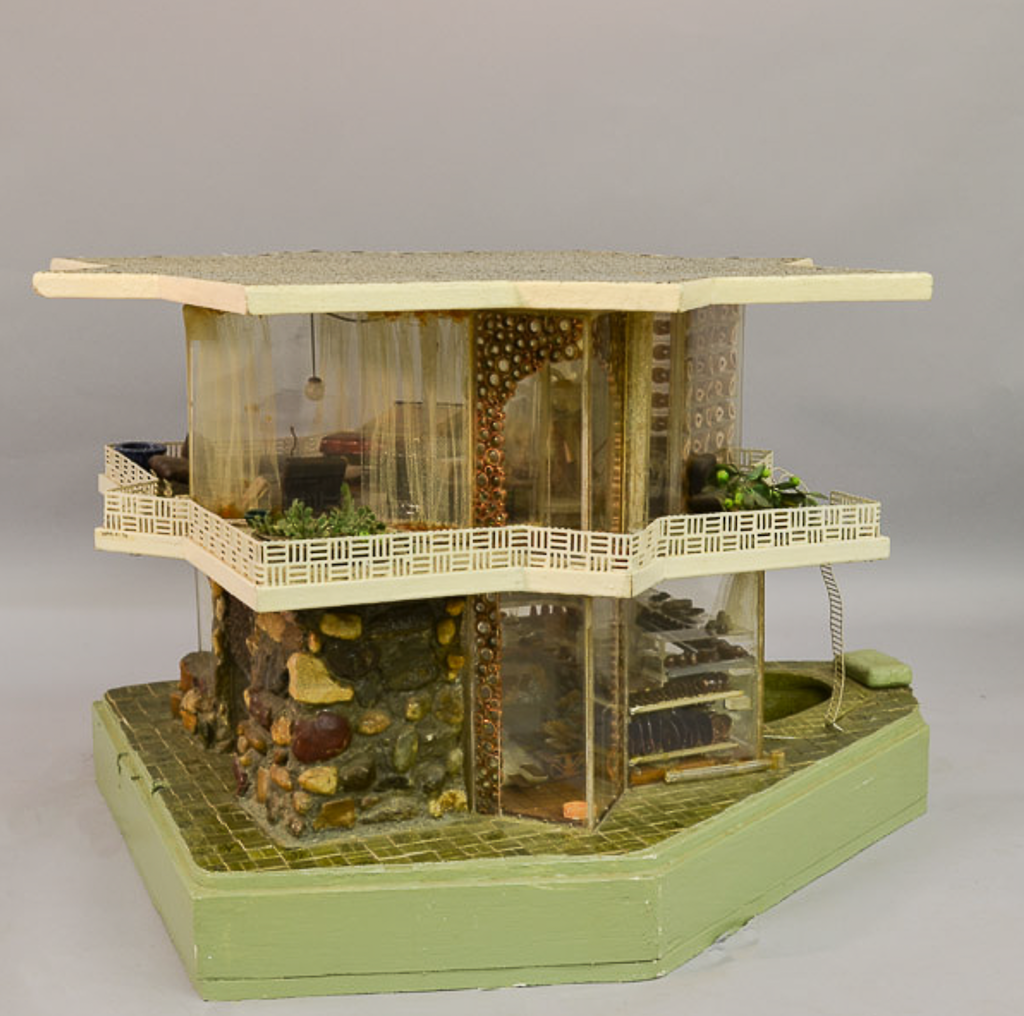
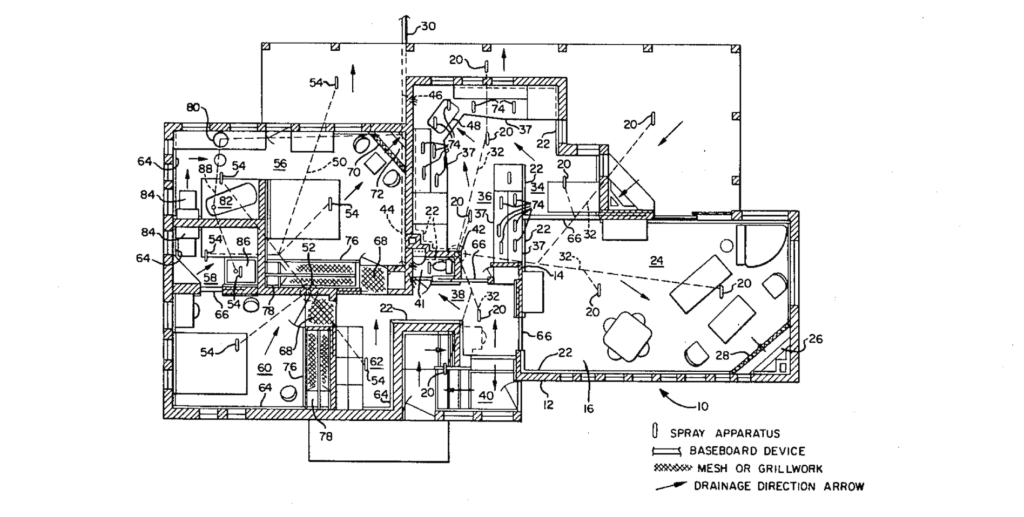
34 1⁄4 inches. The first floor has a kitchen, living room, and dining room; the second floor has a bedroom, bathroom, and a “clothes-freshener closet,” along with outdoor patio space. Gabe’s Self-Cleaning House was patented on January 31, 1984, as a Self-Cleaning
Building Construction (U.S. Patent 4,428,085); the patent included more than sixty separate inventions. Hagley Museum and Library, Wilmington, Delaware, Fred M. B. Amram and Sandra A. Brick Woman Inventor Collection.
In the late 1970s, on a wooded, poison oak–riddled property in Newberg, Oregon, inventor Frances Gabe built her dream home and magnum opus—the Self-Cleaning House(1). This revolutionary dwelling, which she lived in until 2008, did indeed clean itself. As detailed in the sixteen-page-long patent she filed in 1980 and was granted in 1984, Gabe invented sixty-eight separate devices and mechanisms to turn her two-story dwelling into an autonomous washing machine. She designed every aspect of the house—from the slanted floors to allow drainage and proprietary plastic coverings for every surface to the “clothes freshener” closet—to “eliminate handwork” in home maintenance(2). Although Gabe’s self-cleaning house was a unique, and undeniably quixotic project, she believed others could, and should, reap the benefits of living in a house that did its own chores. To promote and refine her revolutionary invention, she created a working scale model of the proposed house as well as miniature components. While singular, her project represents an extreme example of the technological engineering and experimentation driving twentieth-century futuristic domestic design. With her Self-Cleaning House, Gabe advanced the tradition set by earlier “homes of the future,” redefining the house as something to be continually reinvented.
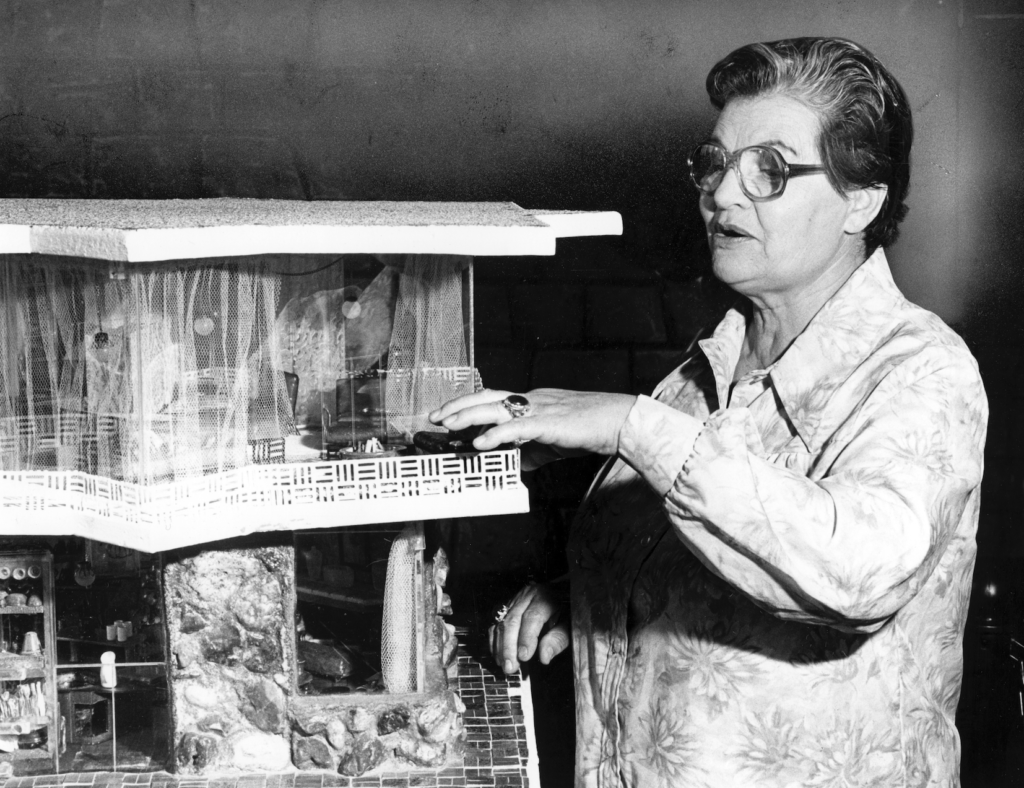
The novel, even whimsical, full-service home showcased Gabe’s creativity, scrappy approach to engineering, and embrace of new technologies. An artist raised by a builder to be self-reliant, her approach to domestic innovation echoed her contemporaries in the counterculture movement with their DIY ethos as well as electronics hobbyists’ inclinations to tinker. All of which was undergirded by her strong creative sensibility. Gabe’s design, like the many radical homes before, stemmed from beliefs that the path to an easier, healthier, more empowered domestic life lay in embracing technology, continual innovation, and progressive designs. The Self-Cleaning House was very much a machine, much more so than a “machine for living” in the Corbusian tradition.
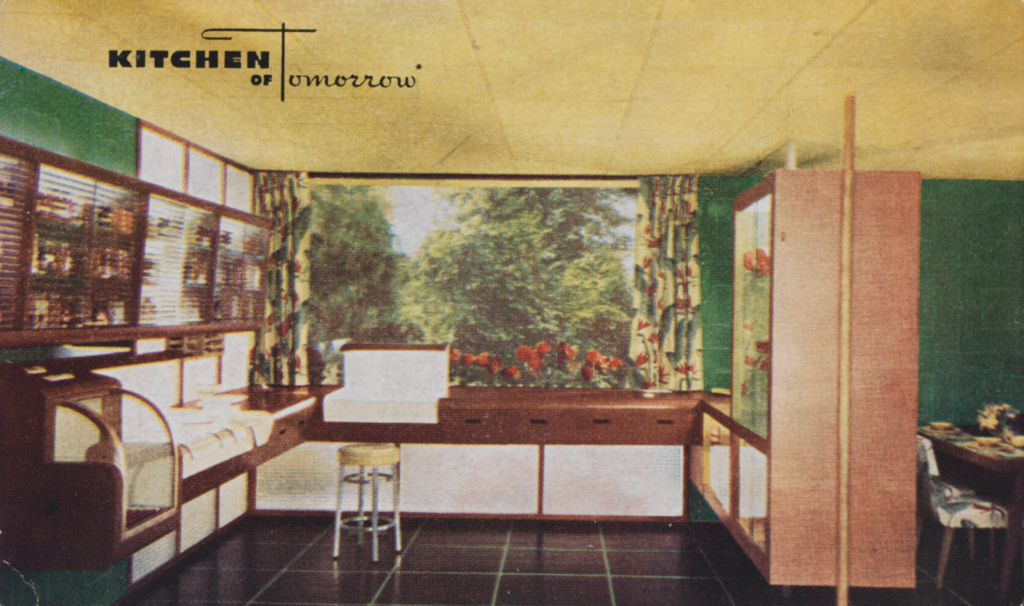
Gabe had grand ambitions for her total domestic machine. She believed that her Self-Cleaning House would “release people from the slavery of everyday living” by freeing them from the need to perform tedious domestic labor. Recognizing the gender disparity in housework, she declared that it was “damn foolishness” for women to “waste half their lives cleaning the house.” This goalechoed decades of marketing promises made by household appliance manufacturers. As gas-powered and electric ovens, washing machines, vacuum cleaners, dishwashers, and microwaves entered the American home, advertisements claimed that each new domestic machine would free women to shop and relax. Such promises reached their most extreme form in mid-century exhibitions and films depicting fantastical homes and kitchens of the future. In 1942 Libbey-Owens-Ford Glass Company made a “Kitchen of Tomorrow” filled with built-in gadgets and automatic timers and touted as a “labor-saving postwar dream room.” The 1956 RCA Whirlpool Miracle Kitchen and Frigidaire’s 1950s “Kitchen of Tomorrow” exhibitions likewise offered dream rooms where women would “never lift a finger–except to push ultrasonic, electronic, and push-button devices.”(3)“That’s What Women Are Coming To!,” American Home, April 1956, p. 22.
And yet, as scholars like Ruth Schwartz Cowan and Sussan Strasser have laid bare, although these myriad household appliances transformed women’s work, they did not meaningfully reduce the time spent on domestic labor.(4) Gabe also recognized the shortcomings of conventional appliances, proclaiming to the Oregonian in 1979 that devices invented by men typically “have women sticking their heads in some hole—the dishwasher, the toilet, the clothes washer, the dryer. You can’t even bathe a kid without hanging your head.” She extended this assessment of the impact of gender in design to the entire home, noting that men were responsible for most residential architecture. When H. Creston Doner designed the “Kitchen of Tomorrow” for Libbey-Owens-Ford, he imagined that it would be occupied not by himself, but his wife—the kitchen’s various gadgets would ease the burden of cooking and cleaning but would not challenge the assumption that these must be her burdens to bear.
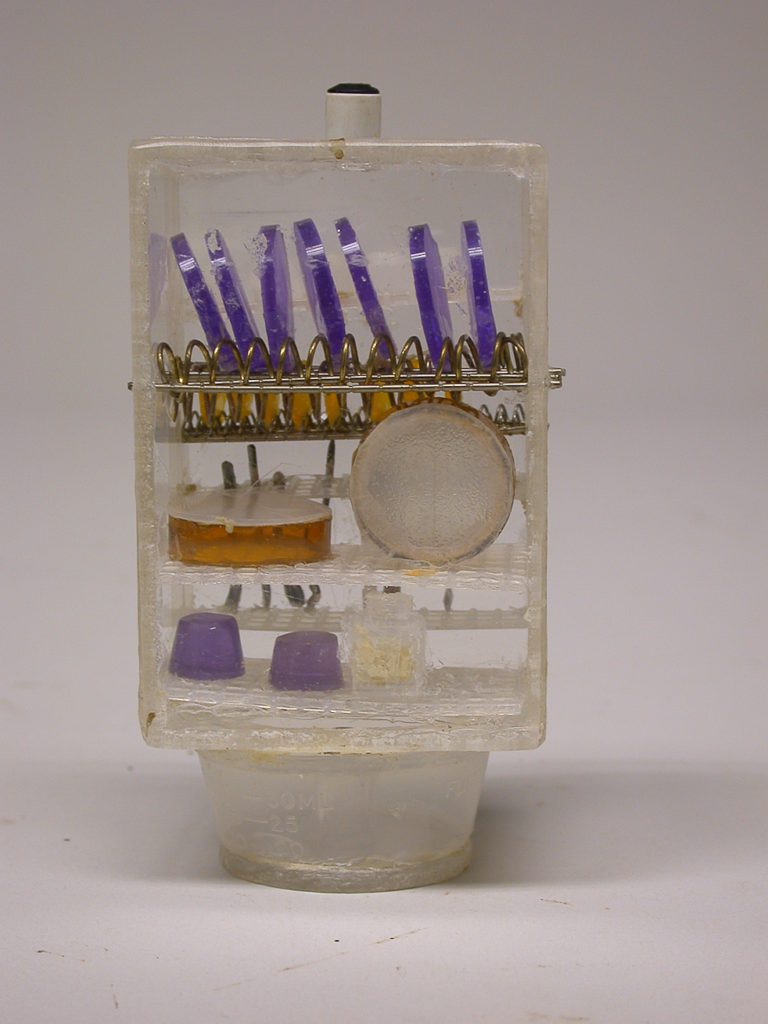
Unlike male designers, Gabe drew on personal experience as a homemaker when she designed the Self-Cleaning House to not only make the labor of cleaning easier, but to eliminate it altogether. For her, the promise of the self-cleaning house was not an advertising slogan, but a means of helping women avoid the frustrations she herself had experienced: “my gift to young mothers, because during all the years that my children were growing up, they were always wanting me to do things with them. I would always have to say I was sorry because I had to clean the blasted house, do the laundry, wash the dishes.”(5)
Nevertheless, some of Gabe’s inventions did closely resemble the miracle gadgets featured in corporate exhibitions. In 1967 Philco-Ford produced a film, 1999 A.D., depicting family life at the end of the century. Among other technological fantasies, the film promised that the house of 1999 would feature “cleaning closets” that would both store clothing and remove dirt. Gabe’s house likewise featured a “clothes-freshener” closet that washed and dried clothes on the hanger before automatically moving them into the main closet compartment. Gabe herself, however, was very different from the housewife featured in 1999 A.D., who was liberated from housework, but lacked even basic access to the family finances. According to the film, 1999’s housewife would shop from home using a video console, and despite the projected progress in home technology, all bills would be sent directly to her husband. Gabe, by contrast, managed a construction business, acting as her husband’s boss for much of their forty-four-year marriage. She was divorced by the time she began work on the Self-Cleaning House and, used to going at it alone, funded the project herself. Unlike the house of 1999 built for film but never actually occupied, Gabe lived in her self-cleaning house. Her clothes-freshener was not a speculative fantasy, but a (relatively) practical invention intended to improve life for herself and others.
Gabe never bought into corporate promises that new off-the-shelf consumer products would usher in a domestic revolution, but she did embrace the idea that technology could transform everyday life. She devised her own apparatuses, drawing from decades of advances in home-appliance engineering, synthetic materials, and automation technology. The house’s main cleaning mechanism operated much like a home dishwasher. For the wash and rinse cycles, spigots installed in each room’s ceiling sprayed the walls and furnishings with soapy water. The slightly slanted floors ensured proper drainage, and an air pump system dried the spaces.
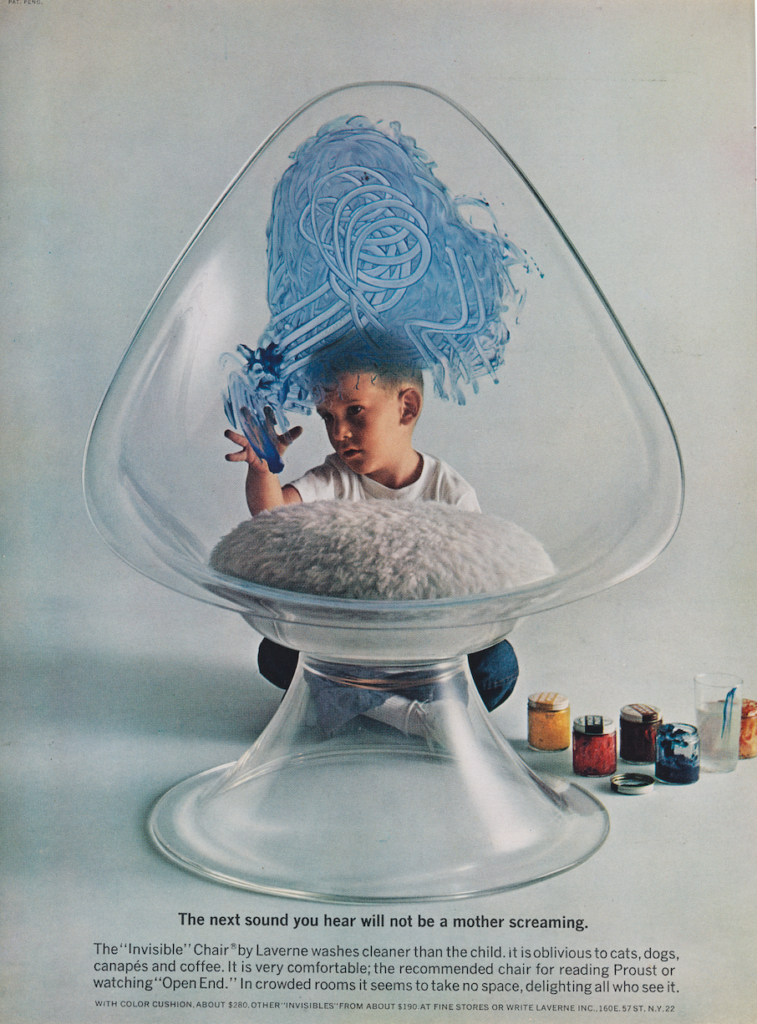
Of course, the ordinary stuff of a modern home—electric wiring, wood floors and plaster walls, upholstered furniture, bedding, curtains, clothes, books, important documents, and family photos—are not waterproof. Gabe’s main workaround for this dilemma was straightforward: make it from or cover it all in plastic. The notion of using plastics to help keep a space clean was decades old by this time; synthetic materials had been touted for their hygienic properties since the 1930s. The claims about how plastic would benefit homemakers were many, but chief of these was what Jeffrey Meikle calls “damp-cloth utopianism.”(6) An ad for Estelle and Erwine Laverne’s clear acrylic Lily chair (1959) captures the power of this message: a child has turned the elegant piece of furniture into their canvas, spreading blue paint all over. Yet, the ad assures, “the next sound you hear will not be a mother screaming.” The plastic chair could be wiped clean.
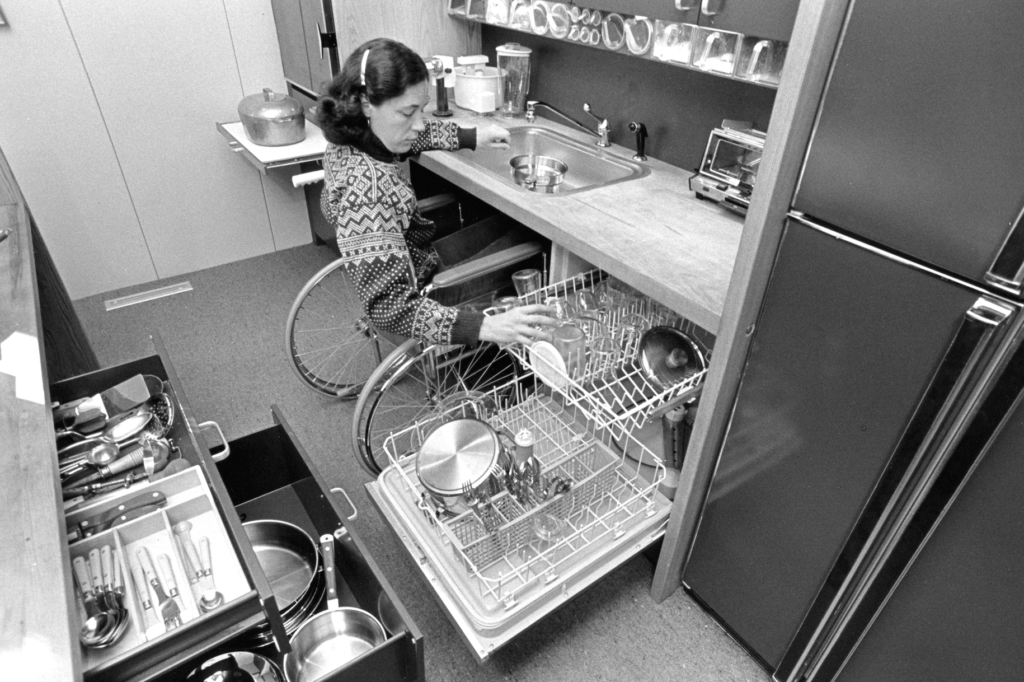
Museum and Library, Audiovisual Collections, Marc Harrison photograph collection.
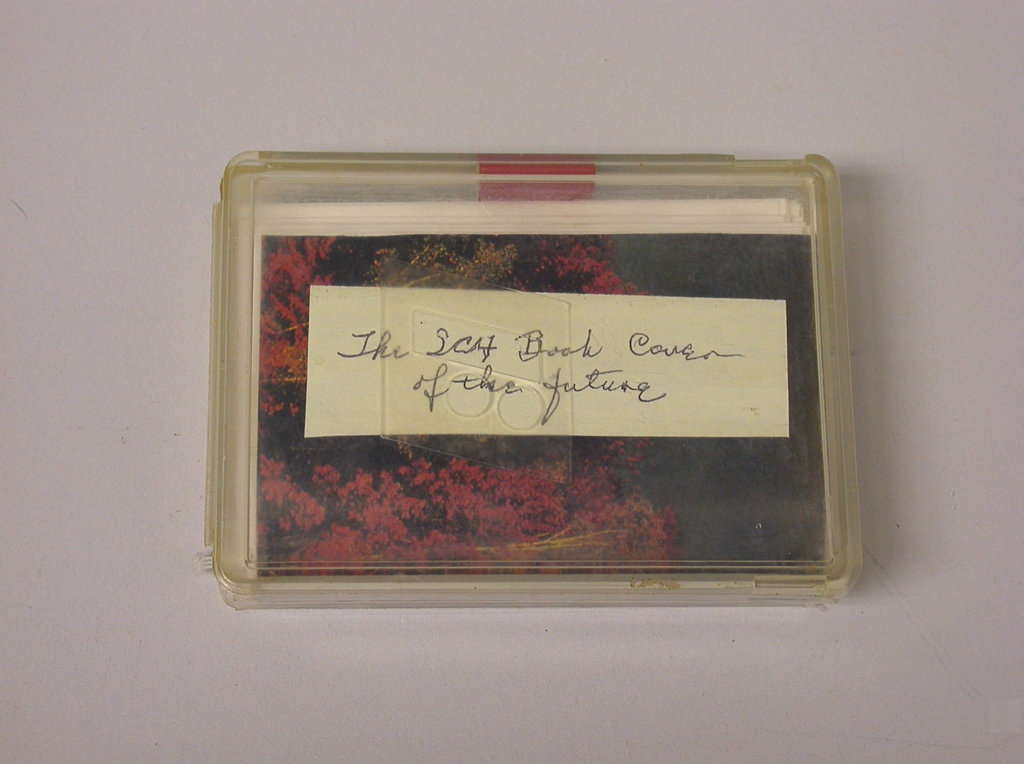
Gabe took the hygiene-focused fantasies about synthetics to their natural conclusion—the only way to keep everything clean is to cover it in plastic. She made a clear plastic “SCH book cover of the future” that prevented dust buildup and kept literary treasures dry during the wash; she hung curtains made of what she claimed to be a proprietary vinyl (likely Naugahyde); covered the bedding with a plastic drape; and coated the furniture with eight layers of synthetic marine varnish. Her self-cleaning house was as much an all-plastic house as Monsanto’s famous 1957 House of the Future at Disneyland. Gabe however used plastics not to produce and sell seductive consumer products or as part of a marketing campaign, but because they were the ideal materials for waterproofing a home.
Beyond added convenience, her interest in making domestic life easier through push-button technologies and wipe-clean surfaces also stemmed in part from her experience living with disabilities. After giving birth to her first child, Gabe became partially blind and remained so for eighteen years. In her twenties, she broke her back and underwent spinal fusion. Her exploration of plastics and automation was therefore not only aimed at freeing homemakers from drudgery but also at making domestic life more accessible for people who might not have the mobility required to use many existing household appliances. She envisioned the Self-Cleaning House as one that people “could stay in no matter how old or sick they got. As long as they could push a button, they could take care of themselves.”(7) The 1970s, when Gabe began work on her house, was a period of rising attention to disabilities, especially in the design of everyday spaces and things. Marc Harrison’s ILZRO (International Lead Zinc Research Organization) House in Rhode Island was one of the first wheelchair accessible homes in the United States,(8) and his Cuisinart redesign featured large, paddle-like controls with highly legible sans serif text. Although Gabe was not as vocal about disability as contemporaries like Harrison, her fully automated house reflected broadening notions of the healthy home, especially ideas about how the innovations of tomorrow would serve residents.
Given the many benefits and potential wide appeal, Gabe expected to find a large market for the Self-Cleaning House, which would be priced at $50,000. Ultimately, her own prototype house was the only one ever built. This, too, was typical of futuristic, revolutionary home design in the twentieth century. R. Buckminster Fuller built just two of his famed Dymaxion Houses (1945–1946); Oy Polykem AB built fewer than one hundred of Matti Suuronen’s portable, flying-saucer-shaped Futuro Houses (designed 1968); Monsanto’s House of the Future did not inspire the widespread use of plastic as a building material; and Roy Mason’s and Bob Masters’s Xanadu (first built 1979) did not launch a new era dominated by computerized smart homes constructed from urethane foam. Each of these quixotic houses, like Gabe’s, promised to make things better for the average person.
Gabe and the other twentieth-century designers who dreamed up houses of the future believed that new technologies and materials might make home ownership accessible, they might make domestic spaces more comfortable, daily life healthier, and household maintenance easier. But Gabe’s vision was much more radical than her male counterparts’. She not only imagined a house that would eliminate housework altogether, she also built it with her own hands, expanding the notion of women’s domestic labor to include hammering and sawing. In doing so, she asserted her expertise as a woman inventor and subverted gender norms. Gabe built the Self-Cleaning House both in spite of and because of her experience facing “resentment” toward her as “a woman doing that sort of work,” by which she meant managing the construction business she owned with her husband. Describing the experience of working on the Self-Cleaning House, she explained, “I belonged to myself finally. I felt as though I were a human being instead of a piece of machinery or a tool to be used by whoever needed me more than they thought I needed myself.”(9) For Gabe, working on the Self-Cleaning House was more than a means of making it easier for women to fulfill the roles of wife and mother: it was a declaration that she had left both roles behind to live for herself.
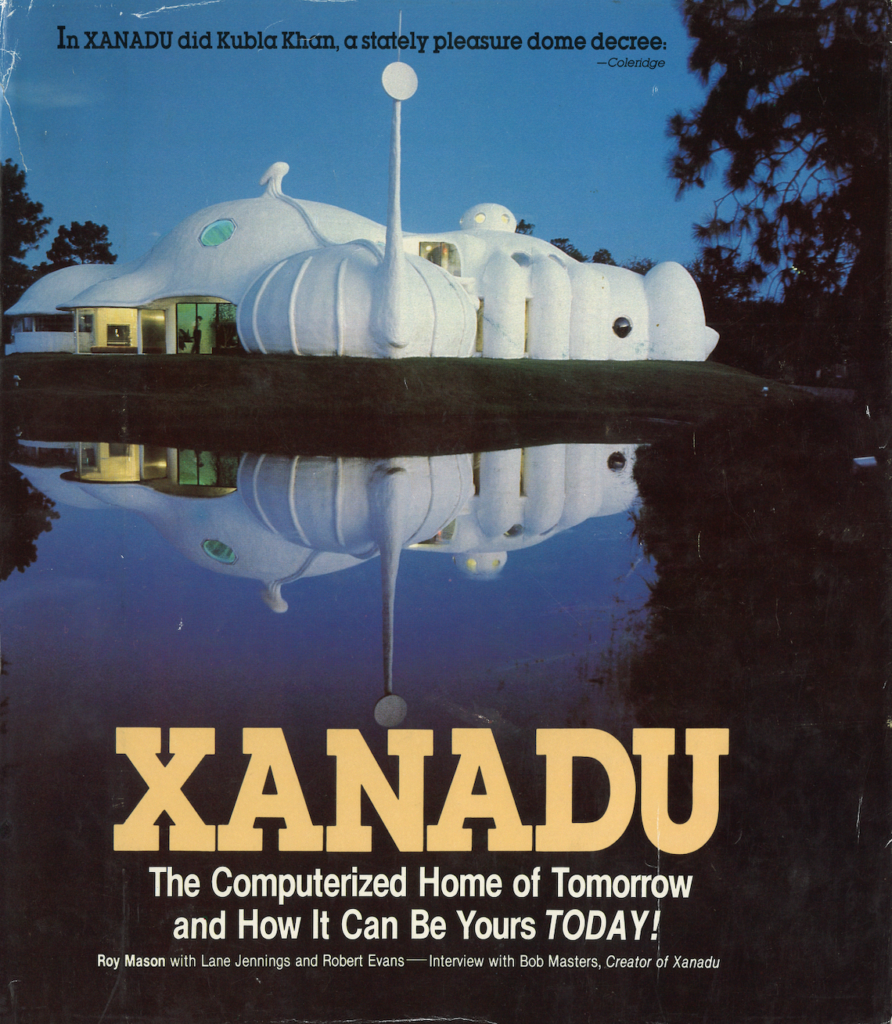
by Acropolis Books, 1983.
Gabe’s model will be on view in an exhibition titled Home of the Future, 1925–1985: Designing Domestic Utopias at the Los Angeles County Museum of Art from September 27 to March 14, 2027.
GRACE CONVERSE is the Karsh Curatorial Fellow in the decorative arts and design department at the Los Angeles County Museum of Art.
MARGARET HANSON is a research assistant in the museum’s decorative arts and design department.
Endnotes:
- Gabe is described as “the self-cleaning woman” in Charles Hillinger, “Push-Button Scrubbing: Inventor Building ‘Self-Cleaning’ House” LA Times, November 1, 1981.
- Frances G. Bateson, United States Patent 4,428,085: Self-Cleaning Building Construction, Filed Apr. 21, 1980, granted Jan. 31, 1984.
- “That’s What Women Are Coming To!,” American Home, April 1956, p. 22.
- Ruth Schwartz Cowan, More Work for Mother: The Ironies of Household Technology from the Open Hearth to the Microwave (Basic Books, Inc., 1983); Susan Strasser, Never Done: A History of American Housework (New York: Pantheon Books, 1982).
- Quoted in Teri P. Tepper and Nona Dawe Tepper, The New Entrepreneurs: Women Working From Home (New York: Universe Books, 1980), p. 194.
- Jeffrey L. Meikle, American Plastics: A Cultural History (New Brunswick, NJ: Rutgers University Press, 1995), p. 167.
- Tepper and Tepper, The New Entrepreneurs: Women Working From Home, p. 194
- The image illustrated is from the Marc Harrison photograph collection (Accession 2005.255). AVD_2005255_12_003_001. Box 12, Folder 3 ‘ILZRO House in use, 1970s’, Audiovisual Collections, Hagley Museum and Library, Wilmington, DE 19807
- Tepper and Tepper, The New Entrepreneurs: Women Working From Home, p. 190.


