
A long-sought-after work by Cole prompts an art historian to re-trace the artist’s early career.
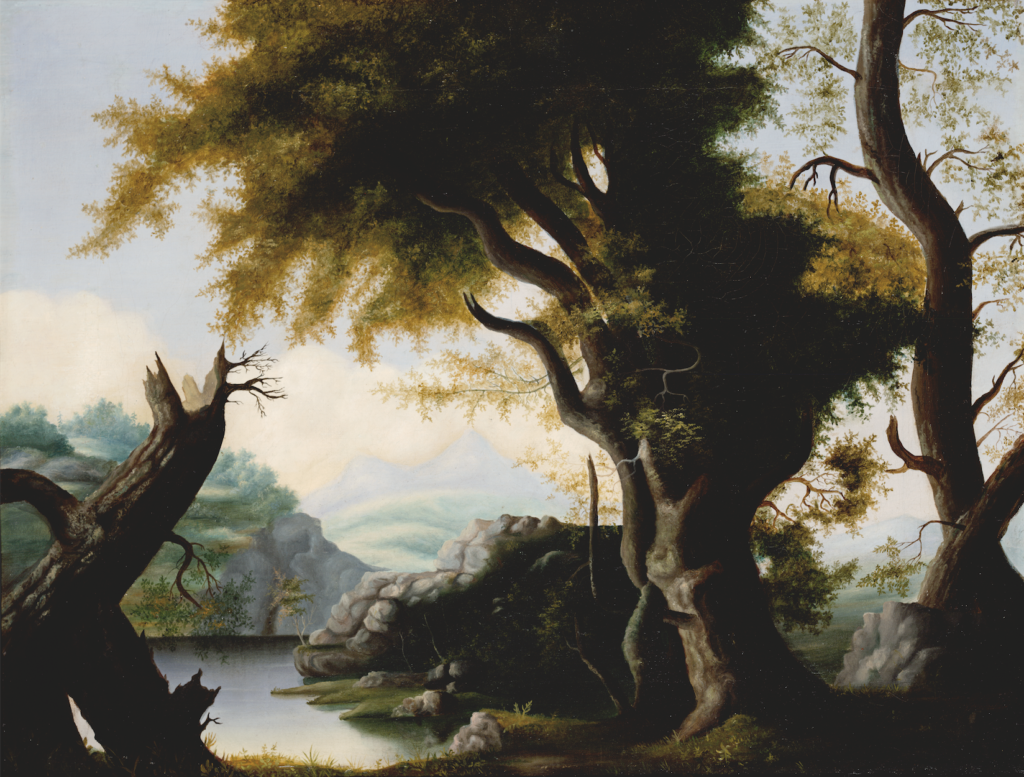
In 1823 young Thomas Cole walked almost three hundred miles across Pennsylvania from the frontier city of Pittsburgh to Philadelphia. The following year he exhibited a painting titled simply Landscape at the Pennsylvania Academy of the Fine Arts, but what that painting looked like has long baffled leading art historians. After decades of investigation and study, we can now identify it as the work shown here, which allows us to better understand Cole’s early efforts to master the art of landscape painting and the indelible impression of wilderness solitude his journey left on him. (1)
Cole was not a newcomer in Philadelphia, as his family had passed through the city after they arrived from England in 1818 and he had worked there briefly as an engraver’s assistant. In 1819 he followed his family to Steubenville, Ohio, where he taught drawing at a ladies’ school run by his sisters. He studied oil painting technique in 1820 and 1821 with John Stein, a traveling portrait painter, and spent over a year trying to make a living as an itinerant artist in the frontier environment of Ohio and western Pennsylvania.(2) In November 1823, in spite of the oncoming winter weather, he made the decision to return to Philadelphia in hopes of finding patronage.(3)
In 1834 William Dunlap chronicled Cole’s early career in his seminal History of the Rise and Progress of the Arts of Design in the United States, his account based on a now-lost letter he had requested from Cole some ten years after the trek from Pittsburgh to Philadelphia. The request provided Cole with the opportunity to cast himself as a suffering genius who had overcome great deprivations, and it provides context surrounding the landscape painting he exhibited in 1824, his first foray into the world of high art and serious collectors.
Quoting from Cole’s letter, Dunlap wrote of the artist’s work in the frontier territory of Ohio: “He now began in 1823, to make studies from nature . . . . He made small, but accurate studies of single objects; a tree, a leafless bough—every ramification and twig was studied, and as the season advanced he studied the foliage, clothed his naked trees, and by degrees attempted extensive scenes.”
Dunlap wrote of Cole’s departure from Pittsburgh in almost fairytale-like prose. “The young man saw that he must be a painter or starve, and determined to go to Philadelphia and seek his fortune. . . . Thus sleeping at night on straw and walking by day exposed to the sleet and rain . . . he at length entered the great city.” On arriving in Philadelphia, “His plan for living, as he could not pay for board, was to take an empty room, sleep with the blanket he had brought from home, and live on bread and water.” His poverty brought on a “serious illness,” but he was nursed back to health by his charitable landlady.
Cole obtained permission from James Thackara, the Pennsylvania Academy’s curator, to draw at the museum. “But [he] was overwhelmed by specimens of art, that he used to go day after day and gaze on the casts and pictures, until the keeper aroused him, saying, ‘Young man, this is no place to lounge in; your permission is for you to draw here.’” Cole told Dunlap that “this was indeed ‘the winter of my discontent.’ . . . His heart [sank] as he felt his deficiencies in art when standing before the landscapes of [Thomas] Birch and [Thomas] Doughty; but it was only by feeling the deficiency, that it could be remedied . . . . He painted some portraits, and received his first commission for a landscape—price seven dollars.”
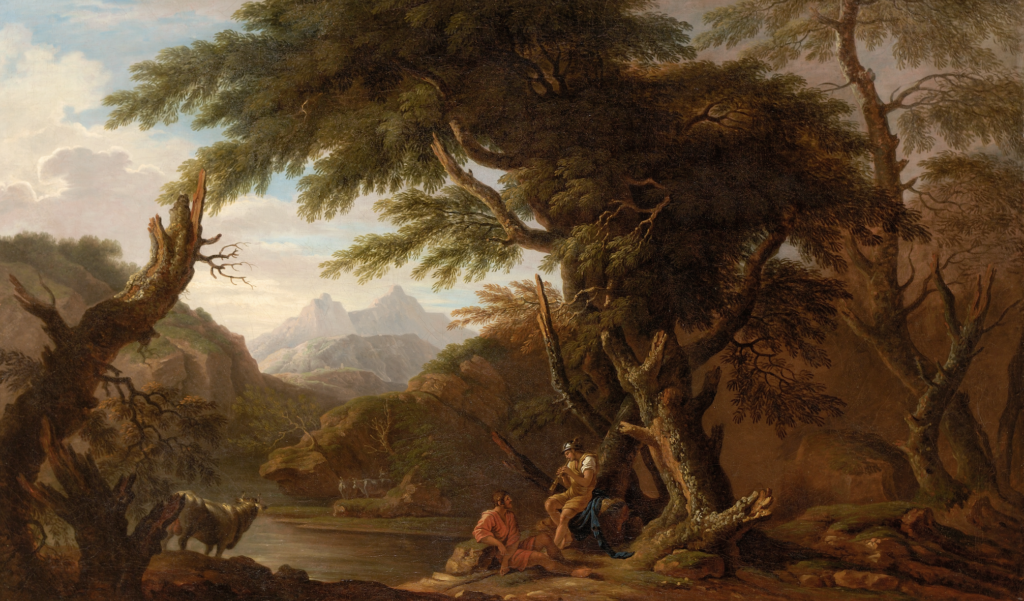
At the Pennsylvania Academy, Cole also encountered for the first time a work by one of the “great masters” he yearned to emulate, Mercury Deceiving Argus, then believed to be by Salvator Rosa and considered the most important European landscape painting in any American public collection. (The painting, since deaccessioned, had been a gift in 1812 from the prominent Philadelphia art collector Joseph Allen Smith, who had questioned its authenticity,(4) and today, art historians know it was a copy after Rosa.(5)) The painting Cole exhibited in 1824 surely resulted from this encounter but went unmentioned in the letter to Dunlap.
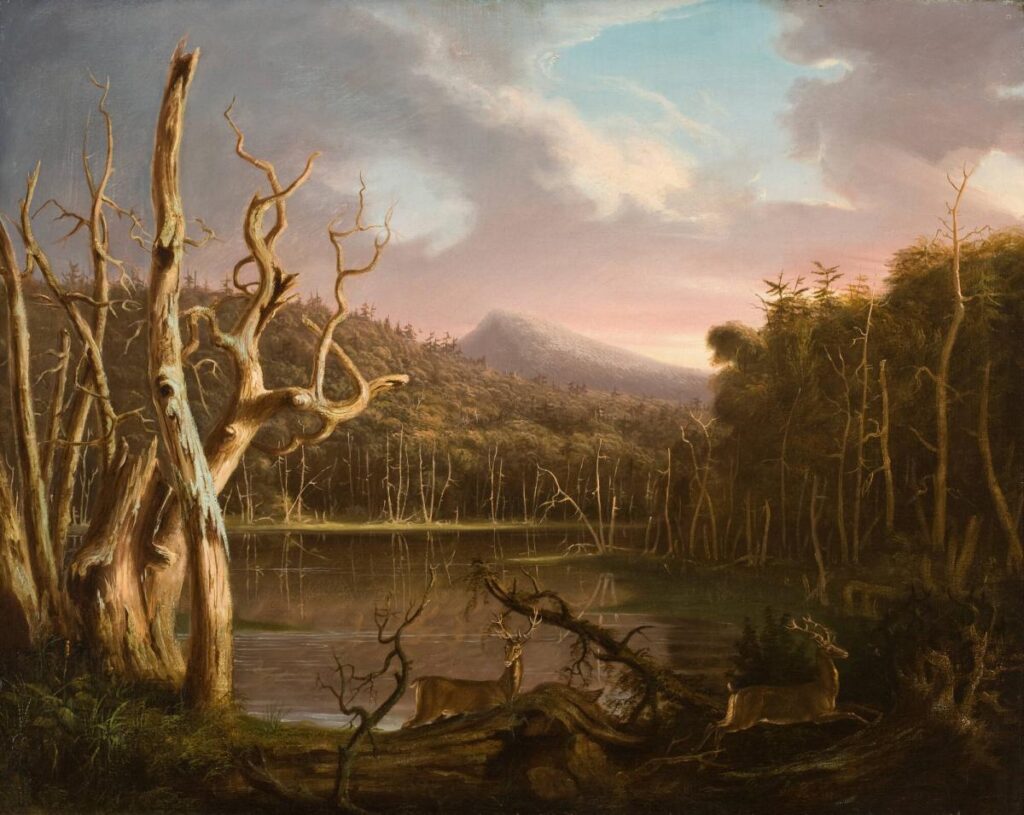
Cole’s unassumingly titled Landscape was listed as Number 89 in the exhibition catalogue. A newcomer, Cole was identified there only by his last name, and, living impoverished in a rented room, he did not provide a street address. Judging from the catalogue, his painting was hung among four hundred works by established American artists such as Washington Allston, Birch, and Doughty and European masters such as Correggio and Rembrandt.(6) Collectors, artists, and the public flocked to the opening, a popular event known as a sales market. Cole’s painting, a variation on a painting well-known to the audience, was not listed as “sold,” and its subsequent whereabouts were long unknown.
In his 1986 essay, “Thomas Cole’s Early Career, 1819–1829,” Ellwood C. Parry III considered influences that informed Cole’s earliest productions.(7) He thought the “Rosa” must have inspired Cole, arguing that early works offer proof that he absorbed a sense of mystery and grandeur in landscape composition from Rosa, and lamented that the location of Landscape was unknown, writing: “The important issue of early influence on Cole would be easier to resolve if only it were possible to identify the one work he submitted to the Pennsylvania Academy’s 1824 exhibition.” A comparison between the “Rosa” and Landscape provides the evidence of influence Parry expected to find.
Cole’s painting is less than half the size of the “Rosa,” but the two pictures are clearly similar in composition and share unique details, such as the storm-blasted tree trunks in the foreground and the distant mountain peaks. But there are important differences. The young Cole, seeking to connect himself with the tradition of sublime landscape painting, yet desiring to appear individual enough to be considered a new talent, created an understated variation. For one thing he does not include the figures of Mercury, Argus, or the cow—perhaps because drawing the human figure was never his gift (8); by eliminating them he evoked the solitude of the American wilderness that he had recently experienced in his wanderings in Ohio and Pennsylvania. Moreover, by removing signs of domesticity, he produced something unfamiliar to his audience, a painting without mythological significance, narrative, or topographical references.
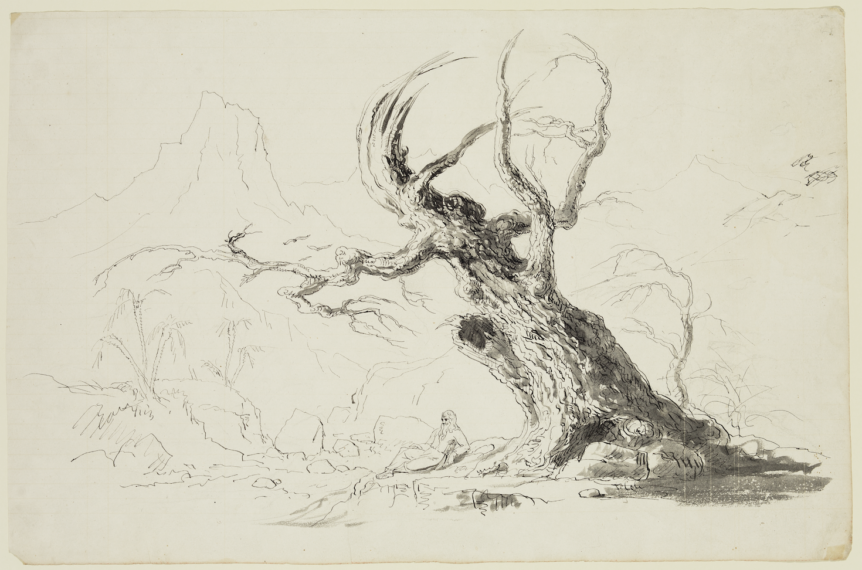
Among the details in Landscape that are clearly derived from the “Rosa” is the tree stump at left with its scraggly, twitching, finger-like branches, which corresponds closely to the passage on the left in the earlier work. The trees at the center right in Cole’s painting also relate to those in Mercury Deceiving Argus, but Cole’s are more expressively contorted, reflecting not only his experience of the American wilderness but providing early evidence of the obsession with storm-blasted trees he displayed throughout his career. Alan Wallach points out that Cole’s early drawings of trees attest to his “characteristically romantic penchant for the ‘pathetic fallacy’—the self conscious anthropomorphizing of natural forms.”(9) The most compelling example from around 1824 to 1825 is Gnarled Tree Trunks, in which the central tree at the right in Landscape is recast as an expressively gesturing arboreal actor.
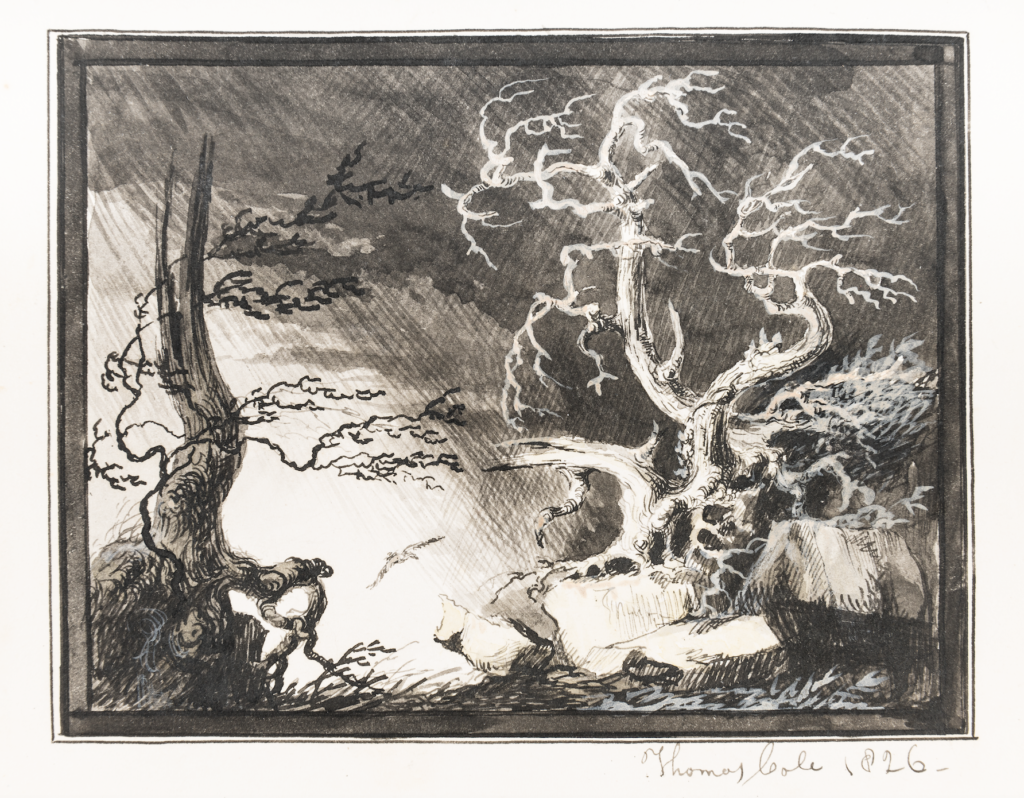
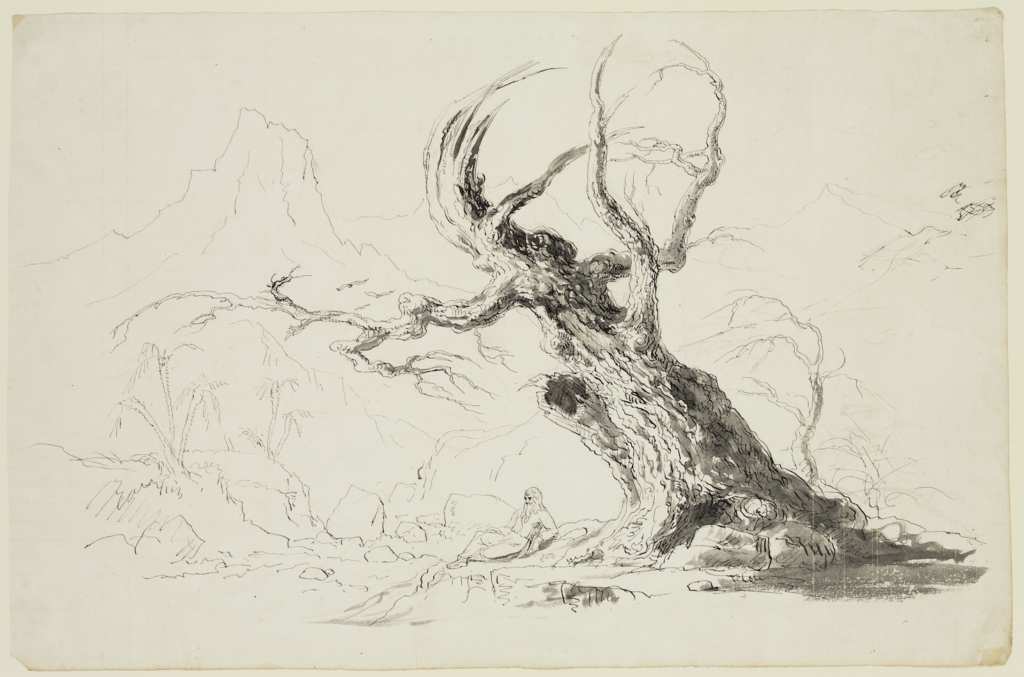
Details in Landscape also display similarities to other early Cole drawings and paintings. For example, the tree trunk with gnarled burls in Cole’s 1823 drawing Tree Sketch from Nature near Pittsburgh is stylistically similar to the twisted tree trunks in Landscape. The shape and expression of the tree stump at left in the painting offer similarities to the drawing From Nature June 28th 1823. Likewise, the serpentine shape of the nearly leafless tree at right in Landscape is similar to that of the tree at the left in Blasted Trees in a Storm of circa 1823–1825 and of many others in Cole’s works of the period. The importance of such elements in Landscape for the development of Cole’s style after he moved to New York in 1825 is apparent in such works as Gnarled Tree with a Bearded Man Seated Below and Daniel Boone at his Cabin as well as in Cole’s early masterpiece Landscape with Tree Trunks, 1828.(10)
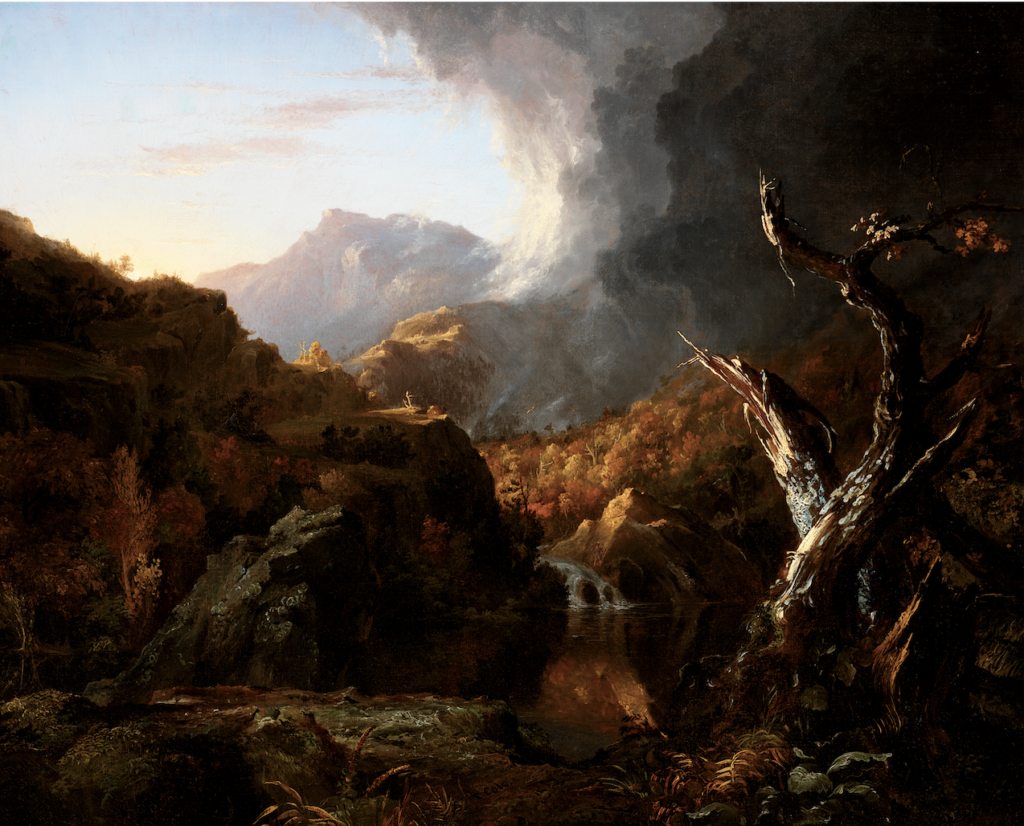
Based on the evidence of style, composition, technique, and provenance,(11) and its subsequent influence on later paintings, Landscape offers a new perspective on the early career of Thomas Cole. In the picture, Cole adapted European artistic conventions of the sublime and merged them with his experiences of American nature. By removing of all signs of domesticity, Cole left the Old World behind, shaping a vision that was wild and unidentifiable. What it meant to curious visitors who saw it at the Pennsylvania Academy of the Fine Arts in 1824 is not known, but the concept would take on profound meaning as wildness became an essence of national identity for an expanding country.
GRAY SWEENEY received his PhD in Art History from Indiana University and has taught American art history and theory for half a century in higher education. He has curated numerous exhibitions and written extensively on American art.
- As a scholar of nineteenth-century American art, I was intrigued in 1985 when the late Ellwood C. Parry III, a well-known student of Thomas Cole, suggested that I contact Harriett Dow, an art dealer in Albany, New York, who, he thought, might have work by Cole that would be of interest to me. My correspondence with Dow, and a subsequent meeting with her in 1986, led me to discover early works by Cole, including a drawing Landscape with Cross and Castle, prints of the Voyage of Life, and, most importantly, the small painting that is the subject of this investigation. At the time, Dow, a life-long resident of the Hudson River valley with considerable experience and numerous contacts there, suggested that the painting might be by Cole. Over the years, with the assistance of Cole scholars such as Parry, Alan Wallach, and James C. Moore I am now able to offer this paper that argues that the work is Cole’s earliest landscape painting in the sublime manner of Salvator Rosa, painted the year before he was “discovered” in 1825 in New York.
- See Nancy Siegel, Along the Juniata: Thomas Cole and the Dissemination of American Landscape Imagery (Huntington, PA: Juniata College Museum of Art, 2003) for a comprehensive account of Cole’s early years in Ohio and Pennsylvania, particularly “Over the River and Through the Woods—Topographical accuracy and the art of Thomas Cole,” pp. 15-43.
- For a study of the conditions at the Pennsylvania Academy and Thakara’s position there, see Lee L. Schreiber, “The Academy: School for Artists or Private Art Club?” Pennsylvania History, vol. 47, no. 4 (October 1980), pp. 331–350. The most comprehensive critical account of the “discovery” of Cole is Alan Wallach’s “Thomas Cole: Landscape and the Course of American Empire, Part 1, Beginnings; The Discovery Story; and The Autodidact” in Thomas Cole: Landscape into History, ed. William H. Truettner and Alan Wallach (New Haven and Washington, DC: Yale University Press/National Museum of American Art, 1994). Wallach was the first to discover the importance of Oram’s book for Cole’s early development (see pp. 25–27).
- See E. P. Richardson, “Allen Smith, Collector and Benefactor,” American Art Journal, vol. 1, no.2 (Autumn 1969), pp. 5–19.
- For the importance of the Rosa in early nineteenth-century American landscape painting, see Richard W. Wallace, Salvator Rosa in America (Wellesley, MA: Wellesley College Museum, 1979), pp. 34–35, no. 16: “This picture is particularly important to the exhibition since it is documented as being in the collection of the Pennsylvania Academy of the Fine Arts as early as 1804, and was in fact one of a gift of four paintings that led to the establishment of the Academy. It was first exhibited in the 1811 Annual Exhibition, and in subsequent annuals through 1870. . . . Cole, who actually studied at the Pennsylvania Academy in 1823, must have certainly known the Mercury and Argus, and seems to have retained a memory of it when he did [Landscape with Tree Trunks]” (see no 12, n.13).
- Anna Wells Routledge, Cumulative Record of Exhibition Catalogues, The Pennsylvania Academy of Fine Arts, 1807–1820 (Philadelphia: Pennsylvania Philosophical Society, 1953), p. 50. See Thirteenth Annual Exhibition of the Pennsylvania Academy of Fine Arts, May, 1824, printed by John Bioren. No. 99, South Second Street.
- Ellwood C. Parry III, “Thomas Cole’s Early Career, 1819–1829” in Views and Visions: American Landscapes Before 1830, ed. Edward Nygren and Bruce Robertson (Washington, DC: Corcoran Gallery of Art, 1986), p. 166.
- Alan Wallach observes that “Cole’s entire artistic career, especially its first few years, was marked by improvisation, a willingness to engage in artistic undertakings with little or no prior preparation or experience. . . While in Philadelphia in 1824-25 he frequented the galleries of the Pennsylvania Academy of Fine Arts, where he studied landscapes by Thomas Birch and Thomas Doughty and, very likely, a mythological landscape attributed to Salvator Rosa. A little study apparently went a long way, as Cole showed a landscape painting (unidentified and now probably lost) at the Academy’s annual exhibition in 1824” (“Thomas Cole: Landscape and the Course of American Empire,” pp. 25–26).
- Ibid., p. 26. For a study of this phenomenon in Cole’s work and the Hudson River school more broadly see: J. Gray Sweeney, “The Nude of Landscape Painting: Emblematic Personification in the Art of the Hudson River School,” Smithsonian Studies in American Art, vol. 3, no. 4 (Autumn 1989), pp. 43–65.
- See Wallace, Salvator Rosa in America, p. 113, no. 78: “Cole’s Landscape with Tree Trunks shows a strong resemblance to the Pennsylvania Academy’s Landscape with Mercury and Argus, which was actually in the Academy’s collection in 1823, when the young Cole studied there.”
- The provenance of Landscape is as follows: Thomas Cole to his death in 1848; Maria Bartow Cole and Theodore Alexander Cole (Cole’s widow and son); Florence Cole Vincent (Cole’s granddaughter) sometime before 1961; parties associated with the Old Print Shop, New York; Harriet Dow, art dealer in Albany, New York until 1986; present owner, from 1986. When the present owner acquired Landscape, Dow affirmed her opinion that the picture was by Cole, although at the time the connection to the Pennsylvania Academy’s “Rosa” that Parry would later assert was unknown. Dow stated that the work had come to her from a source in New York who purchased it from one of the sales Cole’s granddaughter Florence Cole Vincent held at the Cole house from 1940s through the early 1960s. No records of these sales were kept by Florence Cole Vincent. Dow also acquired autograph works by Cole that were purchased by the present owner of Landscape, including the early drawing Landscape with Cross and several hand-colored prints by Cole. Dow died in 2001, and her descendants have no inventory of what she owned. She was the wife of US Representative John Dow, who served in Congress 1964-1968 and 1970-1972.


