The painter who documented twentieth-century decorating at its zenith, one magnificent room after another.
Except as noted, the paintings illustrated are in the collection of the Fondation Sérébriakoff, Paris, and photographs are by Christoph Fouin.
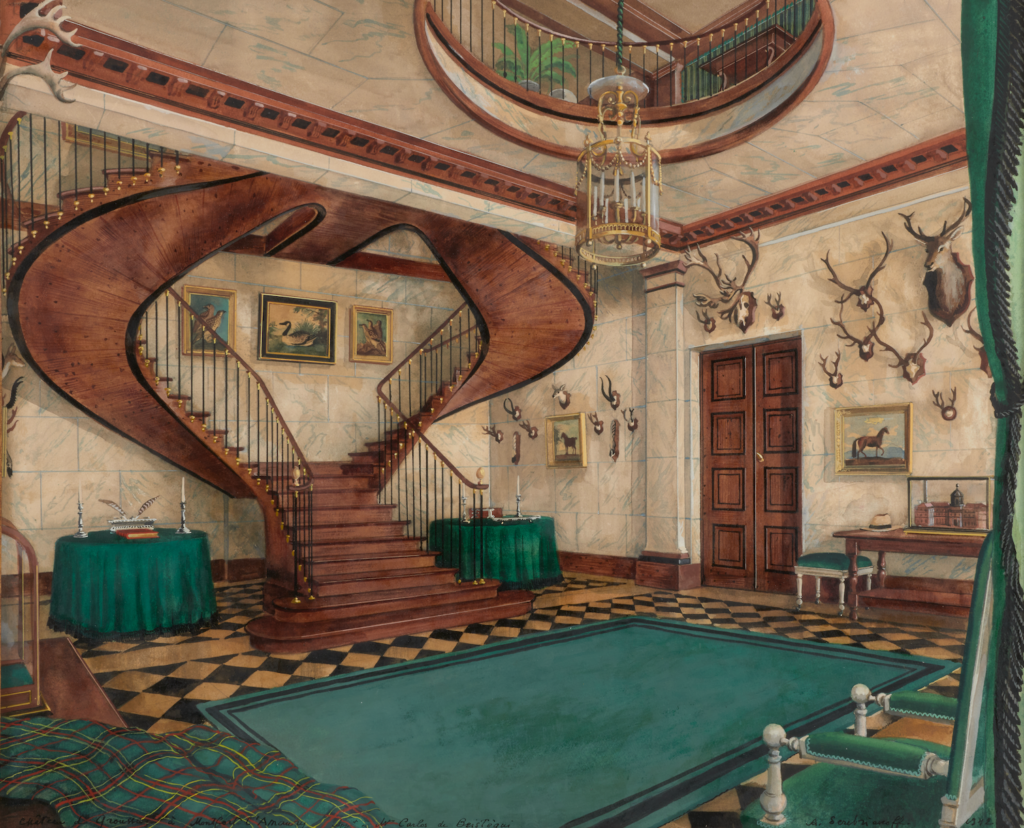
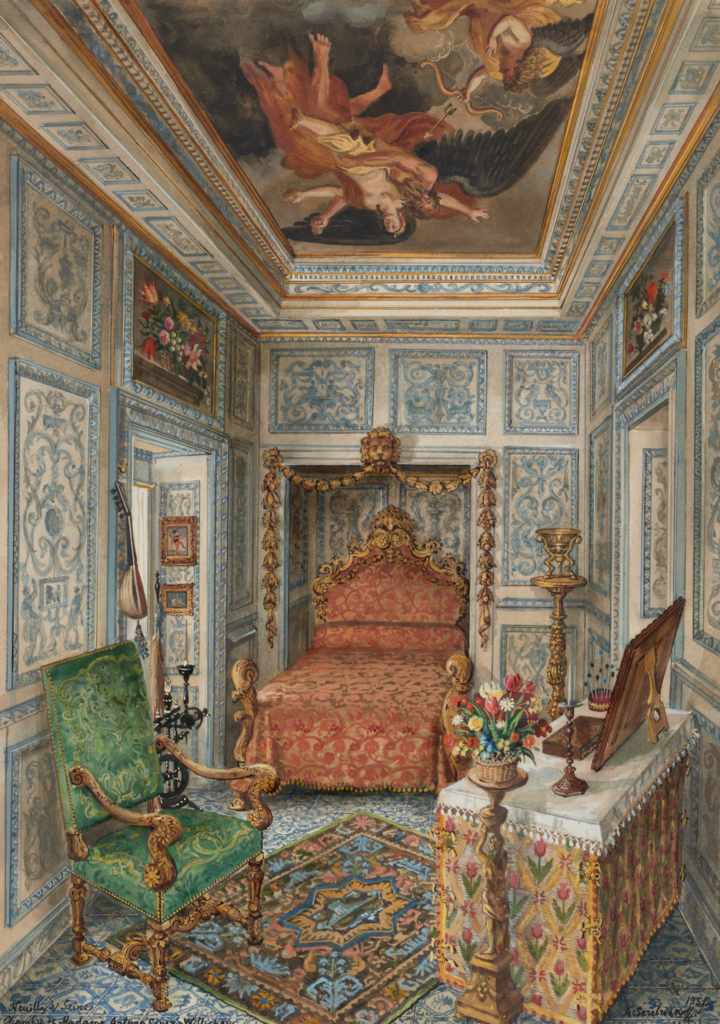
Probably my favorite interior painting by Alexandre Borisovich Sérébriakoff is a humble flower room. Well, it was in Hôtel Rodocanachi, the Versailles-à-go-go Neuilly-sur-Seine house of Patricia and Arturo Lopez-Willshaw, but never mind. Imagine my surprise to discover that a French friend, Jean-Louis Rémilleux, owns that 1950s gouache; I simply opened a door at his Château de Digoine one morning and found it and dozens more framed Sérébriakoffs. Needless to say, I was in heaven. You can be, too, since Digoine, in Burgundy, is now open to the public —and that door is to the left, in the entrance hall.
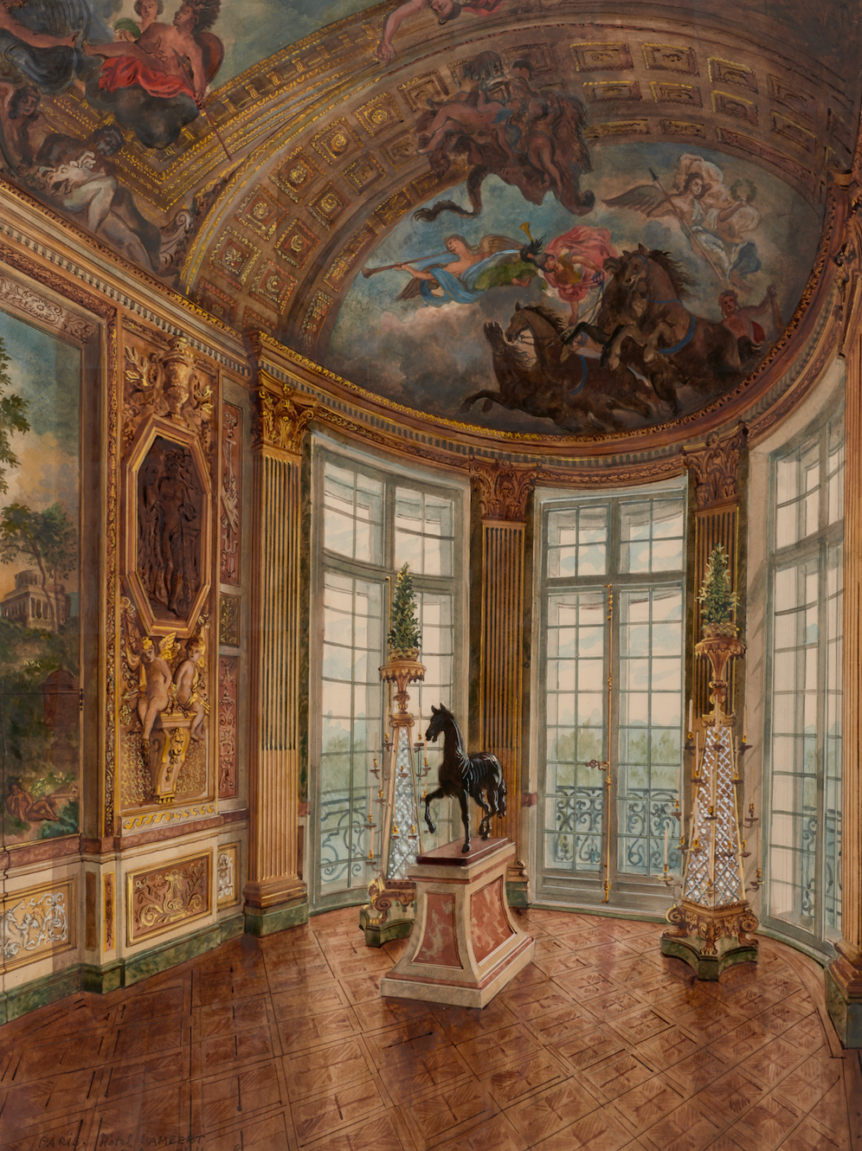
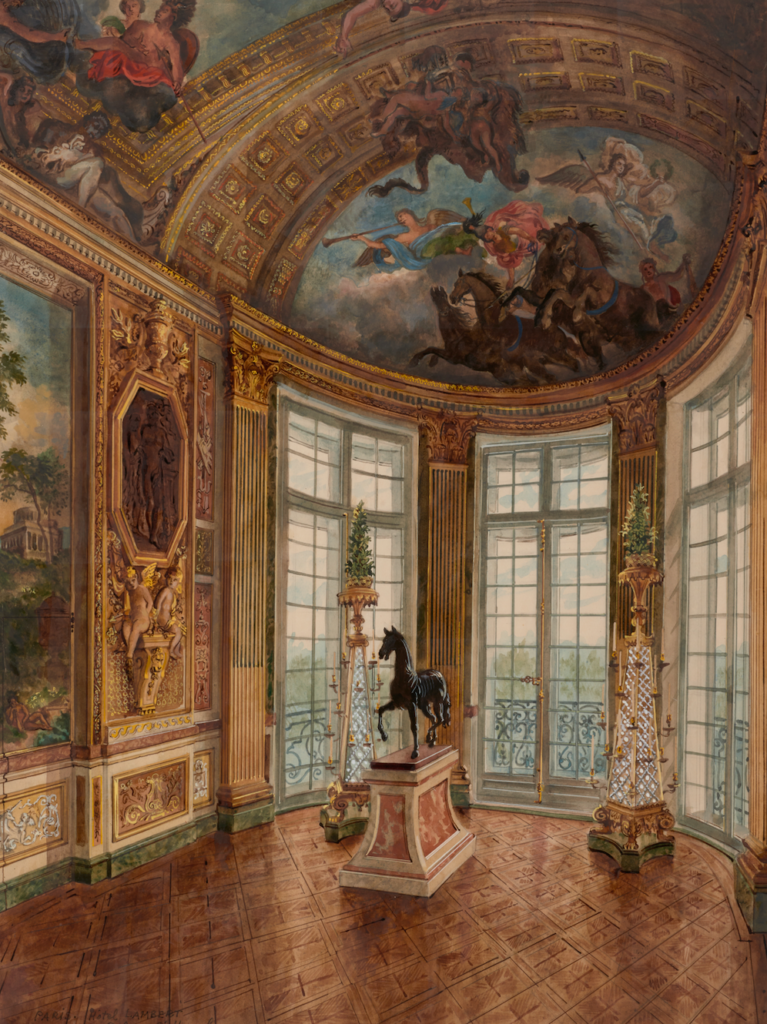
A Russian artist from what is today a war-devastated part of Ukraine, Sérébriakoff painted almost every important space of the twentieth century. The soaring scarlet library of millionaire Charles de Beistegui’s Château de Groussay, which was an inspiration for Henry Higgins’s library in My Fair Lady. The divinely cluttered urban bedroom of fellow artist Christian Bérard. The chic Chinese-theme Banquette Room of the Duke and Duchess of Windsor’s house on boulevard Suchet. A chamber at the Ritz hotel in Paris that was occupied by Daisy Fellowes, the Franco-American sewing-machine heiress. The Galerie d’Hercule at Baron de Redé-Rosenberg’s opulent apartment in Hôtel Lambert. Perhaps best known is the artist’s series of mises en scène that posterized rooms at Ditchley Park, an eighteenth-century Oxfordshire house that then belonged to Marietta and Ronald Tree. Sérébriakoff’s Ditchley pictures were a last hurrah of sorts, as the Trees were relocating to Manhattan, and the rooms—so suavely recorded by Sérébriakoff in the late 1940s—bore the combined stamp of Tree, his previous wife, famously known as Nancy Lancaster, Ethel Bethell, and the great Stéphane Boudin. In the newsletter words of the Ditchley Foundation, which administers the property now, “Within the house, we now have on display a fine set of photographs showing (from the Sérébriakoff waler-colours in Marietta Tree’s ownership) the interiors in the charm of their last phase of private ownership.”
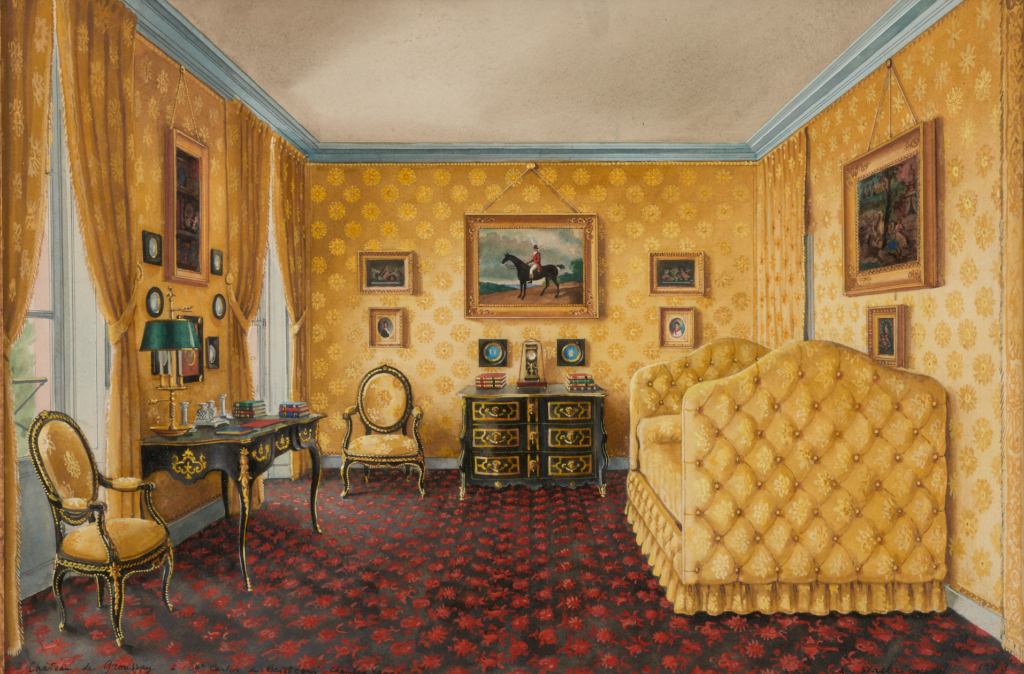
Frankly, Alexandre Sérébriakoff was a genius. Part of a notably artistic family on the maternal side, he grew up in Paris, a refugee like his brilliant widowed mother, Zinaida, the subject of a marvelous 1909 self-portrait at Moscow’s State Tretyakov Gallery. (Its striking resemblance—swirling hair, curling lips, heart-shaped face—to Disney’s “The Little Mermaid” should be discounted. And her 1920s and 1930s Morocco paintings amaze, all color and light.) His cousins were artistic, too. Sir Peter Ustinov, the award-winning British actor, was a relative, also a descendant of Alexandre Nikolayevich Benois, a patriarch who, among other things, produced sets for the Ballets Russes under the equally renowned Serge Diaghilev. It is a family tree where the branches are weighted down with architects, painters, sculptors, and other practitioners of the plastic arts, including Sérébriakoff’s painter sister Catherine (1913–2014), who also grew up in France. (Two children, Vladimir and Tatiana, were left behind when Zina, as she was called, fled to France. Decades passed before she saw them again, but they followed in their forebears’ footsteps and became prominent Soviet artists.) Their goateed father, Boris, in contrast, a cousin of his wife’s, was a railway engineer. Somebody has to pay the bills.
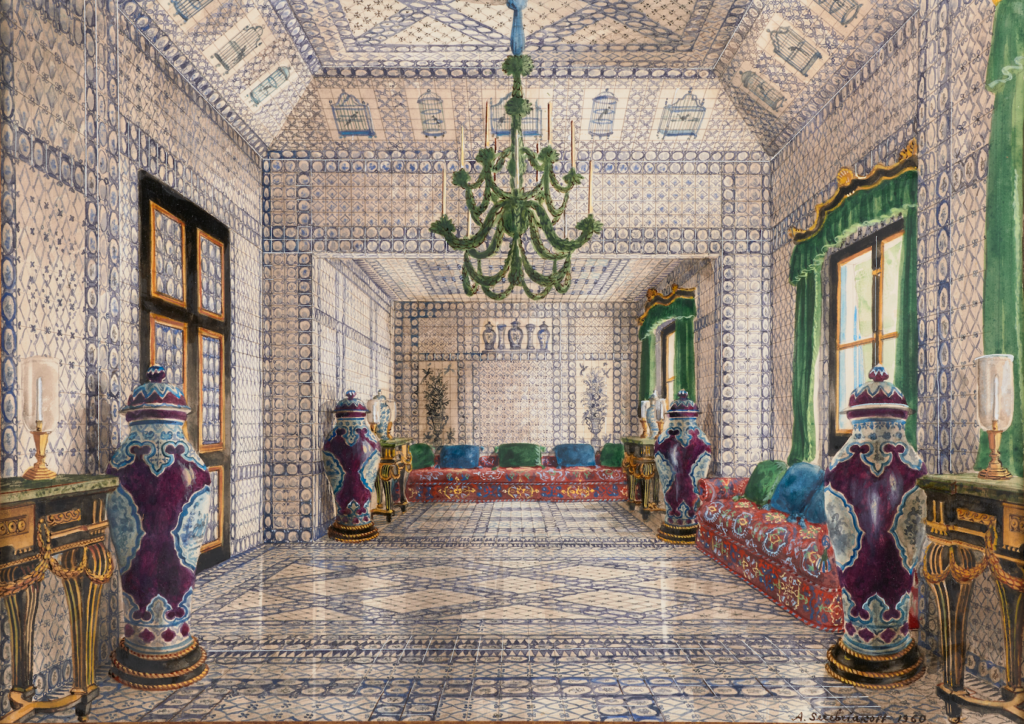
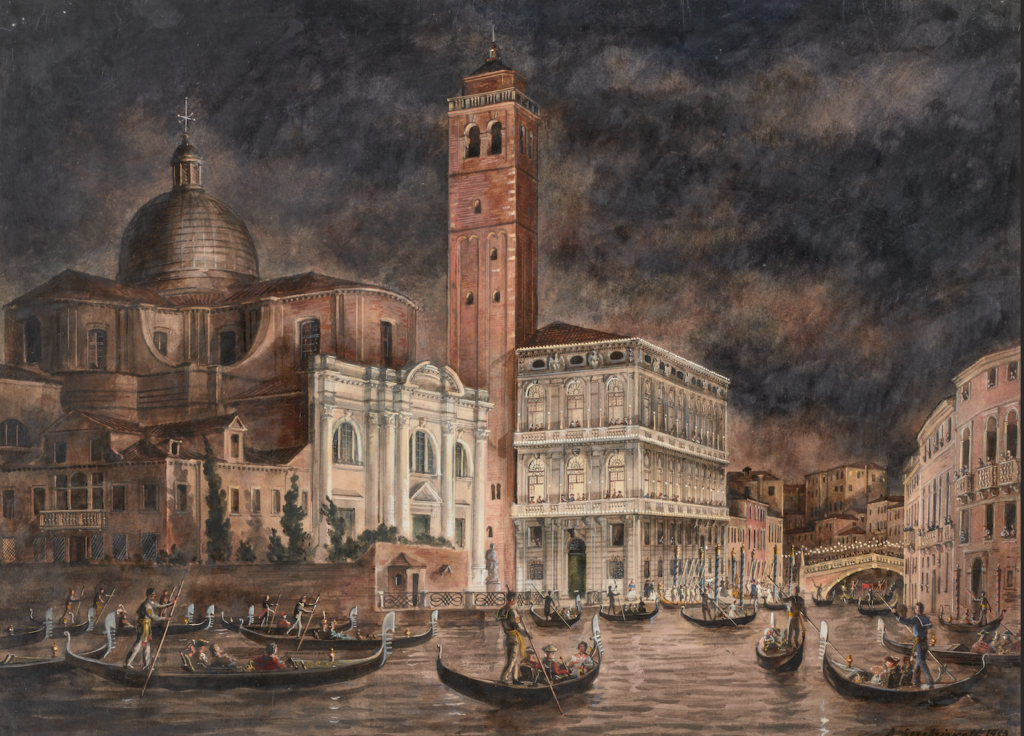
Sérébriakoff’s illustrations, in fact the best interior views, resemble color photographs but are so much better. They are exacting, they are meticulous, they are, well, mesmerizing. In the case of the Lopez-Willshaw flower room, it is a practical feature yet one that is beautifully planned, and Sérébriakoff captures its essence, in a moment when it is being used. One takes in the strange green light fixture, the spears of gladiolus—pink, red, yellow—the watering can that is striped like the French flag, the lacy wicker baskets within reach on the faux-marbre walls and on a scrubbed-wood shelf. A silvery sink holds dahlias, their spiky blooms claret-dark, and sprouting branches fill a basin with autumnal leaves. Sérébriakoff recorded bedrooms and salons and entrance halls and, down in Venice, a canal jammed with celebratory gondolas. That last work, one of many, was for Beistegui, arguably Sérébriakoff’s greatest client, a thoroughly dislikable person but a host of considerable renown. One man—usually aided by Catherine, known as Katya in the family—brushed all these images? As Christie’s explained, no matter the “A. Sérébriakoff” signature and date, “Alexandre was responsible for deciding on the broad outline of the composition, the fall of light, and the placing of the furniture, while Catherine executed the fine detail of pictures, ornaments, and objets d’art.” She was so careful, so exacting, that the Sérébriakoff scenes could be reports filed by an insurance adjustor. Zina’s youngest child also founded, in 2007, Foundation Sérébriakoff in her celebrated family’s honor; members sit on the board, as does one of Beistegui’s nieces. Neither Sérébriakoff sibling married, and both were naturalized as French citizens in 1947.
As a young man, Alexandre Sérébriakoff exhibited his work at Wladimir Hirschman Gallery and Galerie S. Lesnick, both in Paris, the subject being the southern port of Cassis. Soon he began illustrating books, such as the nineteen watercolors that he created for Alice Piguet’s atlas Notre France. “What a taste in the choice of large boards drawn and painted by an artist who knows how to enrapture children, Alexandre Sérébriakoff,” La Vérité observed of his work for Piguet. “We had not seen, until now, maps of France drawn with a lot of wit and skill to help to open up young brains—rivers, seas, forests, and mountains, everything that strikes young intelligences first.” Another publication, Sept, declared the artist’s work “the taste of our time—elegant, stripped, but fresh, like daisies or primroses in leaves of grass . . . small heads will be delighted.” For the French-language journal L’Africain, reporter Marc Nez wrote, admiringly, of Notre France, “We no longer know if the texts comment on the drawings or if the drawings comment on the texts.” Exceptional reviews of the book also appeared in Juvénel, Le Noël, and other publications. Sérébriakoff continued to entertain children with Piguet’s next book, Tirely astronome, and a collection of Russian folk tales, as well as illustrating the unutterably charming Petites Histoires de Tante Nène (1931).
Pint-size admirers were left behind, and adults came to the fore once Sérébriakoff and his younger sister were discovered—and lionized—by Beistegui et al. Reportedly they met the modern Maecenas in 1941, and the mining heir quickly commissioned the Russian émigrés to put his homes, inside and out, to paper or canvas. Beistegui was inspired, in part, by the albums that were put together by royals and aristocrats in the nineteenth century, images that Mario Praz collected, borrowed, and featured in his influential 1964 book An Illustrated History of Interior Decoration. But more than merely record rooms, Sérébriakoff literally painted in them, too, notably a decorative ceiling in the Paris suburb Boulogne-Billancourt, for the dining room of the monied dandy Gilbert Blanchard des Crances: a rotunda, romantically beclouded, with a single golden eagle flying at its center, wings outstretched. The 1920s house was published in Plaisir de France in 1949, but the ceiling stood proudly alone, opening the article, and, importantly, printed in full glorious color. The architect and decorator was des Crances’s close friend Emilio Terry, beloved of Beistegui, which is likely how the two Sérébriakoffs came into the millionaire’s orbit. He and Catherine also designed ballet sets and costumes, some of their fancies shown at the Théâtre des Champs-Élysées in 1948, alongside works by Bérard, Christian Dior, Tom Keogh, Jean Hugo, Marie Laurencin, and other starry names.
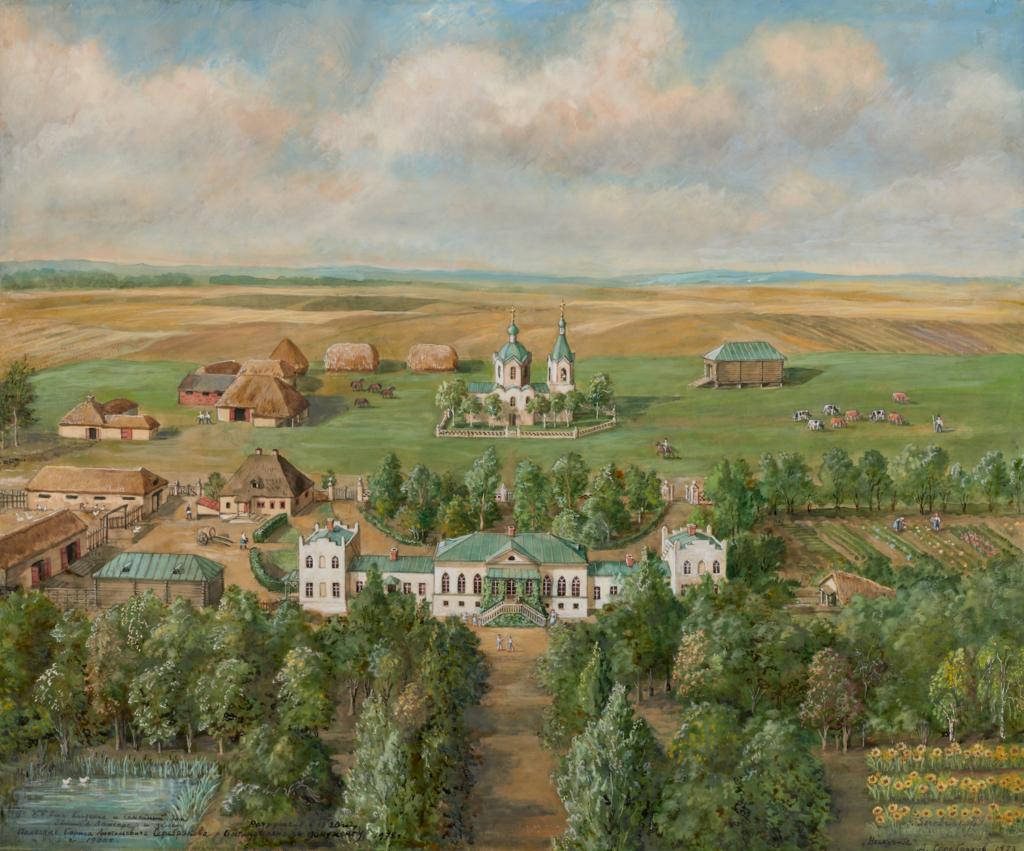
Other Sérébriakoff creations include the ravishing red, green, and gold chinoiserie bridge—the client was author and landscape maestro Gilles de Cossé-Brissac—at Parc Floral d’Apremont-sur-Allier in Cher. Built in 1985, the bridge still captivates, as do the garden’s two other Sérébriakoff follies, the yellow-walled Belvedere (1997) and the blue-and-white-striped Turkish Pavilion (1994). The last, octagonal and frivolous, anchors a shapely pond, not unlike Sérébriakoff’s delirious buildings for Beistegui at Groussay, which were realized by Terry. Pierre Arrizoli-Clémentel, a friend of mine and a former director of Château de Versailles, featured the Sérébriakoffs’’ dozens of Groussay gouaches in his beautifully packaged Groussay: Aquarelles d’Alexandre Serebriakoff (Editions Gourcuff-Gradenigo, 2019) and Le Parc de Groussay: Aquarelles d’Alexandre Serebriakoff (Éditions Gourcuff-Gradenigo, 2022). Rhythmic table plans, too, were among Sérébriakoff’s wide-ranging oeuvre, which included a monk’s cell (odd, that), a noble’s modest garret (slightly better) to palatial galleries (very much his raison d’être). Add to that magazine covers, posters, and much, much more. The mind reels.
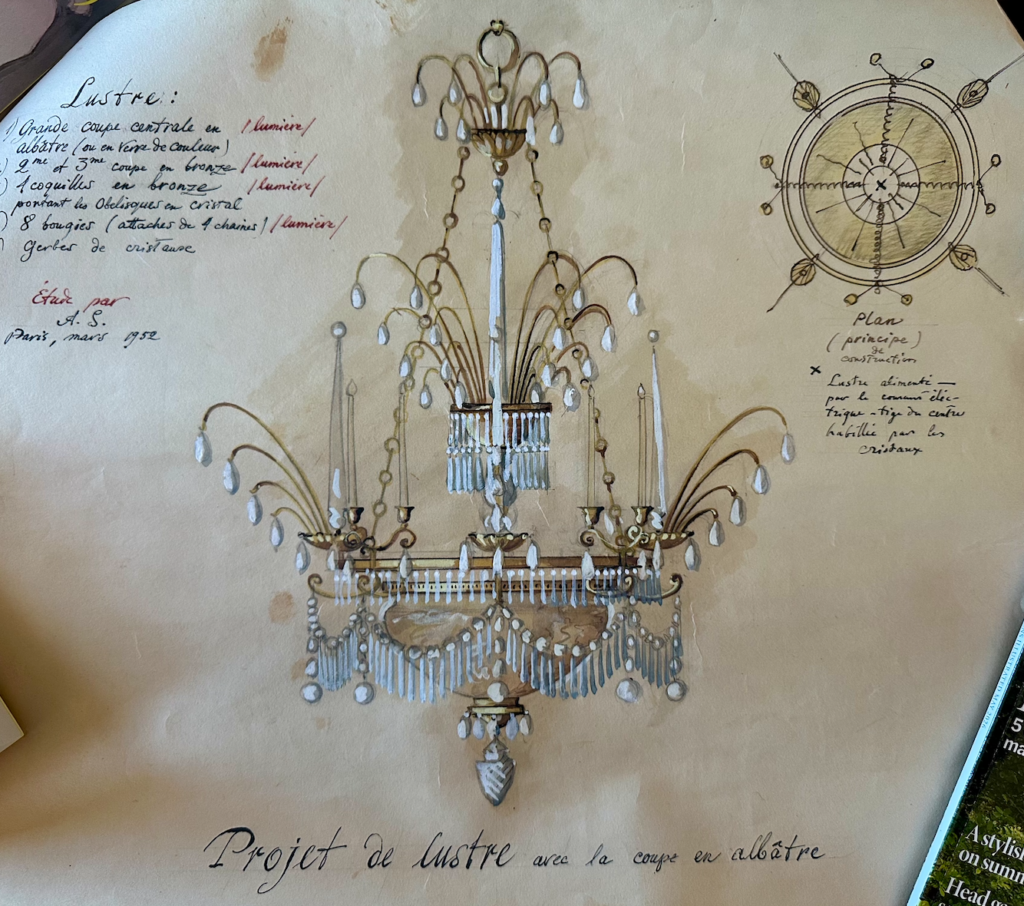
One of Alexandre Sérébriakoff’s early streetscapes, a rather bohemian Paris scene where rue Saint-Médard and rue Mouffetard meet, recently sold for €2,900, about $3,300. (Okay, the setting is depressing but picturesque, a corner dominated by a shoe-repair shop and a dingy café.) Really good interiors, though, depending on the subject, have gone for six figures, notably of the glimmering, shimmering theater at Château de Groussay for €14,490, a grand country house that, before he purchased Digoine, Rémillieux also happened to own. One might have great friends, alas, but little money.
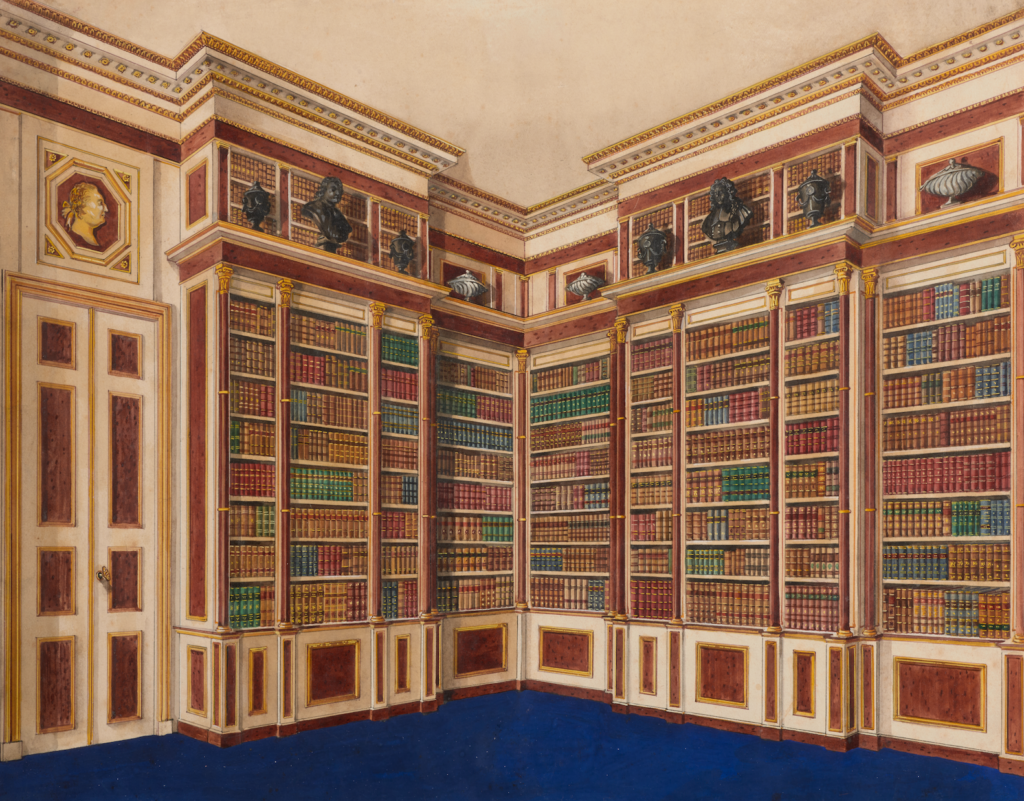
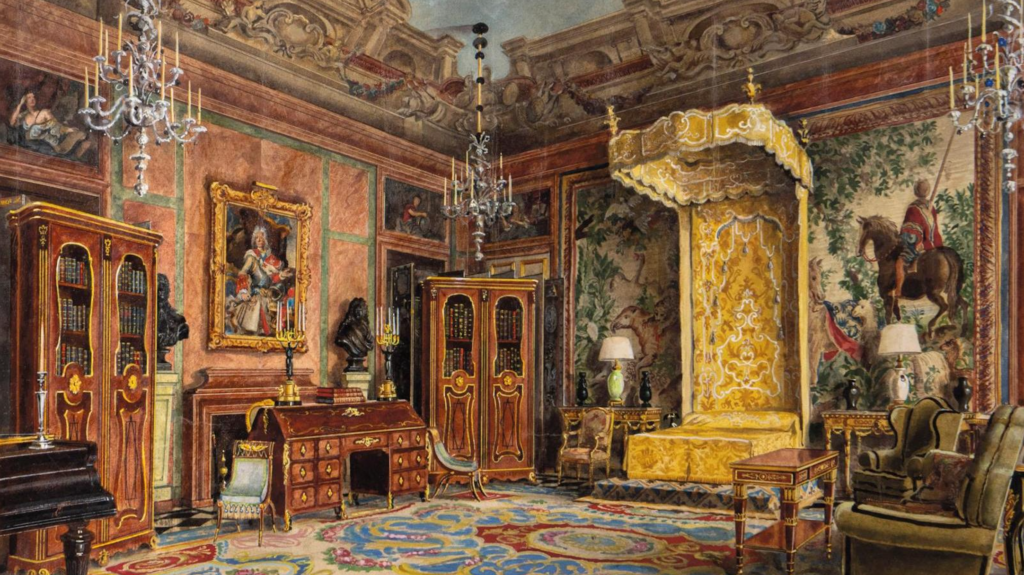
Remilleux collection; Remilleux photograph.


