
The Museum of Fine Arts, Houston celebrates the visionary artist’s centennial.
A vital member of the painterly vanguard that dominated the New York school, Joan Mitchell (1925–1992) achieved a degree of recognition rarely ceded to women artists of her generation. In 1951 she participated in the landmark 9th Street Show, and within two years she had gained representation at the highly regarded Stable Gallery. However, she chose to strike an independent path, moving to Paris in 1959, and in 1968 to Vétheuil, a village overlooking the Seine, which had briefly been Claude Monet’s home as well. Over the following decades she maintained strong ties with painters, writers, poets, and musicians on both sides of the Atlantic, and her work was surveyed by notable exhibitions at the Everson Museum of Art (1972), the Whitney Museum of American Art (1974), the Musée d’art moderne de la Ville de Paris (1982), and by a retrospective that toured numerous American museums (1988–1989). Posthumous exhibitions and recent scholarship have continued to honor Mitchell, and in 2025, the centennial of her birth, more than seventy museums across the United States, France, and Australia committed to presentations highlighting her remarkable achievements. Also honoring the centennial, the Joan Mitchell Foundation launched a generous initiative supporting conservation of notable paintings, allowing conservators and curators to share new research, while supplying essential documentation of Mitchell’s studio materials and practices.
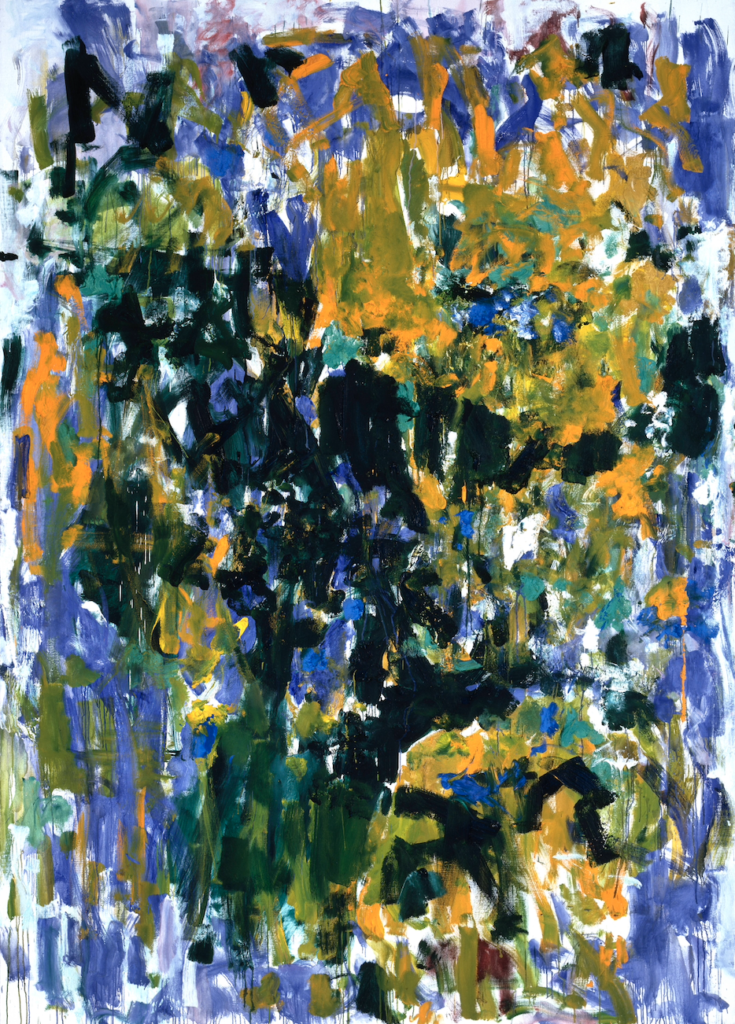
The Museum of Fine Arts, Houston participated in both the exhibition and conservation projects with Celebrating Joan Mitchell, a special installation focused on paintings created from 1976 to 1985, a decade that saw Mitchell at the height of her powers as she brought a fresh lyricism into her work. The museum’s magisterial Tournesols (Sunflowers) (1976) anchored the display, which also highlighted two multi-paneled paintings that are recent gifts to the museum’s permanent collection, as well as Then, Last Time I (1985), an outstanding loan from the Sarofim Foundation Collection.
With Tournesols, Mitchell introduced an important shift in her overall treatment of the canvas surface. Earlier paintings of the 1970s were dominated by subtle color blocking and weighted forms, and several major canvases from the mid-1970s drew upon memories of Canada’s bleak landscape in winter, as her long and tumultuous relationship with Jean Paul Riopelle was reaching a crisis. By 1976, as she was preparing for her first solo exhibition with Xavier Fourcade in New York, Mitchell had entered a period of renewal, drawing inspiration once again from the lush vegetation of her Vétheuil gardens and the sweeping view of the Seine from her terrace. And as Tournesols demonstrates, her brushwork took on a calligraphic fluidity, as she built her compositions through vertical thrusts, or as she termed them “ups and downs,” while she complicated figure-ground relationships with cool blues and warm yellows. Working wet-on-wet, Mitchell pushed and exploited the physical properties of her oil pigments, ranging from thinned passages that whip or drip across the primed surface to dense impastos.
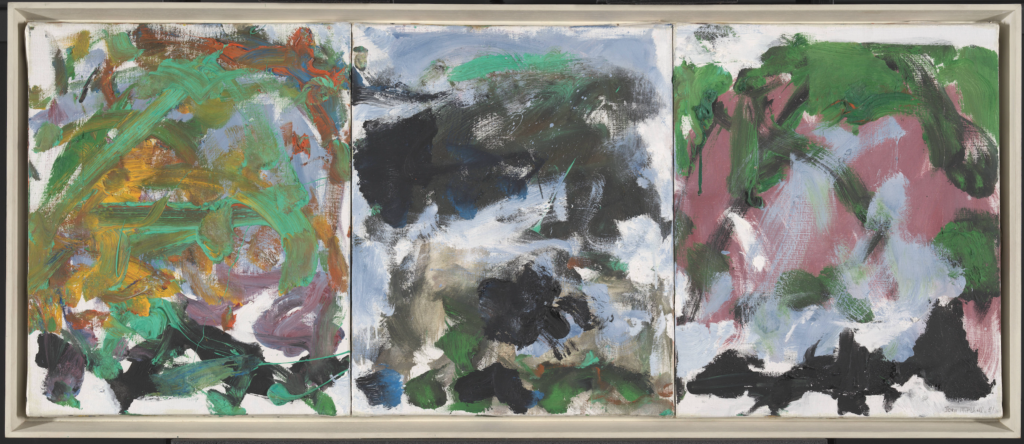
During a 1976 studio interview filmed by Angeliki Haas, Mitchell brought out several smaller canvases, along with Tournesols, stating: “I think sometimes the small paintings have, I would like them to have, the same feeling of scale as a big painting. I work a lot with triptychs and diptychs because for many years I haven’t been able to do a horizontal painting, and I use the verticals to make it become horizontal.” In Houston, an untitled 1976 diptych, as well as the 1981 Cricket triptych, illuminate this key aspect of Mitchell’s practice. Fascinated by the energy generated by tightly juxtaposed canvases, Mitchell increasingly presented her work in multi-panel formats, slyly echoing the diptychs and polyptychs found in Renaissance altarpieces. The two panels of the diptych are complementary, unified in their rich, blue-green palette, while their measured brushwork alternates between open and layered strata. Cricket’s three segments convey a more staccato rhythm, as two similar canvases flank a third dominated by different tonalities and a stacked composition.
Mitchell’s deliberate presentation of themes and variations is more than a formal device, however, as Marcia Tucker astutely observed in the 1974 Whitney catalogue: “The use of multiple panels in [Mitchell’s] work becomes a means of alluding to the passage of time, as canvases with multiple images change from framework to framework as well as within the confines of a single unit. The passage of visual time, like the passage and changing of seasons, provides a lateral dimension in the work so that images must be read across the expanse of canvas as well as into it.”
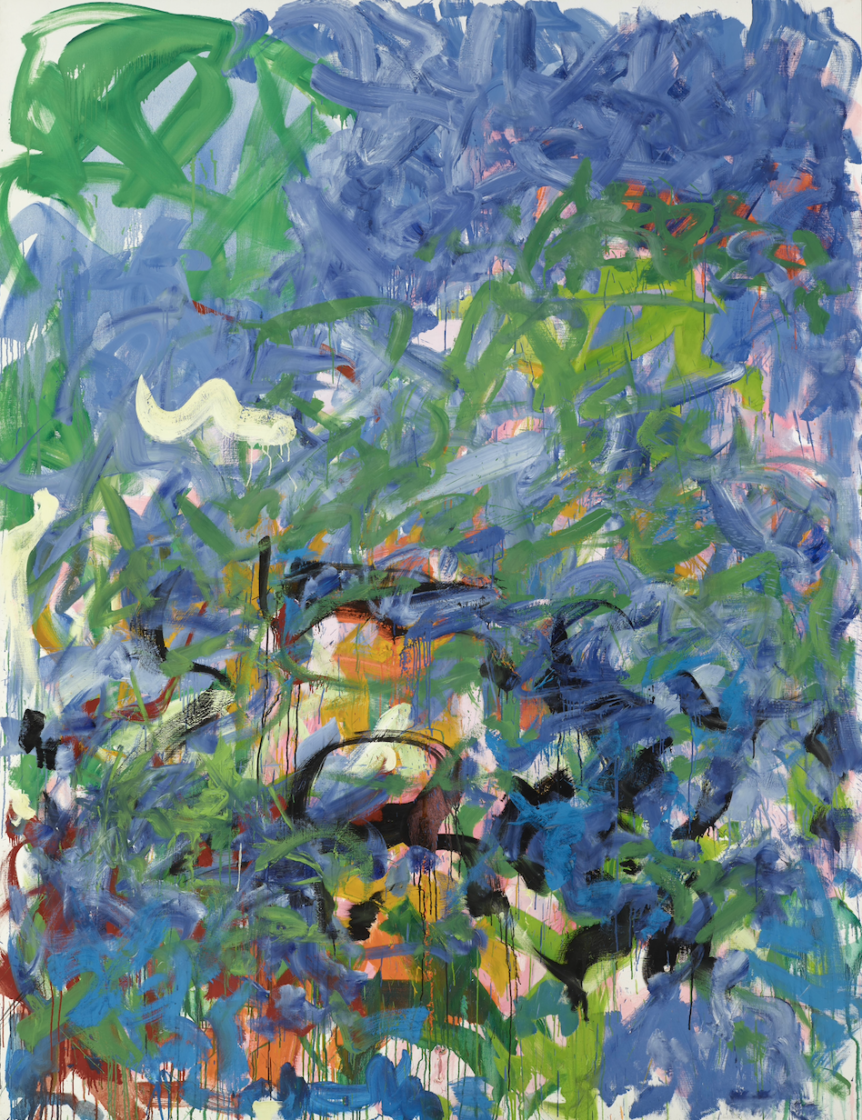
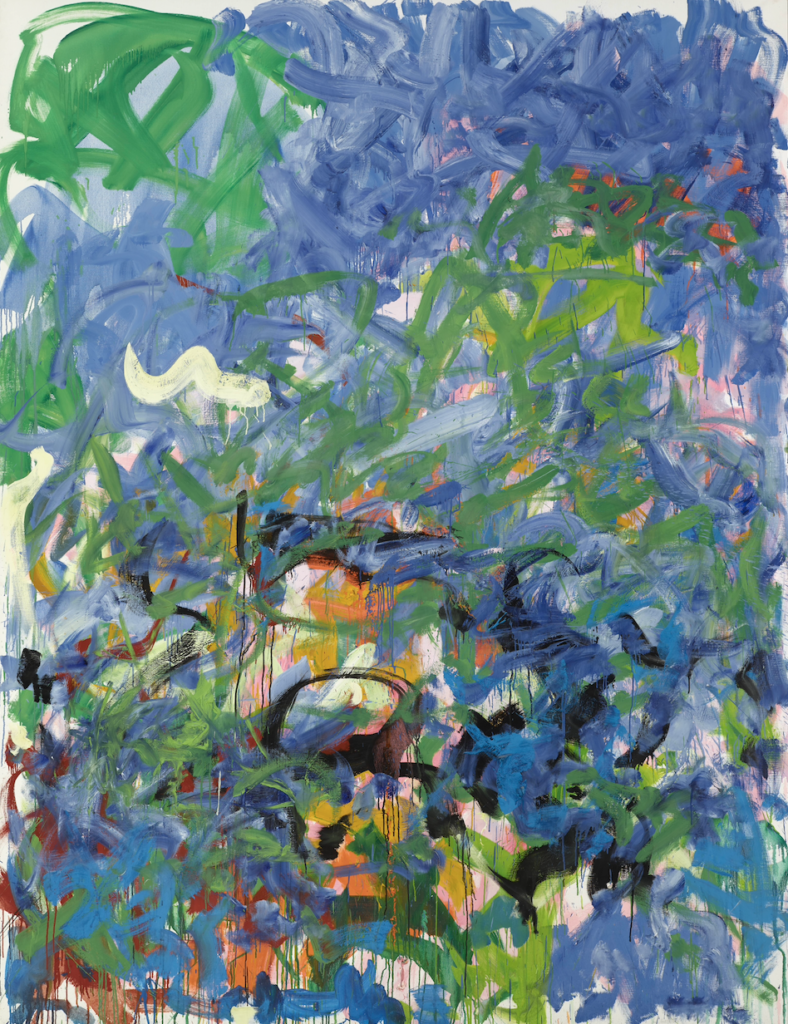
The passage of time became an urgent concern as Mitchell entered the 1980s. It was a decade of increasing recognition, but also one of loss with the definitive end of her relationship with Riopelle in 1979, followed by the deaths of close friends and her sister. Her own health deteriorated after she was diagnosed with cancer of the jaw in 1984, and she underwent the first of two hip replacement surgeries the following year. These traumas are hinted at in the hesitant title of Then, Last Time I, and Mitchell explained in a 1985 interview with Betsy Sussler, “I was sick . . . . I’m trying to stop time, or frame it.” Despite these physical setbacks, Mitchell continued to build on her vast vocabulary of brushwork, filling Then, Last Time I with open strokes, never letting go of the essential discipline that ruled her paintings.
Mitchell expanded on her understanding of time in relation to her work in an interview with Yves Michaud for her 1986 exhibition at Fourcade: “Painting is the only art form except still photography which is without time. Music takes time to listen to and ends, writing takes time and ends, movies end, ideas and even sculpture takes time. Painting does not. It never ends, it is the only thing that is both continuous and still. Then I can be very happy. It’s a still place. It’s like one world, one image.” Fortunately, her paintings continue to transcend time, remaining a powerful statement of her generative spirit, upholding and illuminating her lasting legacy.


