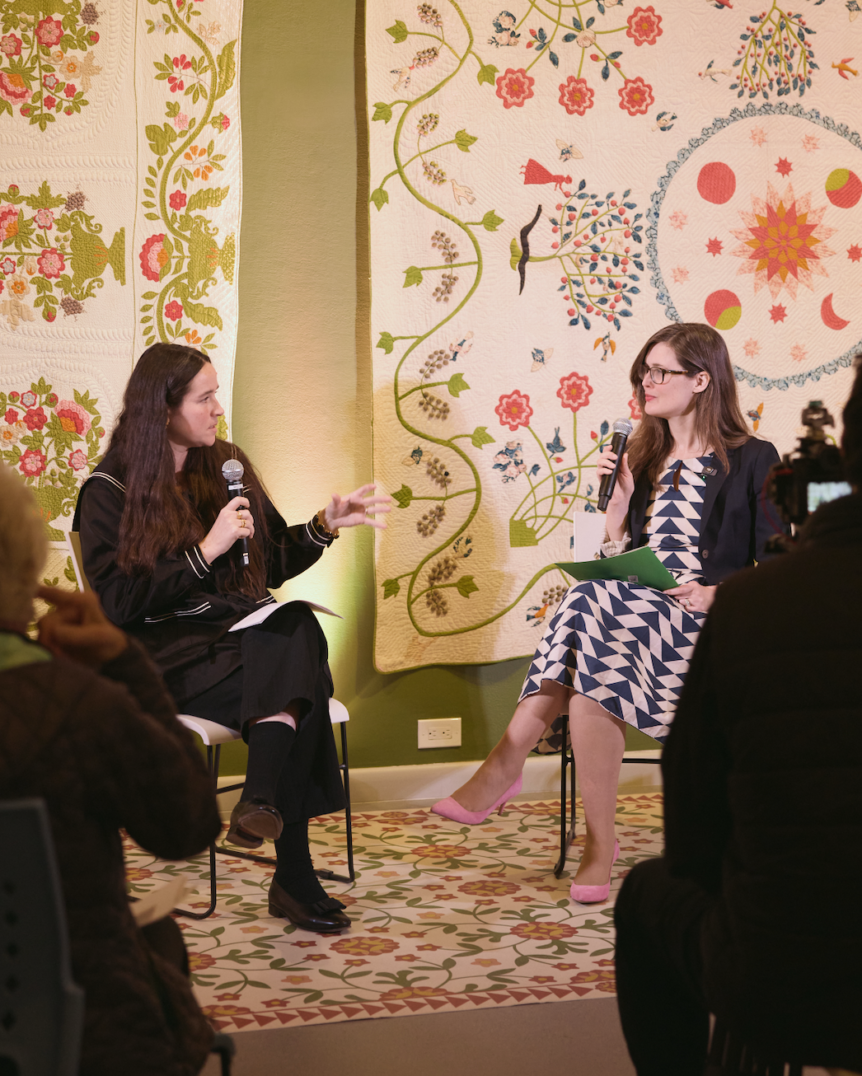
A conversation on quilts and craft between Emily Adams Bode Aujla, founder and designer of Bode, and Emelie Gevalt of the American Folk Art Museum.
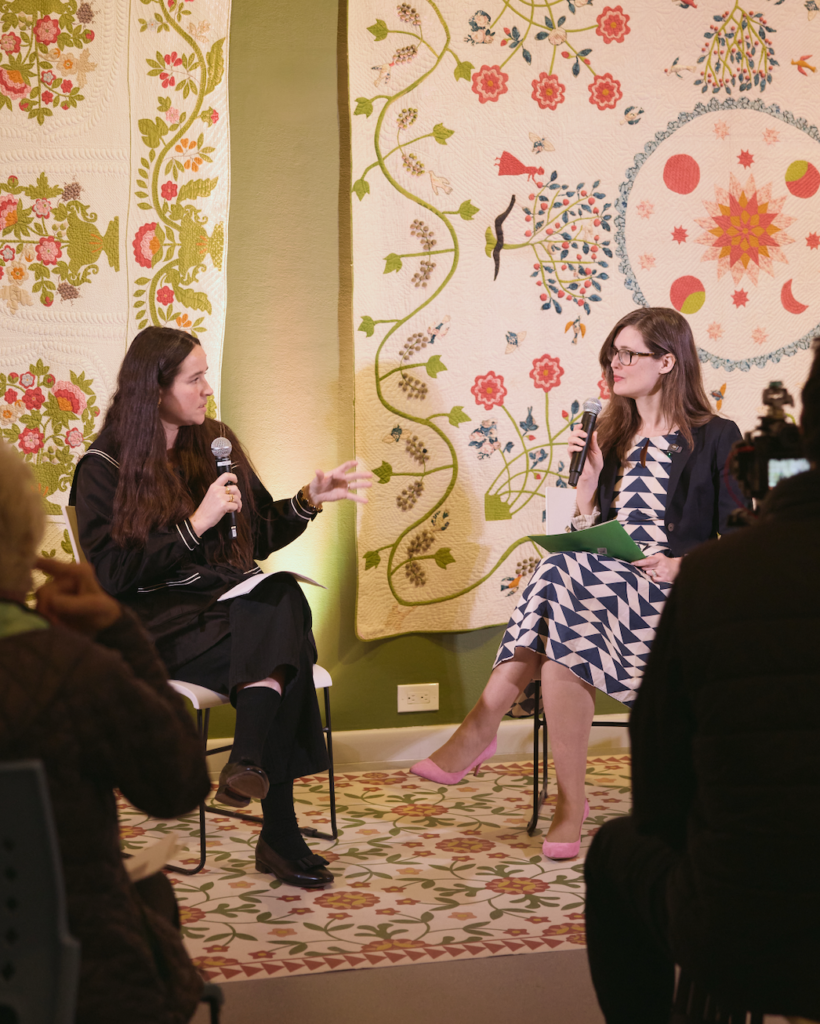
I recently had the opportunity to join Emelie Gevalt, the Deborah Davenport and Stewart Stender Deputy Director and Chief Curatorial and Program Officer at the American Folk Art Museum, for a deeply meaningful conversation.
Set against the backdrop of the museum’s exhibition An Ecology of Quilts: The Natural History of American Textiles—which brought together approximately thirty works from the collection—the discussion offered a rich context for considering quilts beyond their formal qualities.
Emelie and I spoke about quilts as ecological, historical, and cultural documents. We reflected on the ways these objects embody resourcefulness and community and considered how historic textiles continue to inform contemporary craft practices and evolving perspectives on sustainability.
Below are selected excerpts from our conversation that I found particularly resonant.
Emily Adams Bode Aujla (EABA): Throughout my practice, one of the first questions everyone always asks me is what comes first? Is it the material or the story, ahead of every collection? What was it for this particular show you curated? Did you have a story first?
Emelie Gevalt (EG): It’s really interesting that you get that—we get it a lot, too. And it’s kind of a hard one to answer because I actually feel like it’s both, and they evolve at the same time. Our constituents love our quilts. They’re a major component of our collection. So, I always try to think about what we can do with quilts that’s new. One of the most fun ways is to start looking back through our collection, usually at photographs because quilts can’t just be out all the time. The first thing for me is often looking at what speaks to me visually and then thinking what stories this group could tell together.
EABA: Right? Because this is the first instance of this kind of ecological approach.
EG: Yes. Here at AFAM, as far as I know, this is a new direction for us with this show.
EABA: It’s very interesting. It looks beyond just the quilt maker. I wanted to ask you, considering production, trade, and environmental impact, how that approach changes what we think of as the quilt story?
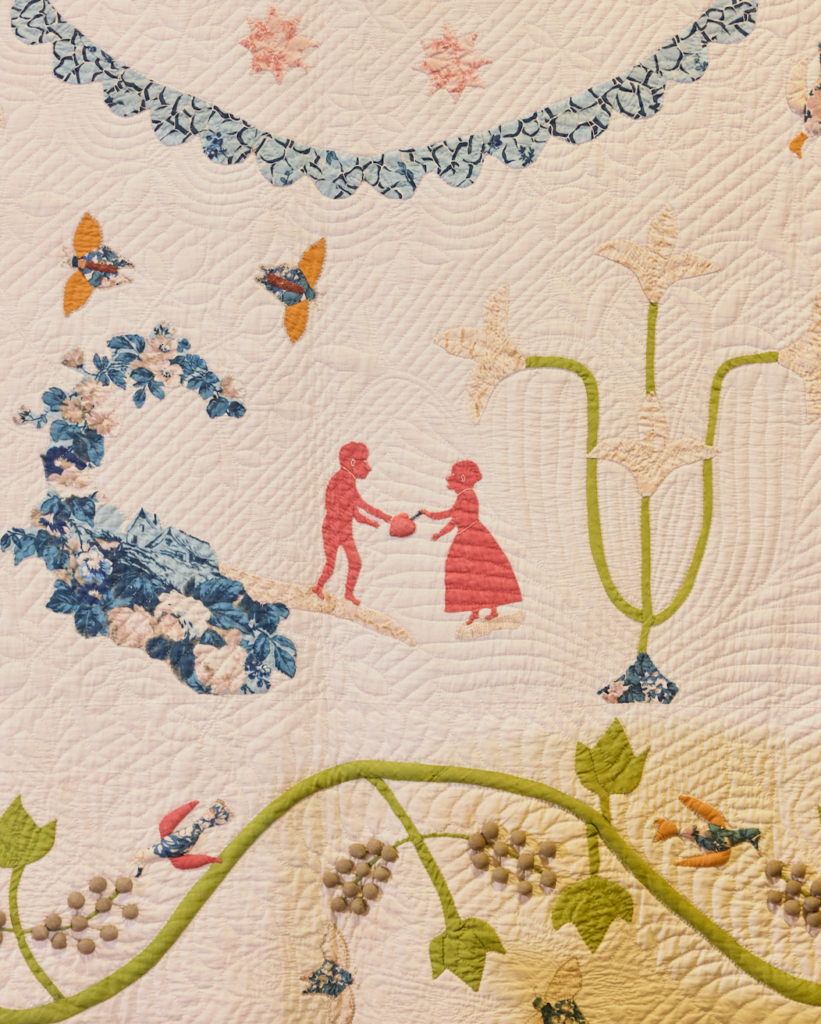
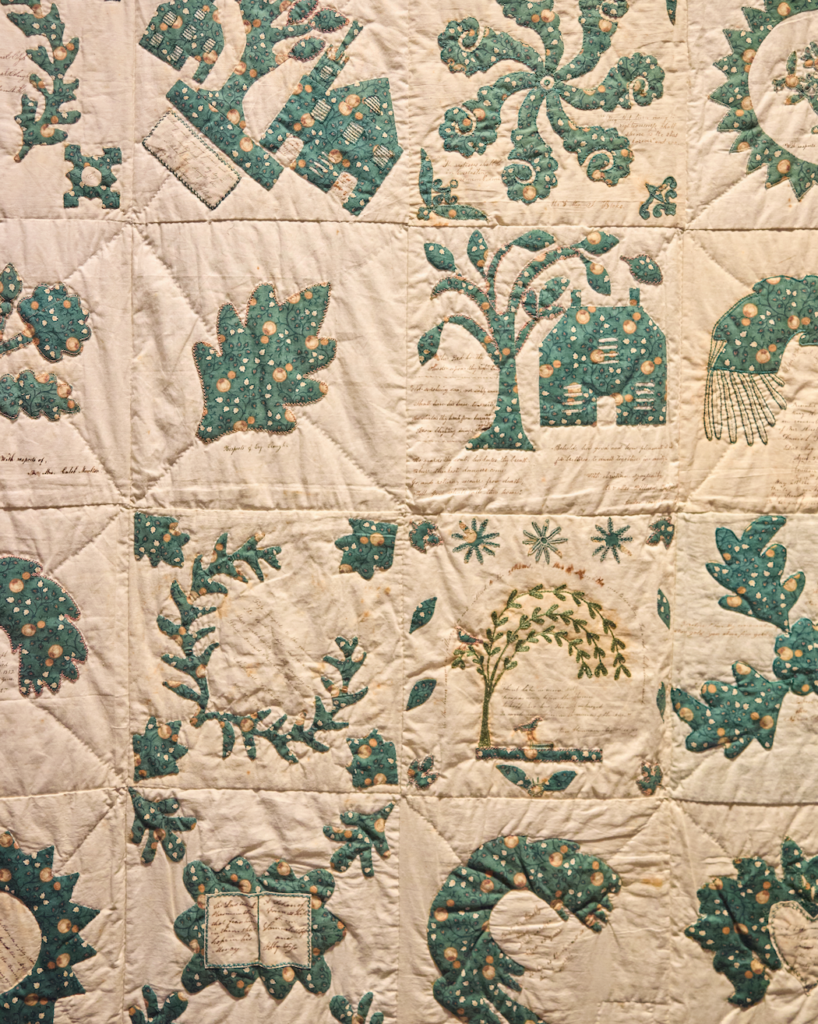
EG: I think this will resonate with you, too. Not everyone is always thinking about material culture, but it’s been a huge part of my background. There is often an emphasis on a single maker, but many quilts are made within communities or represent them in interesting ways, like the one behind us with each block dedicated to a member of a certain community. It’s actually a memorial quilt. Quilts are representative of networks even when made by a single maker.
EABA: Especially that one. Everybody has to look at that quilt up close because it’s…
EG: Yeah, it’s really special.
EABA: So fantastic. All the handwriting too.
___
EABA: So many things in my collection, whether quilts or clothing, involve many different people. You see different signatures, the weight of each hand. Sometimes it’s one person embroidering all the names, other times each person contributes a block and they come together. It creates this eclectic, beautiful sense of community.
EG: Exactly. That idea has resonated in so many ways in our culture. People still remember the AIDS quilt. I’m hearing about new community quilt projects now to celebrate America’s 250th or explore particular memorial moments. It’s really interesting how you’re doing that with your custom, one-off pieces that are so personal.
___
EG: What are some lessons from traditional quilt making practices that you feel are important to preserve for the future?
EABA: Definitely the idea of reuse is overarching, but also repair and mending. The goal, for me, is to extend the life cycle of all my things. What you see here, and why these have survived, is that people took the time to care for them.
___
EG: I know you have an antique quilt collection of your own. How does your personal philosophy enter into preserving these textiles?
EABA: It’s hard. It’s definitely challenging. I’ve seen different methods of documenting and preserving over time, and you can only do as much as you can handle. At Bode, we’ve gone through different iterations of archivists and researchers, photographing collections as they come in or going back to document them later. It’s always evolving. In my personal life, I tend to write something down immediately. More recently, as I get things from family members, I’ll label them simply, even just a piece of masking tape noting where it came from, because at least it’s there.
EG: You’re making the granny notes of the future.
For those interested in the full discussion, the conversation is available on the American Folk Art Museum’s YouTube channel.
This conversation also led to a meaningful next step: a loan from my personal collection to the museum, acquired from the Estate of Laura Fisher. A colorful wartime quilt dating to the late nineteenth century, it was stitched by sailors, using felted wool from military uniforms. I hope you’ll take a moment to find it the next time you’re at the museum.


